 How to resolve AdBlock issue?
News
- Details
- Written by: Elizabeth Larson
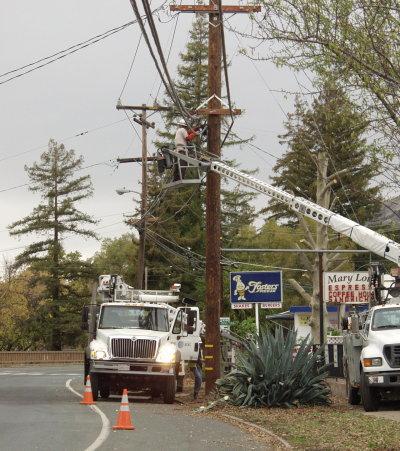
LUCERNE – A vehicle crashing into a power pole left thousands of customers without power for much of the morning on Tuesday as Pacific Gas and Electric staff worked to repair the damage.
PG&E reported that the outage occurred just after 1:30 a.m. Tuesday.
A loud crash was heard through town as the vehicle collided with the pole. In some areas of town, the lights blinked off, came back on and then went out again.
Northshore Fire and the Lake County Sheriff's Office responded to the crash area, located on the east side of Highway 20 between 10th and 11th avenues. No injuries were reported.
Shortly before 2 a.m., sheriff's deputies were blocking the eastbound lane and directing traffic around the crash scene and the damaged pole.
For several hours officials diverted traffic through the middle turn lane while PG&E repaired the pole, the crossarms of which appeared to require replacement.
Highway 20 wasn't completely reopened until about 12:35 p.m., according to the California Highway Patrol. Even then, 10th Avenue was still closed due to pole repairs.
PG&E spokesperson Brandi Ehlers said 3,233 customers were impacted.
Power returned to some areas of town at around 2:30 a.m., with residents in other areas reporting that their power was off until 11 a.m. Ehlers said power was restored to all customers shortly after 1:30 p.m., 12 hours after the outage first occurred.
PG&E staff remained on scene until evening as they continued restoring the damaged power pole.
E-mail Elizabeth Larson at
{mos_sb_discuss:2}
- Details
- Written by: Elizabeth Larson
Bob Penny, the county's assistant veterans service officer and himself a Vietnam veteran, said the Veterans Services Office staff of three helps veterans and their dependents obtain the benefits due to them from local, state and federal agencies.
"That's our main purpose," he said.
It's a crucial task in Lake County, which has a large veterans population.
"We have about 8,000 veterans in our county, which is one of the highest veteran-to-population ratios in the state," he said.
The Veterans Administration is increasing medical services to veterans, particularly those in rural areas like Lake County, said Penny. "That is one of their big pushes right now."
There has been talk for many years of having a VA clinic in Lake County, and Penny said the agency – which has agreed a need exists here – is very seriously looking at locating a clinic in Clearlake, possibly in late 2009 or early 2010.
He said the VA is talking to doctors in Clearlake and discussing possibly locating a VA clinic in an Adventist Health clinic facility on Lakeshore.
Penny cautions, however, "Nothing is written in stone yet."
Lake County's veterans population is dominated by men and women who served in World War II, Korean and Vietnam, Penny said.
There also are a "handful" of veterans who have served in Iraqi and Afghanistan.
Local vets' No. 1 issue – across the generations – is medical care, said Penny.
The county's largest vet groups, World War II and Korean vets, are disappearing at a rapid pace, he said, as many of them reach their 80s and 90s.
Vietnam vets, in their 50s, 60s and some even older, have a variety of health issues as a legacy of their service, said Penny.
The biggest problem for Vietnam vets, he said, is a variety of cancers, diabetes and other conditions caused by Agent Orange exposure.
Dean Gotham, president of Vietnam Veterans of America Chapter 951, said his organization is particularly concerned about the VA's plan to end Agent Orange screenings for veterans.
"They're cutting it off," he said, although when that's supposed to take place hasn't been announced.
VVA also is concerned that the VA has dropped some levels of health care for vets, said Gotham.
The No. 1 issue facing local veterans, according to Gotham, "has been and will continue to be assured funding for veterans health care.
"The VA budget goes through too many ups and downs," he said.
Last year, the government raised VA funding by about $77 million in an effort to address the growing cost of veterans' medical care, said Gotham. But the Assured Funding for Veterans Health Care Act died in committee this year.
"Funding is more important now than what is has been," said Gotham. He said it's especially critical in preparing to care for vets of the war in Iraq and Afghanistan.
Gotham said another concern for veterans is that the California National Guard has the lowest benefits level in the country, which VVA is trying to change. He said the guard's poor benefits situation is ironic, considering that California has the largest population of veterans of any state.
"Our state could stand to pick it up a notch," he said.
When it comes to younger veterans, Penny said some of them are still in a stage of denial about any physical and mental problems they may have as a result of their service.
Their issues of denial, Penny said, may have more to do with their youth; many will seek help later.
Younger veterans' denial differs from that suffered by Vietnam vets in an important respect, said Penny. Vietnam vets didn't reach out for help "because they weren't accepted as veterans back then."
Even today, that stigma seems to haunt Vietnam veterans. Gotham notes that while he has contact with many Vietnam veterans, a lot of them are reluctant when committing to joining groups like VVA.
E-mail Elizabeth Larson at
{mos_sb_discuss:2}
- Details
- Written by: Elizabeth Larson
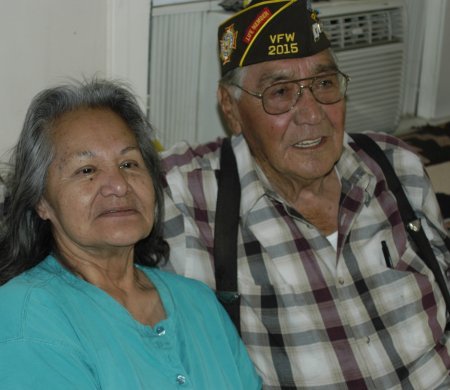
LAKE COUNTY – Nelson Hopper still remembers the war.
Some days, the 91-year-old World War II veteran says tears begin to run down his face, coming seemingly from nowhere. He said his war experience affects him a lot.
“I've seen some terrible things happen,” he said, which made him think differently about his life and the world.
Yet his recollections of the war aren't clouded by fear or sadness.
“I remember a lot of those things really clear. I can remember it still. It's never left my mind,” he said.
Born in February 1917, Hopper was raised on the Big Valley Rancheria.
On March 3, 1943, at age 26, Hopper was drafted into the US Army at the rank of private. He was shipped to Monterey and then to Camp Bowie, Texas, where he took his basic training, before being sent on to Fort Hood, Texas, to receive training as part of the 651st Tank Destroyer Battalion.
From there he was sent to Maryland and then put aboard the USS Marine Raven and sent to the European Theater.
He didn't make the Normandy Invasion; instead, he and fellow soldiers were sent to Scotland and then put on trains into England in May of 1944. A month later, they were sent by ship to Utah Beach in Franch. There, Hopper was placed in the Third Army, Fifth Division's infantry, under Gen. George Patton.
“I respected all those officers,” Hopper said of Patton and the other US war leaders. “They don't have them like that anymore.”
Hopper said he was afraid of dying in Europe, so far away from his home. He prayed every day and night, in his foxhole and as he went about his duties, asking to survive the war and get home safe. He said he promised to be a good person if he survived. “I live by that code, still.”
His grandmother called for a Big Head Dance to protect Hopper when he was first drafted, and another dance would be held after he was sent abroad.
While Hopper would survive the war to return to his family, they weren't left unscathed by the war. Hopper's uncle, Willie Holmes, died in Italy during the Battle of Anzio in January of 1944..
American Indians weren't segregated from other races in the Army during World War II, said Hopper, which is what happened to black soldiers.
Hopper became a squad leader, and said the men referred to him as “chief.” “I didn't mind that,” he said, adding that it was done in a friendly manner.
In fact, he said when many of his fellow soldiers discovered he was Indian, they treated him “like a king.”
During the terribly cold winter that began in late 1944, Hopper was in Germany, where he would shortly take part in the Battle of the Bulge.
He remembers an encounter with an elderly German man, who approached Hopper as he was burning wax paper from his K-rations to heat his coffee.
The German, who had gone to school in the United States, asked Hopper about his race, and Hopper replied he was an American Indian.
“This is not the Indian's war,” Hopper recalled the man saying. The man added that the US “took everything” from Indians.
Hopper said he told the man he was doing his duty and, when it was over, he looked forward to going home.
A short time later, in December of 1944, Hopper was wounded in the foot during the Battle of the Bulge.
Hopper said he didn't see many fellow American Indians while serving. However, it was a young American Indian medic who picked him up to take him to a field hospital after he was shot.
Not only was the medic Indian, he also was from the Lake County area. The medic's name was Bennett Elliott, who died at age 97 this past April. Hopper said Elliott would later remind him of their chance meeting, which Hopper said he hadn't initially recalled because he had been heavily medicated for pain.
Elliott took Hopper to a field hospital; from there, Hopper was sent to a hospital in Paris. During that time, he developed gangrene in his wounded foot and nearly lost his leg.
From Paris, Hopper was sent to a hospital in Birmingham, England, where he underwent spinal taps to deal with his swelling leg.
It would take him three months of hospitalization to recover, but even today he deals with the pain from that injury, which occasionally flares up in the form of pain and swelling.
In the spring of 1945, freshly released from the hospital, Hopper found himself once again headed back to France and then to Worms, Germany.
“By golly, the war ended while I was at Worms,” he said with a grin.
He found himself once again on the move, with the Army shipping him back to Marseilles, France. There, he was placed in the publications office. Hopper said he couldn't type and had no other publication-type skills initially, but they sent him to a 10-day school, where he learned to run a mimeograph machine.
But his service came to an end shortly afterward, as the war in Europe drew to a close.
“I feel, even to this day, that I had God on my side,” he said.
Placed aboard the hospital ship USS General Richardson, Hopper made his way home to the United States, landing in Boston after a 14-day sea crossing in a convoy of 74 ships, all of them zigzagging to avoid submarines.
“I was so happy to get back,” he said.
From Camp Miles Standish in Boston he was sent to Camp Beale in Marysville, where he was discharged. From there, he hitchhiked home to Lake County.
Initially, when he got home, Hopper said he didn't apply for disability due to his wounds. However, the Red Cross made application for him and he received a 10-percent disability determination. The Veterans Administration also did followup exams on his wounds in San Francisco.
He eventually went to work in Ukiah on the courthouse, and his foreman got him interested in becoming an ironworker, a job which took him to the Bay Area.
It was while climbing on a building project one day that he realized he was frightened of climbing, which hadn't happened to him before. That's when the Veterans Administration diagnosed him with what is known today as post traumatic stress disorder.
“'You have a problem and it's terrible,'” he recalled a VA doctor telling him.
“I still have it,” he added. “I'm scared even to this day.”
The same courage that took him through the war years went with him through the rest of his life. Hopper continued as an ironworker, eventually becoming a foreman and taking jobs around the state, including building underground missile silos at an Air Force base near Monterey.
He said he never let tough times get him down.
An opportunity came to go to South America for a dam project, but Hopper couldn't take his first wife with him, so he turned it down.
When he left the war behind, Hopper also left behind tokens of his service, in the form of his medals and awards, which he refused based on his Indian beliefs.
“We never do things to be praised for it,” he said. “We do it because it needs to be done.”
When he came home to Lake County, he joined the Joy Madeiros Veterans of Foreign Wars Post 2015. In 1986, the VFW post went to the US government – without Hopper's knowledge – to ask for the medals on Hopper's behalf.
During the Veterans Day ceremony on Nov. 11, 1986, decades after he had left the medals behind, Hopper got a surprise. He was called to the podium and presented with his awards and medals.
“I almost fell over,” he said.
He received that day the Bronze Star for Valor; a Purple Heart for the wound he suffered at the Battle of the Bulge; an Army Good Conduct Medal; the European-African-Middle Eastern Campaign Medal with four stars; the World War II Victory Medal; and the Combat Infantry Medal, which Hopper said he's proudest of, since it proves he was in combat.
Along with his medals, he received a letter from Superior Court Judge John J. Golden, congratulating him on his service.
This past May, an event was held to honor American Indian veterans, and Hopper was presented a flag and offered the event prayer. It was the first such occasion to specifically honor the contributions of American Indians to protect a country that is still very much theirs.
Today, Hopper has come full circle. He lives once again at Big Valley Rancheria with his wife, Earlene. The couple, married since 2000, live in a little house that looks out onto Clear Lake – or Xa-bahten, as it's known in the tribe's native language of Bahtssal, of which he's believed to be one of the last native speakers.
He has four children, two sons and two daughters, and numerous grandchildren, among them attorneys with Boalt School of Law degrees. His son, Joseph Myers, is executive director of the National Indian Justice Center, based in Santa Rosa.
Over the years, Hopper has taught young tribal members how to build tule boats and how to dance in and conduct ceremonies.
“I live here like I do because I'm an Indian,” he said. “I'm comfortable.”
While he jokes that he's been around “too damn long,” at 91 Hopper is still tall, active and optimistic.
“I'm shooting for 100, anyway,” he said.
E-mail Elizabeth Larson at
{mos_sb_discuss:2}
- Details
- Written by: Ginny Craven
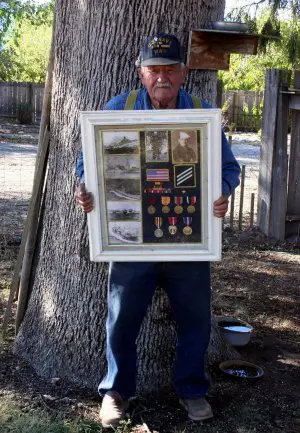
KELSEYVILLE – If you have ever travelled down Sylar Lane in Kelseyville it’s pretty likely that you are familiar with William “Hukk” Hukkanen. He’s an iconic figure in the little town as he sits in his rocking chair on his front porch giving passers by a wave or nod.
William B. Hukkanen was born in Kelseyville in December 1923 at the Allison house, which stood where the telephone building is now. This proud veteran will celebrate his 85th birthday in December.
Every day he sits on the front porch of the home he has lived in since 1926, enjoying the outdoors and the friendly waves from folks. Don’t think for a minute that is the extent of his day though.
“Hukk,” as he likes to be called, works a large garden, chops wood and cooks his own meals. He remains very active, reads voraciously and is not shy about sharing his opinion. At nearly 85 years old and having served his country, he’s earned that right.
Hukk joined the United States Navy in August 1942. He was anxious to serve his country and defend her after the attack on Pearl Harbor. While in the Navy, Hukk served aboard several ships before he was discharged in December 1945 and returned to his home town of Kelseyville.
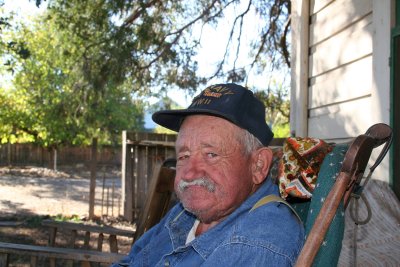
Some time ago he composed a synopsis of his time in the Navy, which follows.
“Well, they went and did it – bombed Pearl Harbor about 1300 or 1400 hours Pacific Time. I was not too shocked because I had figured out that we would go to war with Japan. As soon as I could get a ride, I went to the Santa Rosa Navy Recruiting Station, about 50 miles away from my home. I enlisted in the Navy, but they sent me home to finish high school and told me they would call me when needed. At present, they had more people than they knew what to do with.
“They called me in August 1942 to the Naval Recruiting Station in San Francisco and sent me to boot camp at NTS San Diego. In October 1942, I reported to the USS South Dakota (BB-57) and served in her through the battle of Santa Cruz in October and Savo Island in November in the Solomon Islands.
“In December1942 I transferred to the USS McCawley (APA-4) and served in her while hauling troops and cargo and making landings in the Solomon Islands. She was sunk in the Blanche Strait near Rendova Island in June 1943 and I was transferred to the USS President Hayes (APA-20). I served in her hauling troops and cargo and was coxswain on a Higgins boat in the first wave when we made landings in Bougainville. We also made the landing on Emary Island before I was transferred back to the US in April 1944 for 30 days leave and to work on the construction of a new ship.
“I reported aboard the USS Bering Strait (AVP-34) in July 1944 at Kirkland Shipyard in Seattle and our shakedown cruise was to Pearl Harbor. We then took part in the invasion of the Marshalls, Gilberts and Saipan, as well as working air sea rescue for the B-29s bombing Japan. Working as a coxswain or bow hook on a rescue vessel, we picked up five crews from the ocean.
“I returned to the US and was transferred to the USS Tamalpais (AO-96) in May 1945. After a shakedown cruise, we spent time in the Marshalls, Gilberts, Admiralty Islands and then on to the occupation of Japan.
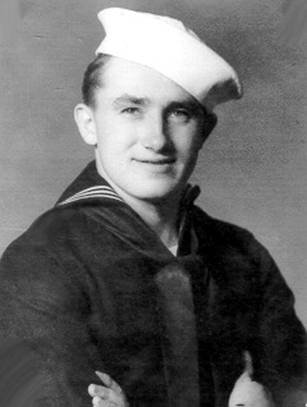
“In summation of my time in the Navy, I would probably have reenlisted if it hadn’t gotten so chicken after the war was over. We got a bunch of 90-day wonders who were constantly trying to tell me how to do my seamanship after I had served in five ships. I loved my ships with the mother image they portrayed and the great crews. I served with some of the best skippers in the fleet and a couple not so good. I did some time on bread and water and stood before the mast and had a blast in the Navy.
“I came out of the Navy with 10 Battle Stars on my Pacific Ribbons and two Ship Citations from the Secretary of the Navy. When I go “deep six” I will say, “Boy, am I glad I did that!” If this sounds a little salty, well I was, and I still am!
“My son is helping me write a book on my time in the Navy. It’s good reading for sailors because they understand what I am about. They say, “Once a jarhead, always a jarhead.” Once a blue water sailor, always a sailor.”
Hukkanen earned several awards during his naval service. He does not brag but is tremendously proud of his service, the men he served with and especially of those who never made it home.
His awards include the Combat Action Ribbon, the Navy Good Conduct Medal, the Navy Unit Citation with two stars, the Asiatic Pacific Campaign Medal with 10 stars, the World War II Victory Medal and the Navy Occupation Service Medal (Japan).
When he shows you his awards he talks with sincerity and his voice cracks and eyes water when he remembers the men who gave their all, never to return to their families.
Hukkanen was married twice and currently lives with his two dogs, Sally and Scooter. On relationships with women he says, “I learned a long time ago not to argue with women. That’s a fight you can’t win.”
His son, Sam, is employed at the Kelseyville Fire Department and his daughter, Kristine, lives in Fond du Lac, Wisconsin.
As for life today he said, “'Generation gap’ is an older person’s excuse ‘cause they can’t communicate.” He mentioned that he chats with the kids walking past his porch and shows an interest in them, something he believes matters in their lives.
Hukk also believes people have lost focus on what really matters. He said, “People want more than they can get. That’s why we’re in such trouble.”
As for him, Hukk says, “My life has been a helluva good ride. I never hurt nobody, that I know of.”
He added, “I could go outta here tomorrow and I’d be OK. If you live with a fear of death you’ll be scared your whole life.”
Ginny Craven is the founder of Operation Tango Mike. On Veterans Day 2007 she received the annual “Friend of the Veteran Award.” Craven lives in Kelseyville.
{mos_sb_discuss:2}