How to resolve AdBlock issue?
Refresh this page
How to resolve AdBlock issue?
Refresh this page
Lake County News,California
  • Home
    • Registration Form
  • News
    • Education
    • Veterans
    • Community
      • Obituaries
      • Letters
      • Commentary
    • Police Logs
    • Business
    • Recreation
    • Health
    • Religion
    • Legals
    • Arts & Life
    • Regional
  • Calendar
  • Contact us
    • FAQs
    • Phones, E-Mail
    • Subscribe
  • Advertise Here
  • Login
How to resolve AdBlock issue?
Refresh this page

News

Clearlake Animal Control: Meet ‘Turbo’ and the dogs; update on shelter population

Details
Written by: Elizabeth Larson
Published: 20 April 2024
“Turbo.” Photo courtesy of Clearlake Animal Control.

CLEARLAKE, Calif. — Clearlake City Council members met one of this week’s adoptable dogs and heard a report from the animal shelter on Thursday night.

Clearlake Police Lt. Martin Snyder gave the council an update on adoption numbers year to date.

So far in 2024, the city’s animal shelter has taken in 187 dogs. Of those, 164 have left, with 17 going to rescue, 136 returning home, nine were adopted and two being euthanized, for a live release rate of 98.6%, Snyder said.

At that point, Snyder said there were 46 dogs in the shelter, including 43 dogs and three puppies.

Year to date, they have issued 88 microchips and 56 free vaccinations, Snyder said.

On Thursday night, the Clearlake City Council also met “Turbo,” a male Belgian malinois mix looking for his forever home, who made a special trip to the council chambers.

Shelter staff said Turbo has done well with all of the dogs he’s met.

The Clearlake Animal Control website lists 38 adoptable dogs.

“Jasmine.” Photo courtesy of Clearlake Animal Control.

Other dogs available this week include “Jasmine,” a 6-month-old Parson Russell terrier mix with a white coat.

Also available is “Cutie Pie,” a female pit bull terrier mix with a bronze and brindle coat.

The shelter is located at 6820 Old Highway 53. It’s open from 9 a.m. to 6 p.m. Tuesday through Saturday.

“Cutie Pie.” Photo courtesy of Clearlake Animal Control.

For more information, call the shelter at 707-762-6227, email This email address is being protected from spambots. You need JavaScript enabled to view it., visit Clearlake Animal Control on Facebook or on the city’s website.

This week’s adoptable dogs are featured below.

Email Elizabeth Larson at This email address is being protected from spambots. You need JavaScript enabled to view it.. Follow her on Twitter, @ERLarson, or Lake County News, @LakeCoNews.

California’s grid sets new clean energy records

Details
Written by: Lake County News reports
Published: 20 April 2024


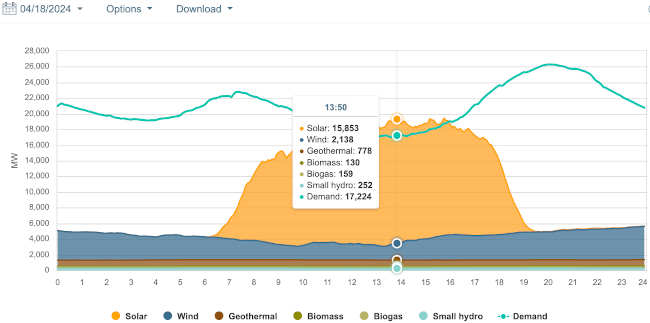
Heading into Earth Week, officials reported that the state’s electric grid racked up a series of accomplishments never before seen in California history.

By bringing on more sources of clean electricity and diversifying the state’s energy portfolio, clean energy has been exceeding the demands of nearly 40 million people and the world’s 5th-largest economy.

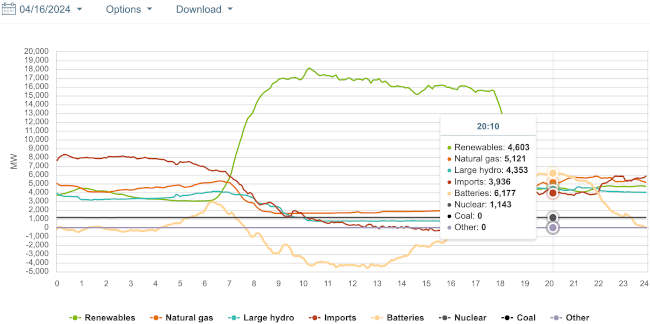
The state reported that during 31 of the past 43 days, clean energy exceeded grid demand consumed at a point during the day; that’s compared to only seven days all of last year. And, it was only two years ago in May that California first even momentarily met demand with 100% clean energy.

Solar projects served a new high of 17,170 MW, an increase of over a thousand MW from last year’s peak — enough to power millions of homes. And, the amount of demand served by solar hit a new record, powering 86.4% of electricity demand.

In addition, for the first time ever, battery storage discharge exceeded 6 GW and batteries were the largest source of supply to power the grid at a point during the day.

California has built out 5,600 MW of battery storage capacity, a 1020% increase since 2020, the state reported.

Space News: Saturn’s ocean moon Enceladus is able to support life − my research team is working out how to detect extraterrestrial cells there

Details
Written by: Fabian Klenner, University of Washington
Published: 20 April 2024


Scientists could one day find traces of life on Enceladus, an ocean-covered moon orbiting Saturn. NASA/JPL-Caltech, CC BY-SA

Saturn has 146 confirmed moons – more than any other planet in the solar system – but one called Enceladus stands out. It appears to have the ingredients for life.

From 2004 to 2017, Cassini – a joint mission between NASA, the European Space Agency and the Italian Space Agency – investigated Saturn, its rings and moons. Cassini delivered spectacular findings. Enceladus, only 313 miles (504 kilometers) in diameter, harbors a liquid water ocean beneath its icy crust that spans the entire moon.

Geysers at the moon’s south pole shoot gas and ice grains formed from the ocean water into space.

Though the Cassini engineers didn’t anticipate analyzing ice grains that Enceladus was actively emitting, they did pack a dust analyzer on the spacecraft. This instrument measured the emitted ice grains individually and told researchers about the composition of the subsurface ocean.

As a planetary scientist and astrobiologist who studies ice grains from Enceladus, I’m interested in whether there is life on this or other icy moons. I also want to understand how scientists like me could detect it.

Ingredients for life

Just like Earth’s oceans, Enceladus’ ocean contains salt, most of which is sodium chloride, commonly known as table salt. The ocean also contains various carbon-based compounds, and it has a process called tidal heating that generates energy within the moon. Liquid water, carbon-based chemistry and energy are all key ingredients for life.

In 2023, I and others scientists found phosphate, another life-supporting compound, in ice grains originating from Enceladus’ ocean. Phosphate, a form of phosphorus, is vital for all life on Earth. It is part of DNA, cell membranes and bones. This was the first time that scientists detected this compound in an extraterrestrial water ocean.

Enceladus’ rocky core likely interacts with the water ocean through hydrothermal vents. These hot, geyserlike structures protrude from the ocean floor. Scientists predict that a similar setting may have been the birthplace of life on Earth.
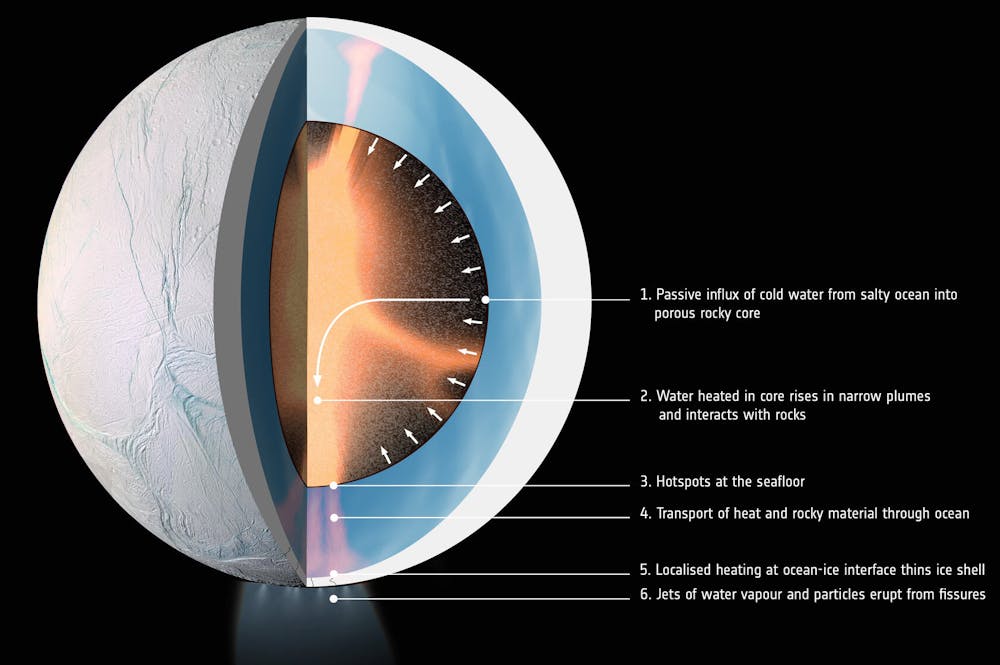
A diagram showing the inside of a gray moon, which has a hot rocky core.
The interior of Saturn’s moon Enceladus. Surface: NASA/JPL-Caltech/Space Science Institute; interior: LPG-CNRS/U. Nantes/U. Angers. Graphic composition: ESA


Detecting potential life

As of now, nobody has ever detected life beyond Earth. But scientists agree that Enceladus is a very promising place to look for life. So, how do we go about looking?

In a paper published in March 2024, my colleagues and I conducted a laboratory test that simulated whether dust analyzer instruments on spacecraft could detect and identify traces of life in the emitted ice grains.

To simulate the detection of ice grains as dust analyzers in space record them, we used a laboratory setup on Earth. Using this setup, we injected a tiny water beam that contained bacterial cells into a vacuum, where the beam disintegrated into droplets. Each droplet contained, in theory, one bacterial cell.

Then, we shot a laser at the individual droplets, which created charged ions from the water and the cell compounds. We measured the charged ions using a technique called mass spectrometry. These measurements helped us predict what dust analyzer instruments on a spacecraft should find if they encountered a bacterial cell contained in an ice grain.

We found these instruments would do a good job identifying cellular material. Instruments designed to analyze single ice grains should be able to identify bacterial cells, even if there is only 0.01% of the constituents of a single cell in an ice grain from an Enceladus-like geyser.

The analyzers could pick up a number of potential signatures from cellular material, including amino acids and fatty acids. Detected amino acids represent either fragments of the cell’s proteins or metabolites, which are small molecules participating in chemical reactions within the cell. Fatty acids are fragments of lipids that make up the cell’s membranes.

In our experiments, we used a bacteria named Sphingopyxis alaskensis. Cells of this culture are extremely tiny – the same size as cells that might be able to fit into ice grains emitted from Enceladus. In addition to their small size, these cells like cold environments, and they need only a few nutrients to survive and grow, similar to how life adapted to the conditions in Enceladus’ ocean would probably be.

The specific dust analyzer on Cassini didn’t have the analytical capabilities to identify cellular material in the ice grains. However, scientists are already designing instruments with much greater capabilities for potential future Enceladus missions. Our experimental results will inform the planning and design of these instruments.

Future missions

Enceladus is one of the main targets for future missions from NASA and the European Space Agency. In 2022, NASA announced that a mission to Enceladus had the second-highest priority as they picked their next big missions – a Uranus mission had the highest priority.

The European agency recently announced that Enceladus is the top target for its next big mission. This mission would likely include a highly capable dust analyzer for ice grain analysis.

Enceladus isn’t the only moon with a liquid water ocean. Jupiter’s moon Europa also has an ocean that spans the entire moon underneath its icy crust. Ice grains on Europa float up above the surface, and some scientists think Europa may even have geysers like Enceladus that shoot grains into space. Our research will also help study ice grains from Europa.

NASA’s Europa Clipper mission will visit Europa in the coming years. Clipper is scheduled to launch in October 2024 and arrive at Jupiter in April 2030. One of the two mass spectrometers on the spacecraft, the SUrface Dust Analyzer, is designed for single ice grain analysis.
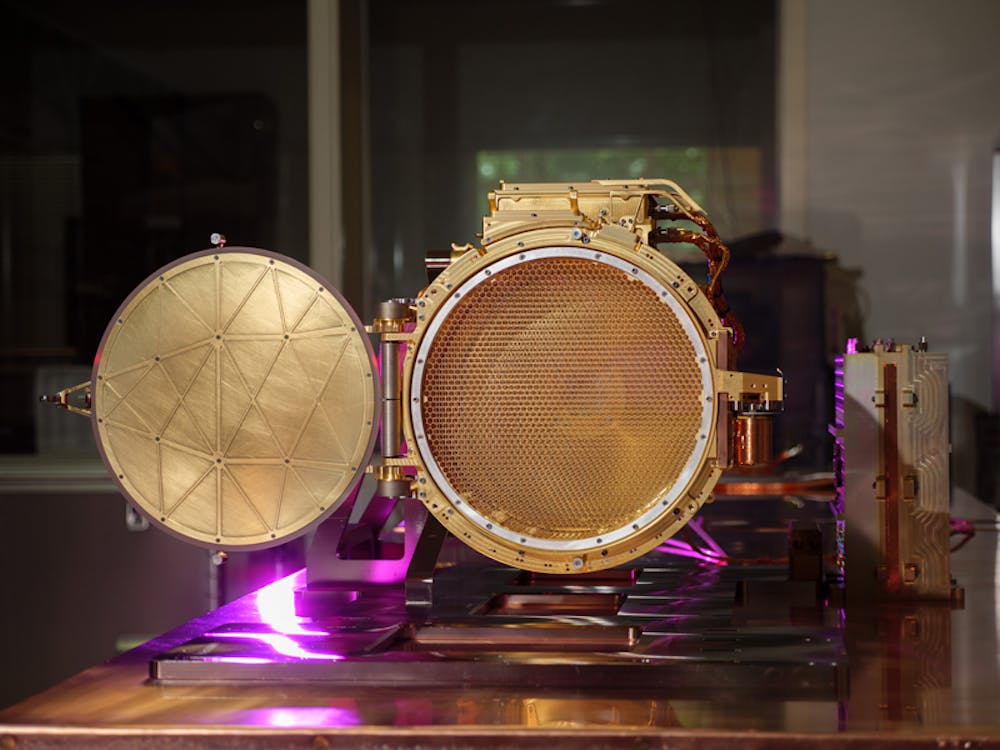
A metal instrument with a circular door open to reveal a mesh strainer designed to catch dust.
The SUrface Dust Analyzer instrument on Clipper will analyze ice grains from Jupiter’s moon Europa. NASA/CU Boulder/Glenn Asakawa

Our study demonstrates that this instrument will be able to find even tiny fractions of a bacterial cell, if present in only a few emitted ice grains.

With these space agencies’ near-future plans and the results of our study, the prospects of upcoming space missions visiting Enceladus or Europa are incredibly exciting. We now know that with current and future instrumentation, scientists should be able to find out whether there is life on any of these moons.The Conversation

Fabian Klenner, Postdoctoral Scholar in Earth and Space Sciences, University of Washington

This article is republished from The Conversation under a Creative Commons license. Read the original article.

Clearlake City Council approves AI policy, updated city manager contract

Details
Written by: Lake County News reports
Published: 19 April 2024
CLEARLAKE, Calif. — The Clearlake City Council on Thursday adopted a new policy regarding the city’s use of artificial intelligence, approved a new contract with the city manager and gave the go ahead for an application for gap funding for a new apartment project.

City Manager Alan Flora presented the new generative artificial intelligence, or AI, policy to the council, explaining that the technology is now making its way into all sorts of software being used by the city.

As an example, he said that the video system that the police department uses for its body cams and cars uses AI.

At a recent city managers conference, Flora said there was a lot of talk about the municipalities using AI which, from his perspective, can be both quite powerful and troubling.

He said AI can add value to the city’s work and getting a policy in place for staff is “a good step.”

The four-page policy, found in the staff report, includes a list of acceptable uses of generative AI, that includes creating an outline for written content, copying a document into a generative AI tool for the purposes of summarizing and/or querying it, suggesting writing improvements, learning about and exploring topics, analyzing different types of data, idea generation and research.

Requirements for use include staff being responsible for all outcomes of generative AI used for work purposes, conducting fact checks, providing attribution whenever generated content is published including images, opting out of data collection whenever possible, and not using generative AI to generate code or audio at this time.

With AI rapidly changing, Flora said the city will need to take a fresh look at the policy on a regular basis.

He said Mayor David Claffey probably knows more about AI than anyone else in the room, and he went over the proposed policy with Claffey ahead of time.

Flora said they had discussed having a review of the policy every couple of years, and he said he could go ahead and add that into the policy.

Councilmember Joyce Overton said that, because she expected AI to change so much so fast, the city policy needs to be reviewed every year, and she suggested it be done during the budget process.

Councilmemember Dirk Slooten said he wholeheartedly agreed. “We need to keep on top of it, definitely,” Slooten said, adding he also wanted an annual review.

“There are very few jurisdictions that are thinking like this,” said Claffey, who thanked Flora for putting the new policy together. “This is the way we need to be thinking.”

Claffey said there are so many great tools coming that will benefit small cities like Clearlake, and that they needed to give staff flexibility to try those tools.

Slooten moved to approve the policy with the addition to have it reviewed on a yearly basis. Overton seconded and the council approved the policy 5-0.

Also on Thursday, the council approved a new employment services agreement with Flora.

City Attorney Ryan Jones said Flora has been with the city for five years, twice as long as the average city manager tenure in California. He said that’s a testament to the longevity, consistency and stability in the city government.

Jones emphasized that the new contract did not change any of the fiscal aspects — Flora’s $16,342.05 a month salary, his benefits and other terms of the agreement — but rather extended Flora’s current three year contract by one year. It will now continue for another two years — rather than ending next year. Hopefully at that point the council will extend it again, Jones said.

The new contract also includes a provision requiring that terminating Flora without cause would require a 4/5th vote of the council for a period of year after the election of a new council member. Jones noted that termination for cause doesn’t require a 4/5th vote.

Councilman Russ Cremer moved to approve the updated contract, with Overton seconding.

In what Mayor Claffey called “one of the longest seconds in city council history,” Overton noted that she has served almost 20 years on the council and respects Flora highly.

“You have saved us in many situations that I cannot believe you got us out of some of them,” Overton said, adding that it’s a privilege to work with Flora and she wanted to say it publicly.

“You deserve everything that we can possibly offer you,” she said.

The council then approved the new contract 5-0.

Also during the meeting, which lasted just under an hour, the council agreed to pull from the consent agenda Resolution 2024-18 authorizing the city to submit an application to the California Department of Housing and Community Development for funding under the Competitive Permanent Local Housing Allocation.

If the city is successful with the application, which will seek up to $5 million, it will in turn loan the funds to the developers of Konocti Gardens, a new apartment complex project that has gone into the red due to factors including a variable interest rate on its construction zone that went up and unanticipated infrastructure improvements that are necessary.

In other business, the council presented a proclamation declaring April 2024 as Child Abuse Prevention Month, met one of the shelter’s adoptable dogs, “Turbo,” a male Belgian malinois mix, and received an update on the shelter population.

Email Elizabeth Larson at This email address is being protected from spambots. You need JavaScript enabled to view it.. Follow her on Twitter, @ERLarson, or Lake County News, @LakeCoNews.
  1. Vector Control offers reminders for a healthy, happy spring
  2. Savings Bank of Mendocino County participating in $13 million WISH program
  3. State legislative committee OKs school district fiscal health bill
  • 708
  • 709
  • 710
  • 711
  • 712
  • 713
  • 714
  • 715
  • 716
  • 717
How to resolve AdBlock issue?
Refresh this page