
 How to resolve AdBlock issue?
News
- Details
- Written by: Elizabeth Larson
LAKE COUNTY – Another race is forming as the 2010 election season nears, this time for Lake County superintendent of schools.
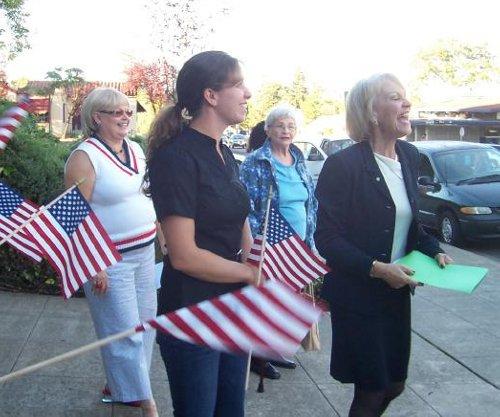
Dr. Judy Luchsinger told a group of about 75 people at the Lake Court Courthouse in Lakeport on Friday afternoon that she intends to challenge incumbent Dave Geck in next year's election.
Luchsinger, 64, previously held the job for 16 years. She was defeated by Dr. Bill Cornelison in the 1994 election and left office in January of 1995.
Geck, who came up through the ranks of Cornelison's office, succeeded him after being elected in 2006.
Hearing of Luchsinger's intent to run, the 61-year-old Geck said Friday that he believes his office has been providing excellent services to the school districts around the county.
“I'm sure we'll have interesting conversations,” he said of the election challenge.
The election next year will determine who will oversee the district, which has 120 employees and a $16 million annual budget.
The superintendent's job has a five-step salary schedule, with a superintendent's pay determined by his Board of Trustees. Geck currently makes $122,000 a year, about two and a half times the salary of a county supervisor.
Luchsinger said she's running on a platform of fiscal accountability and developing quality management systems to improve the district's performance.
She said she's been asked by many people to please run again. “I thought long and hard about it,” before finally deciding to take it on, she said.
The recent grand jury report, which among other things faulted Geck for signing a form that allowed a former administrator to apply for a credential program for which she wasn't qualified, was a basis for many people asking her to run, said Luchsinger.
However, Luchsinger said she preferred to focus on what she can offer the educational office.
Thanks to her previous experience, “there will be no learning curve,” Luchsinger said.
Luchsinger received her doctorate degree from the University of California, Santa Barbara, before moving to Lake County 42 years ago.
She taught high school English and math classes in Lakeport, and her four children went through the local schools. Luchsinger now has a young grandson attending local schools, and she lives in Lakeport with her fiance.
While she was county superintendent, she started collaborative efforts to purchase insurance for all districts jointly and brought the Academic Decathlon program to local schools. During that time there also was a collaborative district purchasing program for all the schools.
After leaving elected office, Luchsinger started her own consulting firms. Today, she works with corporations on three continents on quality and environmental management systems.
She'd like to bring those same systems to local education.
Addressing the recent community discussion about school district consolidation, Luchsinger explained, “You have to know that a school district is sort of a center of a community.”
She said the county office of education allows districts to remain small by taking on some duties. “That's what a county office can do for a district,” she said.
Luchsinger said countywide consolidation “probably doesn't make sense,” although very small districts that are in close proximity might consider it because that's a scenario where it might work best.
Among Luchsinger's goals are reestablishing fiscal accountability in the Lake County Office of Education.
She said she's been concerned that the cost of running the office has exploded since she left office in 1995.
That's what she told her audience on the courthouse steps Friday.
While teachers are working harder than ever with larger class sizes, “the quality of education has been compromised,” she said.
Responding to Luchsinger's criticisms, Geck said, “When you look at the cost of the office you have to measure it against the service and programs provided.”
Luchsinger said she thoroughly enjoys working with teachers, and appreciates what can be accomplished when organizations develop a culture of performance.
E-mail Elizabeth Larson at
- Details
- Written by: Elizabeth Larson
LAKEPORT – It's been 10 years since a dilapidated former hospital was given new life as a renovated health clinic, and on Friday a gathering commemorated that transformation and a decade of health services offered to those in need.
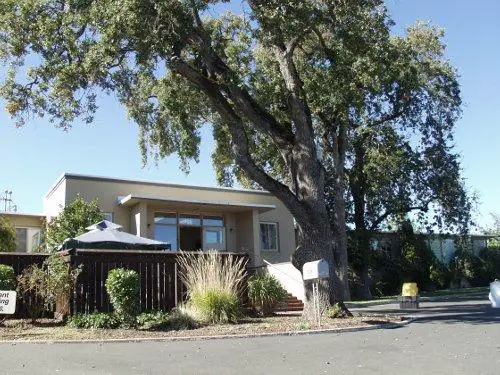
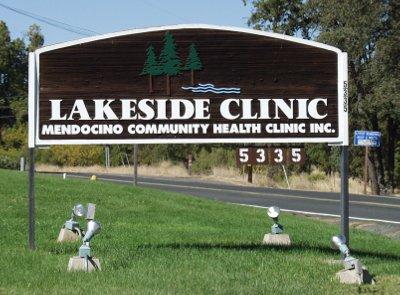
Lakeside Health Center, located at 5335 Lakeshore Blvd., inhabits a building that once housed Lakeside Hospital.
Since 1999 the clinic – one of three run by Mendocino Community Health Clinic Inc., which also has facilities in Willits and Ukiah – has offered a variety of health services to low-income families.
Clinic and organization employees and community members gathered Friday to celebrate its decade of service at an anniversary luncheon.
John Pavoni, chair of the Mendocino Community Health Clinic Inc. Board of Directors, said the old hospital was built in 1949 and had 33 beds.
In the late 1970s the hospital moved next door to the current Sutter Lakeside Hospital location, and the building then housed a convalescent home before sitting vacant for a time, Pavoni said.
When the clinic organization began looking for a location in Lake County, they found the empty building, which had fallen into a state of disrepair, with broken out windows.
Thanks to a $1 million loan from US Department of Agriculture's Rural Development, they renovated the building and opened for business.
Today it offers dental, medical services and psychiatric services to both children and adults. They also have obstetrics, which Chief Executive Officer Lin Hunter wants to expand.
Services are available in both English and Spanish.
Pavoni said Lakeside Health Center is a major local treatment center for HIV and hepatitis C, and it participates in national collaborations to track the most effective treatments for those diseases as well as diabetes and heart disease.
They've voluntarily pursued accreditation by the Joint Commission on Accreditation of Hospitals (JCAHO), said Pavoni. “It's quite a bit of work to do.”
The Lakeport clinic sees hundreds of people a day. Numbers for Thursday showed close to 60 regular doctor's visits, 52 pediatric patients and 47 dental visits, according to Chief Operating Officer Carole Press.
“The regular medical community is afraid of us,” because they perceive the clinic as taking patients, said Pavoni.
But Press added, “We're really a safety net provider.”
As a federally qualified health center, Lakeside Health Center offers a sliding payment scale for patients, and also takes Medicare and Medi-Cal, Health Families and some private insurance, Press said.
Hunter estimated that the Lakeside Health Center has between 6,000 and 7,000 patients that it serves, with a total of 24,000 patients in the organization's entire Lake and Mendocino County service area.
Hunter said Mendocino Community Health Clinic Inc. recently lost $2 million in Medi-Cal reimbursements for 15,000 visits. The organization's total budget is about $21 million.
The clinic's main facility has 10 to 15 exam rooms and a 10-chair dental facility.
“They're always full,” Hunter said of the dental department. “It's a huge need in this community.”
They're especially proud of their pediatric care facility. Located behind the main building in a newly renovated and expanded facility, the pediatrics center opened in February.
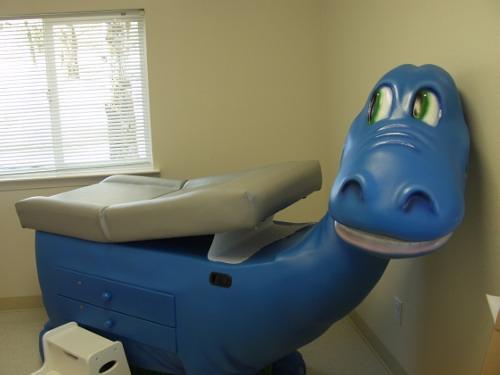
There, Dr. Marlene Quilala sees children in exam rooms decorated with colorful floor tiles and exam tables shaped like dinosaurs, hippos and school buses.
At the luncheon on Friday Heidi Dickerson of Congressman Mike Thompson's office presented the clinic with a plaque commemorating its service to the community in its first decade.
For more information about the center visit www.mchcinc.org/centers/lakeside-center.php or call 707-263-7725.
E-mail Elizabeth Larson at
- Details
- Written by: Elizabeth Larson
The latest report from the Employment Development Department showed that Lake County's September unemployment rate was 14.7 percent, down from 15.3 percent in August but up from the 10.2-percent rate recorded in September 2008.
Last month, approximately 3,800 Lake County residents were reported to be unemployed out of a total labor force of 25,890 people, compared to 2,590 people out of work a year ago in a workforce that then measured 25,340 residents.
Statewide, the unemployment rate measured 12.2 percent, with just over 2.2 million people unemployed, according to the Employment Development Department. That's down slightly from the 12.3-percent rate measured in August, when 2.25 million people were out of work.
California's September 2008 unemployment rate was 7.8 percent, at which time almost 1.4 million people were unemployed, according to state records.
The number of people unemployed in California last month was 2,247,000 – down by 13,000
over the month, but up by 799,000 compared with September of last year, according to the Friday report.
The US unemployment rate increased in September, rising to 9.8 percent from 9.7 in August, and up from 6.2 percent in September 2008, according to the US Bureau of Labor Statistics.
In September, Lake's neighboring counties registered the following unemployment rates: Colusa, 14.5 percent; Glenn, 13.8 percent; Mendocino, 10.1 percent; Napa, 8.7 percent; Sonoma, 9.9 percent; and Yolo, 10.9 percent.
Counties with the lowest and highest unemployment rates, respectively, were Marin, with 8 percent, and Imperial, with 30.1 percent.
The Employment Development Department reported that in September California's nonfarm jobs totaled 14,200,400, a decrease of 39,300 over the month, according to a survey of 42,000 California businesses. The year-over-year change – from September 2008 to September 2009 – showed a decrease of 732,700 jobs or a 4.9 percent reduction.
A federal survey of households, done with a smaller sample than the survey of employers, showed a decrease in the number of employed people, the agency reported.
That survey estimated the number of Californians holding jobs in September was 16,137,000, a decrease of 6,000 from August, and down 896,000 from the employment total in September of last year.
EDD’s report on payroll employment – wage and salary jobs – in the state's nonfarm industries totaled 14,200,400 in September, a net loss of 39,300 jobs since the August survey. This followed a loss of 7,200 jobs in August.
The Employment Development Department reported that two categories – natural resources and mining, and trade, transportation and utilities – added jobs over the month, gaining 4,100 jobs. Trade, transportation and utilities posted the largest increase over the month, adding 3,900 jobs.
At the same time, nine categories reported job declines this month, down 43,400 jobs, according to the report. Those categories included construction; manufacturing; information; financial activities; professional and business services; educational and health services; leisure and hospitality; other services; and government. Construction posted the largest decline over the month, down by 14,100 jobs.
From September 2008 to September 2009, nonfarm payroll employment in California dropped by 4.9 percent or 732,700 jobs, according to the Employment Development Department. One industry division, educational and health services, posted job gains over the year, adding 11,800 jobs, a growth of 0.7 percent.
The report also noted that 10 categories had job declines totaling 744,500 over the year. The categories included natural resources and mining; construction; manufacturing; trade, transportation and utilities; information; financial activities; professional and business services; leisure and hospitality; other services; and government.
Trade, transportation and utilities employment had the largest decline on a numerical basis, down by 172,400 jobs or 6.1 percent, according to the report. Construction posted the largest decline on a percentage basis, down by 19.0 percent, a decrease of 144,000 jobs.
Approximately 744,924 people received regular unemployment insurance benefits during the September survey week, the report noted, compared with 790,099 in August and 500,962 last year.
The Employment Development Department reported that new claims for unemployment insurance were 69,160 in September 2009, compared with 69,488 in August and 53,418 in September of last year.
E-mail Elizabeth Larson at
- Details
- Written by: Dennis Fordham
The taxes potentially involved are federal estate taxes, federal and state personal income taxes, federal and state fiduciary income taxes, and local real property taxes. Let’s examine them separately.
Federal estate taxes now only affect persons transferring more than $3.5 million at death to their surviving family, excluding gifts left to the surviving spouse – there is an unlimited marital deduction for transfers to surviving spouses.
The $3.5 million is the net worth of the decedent considering all assets, including life insurance. Also, a generation skipping transfer tax may apply when more than $3.5 million is left to related persons more than one generation younger than the decedent (e.g., grandchildren), unless the intervening generation has predeceased the decedent, or is left to unrelated persons who are more than 37.5 years younger.
What about personal income tax? Personal income tax only applies to transfers of items of income in respect of a decedent (IRD).
What is IRD? IRD is anything that would have been included as ordinary income on the decedent’s annual tax return, if received while alive.
Examples include unpaid retirement monies (such as IRAs, annuities, and 401(k)s) and earned but unpaid compensation. Not included as IRD is life insurance. The proceeds are not subject to income tax unless an exception to the “no taxation” of life insurance proceeds applies.
The receipt of property – other than IRD – is not income taxable; there is, however, often an income tax opportunity for the beneficiary who receives property from a decedent. Specifically, any appreciation in value that occurred while the decedent owned the property is eliminated at death and will not be subject to capital gains income tax. That is, the beneficiary receives a so-called “step up in basis” based on date of death appraisal.
For example, if the decedent bought his house in 1970 for $75,000, the decedent had a purchase cost basis of $75,000. If he dies on June 25, 2009, when it is worth $250,000 and leaves it all to his son, then the son’s basis for income tax purposes is stepped up to $250,000, thus eliminating all $175,000 of appreciation when the son sells.
If a deceased person’s estate is held within a trust or probate estate, then a so-called fiduciary income tax return is usually required, and taxes may be due at the estate level. Because trusts pay taxes at the highest graduated rate once their taxable income reaches around $11,000, it is prudent to distribute the taxable income out to the beneficiaries prior to the trust’s own tax year end to avoid paying higher trust tax rates. Taxation of trusts is a very complex, so rely on a qualified tax expert here.
Next, death can trigger a reassessment in value for local (county) real property taxes. With the exceptions of the interspousal transfer exclusion and parent child transfer exclusion for transfers of one’s primary residence and up to one million dollars in other additional real property to surviving children (and sometimes grandchildren), all other transfers trigger a reassessment in tax value to the recipient at time of transfer.
Accordingly, when a decedent’s estate consists of real property and other substantial assets and one child wants to receive a particular real property asset, there is a planning opportunity if the real property in question is left directly by the parent to that child.
Otherwise, if that child buys out his or her siblings, then the portion that is purchased from the other siblings will be reassessed, as there is no exclusion for transfers between siblings.
In conclusion, there are numerous tax opportunities and pitfalls to be considered carefully when planning and subsequently administering a person’s estate.
Dennis A. Fordham, attorney (LL.M. tax studies), is a State Bar Certified Specialist in Estate Planning, Probate and Trust Law. His office is at 55 1st St., Lakeport, California. Dennis can be reached by e-mail at