How to resolve AdBlock issue?
Refresh this page
How to resolve AdBlock issue?
Refresh this page
Lake County News,California
  • Home
    • Registration Form
  • News
    • Education
    • Veterans
    • Community
      • Obituaries
      • Letters
      • Commentary
    • Police Logs
    • Business
    • Recreation
    • Health
    • Religion
    • Legals
    • Arts & Life
    • Regional
  • Calendar
  • Contact us
    • FAQs
    • Phones, E-Mail
    • Subscribe
  • Advertise Here
  • Login
How to resolve AdBlock issue?
Refresh this page

News

Legislation seeks to make Office of Wildfire Technology Research and Development permanent

Details
Written by: Lake County News reports
Published: 25 June 2024
Legislation advanced on Monday from Sen. Bill Dodd, D-Napa, that would continue the significant wildfire safety innovation coming from the state’s Office of Wildfire Technology Research and Development by lifting an upcoming sunset date on the office and making it a permanent fixture under Cal Fire.

“Through the extension of this office, California can continue to work smarter to address the increasing wildfire threat,” Sen. Dodd said. “We must continue to be leaders on wildfire innovation, whether it be through novel use of artificial intelligence for early smoke detection or any other means. By remaining on the vanguard, this office can continue to develop ways to keep our state safe.”

In response to catastrophic wildfires over the past five years, Sen. Dodd in 2021 wrote Senate Bill 109, creating the Office of Wildfire Technology Research and Development to study emerging technology in wildfire safety.

The office has since been producing noteworthy results, including an AI-related tool in conjunction with University of San Diego called Alert California that helps detect smoke in California forests.

However, under the original bill, the Office of Wildfire Technology Research and Development would close after 2029.

Sen. Dodd’s new bill, SB 74, repeals the sunset date, making the office permanent under Cal Fire. With SB 74’s approval, the Office of Wildfire Technology Research and Development can continue to be a central organizing hub for the state’s identification of emerging wildfire technology.

Under provisions of the bill, the office will be governed by a board, which is required to submit an annual report of findings and recommendations to the Legislature and governor.

The bill was approved by the Assembly Emergency Management committee and heads next to Assembly Appropriations.

Dodd represents California’s Third Senate District, which includes all or portions of Napa, Solano, Sonoma, Yolo, Sacramento, and Contra Costa counties.

Traffic engineers build roads that invite crashes because they rely on outdated research and faulty data

Details
Written by: Wesley Marshall, University of Colorado Denver
Published: 25 June 2024


A car fails to yield as a family attempts to cross a road in Long Beach, Calif. Brittany Murray/MediaNews Group/Long Beach Press-Telegram via Getty Images

Back in 1998, “The Simpsons” joked about the Canyonero, an SUV so big that they were obviously kidding. At that time, it was preposterous to think anyone would drive something that was “12 yards long, two lanes wide, 65 tons of American Pride.”

In 2024, that joke isn’t far from reality.

And our reality is one where more pedestrians and bicyclists are getting killed on U.S. streets than at any time in the past 45 years – over 1,000 bicyclists and 7,500 pedestrians in 2022 alone.

Vehicle size is a big part of this problem. A recent paper by urban economist Justin Tyndall found that increasing the front-end height of a vehicle by roughly 4 inches (10 centimeters) increases the chance of a pedestrian fatality by 22%. The risk increases by 31% for female pedestrians or those over 65 years, and by 81% for children.

It’s hard to argue with physics, so there is a certain logic in blaming cars for rising traffic deaths. In fact, if a bicyclist is hit by a pickup truck instead of a car, Tyndall suggests that they are 291% more likely to die.

Yet automakers have long asserted that if everyone simply followed the rules of the road, nobody would die. Vehicle size is irrelevant to that assertion.

My discipline, traffic engineering, acts similarly. We underestimate our role in perpetuating bad outcomes, as well as the role that better engineering can play in designing safer communities and streets.
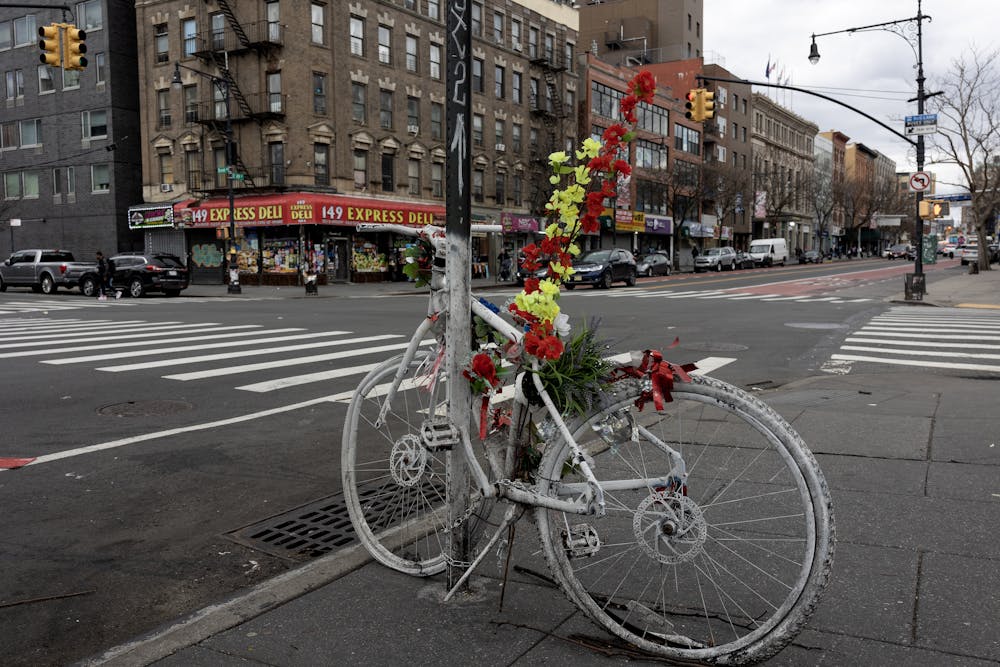
A bicycle, painted white and decorated with flowers, attached to a street pole at an urban intersection.
One of three memorial ‘ghost bikes’ on a single block in the Bronx, New York, April 6, 2024, memorializing delivery workers killed in traffic accidents. Andrew Lichtenstein/Corbis via Getty Images

Millions of road deaths

How bad are the bad outcomes? The U.S. has been tracking car-related road deaths since 1899. As a country, we hit the threshold of 1 million cumulative deaths in 1953, 2 million in 1975 and 3 million in 1998. While the past several years of data have not yet been released, I estimate that the U.S. topped 4 million total road deaths sometime in the spring of 2024.

How many of those are pedestrians and bicyclists? Analysts didn’t do a great job of separating out the pedestrian and cyclist deaths in the early years, but based on later trends, my estimate is that some 930,000 pedestrians and bicyclists have been killed by automobiles in the U.S.

How many of those deaths do we blame on big cars or bad streets? The answer is, very few.

As I show in my new book, “Killed by a Traffic Engineer: Shattering the Delusion that Science Underlies our Transportation System,” the National Highway Traffic Safety Administration calls road user error the “critical reason” behind 94% of crashes, injuries and deaths.

Crash data backs that up.

Police investigate crashes and inevitably look to see which road users, including drivers, pedestrians and cyclists, are most at fault. It’s easy to do because in almost any crash, road user error appears to be the obvious problem.

This approach helps insurance companies figure out who needs to pay. It also helps automakers and traffic engineers rationalize away all these deaths. Everyone – except the families and friends of these 4 million victims – goes to sleep at night feeling good that bad-behaving road users just need more education or better enforcement.

But road user error only scratches the surface of the problem.


Who creates dangerous streets?

When traffic engineers build an overly wide street that looks more like a freeway, and a speeding driver in a Canyonero crashes, subsequent crash data blames the driver for speeding.

When traffic engineers provide lousy crosswalks separated by long distances, and someone jaywalks and gets hit by that speeding Canyonero driver, one or both of these road users will be blamed in the official crash report.

And when automakers build gargantuan vehicles that can easily go double the speed limit and fill them with distracting touchscreens, crash data will still blame the road users for almost anything bad that happens.

These are the sorts of systemic conditions that lead to many so-called road user errors. Look just below the surface, though, and it becomes clear that many human errors represent the typical, rational behaviors of typical, rational road users given the transportation system and vehicle options we put in front of them.

Look more deeply, and you can start to see how our underlying crash data gives everyone a pass but the road users themselves. Everyone wants a data-driven approach to road safety, but today’s standard view of crash data lets automakers, insurance companies and policymakers who shape vehicle safety standards off the hook for embiggening these ever-larger cars and light-duty trucks.

It also absolves traffic engineers, planners and policymakers of blame for creating a transportation system where for most Americans, the only rational choice for getting around is a car.

Transportation engineer Wesley Marshall explains why he believes traffic engineers systematically fail to design safer streets.

Understanding road behavior

Automakers want to sell cars and make money. And if bigger SUVs seem safer to potential customers, while also being much more profitable, it’s easy to see how interactions between road users and car companies – making seemingly rational decisions – have devolved into an SUV arms race.

Even though these same vehicles are less safe for pedestrians, bicyclists and those in opposing vehicles, the current data-driven approach to road safety misses that part of the story.

This can’t all be fixed at once. But by pursuing business as usual, automakers and traffic engineers will continue wasting money on victim-blaming campaigns or billboards placed high over a road telling drivers to pay attention to the road.

A better starting point would be remaking the U.S.’s allegedly data-driven approach to road safety by reinventing our understanding of the crash data that informs it all.

The key is starting to ask why. Why did these road users act as they did? Why didn’t they follow the rules that were laid out for them? Bad road user behavior shouldn’t be excused, but a bit of digging below the surface of crash data unearths a completely different story.

Figuring out which road user is most at fault may be useful for law enforcement and insurance companies, but it doesn’t give transportation engineers, planners, policymakers or automakers much insight into what they can do better. Even worse, it has kept them from realizing that they might be doing anything wrong.The Conversation

Wesley Marshall, Professor of Civil Engineering, University of Colorado Denver

This article is republished from The Conversation under a Creative Commons license. Read the original article.

“Can you name the truck with four-wheel drive, smells like a steak, and seats 35?”

Fire in Lakeport prompts evacuations

Details
Written by: Elizabeth Larson
Published: 24 June 2024
LAKEPORT, Calif. — Firefighters are on the scene of a fire in Lakeport that has led to evacuations in nearby neighborhoods.

The fire at 155 S. Estep was first reported just before 3 p.m. Monday.

The home was reported to be 50% involved when firefighters arrived, with power lines down and the residents out of the home.

Very quickly, the fire spread into nearby wildland and began threatening other structures.

That prompted police to begin evacuations on Estep, First, Second, Lakeview and Crawford streets.

As of just after 3:15 p.m., a total of three homes were on fire. In addition to the original home, there were homes burning on Lakeview Street, near the Lake County Courthouse, and Second streets.

At 3:19 p.m., in support of Lakeport Fire, Lake County Fire issued a call for an immediate need in-county strike force of at least three engines of any type to respond to the fire.

Air support from Cal Fire also was requested, based on radio reports.

Lake County Fire reported that Mendocino County also is sending three engines to assist.

There were spot fires reported on Second and N. Estep streets and Lakeport’s roads crew parked a truck at Third and Estep streets to keep people out of the area.

Just before 3:40 p.m., the task force was canceled and it was reported that forward progress had stopped on the wildland fire aspect of the incident.

At that time, Cal Fire’s air attack arrived and noted the fire appeared to be contained within the original block, with no spot fires at that point.

At 3:49 p.m., incident command said the fires in the three structures had been knocked down and they were in mop up.

It was reported that one home was heavily damaged, a second had exterior damage and a third structure, an outbuilding, also had exterior damage.

Additional information will be published as it becomes available.

Email Elizabeth Larson at This email address is being protected from spambots. You need JavaScript enabled to view it.. Follow her on Twitter, @ERLarson, or Lake County News, @LakeCoNews.

Museums of Lake County Oral History Program gives new dimension to community’s past

Details
Written by: Lake County News reports
Published: 24 June 2024
LAKE COUNTY, Calif. — The history and people of Lake County are truly amazing.

Have you ever wondered what Seigler Springs Resort was like years ago? Darlene Hecomovich can tell you because her parents owned the resort.

How about hearing from the man behind the company, Jonas Oil? Or the history of our former television station, LCTV in Lakeport? Yes, Lake County had its own TV station.

Listen to the museum’s oral history interviews and you will learn more.

Lots of memories and stories from the past are retold by members of our community. Native stories are also captured such as the voice of Millie Simon, Supervisor Moke Simon’s aunt. And the story of how the Pomo statute project was envisioned by Scotts Valley Pomo Elder Leslie Miller.

Interviews are filmed in the Weaver Auditorium at the Lower Lake Schoolhouse Museum, utilizing equipment purchased by the Preservation Committee.

They are 30 minutes to two hours long and are viewable on the Museum’s Youtube Channel.

Make sure to subscribe and check back for new fresh content.

If you want to be interviewed or know someone who has a great story to tell, please call the Lower Lake Schoolhouse Museum and ask to speak to Gabriele: 707-995-3565. You can also email her at This email address is being protected from spambots. You need JavaScript enabled to view it..

The Lower Lake Schoolhouse Museum is open Thursday through Saturday, 10 a.m. to 4 p.m.
  1. Containment rises on Point, Sites fires
  2. ‘Senior Days’ events continue at Anderson Marsh
  3. Extreme heat can be dangerous for runners, cyclists and anyone spending time outdoors: 6 tips for staying safe
  • 637
  • 638
  • 639
  • 640
  • 641
  • 642
  • 643
  • 644
  • 645
  • 646
How to resolve AdBlock issue?
Refresh this page
