How to resolve AdBlock issue?
Refresh this page
How to resolve AdBlock issue?
Refresh this page
Lake County News,California
  • Home
    • Registration Form
  • News
    • Education
    • Veterans
    • Community
      • Obituaries
      • Letters
      • Commentary
    • Police Logs
    • Business
    • Recreation
    • Health
    • Religion
    • Legals
    • Arts & Life
    • Regional
  • Calendar
  • Contact us
    • FAQs
    • Phones, E-Mail
    • Subscribe
  • Advertise Here
  • Login
How to resolve AdBlock issue?
Refresh this page

News

Norovirus, aka the winter vomiting bug, is on the rise – an infectious disease expert explains the best ways to stay safe

Details
Written by: William Schaffner, Vanderbilt University
Published: 28 January 2025


Norovirus is accompanied by abdominal pain, diarrhea and explosive vomiting. Alla Bielikova/Moment via Getty Images

The highly contagious norovirus – popularly known as “stomach flu” or the “winter vomiting bug” – is now surging through the U.S.. The number of outbreaks is up significantly over previous years, possibly due in part to a new strain of the virus. Outbreaks can occur after direct contact with someone who is infected. Food and household surfaces can also become contaminated.

William Schaffner, a professor of preventive medicine and infectious diseases at the Vanderbilt University School of Medicine, discusses the symptoms of norovirus, how best to treat it, and the populations most vulnerable to this illness.

Dr. William Schaffner discusses the norovirus.

The Conversation has collaborated with SciLine to bring you highlights from the discussion that have been edited for brevity and clarity.

What are the symptoms of a norovirus infection?

William Schaffner: Norovirus is an intestinal virus that can make you very, very sick. It is indelicately called winter vomiting disease, and it begins suddenly, often with an explosive vomit that then repeats itself.

Norovirus can cause abdominal pain and diarrhea at the same time, along with a fever. It will probably make you feel miserable for two or three days – but then everybody pretty much recovers.

How should norovirus be treated?

William Schaffner: The major problem norovirus causes is dehydration from all that vomiting and diarrhea. So you have to stay hydrated. Do this with little sips of clear liquids, because if you take too much, it’ll come right back up. Sports drinks are very good.

Most people who get into trouble are either very young or older and more frail. They may have to go to the hospital to get rehydrated with an IV. When the occasional death occurs due to this dehydrating infection, it’s in those vulnerable populations.

Why does norovirus tend to surge during the winter?

William Schaffner: You can get it any time of the year, but there is a seasonal increase in the winter for reasons that scientists are not quite sure of. But people spend a lot of time indoors with each other in wintertime, so that makes it easier for the virus to get from one place to another. All that travel over the holidays, as well as family gatherings and parties, can spread the virus.

How can people protect themselves from the norovirus?

William Schaffner: The most important thing is good hand hygiene. Washing with soap and water works the best. Those hand hygiene gels and wipes – the hand sanitizers – that people tend to use aren’t as effective against norovirus, so just wash frequently with good old soap and water. And then, of course, avoid people who are sick.

Also, remember that the virus can survive on environmental surfaces, like counters, doorknobs and tables. You don’t want to pick up those viruses on your fingers. If you get a little bit of virus on your fingertips and then touch your lips, you can get an infection because it just takes a small dose of the virus to make you sick.

Who’s particularly vulnerable to norovirus?

William Schaffner: The people who are more susceptible to catching it are those living in semi-enclosed or enclosed populations. For example, people in nursing homes, schools and prisons – essentially any circumstance where people are together for a long period of time.

Another place where the virus can spread is cruise ships, which is why norovirus is also called the cruise ship virus. When people are confined on a ship for days and days, these outbreaks can run through most of the passengers.

Interestingly enough – and this has never been well explained – the crew is usually less affected.

But again, the most serious illness occurs in older, frail and immune-compromised people, or in the very young, where dehydration can be more serious.

Where’s the research on developing a norovirus vaccine?

William Schaffner: Norovirus has presented some scientific challenges. It’s actually rather difficult to grow in the laboratory, and so that has delayed the development of a vaccine. But researchers are working on it.

Are there other infectious diseases going around right now?

William Schaffner: Along with norovirus, respiratory viruses are still out there: influenza, COVID-19 and respiratory syncytial virus, or RSV. They’re all perking up at the same time. It looks as though we’re having a very brisk winter viral season.

Watch the full interview to hear more.

SciLine is a free service based at the American Association for the Advancement of Science, a nonprofit that helps journalists include scientific evidence and experts in their news stories.The Conversation

William Schaffner, Professor of preventive medicine, health policy, infectious diseses, Vanderbilt University

This article is republished from The Conversation under a Creative Commons license. Read the original article.
Supervisors to hold annual governance workshop

Details
Written by: Elizabeth Larson
Published: 27 January 2025
LAKE COUNTY, Calif. — The Board of Supervisors will meet this week to hold the annual governance workshop with department heads.

The‌ ‌board will meet beginning ‌at‌ ‌9‌ ‌a.m. Tuesday, Jan. 28, in the board chambers on the first floor of the Lake County Courthouse, 255 N. Forbes St., Lakeport.

The‌ ‌meeting‌ ‌can‌ ‌be‌ ‌watched‌ ‌live‌ ‌on‌ ‌Channel‌ ‌8, ‌online‌ ‌at‌ ‌https://countyoflake.legistar.com/Calendar.aspx‌‌ and‌ ‌on‌ ‌the‌ ‌county’s‌ ‌Facebook‌ ‌page. ‌Accompanying‌ ‌board‌ ‌documents, ‌the‌ ‌agenda‌ ‌and‌ ‌archived‌ ‌board‌ ‌meeting‌ ‌videos‌ ‌also‌ ‌are‌ ‌available‌ ‌at‌ ‌that‌ ‌link. ‌ ‌

To‌ ‌participate‌ ‌in‌ ‌real-time, ‌join‌ ‌the‌ ‌Zoom‌ ‌meeting‌ ‌by‌ ‌clicking‌ ‌this‌ ‌link‌. ‌ ‌

The‌ ‌meeting‌ ‌ID‌ ‌is‌ 865 3354 4962, ‌pass code 726865.‌ ‌The meeting also can be accessed via one tap mobile at +16694449171,,86533544962#,,,,*726865#. The meeting can also be accessed via phone at 669 900 6833.

The meeting’s main item will be presentations from department heads, who will present their 2024 accomplishments, data points and diversity metrics.

Also on Tuesday, the board will consider appointments to the Central Region Town Hall and Eastern Region Town Hall, and a proposed agreement between the county of Lake and Workday Inc. for finance and human capital management enterprise resource planning software in the amount of $4,192,452 for January 2026 to January 2035.

Email Elizabeth Larson at This email address is being protected from spambots. You need JavaScript enabled to view it.. Follow her on Twitter, @ERLarson, and on Bluesky, @erlarson.bsky.social. Find Lake County News on the following platforms: Facebook, @LakeCoNews; X, @LakeCoNews; Threads, @lakeconews, and on Bluesky, @lakeconews.bsky.social.

Homeward bound: More people moved back home at height of pandemic

Details
Written by: Justin V. Palarino and L. Slagan Locklear
Published: 27 January 2025


People move all the time but at the height of the COVID-19 pandemic, a growing share of movers returned to their state of birth, a shift that began before the pandemic and gained even more traction at its peak.

From 2019 to 2022, the share of “return-home” movers — a subset of movers who resided outside their state of birth the previous year and have since returned — increased from 4.2% to 5.0%, according to the American Community Survey (ACS) 1-year data.

The ACS offers a unique view of the changes in national migration patterns by providing information about the type and geographic scope of moves in the United States. Subject table S0601 and the B06 detailed table series offer insight into place of birth and current residence, while migration flows show where people move between geographies.

We focus on cross-state “return-home” movers that show people moving back to their state of birth.

Several trends emerge from 2019 to 2022:

• Return-home moves for those under 18 years of age increased from 4.8% to 6.4%.
• The return-home mover rate for those ages 25 to 44 increased from 4.1% to 4.7%.
• Among those ages 65 years and older, return-home moves declined between 2018 and 2019 but increased from 2019 to 2021, and again from 2021 to 2022.


Movers in the United States

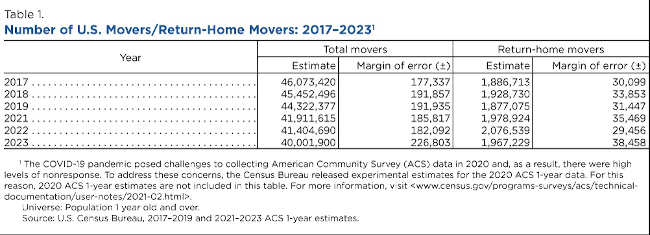
The number of U.S. movers declined between 2006 and 2019 and continued to decline into 2021. Table 1 shows estimates for total movers and return-home movers between 2017 and 2023.

Return-home moves increased from 2017 to 2018, declined between 2018 and 2019, then increased again each year between 2019 and 2022.

Return-home movers

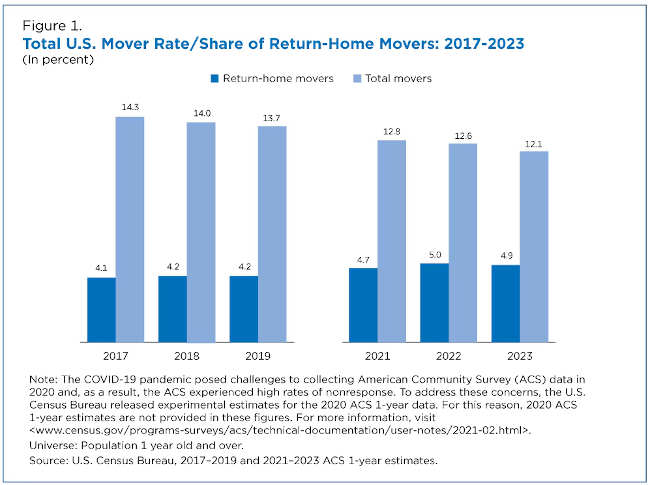
Despite declines in the total mover rates between 2017 and 2023, return-home moves increased during certain intervals throughout this period (Figure 1).

• The percentage of movers 1 year and over who moved back to their state of birth increased from 4.1% to 4.2% between 2017 and 2018.
• The percentage of return-home movers did not change significantly between 2018 and 2019, the year before the COVID-19 pandemic.
• The largest percentage change of movers returning home was from 2019 (4.2%) to 2021 (4.7%).
• Relative to 2021, the percentage of return-home movers continued to increase to 5.0% in 2022 and did not change significantly in 2023 (4.9%).


Age and return-home movers

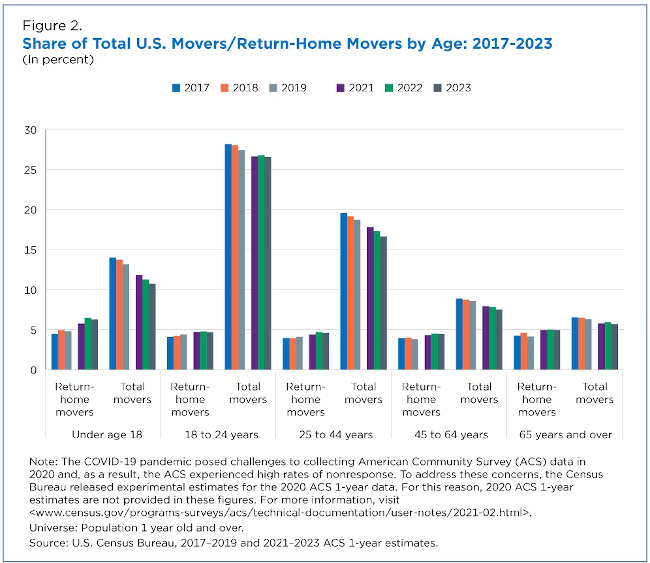
Moving patterns tend to change as people age. We look at return-home mover rates for five age groups: under age 18; 18 to 24; 25 to 44; 45 to 64; and 65 and over:

• Those under 18 had the highest percentage of return-home movers of all age groups (Figure 2), rising from 4.5% in 2017 to 4.9% in 2018, then remaining stable from 2018 to 2019 (4.8%). It increased again to 5.7% in 2021 and to 6.4% in 2022.
• Those between ages 18 and 24, or “college-age,” showed relative stability in their return-home mover rates in this period, except for an increase between 2019 (4.4%) and 2021 (4.7%).
• The 25 to 44 age range saw consistent increases in rates of return-home movers from 2017 to 2022. In 2017, 3.9% of movers returned home. By 2022, that share increased to 4.7%.
• Those between ages 45 and 64 saw relative stability in return-home mover rates, except for a drop between 2018 (4.0%) and 2019 (3.8%), and an increase between 2019 (3.8%) and 2021 (4.3%).
• The return-home mover rates for those 65 or older, or in “retirement age,” rose from 2017 (4.2%) to 2018 (4.6%), only to decline in 2019 (4.1%). In 2021, the rate was 4.9% and was not significantly different in 2022 and 2023.

Justin V. Palarino is a survey statistician in the Census Bureau’s Social, Economic, and Housing Statistics Division. L. Slagan Locklear is a survey statistician in the Census Bureau’s Social, Economic, and Housing Statistics Division.

2024 was the world’s warmest year on record

Details
Written by: NATIONAL OCEANIC AND ATMOSPHERIC ADMINISTRATION
Published: 27 January 2025
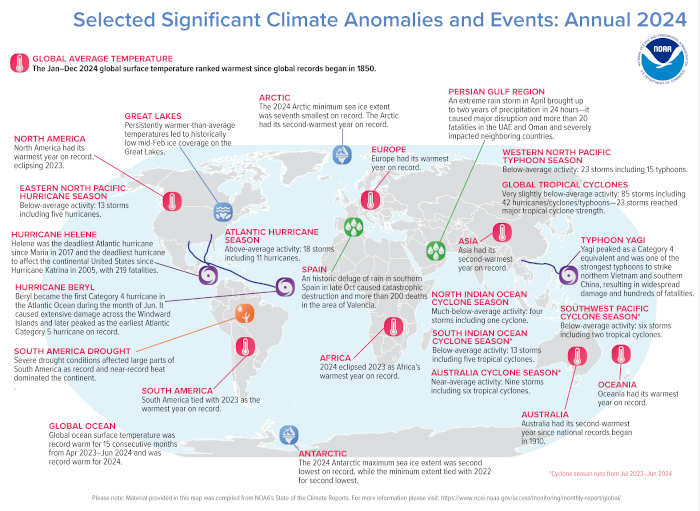
An annotated map of the world plotted with the year's most significant climate events. See the story below as well as the report summary from NOAA NCEI at http://bit.ly/Global202413offsite link. (Image credit: NOAA/NCEI).

It’s official: 2024 was the planet’s warmest year on record, according to an analysis by scientists from NOAA’s National Centers for Environmental Information, or NCEI.

Along with historic heat, Antarctic sea ice coverage dropped to its second-lowest extent (coverage) on record.

Below are highlights from NOAA’s 2024 annual global climate report:

Climate by the numbers

Earth’s average land and ocean surface temperature in 2024 was 2.32 degrees F (1.29 degrees C) above the 20th-century average — the highest global temperature among all years in NOAA’s 1850-2024 climate record. It was 0.18 of a degree F (0.10 of a degree C) warmer than 2023, which was previously the warmest year on record.

Regionally, Africa, Europe, North America, Oceania and South America (tied with 2023) had their warmest year on record. Asia and the Arctic had their second-warmest year on record.

The planet’s 10 warmest years since 1850 have all occurred in the past decade. In 2024, global temperature exceeded the pre-industrial (1850–1900) average by 2.63 degrees F (1.46 degrees C).

Other scientific organizations, including NASA, the Copernicus Climate Change and the UK Met Office have conducted separate but similar analyses that also rank 2024 as the warmest year on record.

Other notable climate findings and events

• Antarctic sea ice ran near record lows: Antarctic sea ice extent (coverage) averaged 4.00 million square miles in 2024, second lowest on record. The maximum extent in September was 6.59 million square miles, which ranked second lowest, and the minimum extent in February was 830,000 square miles, which also ranked second lowest. Arctic sea ice extent averaged 4.03 million square miles in 2024, seventh lowest on record. The maximum extent in March was 5.74 million square miles, which ranked 15th lowest, while the minimum extent in September was 1.69 million square miles, which ranked sixth lowest.
• Upper ocean heat content set record high: The 2024 upper ocean heat content, which is the amount of heat stored in the upper 2,000 meters of the ocean, was the highest on record. Ocean heat content is a key climate indicator because the ocean stores 90% of the excess heat in the Earth system. The indicator has been tracked globally since 1958, and the five highest values have all occurred in the last five years.
• Global tropical cyclone activity was near average: Eighty-five named storms occurred across the globe in 2024, which was near the 1991–2020 average of 88. Forty-two of those reached tropical cyclone strength (sustained winds of 74 mph or higher), and 23 reached major tropical cyclone strength (sustained winds of 111 mph or higher). These also included four storms that reached Category 5 (sustained winds of 157 mph or higher) on the Saffir-Simpson hurricane wind scale. The global accumulated cyclone energy (ACE) was about 21% below the 1991–2020 average.
  1. The technology that runs Congress lags so far behind the modern world that its flag-tracking system just caught up to 2017-era Pizza Hut
  2. Authorities investigate Friday night stabbing; suspect arrested
  3. Lake County Symphony Association to hold Feb. 2 audition event
  • 403
  • 404
  • 405
  • 406
  • 407
  • 408
  • 409
  • 410
  • 411
  • 412
How to resolve AdBlock issue?
Refresh this page