How to resolve AdBlock issue?
Refresh this page
How to resolve AdBlock issue?
Refresh this page
Lake County News,California
  • Home
    • Registration Form
  • News
    • Education
    • Veterans
    • Community
      • Obituaries
      • Letters
      • Commentary
    • Police Logs
    • Business
    • Recreation
    • Health
    • Religion
    • Legals
    • Arts & Life
    • Regional
  • Calendar
  • Contact us
    • FAQs
    • Phones, E-Mail
    • Subscribe
  • Advertise Here
  • Login
How to resolve AdBlock issue?
Refresh this page

News

Space News: Lightning strikes link weather on Earth and weather in space

Details
Written by: Lauren Blum, University of Colorado Boulder
Published: 09 February 2025


Lightning, when coupled with solar flares, can knock electrons flying above the Earth out of place. AP Photo/David Zalubowski
Lauren Blum, University of Colorado Boulder

There are trillions of charged particles – protons and electrons, the basic building blocks of matter – whizzing around above your head at any given time. These high-energy particles, which can travel at close to the speed of light, typically remain thousands of kilometers away from Earth, trapped there by the shape of Earth’s magnetic field.

Occasionally, though, an event happens that can jostle them out of place, sending electrons raining down into Earth’s atmosphere. These high-energy particles in space make up what are known as the Van Allen radiation belts, and their discovery was one of the first of the space age. A new study from my research team has found that electromagnetic waves generated by lightning can trigger these electron showers.

A brief history lesson

At the start of the space race in the 1950s, professor James Van Allen and his research team at the University of Iowa were tasked with building an experiment to fly on the United States’ very first satellite, Explorer 1. They designed sensors to study cosmic radiation, which is caused by high-energy particles originating from the Sun, the Milky Way galaxy, or beyond.

A black and white photo of three men holding a model of a cylindrical spacecraft over their heads.
James Van Allen, middle, poses with a model of the Explorer 1 satellite. NASA

After Explorer 1 launched, though, they noticed that their instrument was detecting significantly higher levels of radiation than expected. Rather than measuring a distant source of radiation beyond our solar system, they appeared to be measuring a local and extremely intense source.

This measurement led to the discovery of the Van Allen radiation belts, two doughnut-shaped regions of high-energy electrons and ions encircling the planet.

Scientists believe that the inner radiation belt, peaking about 621 miles (1000 kilometers) from Earth, is composed of electrons and high-energy protons and is relatively stable over time.

The outer radiation belt, about three times farther away, is made up of high-energy electrons. This belt can be highly dynamic. Its location, density and energy content may vary significantly by the hour in response to solar activity.

Charged particles, with their trajectories shown as blue and yellow lines here, exist in the radiation belts around Earth, depicted here as the yellow, green and blue regions.

The discovery of these high-radiation regions is not only an interesting story about the early days of the space race; it also serves as a reminder that many scientific discoveries have come about by happy accident.

It is a lesson for experimental scientists, myself included, to keep an open mind when analyzing and evaluating data. If the data doesn’t match our theories or expectations, those theories may need to be revisited.

Our curious observations

While I teach the history of the space race in a space policy course at the University of Colorado, Boulder, I rarely connect it to my own experience as a scientist researching Earth’s radiation belts. Or, at least, I didn’t until recently.

In a study led by Max Feinland, an undergraduate student in my research group, we stumbled upon some of our own unexpected observations of Earth’s radiation belts. Our findings have made us rethink our understanding of Earth’s inner radiation belt and the processes affecting it.

Originally, we set out to look for very rapid – sub-second – bursts of high-energy electrons entering the atmosphere from the outer radiation belt, where they are typically observed.

Many scientists believe that a type of electromagnetic wave known as “chorus” can knock these electrons out of position and send them toward the atmosphere. They’re called chorus waves due to their distinct chirping sound when listened to on a radio receiver.

Feinland developed an algorithm to search for these events in decades of measurements from the SAMPEX satellite. When he showed me a plot with the location of all the events he’d detected, we noticed a number of them were not where we expected. Some events mapped to the inner radiation belt rather than the outer belt.

This finding was curious for two reasons. For one, chorus waves aren’t prevalent in this region, so something else had to be shaking these electrons loose.

The other surprise was finding electrons this energetic in the inner radiation belt at all. Measurements from NASA’s Van Allen Probes mission prompted renewed interest in the inner radiation belt. Observations from the Van Allen Probes suggested that high-energy electrons are often not present in this inner radiation belt, at least not during the first few years of that mission, from 2012 to 2014.

Our observations now showed that, in fact, there are times that the inner belt contains high-energy electrons. How often this is true and under what conditions remain open questions to explore. These high-energy particles can damage spacecraft and harm humans in space, so researchers need to know when and where in space they are present to better design spacecraft.

Determining the culprit

One of the ways to disturb electrons in the inner radiation belt and kick them into Earth’s atmosphere actually begins in the atmosphere itself.

Lightning, the large electromagnetic discharges that light up the sky during thunderstorms, can actually generate electromagnetic waves known as lightning-generated whistlers.

A bolt of lightning striking above a city skyline.
Lightning strikes generate electromagnetic waves, which can travel into the radiation belts above the Earth’s atmosphere. mdesigner125/iStock via Getty Images Plus

These waves can then travel through the atmosphere out into space, where they interact with electrons in the inner radiation belt – much as chorus waves interact with electrons in the outer radiation belt.

To test whether lightning was behind our inner radiation belt detections, we looked back at the electron bursts and compared them with thunderstorm data. Some lightning activity seemed correlated with our electron events, but much of it was not.

Specifically, only lightning that occurred right after so-called geomagnetic storms resulted in the bursts of electrons we detected.

Geomagnetic storms are disturbances in the near-Earth space environment often caused by large eruptions on the Sun’s surface. This solar activity, if directed toward Earth, can produce what researchers term space weather. Space weather can result in stunning auroras, but it can also disrupt satellite and power grid operations.

We discovered that a combination of weather on Earth and weather in space produces the unique electron signatures we observed in our study. The solar activity disturbs Earth’s radiation belts and populates the inner belt with very high-energy electrons, then the lightning interacts with these electrons and creates the rapid bursts that we observed.

These results provide a nice reminder of the interconnected nature of Earth and space. They were also a welcome reminder to me of the often nonlinear process of scientific discovery.The Conversation

Lauren Blum, Assistant Professor of Atmospheric and Space Physics, University of Colorado Boulder

This article is republished from The Conversation under a Creative Commons license. Read the original article.
Pet Fix clinic spays and neuters over 200 pets in three days

Details
Written by: LINGZI CHEN
Published: 08 February 2025
More than 200 pets received spay and neuter services during the Pet Fix in Kelseyville, California. Photo courtesy of SPCA of Lake County.

LAKE COUNTY, Calif. — Amid heavy winter rains, the first Pet Fix animal clinic spayed and neutered 203 animals over three days, from Jan. 31 to Feb. 2.

Pet Fix is a volunteer-driven partnership of three local animal care nonprofit groups:Clearlake Animal Association, Dogwood Animal Rescue and SPCA of Lake County.

The community-led effort to provide low-cost and high-volume spay and neuter services aims to address Lake County’s long concerned “overpopulation crisis” of pets, according to Pet Fix’s Facebook page.

“It means there’s going to be less dumped and abandoned animals,” SPCA president Nancy Johnson said of the clinic’s impact.

It means less feral cats, roaming dogs, and less hit by cars, she added, “Because people aren’t dumping their unwanted kittens out in the middle of nowhere.”

In addition to the surgeries, every pet that was serviced got vaccinated — a rabies, a microchip, an FVRCP for cats, or the Parvo and DHPP for dogs. With reduced risks of certain cancers in dogs, these procedures would lead to healthier pets, Johnson said.

The first Pet Fix clinic service was by appointment only and applications opened on Jan.1. The poster said there would be a $25 copay for every eligible pet and the portal would close after signing up 100 cats and 300 dogs.

“We took 300 applications for dogs to fill the 100 appointments that we had available, because we have to have specific sizes and genders and whatnot to fill,” Johnson explained. “So we have a big enough mix to get the animals that we need to make the best roster,” Johnson explained.

By Jan. 22, the clinic had been fully booked and scheduled.

Over the three days of the clinic, three vets and six registered veterinary technicians from the contractor Animal Balance, together with 25 to 30 volunteers per day, carried out the services for 203 pets brought in by their owners, Johnson said. In total, about 50 volunteers participated.

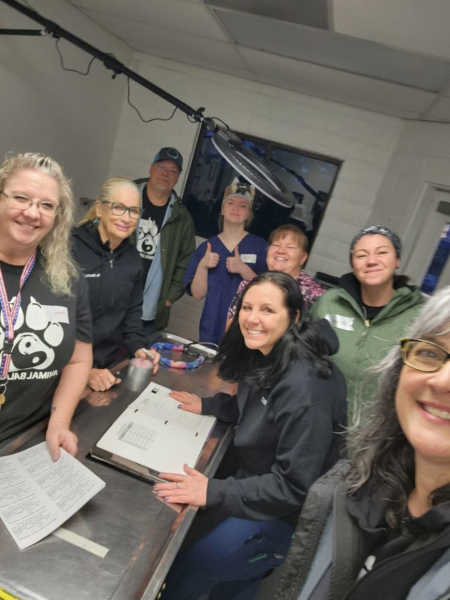
A group of volunteers who made the Pet Fix happen. Photo courtesy of SPCA of Lake County.


The ‘scaled-up’ clinic work and the county’s vet shortage

Spaying and neutering 203 animals in three days was a stretch.

“It took SPCA three months last year to do that same amount,” Johnson told Lake County News.

“There's a lot of unthought of things everywhere, from extra oxygen to more copy paper and just all the extra things that come with running a clinic,” Johnson explained of the different aspects of the work that was being “scaled up.”

“We normally do 25 in a clinic four days a month. And to scale that up to 200 animals in three days, you forget what you don’t know,” she said with a chuckle.

Looking ahead, Johnson told Lake County News that Pet Fix has four more clinics planned for this year, which means a total of 1,000 pets could have their surgeries completed this year. Dates of future clinics have yet to be determined.

“Getting this high volume span neuter done does have an impact,” said Johnson, making reference to the concerns over vet shortage.

“We figured out there’s about 8,000 owned dogs and cats in the county,” she said, adding that there are about eight vets in the whole county. “There’s no way they can service 8,000 pets.”

Lake County Animal Control, the major sponsor of the first clinic, hasn’t had a vet for several years, Johnson noted. “They can’t get a vet. Nobody wants the job.”

Sometimes people do want to bring their pets for spay and neuter services but are not able to, “because either you can’t afford it or you can’t get an appointment,” she said.

At one point, SPCA was booked out three months in advance, and Johnson stopped taking appointments. “It just doesn’t do any good to schedule people six months from now, right?”

At SPCA, the standard procedures may cost between $125 for neuter of a male dog under 50 lbs, and up to $230 for spay of a female dog over 75 pounds, according to a Pet Fix Facebook post that provides information for applicants who didn’t get the appointment at the Pet Fix’s first clinic.

“If interested, you will be responsible for the full price of the SPCA clinic, which is still significantly less than full service veterinary offices,” the post said.

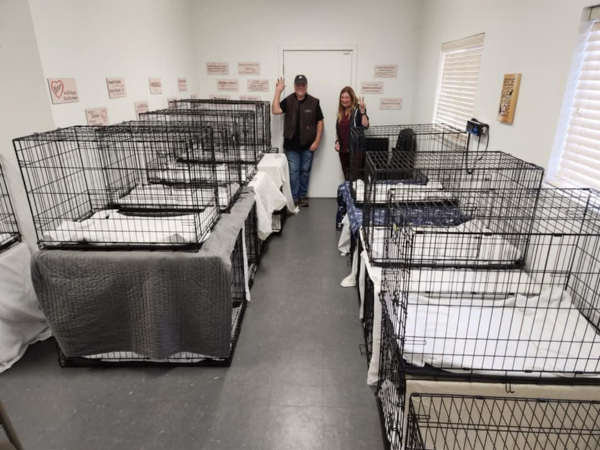
Volunteers with cages prepared for the animals that would receive care during the Pet Fix. Photo courtesy of SPCA of Lake County.


The joint effort

“It was almost a year in the making,” said Johnson of how the project came about with the three partnering agencies. “It was a lot of coordination and a lot of public help.”

Johnson explained the roles of the three partnering agencies: Dogwood and Clearlake Animal Association are handling fundraising efforts through grants and other means, whereas the SPCA contributes by providing the “boots on the ground.”

For the first clinic, Lake County Animal Care and Control contributed $37,000 to contract Animal Balance, while Kelseyville Lumber covered food costs, providing breakfast and lunch for more than 30 people each day.

The city of Clearlake donated $4,000 to purchase a new autoclave for sterilizing equipment. A couple months ago, a Facebook fundraiser for getting surgical instruments raised $2,500 in less than seven days.

The team created an Amazon wishlist of supplies and equipment and received generous donations from the community.

A fuller list of contributors can be found in SPCA’s Facebook post.

“Lake County has been amazing,” said Johnson of the community support.

So far, they have yet figured out the total value of all donations, she added.

The three-day program met with the new year’s rainstorms. Yet it was a success and a learning experience.

“We were out there in our rain slickers,” Johnson recalled. Still, “It went smoother than we expected.”

She credited Animal Balance’s check-in procedures for streamlining operations.

Learning how to do so many in such a short amount of time for Johnson was “an educational thing for us.”

When asked what they had learned, “they had a lot more surgical staff than we do; we have one vet,” she said in addition to the productive procedures.

Email staff reporter Lingzi Chen at This email address is being protected from spambots. You need JavaScript enabled to view it..

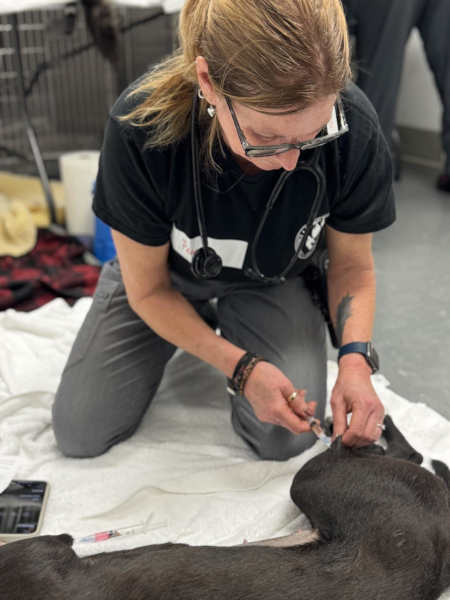
A vet works on a dog during the Pet Fix. Photo courtesy of SPCA of Clear Lake.

Napa man sentenced for killing of Oregon bicyclists

Details
Written by: LAKE COUNTY NEWS REPORTS
Published: 08 February 2025
NORTH COAST, Calif. — A Napa man will do jail time for a traffic crash in 2023 that killed an Oregon couple.

Napa County District Attorney Allison Haley on Friday announced the sentencing of Porfirio Sanchez, age 57, to one year in jail for his role in the death of Christian Deaton, 52, and his wife Michelle Deaton, 48.

On the morning of Oct. 17, 2023, Sanchez failed to properly secure the lumber load he was hauling along Silverado Trail, causing a large piece of lumber to swing out perpendicular to the truck and strike the Deatons, who were riding their bicycles alongside the road. Both bicyclists lost their lives due to the collision.

On Nov. 14, 2024, Sanchez signed an agreement in which he pled no contest to two counts of vehicular manslaughter. Sanchez agreed to serve up to four years in state prison for the crimes he pleaded to, according to the plea agreement.

During Friday’s sentencing hearing Napa County Deputy District Attorney Shashawnya Worley, who prosecuted the case against Sanchez, requested the court sentence Sanchez to four years in state prison in accordance with the plea agreement.

After hearing testimony from Mr. Deaton’s brother in which he requested leniency for Sanchez, and reading victim impact statements submitted in this case, Napa County Superior Court Judge Scott Young sentenced Sanchez to 364 days in jail.

Judge Young, however, stayed 180 of those days upon completion of 180 hours of community service related to bike safety, or other program authorized by the Napa County Probation Department.

Sanchez was additionally sentenced to two years of formal probation with terms and conditions.

“It seems that everyone in this case, generally, is requesting justice and mercy,” Judge Young stated during Friday’s sentencing. “The court is moved by the amount of grace in this courtroom by all the families.”

During the sentencing hearing, Worley said, “This case boils down to two happy, healthy lives that were cut short due to the negligence of the defendant. Their deaths have had a profound impact on their family and friends. There’s nothing I can say or do today that can bring their loved ones back, but I hope that this sentence can bring them closure.”

Bonta: Trump Administration not complying with court order to unfreeze certain federal funding

Details
Written by: LAKE COUNTY NEWS REPORTS
Published: 08 February 2025
On Friday California Attorney General Rob Bonta led a coalition of 23 attorneys general in filing a motion to enforce and a motion for preliminary injunction in NY v. Trump, the ongoing lawsuit challenging actions by President Trump, the Office of Management and Budget and federal agencies attempting to pause nearly $3 trillion in federal assistance funding allocated to the states that support critical programs and services that benefit the American people.

The coalition is seeking to preliminarily enjoin the Trump Administration’s actions to impose a funding freeze, emphasizing the widespread and irreparable harm to states, which rely on billions of dollars of critical federal assistance for public services that ensure access to education, clean air and water, and health care and that support essential infrastructure projects.

The motion further highlights the harm states face if funds under the Inflation Reduction Act, or IRA, and Infrastructure, Investment, and Jobs Act, or IIJA, also known as the Bipartisan Infrastructure Law, are not allocated as required by statute.

The Inflation Reduction Act and IIJA funding strengthens domestic energy security, reduces energy costs, diversifies our domestic energy resources, rebuilds our domestic manufacturing economy, bolsters and modernizes critical infrastructure, and creates well-paying jobs while simultaneously reducing harmful pollution.

Citing evidence of ongoing disruptions impacting disbursements to states, and federal funds that remain blocked under the IRA and IIJA despite the court’s temporary restraining order, which remains in place, the coalition also seeks to enforce the temporary restraining order to require the Trump Administration to disperse these funds.

“Let’s be crystal clear: the power of the purse belongs to Congress, not the president,” said Attorney General Bonta. “The Trump Administration’s dangerous and unconstitutional actions have created chaos and confusion across this country, and caused significant harm to states across the country and the millions of Americans who rely on federal funding, from children to the elderly. In yet another unlawful move, we have evidence that despite the Temporary Restraining Order we secured, the Trump Administration has continued to block funds needed for our domestic energy security, transportation, and infrastructure provided under the IRA and IIJA. We’re asking the court to enforce its order and ensure that the Trump Administration reinstates access to this critical funding. No one is above the law, and at the California Department of Justice, we will not waver in our commitment to uphold the law and ensure that necessary funding for critical programs and services in states across our country can continue.”

In just this fiscal year, California is expected to receive $168 billion in federal funds — 34% of the state’s budget — not including funding for the state’s public college and university system.

This includes $107.5 billion in funding for California’s Medicaid programs, which serve approximately 14.5 million Californians, including 5 million children and 2.3 million seniors and people with disabilities.

Additionally, over 9,000 full-time equivalent state employee positions are federally funded. As detailed in the preliminary injunction motion, without access to federal financial assistance, many states could face immediate cash shortfalls, making it difficult to administer basic programs like funding for healthcare and food for children and to address their most pressing needs.

As of January 2025, California has been awarded $63 billion from the IIJA and nearly $5 billion from the IRA, not including funds going to California cities, air and water districts, or other political subdivisions.

Due to ongoing disruptions impacting disbursements to states despite the court’s temporary restraining order, efforts that bolster clean energy investments, transportation, and infrastructure have been put at risk, including:

• The Home Electrification and Appliances Rebates Program, for which the IRA appropriates $4.5 billion to the Department of Energy. The rebate program, administered by state energy offices under final federal grants, subsidizes low- and moderate-income households’ purchase and installation of electric heat pump water heaters, electric heat pump space heating and cooling systems, and other home electrification projects. Thousands of California homeowners have signed up for these programs, received approvals, and even started installation in reliance on these rebates, and are stuck paying their contractors an extra $8,000 if our state energy offices cannot draw down funds. As of February 5, that remained the case: the home rebate grants were being held “for agency review.”

• The Solar for All program, administered by EPA and funded by the IRA’s Greenhouse Gas Reduction Fund, awarded $7 billion to 60 grantees to install rooftop and community solar energy projects in low-income and disadvantaged communities. These awards — all subject to final grant agreements—support the construction of cheap, resilient power in underserved neighborhoods, and provide particular protection to communities in which wildfire risk regularly causes utilities to de-energize transmission lines. As of February 5, numerous states in the coalition were unable to access their Solar For All grant accounts.

• The Climate Pollution Reduction Grant program, administered by EPA and funded by a $5 billion IRA appropriation, supports states, tribes, and local governments in planning and implementing greenhouse-gas reduction measures. For example, the regional air district covering Los Angeles received a $500 million award, subject to a final grant agreement, to clean up the highly polluting goods movement corridor between the Imperial Valley's logistics hubs and warehouses to the Port of Los Angeles. As of Feb. 5, this grant and other Climate Pollution Reduction Grants remained inaccessible.

The national air monitoring network and research program under Clean Air Act sections 103 to 105, which has been administered by EPA for the last sixty years to protect communities from dangerous pollution.

The IRA appropriated $117.5 million to fund air monitoring grants under this program to increase states’ abilities to detect dangerous pollution like particulate matter (soot) and air toxics, especially in disadvantaged communities.

These pollutants create a particular public health emergency in areas recovering from wildfires. As of Feb. 5, air monitoring grants remained inaccessible.

Amid evidence that the Trump Administration has continued to block these critical funds, in violation of the court's order, the attorneys general filed a motion to enforce to ensure that the funds are swiftly dispersed so that states can put them to use to protect for the health and well-being of their residents.

Attorney General Bonta, along with the attorneys general of New York, Rhode Island, Massachusetts and Illinois, led the attorneys general of Arizona, Colorado, Connecticut, Delaware, the District of Columbia, Hawaii, Maine, Maryland, Michigan, Minnesota, New York, Nevada, North Carolina, New Jersey, New Mexico, Oregon, Rhode Island, Vermont, Washington, and Wisconsin in filing the motions.
  1. Is DOGE a cybersecurity threat? A security expert explains the dangers of violating protocols and regulations that protect government computer systems
  2. Space News: Property and sovereignty in space − as countries and companies take to the stars, they could run into disputes
  3. Thompson holds town hall to discuss congressional response to Trump Administration actions
  • 389
  • 390
  • 391
  • 392
  • 393
  • 394
  • 395
  • 396
  • 397
  • 398
How to resolve AdBlock issue?
Refresh this page