How to resolve AdBlock issue?
Refresh this page
How to resolve AdBlock issue?
Refresh this page
Lake County News,California
  • Home
    • Registration Form
  • News
    • Education
    • Veterans
    • Community
      • Obituaries
      • Letters
      • Commentary
    • Police Logs
    • Business
    • Recreation
    • Health
    • Religion
    • Legals
    • Arts & Life
    • Regional
  • Calendar
  • Contact us
    • FAQs
    • Phones, E-Mail
    • Subscribe
  • Advertise Here
  • Login
How to resolve AdBlock issue?
Refresh this page

News

Lake County News selected to participate in journalism funding program

Details
Written by: LAKE COUNTY NEWS REPORTS
Published: 27 March 2025
Local Media Association, or LMA, is pleased to announce 46 newsrooms selected to participate in three state cohorts of the LMA Lab for Journalism Funding in 2025.

These newsrooms in California, Illinois and New Mexico will engage in a six-month cohort learning program to develop fundraising strategies to help sustain their essential local journalism.

Among the California cohort members is Lake County News.

“We’re excited to work with the lab and other member publications to bring best practices for fundraising and community engagement to Lake County, with a view to learning new and successful strategies for conversing with community members to find out what coverage is critical to them,” said Lake County News Editor and Publisher Elizabeth Larson. “Our hope is that, from this experience, we will create avenues for fundraising that will strengthen our publication’s resources and enhance our ability to carry out the journalism that’s important to Lake County, both now and in the future.”

Since its launch in September 2020, the LMA Lab for Journalism Funding has trained 148 newsrooms in five national and two state cohorts on fundraising best practices.

Collectively, those newsrooms have raised more than $28 million to support their journalism. Training for newsrooms in the lab is made possible through sustained support from Google News Initiative.

This expansion will bring the lab’s proven training and fundraising to 19 news outlets in California, 13 news outlets in Illinois and 14 news outlets in New Mexico, enabling them to support their civic journalism in part through philanthropy.

“We are excited to expand the proven practices of the Lab for Journalism Funding to these three new states,” said Frank Mungeam, who leads the lab as LMA chief innovation officer. “These newsrooms have a deep commitment to community service journalism, and we look forward to helping them grow local support for their essential reporting.”

“The Google News Initiative has been a long-standing partner of the Lab for Journalism Funding,” said Lauren Ashcraft, news partner manager at Google. “It was exciting to see the success of the new state cohorts of the lab from last year and we’re thrilled to support an expansion of the program in these important states. We look forward to our continued partnership with LMA and its members.”

The state cohorts will be led by Mungeam and Liz White Notarangelo, LMA’s co-CEO, along with a team of best-in-class coaches including Joaquin Alvarado, who has been instrumental in the development of philanthropic funding at The Seattle Times and other local newsrooms; Jennifer Preston, formerly vice president of journalism at Knight Foundation; executive coach Joanne Heyman; and Judi Terzotis who as CEO has helped dramatically grow philanthropic support for journalism at Georges Media Group.

Each publisher in the state cohorts will set a fundraising goal, receive one-on-one customized coaching, and create and pitch a journalism project to be funded through philanthropy. Newsrooms will also gather for an in-person training and convening and have the chance to compete for stipends to kick-start their projects.

In 2025, in addition to these three new state cohorts, LMA will once again offer a national cohort of the Lab for Journalism Funding with new support from John S. and James L. Knight Foundation. LMA has also published two industry reports, Pathways to Philanthropy and Sustaining Philanthropy for Journalism, available as free downloads to help all local newsrooms learn and apply fundraising best practices.

Six-month program to focus on fundraising practices

Local Media Association said the news organizations selected to participate in the California cohort of the Lab for Journalism Funding will take part in an intensive, six-month program that brings the lab’s proven fundraising practices to independent news organizations across the state.

The 19 organizations selected for the 2025 Lab for Journalism Funding California cohort represent local newsrooms big and small, serving diverse communities across the state of California, all united in their focus on civic journalism.

The news organizations selected are:

Beyond Borders Gazette
California Health Report
Community Alliance Newspaper
Fountain Valley Living and Huntington Beach Living Magazines
Indigenous Network
inewsource
La Opinión
Lake County News
Mission Local
Monterey County Weekly (Monterey County Now)
Post News Group
Santa Cruz Local
Street Spirit
Tahoe Daily Tribune
The Mendocino Voice (Bay City News Foundation)
The San Diego Voice & Viewpoint Newspaper
The San Fernando Valley Sun/el Sol del Valle de San Fernando
The Trinity Journal
Vida Newspaper

The California cohort of the Lab for Journalism Funding is made possible with support from Google News Initiative. The lab will help these local news organizations develop and execute comprehensive programs to secure philanthropic support for their essential local journalism that is responsive to community priorities.

The lab runs from April through September 2025.

‘California’s Bookshelf’ opens up vast collection of eBooks and eAudiobooks for free

Details
Written by: California State Library
Published: 27 March 2025
Every Californian with an email address and an internet connection can now visit California’s Bookshelf and access more than 300,000 eBooks and eAudiobooks.

Previously, readers had to log in through a participating library to get to all the ebooks available on the eBookshelf. With California’s Bookshelf, access to our vast collection is just a few clicks away, as you’ll see below.

“With just a few clicks, any Californian can go and grab what they’re looking for on California’s Bookshelf. Trust me, we’ve tried to make something for every reader,” said California State Librarian Greg Lucas. “From your home, a coffee shop or while traveling, you will always be connected to convenience with this new virtual library bookshelf. Did I mention it’s free?”

California’s Bookshelf has thousands of eBooks and eAudiobooks in multiple genres and over 20 languages.

The eBookshelf is a partnership with the Palace Project. It uses the Palace app to provide access to digital content.

There are five steps to access California’s Bookshelf and create a virtual library card:

1. Download the free Palace app on your iOS or Android device.
2. Inside the app, use the “find my library” search function to find “California’s Bookshelf.”
3. Browse the collection until you find a title you would like to read then either “get” or “reserve” that book.
4. Choose the option to create a virtual card and then complete the details in the form. You will need to enable the app’s permission to use your specific location, just one time, for the creation of your library card.
5. Look in your email for your library card number. You can borrow items using that number and your new password.

When you browse California’s Bookshelf, you’ll have access to over 300,000 eBooks and eAudiobooks and over 70,000 unique titles. There are over 3,500 titles available with no wait times or hold queues.

If you log into the Palace app through your local library, you’ll not only have access to all the materials in California’s Bookshelf but all the eBooks and audiobooks in your local library’s collection.

Established in 1850, the California State Library is the central reference and research library for state government and the Legislature. The library collection includes more than four million titles, 6,000 maps and 250,000 photographs, and includes an extensive collection of documents from and about the state’s rich history. The State Library also serves California’s local libraries, providing more than $500 million state and federal funds to support public libraries and deliver statewide programs and services.

The Palace Project was born of the belief that the public library is the digital center of knowledge and creativity for their community. A robust suite of content, services and tools for the delivery of ebooks, audiobooks and other digital media to benefit public libraries and their patrons, The Palace Project offers a seamless, easy-to-use system, including platform, content and mobile app, for libraries to engage directly with patrons and improve, enhance and expand the resources available to them. The Palace Project is supported by Lyrasis, in strategic partnership with the Digital Public Library of America.

Lyrasis is a community-focused, mission-driven nonprofit that partners with archives, libraries, museums and research communities to ensure enduring access to our shared academic, scientific and cultural heritage. Home to The Palace Project, BiblioBoard, the Indie Author Project, DSpace, ArchivesSpace and other community-supported programs, Lyrasis offers technologies and services to help knowledge professionals and collections-holding organizations worldwide foster collaboration, solve problems and build solutions to benefit the wider community.

National monuments have grown and shrunk under US presidents for over a century thanks to one law: The Antiquities Act

Details
Written by: Monica Hubbard, Boise State University and Erika Allen Wolters, Oregon State University
Published: 27 March 2025


Over 730,000 people visit Colorado National Monument each year. It was established in 1911 under the Antiquities Act. Gordon Leggett, CC BY-SA
Monica Hubbard, Boise State University and Erika Allen Wolters, Oregon State University

America’s public lands, from its majestic national parks to its vast national forests, are at the heart of the country’s identity.

They cover more than a quarter of the nation and large parts of the West. Some are crisscrossed by hiking trails and used by hunters and fishermen. Ranchers graze cattle on others. In many areas, the government earns money through oil, gas, timber and mining leases.

These federally managed public lands have long enjoyed broad bipartisan support, as have moves to turn them into protected national parks and monuments. Research consistently shows that a majority of Americans want their congressional representatives to protect public access to these lands for recreation. One avenue for protection is the creation of national monuments.

But the status of national monuments can change.

Presidents have expanded and contracted national monuments, as the U.S. saw with Bears Ears National Monument in Utah over the course of the past three presidencies. The rules for the use and maintenance of various public lands can also change, and that can affect surrounding communities and their economies.

The U.S. is likely to see changes to public lands again under the second Trump administration. One of the new administration’s early orders was for the Department of Interior to review all national monuments for potential oil and gas drilling and mining. At least two national monuments that President Joe Biden created in California are among the new administration’s targets.

The avenue for many of these changes is rooted in one century-old law.

The power and vagary of the Antiquities Act

The Antiquities Act of 1906, signed into law by President Theodore Roosevelt, gave Congress or the president the authority to establish national monuments on federal land as a means of protecting areas for ecological, cultural, historical or scientific purposes.

From Theodore Roosevelt on, 18 of the 21 presidents have used the Antiquities Act to create, expand or contract national monuments through a presidential proclamation.

By using the Antiquities Act to create, expand or reduce national monuments, presidents can avoid an environmental impact statement, normally required under the National Environmental Policy Act, which also allows for public input. Supporters argue that forgoing the environmental impact statement helps expedite monument creation and expansion. Critics say bypassing the review means potential impacts of the monument designations can be overlooked.

The Antiquities Act also offers no clarity on whether a president can reduce the amount of area protected by prior presidents. The act simply states that a president designates “the smallest area compatible with the proper care and management of the objects to be protected.” This has led to the shifting of national monument boundaries based on the priorities of each administration.
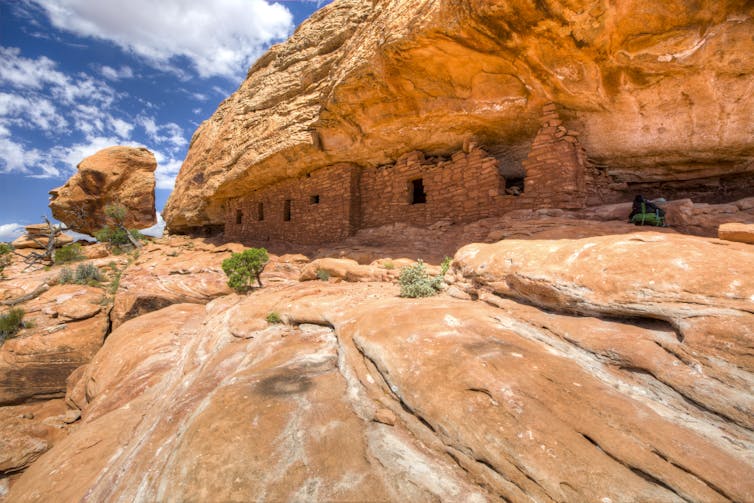
Cliff dwellings under the rim of a cliff
The Citadel Ruins are the remains of Anasazi cliff dwellings at Bears Ears National Monument in Utah. Bob Wick/Bureau of Land Management via Wikimedia Commons

An example is Bears Ears, an area of Utah that is considered significant to several tribes but also has uranium, gas and oil resources. In 2016, President Barack Obama designated Bears Ears a national monument. In 2017, President Donald Trump signed a proclamation reducing Bears Ears by 80% of its total designated size. The monument’s size and scope shifted a third time when President Joe Biden reestablished Bears Ears to the boundaries designated by Obama.

In the span of just over five years, the monument was created, reduced, then restored to the original monument designation.

The uncertainty about the long-term reliability of a designation makes it challenging for federal agencies to manage the land or assure Indigenous communities that the government will protect cultural, historical and ecological heritage.

Public lands can be economic engines

National parks and monuments can help fuel local economies.

A 2017 study by Headwaters Economics, a nonprofit research group, found that Western rural counties with more public land have had greater economic growth, including in jobs and personal income, than those with little public land. National monuments can also benefit neighboring counties by increasing population, income and employment opportunities.
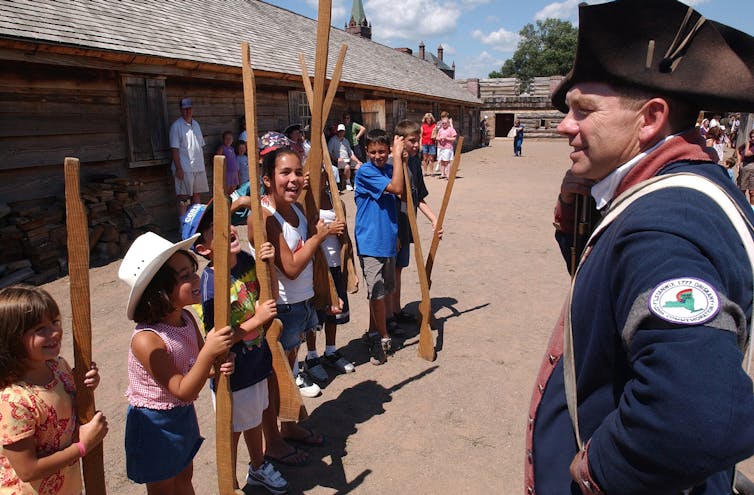
Kids and a worker in a soldier's uniform at Fort Stanwix, a reconstructed fort in the shape of star.
Even small national monuments provide economic benefits for their surrounding communities. Visitors to Fort Stanwix National Monument in Rome, N.Y., spent $5.3 million in nearby communities in 2023, according to a National Park Service report. National Park Service via Wikimedia Commons

While many counties adjacent to public lands may be dependent on natural resource extraction, the establishment of a national monument can open up new opportunities by expanding tourism and recreation. For example, four national parks and monuments in southeastern Utah, including Natural Bridges, drew about 2.4 million visitors who spent nearly US$400 million in surrounding communities.

However, when there is uncertainty over whether public lands will remain protected, communities may be hesitant to invest in that future, not knowing whether it will soon change.

What Congress and the courts could do

There are a few ways to increase the certainty around the future of national monuments.

First, lawsuits could push the courts to determine whether the president has the authority to reduce national monuments. Since the Antiquities Act doesn’t directly address presidential authority to reduce monument size, that’s an open question.

Advocacy groups sued the government over Trump’s authority to shrink Bears Ears National Monument, but their cases were put on hold after Biden expanded the monument again. The U.S. Supreme Court declined to hear other cases in 2024 that argued that a president’s authority to declare and expand national monuments should be far more limited under the law.

Second, Congress could permanently protect designated national monuments through legislation. That would require presidential approval, and the process would likely be slow and cumbersome. Creating White Clouds Wilderness in Idaho, for example, took decades and a public campaign to have it designated a national monument before Congress approved its wilderness designation.

Third, Congress could take new steps to protect public lands. For example, a bipartisan bill titled Public Lands in Public Hands Act could block privatization of public lands and increase and maintain access for recreation. One of the bill’s lead sponsors is U.S. Rep. Ryan Zinke, a Republican from Montana who served as Interior secretary during the first Trump administration. Whether the bill will pass and gain the president’s approval remains to be seen.

Public lands have widespread support

The Antiquities Act has led to the creation of 163 terrestrial and marine monuments and subsequently the protection of land and waters that hold cultural, scientific or historic significance.

These monuments tend to have broad support. During the first Trump administration, there were over 650,000 public comments on Trump’s review of national monument creation. An analysis found that 98% of the comments expressed broad support for both the creation and expansion of national monuments.
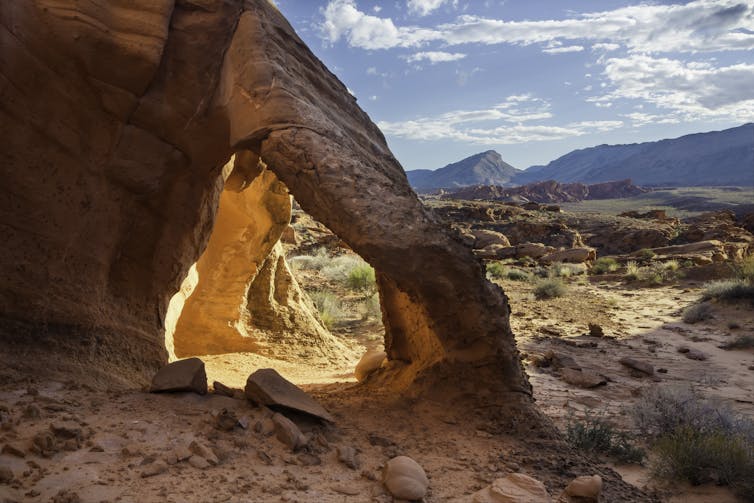
An arch in the Mojave Desert.
Gold Butte National Monument covers nearly 300,000 acres of remote and rugged desert landscape in southeastern Nevada and is popular with hikers. Bureau of Land Management

Public lands are more than just physical places. They are spaces where our ideals and values around public land unify us as Americans. They are quintessentially American – and in many ways define and shape the American identity.The Conversation

Monica Hubbard, Associate Professor of Public Policy and Administration, Boise State University and Erika Allen Wolters, Assistant Professor of Political Science, Oregon State University

This article is republished from The Conversation under a Creative Commons license. Read the original article.


Tuesday night fire damages building at Ceago Vinegarden

Details
Written by: Elizabeth Larson
Published: 26 March 2025
A fire damaged the “shop” building at Ceago Vinegarden in Nice, California, on the night of Tuesday, March 25, 2025. Photo courtesy of Jim Fetzer.

NICE, Calif. — A fire on Tuesday night damaged a building at a famed Northshore winery.

The fire at Ceago Vinegarden, located on Highway 20 between Nice and Lucerne, was dispatched just before 9 p.m. Tuesday.

Initial reports from the scene indicated one of the structures in the Ceago’s compound of buildings was fully involved when firefighters arrived on scene minutes after the initial dispatch.

Firefighters from Northshore Fire, Lakeport Fire and Cal Fire responded to the scene. Lakeport Fire sent its ladder truck to assist with the firefighting effort and the Northshore Fire Support Team was dispatched due to the incident being extended.

Ceago’s owner, Jim Fetzer, told Lake County News that his son, Barney, heard a loud boom before discovering the fire in what Fetzer called the “shop” building. Barney Fetzer then ran to his father’s residence shouting, “Fire! Fire!”

A view of the fire down a hallway at Ceago Vinegarden in Nice, California, on the night of Tuesday, March 25, 2025. Photo courtesy of Jim Fetzer.

The shop building, Jim Fetzer said, is not lived in, but has been used for events. It’s located at the back of the main building and is where Fetzer has plans for a commercial kitchen and restaurant venue.

There was no one in the building. “Everybody’s safe,” Fetzer said.

“You never imagine” an incident like the fire, he said.

The fire, which was kept to the shop building, was reported to be knocked down shortly before 10 p.m., but overhaul continued until early Wednesday morning.

Fetzer has owned the 163-acre property since 2001. He developed a biodynamic winery and farm there which he closed to the public in 2014 when he retired.

Email Elizabeth Larson at This email address is being protected from spambots. You need JavaScript enabled to view it.. Follow her on Twitter, @ERLarson, and on Bluesky, @erlarson.bsky.social. Find Lake County News on the following platforms: Facebook, @LakeCoNews; X, @LakeCoNews; Threads, @lakeconews, and on Bluesky, @lakeconews.bsky.social.


Firefighters work to control a fire at Ceago Vinegarden in Nice, California, on the night of Tuesday, March 25, 2025. Photo courtesy of Jim Fetzer.
  1. Scotts Valley Pomo respond to lawsuit seeking to stop casino project
  2. Yuba Community College District Board to discuss possible bond measure
  3. Public invited to Klaus Park concept design meeting March 26
  • 340
  • 341
  • 342
  • 343
  • 344
  • 345
  • 346
  • 347
  • 348
  • 349
How to resolve AdBlock issue?
Refresh this page