 How to resolve AdBlock issue?
News
- Details
- Written by: LAKE COUNTY NEWS REPORTS
SB 48, authored by Senate Majority Leader Lena Gonzalez (D-33), is sponsored by Thurmond to address safety concerns of immigrant families and protect school funding that is projected to decline in some parts of the state as attendance is suppressed as undocumented individuals fear deportation consequences at school.
The bill is in direct protest to President Trump’s threats to lead mass deportation efforts at schools and houses of worship.
“We know that the fearmongering happening across our nation has disruptive impacts on children in our immigrant families, and it could cost California schools millions of dollars,” Thurmond said.
California is one of a handful of states that still uses an average daily attendance system for attributing funding or the loss of funding to schools.
Approximately half of all students in California are members of immigrant families, in which at least one parent is an immigrant.
One in five students in California live in mixed-status families, in which one or more parents are undocumented.
“All California children deserve safe school environments that prioritize student learning, regardless of immigration status,” said Gonzalez. “As chair of the California Latino Legislative Caucus, I’m proud to be partnering with Superintendent Tony Thurmond to author this important legislation, which will prevent disruptions to student learning, keep children in school, and prevent families from being torn apart.”
Thurmond has called on federal policymakers to create a path to citizenship where undocumented immigrants, who are estimated to generate billions in state revenue through earnings, can take on hard-to-fill jobs and pay into the tax system.
Thurmond and the California Department of Education are leading numerous efforts to push back on Trump policies and executive orders, including leading a plan to block the elimination of the U.S. Department of Education.
SB 48 was heard on Wednesday, April 2, in the California Senate Education Committee.
A recording of the Superintendent’s testimony on April 2 is available on the California State Senate website.
- Details
- Written by: LAKE COUNTY NEWS REPORTS
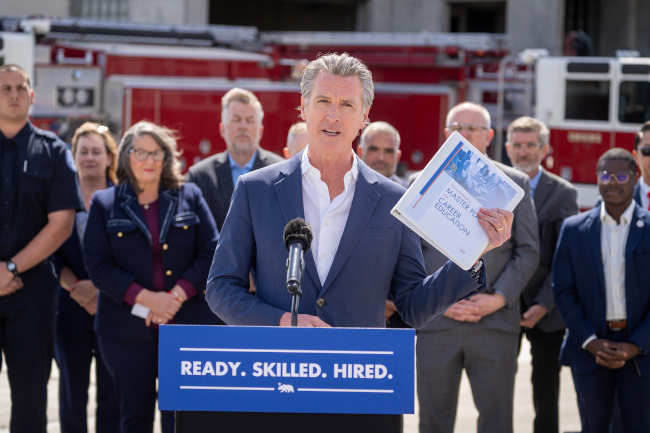
Gov. Gavin Newsom on Wednesday unveiled the Master Plan for Career Education to strengthen career pathways, prioritize hands-on learning and real-life skills, and advance educational access and affordability.
In a meeting at Modesto Junior College, Gov. Newsom received the Master Plan, which provides a framework to respond to the complex challenges facing California’s labor market and education landscape and prepare all learners for the ever-changing workforce.
The plan, supported by proposed budget investments, will make it easier for Californians to receive college credit for their real-world experience — including veterans.
With strategic input from agencies and community members, two central themes emerged to guide the creation of the Master Plan: enhance coordination and address structural barriers that make it difficult for Californians to navigate education, workforce training, and public benefit systems.
By designing systems so they are inherently accessible to all learners regardless of their varied needs and circumstances, California can simultaneously expand access for a wide variety of learners and free up resources to provide more customized support for specific populations.
The Governor’s January Budget includes several proposals that stem from the Master Plan.
“The Master Plan lays out a clear path to help all Californians — whether just starting out or switching careers — access high-paying, fulfilling jobs, with or without a college degree. By aligning our education system with real workforce needs, we’re powering economic growth and creating stronger communities,” said Newsom.
Career passports and credit for prior learning
To help Californians better showcase their skills, the state will launch Career Passports — a digital tool that combines academic records with verified experience from work, military service, training programs and more.
This skills-based record will help shift hiring away from degree-only requirements and open up more good jobs for workers of all backgrounds.
The plan also invests in expanding Credit for Prior Learning, or CPL, allowing veterans and working Californians to turn real-world experience into college credit.
This statewide push is expected to benefit 250,000 people — including 30,000 veterans — and generate billions in long-term economic gains by speeding up time to degree and cutting costs.
Together, these efforts help Californians get credit for what they already know — and put that knowledge to work.
Stronger state and regional coordination
To make career pathways more effective, the Master Plan calls for a new statewide collaborative to align education, training, and hiring needs. This body will help track labor market trends, reduce duplication, and build smarter workforce strategies.
Locally, the plan supports stronger regional partnerships — expanding paid internships, streamlining funding, and engaging employers to identify in-demand skills. The goal: create seamless, real-world pathways from the classroom to the job site.
You can read the full Master Plan below.
The history of the plan
In the 1960s, California’s Master Plan for Higher Education established a clear structure for its postsecondary systems (Community Colleges, CSU, and UC), based on a labor market requiring minimal formal education. However, as the 21st century has progressed, California's economy has evolved.
To meet the demands of a rapidly changing workforce, including the rise of artificial intelligence, educational institutions must adapt and develop strategies that support continuous upskilling throughout students' careers.
In recognition of this, in August 2023, Gov. Newsom launched a new way forward through the Freedom to Succeed Executive Order.
The culmination of those efforts, the Master Plan for Career Education provides a strategy for responding to the complex, multifaceted challenges confronting California’s labor market and educational landscape.
It acknowledges the shifting demographics of college attendees and the changing nature of work — with automation and artificial intelligence reshaping job categories and skill requirements — and provides flexibility to address new challenges that will emerge in the future. The statewide effort has been led by a public-private partnership with philanthropy.
The initial framework for the Master Plan was first released in December at Shasta Community College.
2025 CA Master Plan for Career Education by LakeCoNews on Scribd
- Details
- Written by: LAKE COUNTY NEWS REPORTS
Assemblymember James C. Ramos (D-San Bernardino) introduced the bill, AB 989, which made it out of committee on a 20-0 vote. It will next go to the Committee on Public Employment and Retirement.
Ramos, a member of the Serrano/Cahuilla tribe, is the first California Native American lawmaker elected in the state’s almost 175-year history. He has been working to enact a California Native American Day since 1998. The Assembly committee analysis of AB 989, provides the following background:
Native American Day began in California in 1939, when Gov. Culbert Olson dedicated Oct. 1 as “Indian Day.”
In 1968, Governor Ronald Reagan signed a resolution calling for a holiday called American Indian Day, to be held on the Fourth Friday in September.
In 1998, the California legislature passed, and the Governor signed AB 1953 (Baca) which changed the name of American Indian Day to Native American Day, and authorized public schools to provide instruction on the contributions of Native Americans. Governor Edmund G. Brown Jr., in 2011 wrote a Governor’s Proclamation highlighting this momentous and important day.
Since 2014, with the passage of AB 1973 (R. Hernández), Chapter 537, Statutes of 2014, California has recognized the fourth Friday in September as "Native American Day" as an official state holiday, albeit a holiday that does not directly provide for paid time off for any state employee.
Ramos said, “I was a San Manuel council member when I started working toward this goal with then-Assemblymember Joe Baca Sr. “This is one more step forward in recognizing and building knowledge about the history, culture and contributions of California’s Native Americans.”
In 2021, he successfully authored AB 855 that created a paid judicial holiday. The legislation did not include other state personnel because they are governed by a different statutory code section. Ramos noted, “California Native American history is California history, and the current unpaid holiday designation is an inadequate acknowledgment of the state’s First People and their millennia-long presence, saga and stewardship of the lands now known as California.”
Supporters include Blue Lake Rancheria Tribe of California, California Consortium for Urban Indian Health, Chalon Indian Nation of California, Elk Valley Rancheria, California as well as Iipay Nation of Santa Ysabel, Indigenous Justice, Mongo Band of Mission Indians and Native Development Network.
- Details
- Written by: Elizabeth Larson
On Tuesday, the Lakeport-based Scotts Valley Band of Pomo Indians filed a federal lawsuit and an emergency motion for a temporary restraining order to block what the tribe called the Department of the Interior’s “sudden and unlawful attempt” to reopen the tribe’s gaming eligibility determination for the casino project.
In January, the Department of Interior, while still under the Biden Administration, granted Scotts Valley’s fee-to-trust application for the $700 million, 400,000-square-foot mega casino complex, along with 24 homes and an administrative building, which is slated to be built near I-80 and Highway 37.
On March 24, two other tribes — the Yocha Dehe Wintun Nation, which owns Cache Creek Casino in Yolo County, and the Kletsel Dehe Band of Wintun Indians, a nongaming tribe based in Colusa County — filed a lawsuit challenging the Department of the Interior’s casino decision, as Lake County News has reported.
Three days later, the Department of the Interior wrote to the Scotts Valley Pomo to say that it was rescinding the gaming eligibility determination granted to the tribe under the Biden Administration in January in order for it to be reconsidered.
In a Tuesday statement, Scotts Valley said the Department of Interior’s March 27 action “seeks to upend years of federal approvals and threatens a carefully planned economic development project that would provide jobs, revenue, and long-term stability for the Tribe and the City of Vallejo.”
The tribe said it is “calling the action motivated by unfounded opposition from competitors, legally baseless, and in direct violation of the federal Indian Gaming Regulatory Act, federal trust obligations, and basic principles of administrative law.”
The Department Interior’s reconsideration “effectively ignores the determination that the Tribe’s trust land in Vallejo is eligible for gaming — despite DOI's own prior conclusion after years of review,” according to the statement.
Scotts Valley said the determination it received from the Department of Interior on Jan. 10 “came after years of extensive administrative review and litigation.”
As part of those previous reviews and lawsuits, Scotts Valley said it “successfully challenged an earlier negative decision, which a federal court found to be deficient.” As a result, the court ordered the matter remanded to the Department of Interior, leading to the January determination.
“The January 10 decision was based on evidence submitted by all parties as of 2019, and the Department already considered and rejected the points put forward by opposing casino operators,” the tribe said. “DOI is attempting to revisit a final decision that it had no legal basis to reopen.”
“This is a shameful decision,” said Scotts Valley Chairman Shawn Davis. “We will not allow bureaucrats to trample our sovereignty or destroy the opportunities we have fought decades to secure. This land is ours. The law is on our side. And we will see the Department of the Interior in court.”
Davis added, ““This is like trying to replay a football game after the final whistle has blown and the score has been posted. We won. The process is over. We shouldn’t have to replay the game because others don’t like the outcome.”
Scotts Valley’s Tuesday filing seeks immediate judicial intervention to prevent the Department of Interior “from inflicting further harm while the case proceeds. The Tribe is confident that the law, the facts, and common sense are on its side.”
The tribe’s statement said it “remains steadfast in its mission to exercise its sovereign rights, develop its economy, and hold the federal government accountable to its promises.”
The Yocha Dehe Wintun Nation did not immediately respond to a request for comment.
Email Elizabeth Larson at