 How to resolve AdBlock issue?
Veterans
- Details
- Written by: Editor
WASHINGTON, DC – The Department of Veterans Affairs (VA) announced that it began mailing Veterans Choice Cards on Nov. 17 to veterans currently waiting more than 30-days from their preferred date or the date that is medically determined by their physician for an appointment at a VA facility.
“VA continues to focus on implementation of this new temporary benefit so that veterans receive the timely quality care they need in a way that reduces confusion and inefficiencies,” said Secretary Robert A. McDonald, who penned an open letter to veterans announcing the implementation of the Choice Card program.
The Choice Program is a new, temporary benefit that allows some veterans to receive health care in their communities rather than waiting for a VA appointment or traveling to a VA facility.
The first round of cards along with a letter explaining the program was issued on Nov. 5 to veterans who are eligible based on their place of residence.
VA is now engaging in the next phase of its rollout – eligibility explanation letters are being sent to veterans waiting more than 30 days from their preferred date to be seen or considered medically necessary by their physician.
To improve service delivery, VA has prioritized efforts to accelerate veterans off of wait lists and into clinics through the Accelerated Care Initiative begun over the summer.
Through this initiative, VA medical centers have increased access to care inside and outside of VA, added more clinic hours and work days, deployed mobile medical units and shared their best practices from VA’s high-performing facilities throughout the organization.
Significant improvements have resulted nationally:
– Scheduling more than 1.2 million more appointments in the past four months than in the same period last year. In total, VA medical centers have scheduled over 19 million veteran appointments from June to October 1, 2014;
– Reducing the national new patient Primary Care wait time by 18 percent;
– Completing 98 percent of appointments within 30 days of the veterans’ preferred date, or the date determined to be medically necessary by a physician;
– Authorizing 1.1 million non-VA care authorizations, a 47-percent increase over the same period last year; and
– Increasing the amount of time providers could deliver care to veterans by increasing the amount of clinic hours in primary and specialty care and through adding weekend and evening clinics at our medical centers.
VA is America’s largest integrated health care system with more than 1,700 sites of care, serving approximately 9 million veterans enrolled in health care services.
The Choice Program is part of the Veterans Access, Choice, and Accountability Act of 2014 (VACAA), enacted nearly three months ago, to enable VA to meet the demand for veterans’ health care in the short-term.
For more information about the Choice Program, call 1-866- 606-8198 or visit http://www.va.gov/opa/choiceact/ .
- Details
- Written by: Editor
On Veterans Day, the California Department of Veterans Affairs (CalVet) released its new Women Veterans Outreach Toolkit to educate government, business, education, health care and community service organizations about the unique challenges facing the nearly 200,000 women veterans in the Golden State.
“While female veterans face many of the same challenges as their male counterparts, some are unique to women,” said Lindsey Sin, CalVet deputy secretary for Women Veterans Affairs. “Our toolkit offers very specific ways organizations can support our female veterans in their efforts transitioning to civilian life – a process research shows remains more difficult for women.”
Created in response to requests for guidance by service providers, the CalVet Toolkit offers facts about women veterans, best practices, a “to do list” of actions to assist women veterans, plus links to state and national resources.
The publication is the first-ever toolkit published in the nation designed to provide resources for groups assisting women veterans.
“I commend CalVet for providing this much-needed Toolkit,” said Major Ophelia Alvarez-Willis, M.D., commissioner, California Commission on the Status of Women and Girls. “CalVet’s Toolkit is an extraordinary improvement in our state’s efforts to assist leaders and advocates committed to ensuring women Veterans obtain healthcare, employment, housing stability, and safety.”
CalVet’s toolkit is endorsed by the California Association of County Veterans Services Officers, CalVet’s partner in serving veterans.
To view the Women Veterans Outreach Toolkit, go to http://bit.ly/1xxQHsa .
- Details
- Written by: Editor
WASHINGTON, DC – The Department of Veterans Affairs (VA) announced that it began accepting applications by mail on Nov. 3 for the Fry Scholarship under newly expanded eligibility criteria to include surviving spouses.
The expanded criteria for the Fry Scholarship is the latest in a series of VA actions to implement provisions of the Veterans Access, Choice, and Accountability Act of 2014 (“Choice Act”).
Specifically, Section 701 of the Choice Act expands the Fry Scholarship to include the surviving spouses of Servicemembers who died in the line of duty after Sept. 10, 2001.
Prior to this expansion, only children of those who died in the line of duty were eligible for this benefit.
“We can never fully repay the debt we owe to these families who have lost a loved one,” said VA Secretary Robert McDonald. “It is a privilege to provide educational benefits that will make a positive difference in their lives.”
The Fry Scholarship was created to honor Sergeant John David Fry, 28, of Lorena, Texas. Sergeant Fry had one week left in his tour in Iraq in 2006, when he volunteered to continue working for seven more hours disarming explosive devices, despite having already sustained an injury to his hand.
He made the ultimate sacrifice on March 8, 2006, in Anbar province, Iraq, when an improvised explosive device detonated. He left behind a widow and three young children.
The Fry Scholarship will entitle eligible spouses to up to 36 months of the full, 100-percent level of the Post-9/11 GI Bill, which includes a tuition-and-fee payment, a monthly housing allowance and stipend for books and supplies.
Some spouses currently eligible for or already receiving benefits under the Survivors’ and Dependents’ Educational Assistance (DEA) program may now be eligible for the Fry Scholarship.
All surviving spouses eligible for DEA and the Fry Scholarship must make an irrevocable election for terms beginning on or after Jan. 1, 2015.
VA will identify surviving spouses eligible for both programs and send them a letter with comparative information on the benefits available and instructions on how make an election.
Information about these two programs is available on VA’s Web site and the GI Bill Web site ( www.benefits.va.gov/gibill ).
The VA call center (888-GIBILL-1) also will be able to help individuals understand the differences between the two programs.
- Details
- Written by: Editor
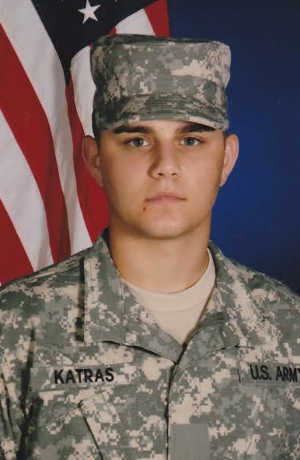
FORT SILL, Okla. – Jarret Katras of Clearlake Oaks, Calif., graduated from U.S. Army boot camp in Fort Sill on Oct. 3.
He is a 2014 graduate of Lower Lake High School.
Katras is now studying for an occupation in the medical field.
He is the son of Frank Katras and the grandson of Daniel and Josephine Katras.
- Details
- Written by: Editor
SACRAMENTO – The California Vietnam Memorial Name Committee has agreed to add the names of 31 California Veterans who died while serving our country in the Vietnam War.
The 31 names are scheduled to be added to the California Vietnam Veterans Memorial and then unveiled during a ceremony in Capitol Park on March 29, 2015.
“We are honored to formally recognize the service and sacrifice of our brave men in uniform,” said Peter Gravett, secretary, California Department of Veterans Affairs (CalVet). “Although our recognition is decades late, California’s salute is equally heartfelt and deserved for all of our fallen service members and their families.”
On Oct. 28, the committee took two actions.
First, it voted in favor of adding the names of 10 California veterans to the state memorial that were already etched into the Vietnam Veterans Memorial located in Washington, DC, yet not on the California memorial.
The following 10 veterans will be added to the state memorial in Sacramento:
– Johnny Owen Brooks;
– Donald Scott Carson;
– James Douglas Chappell;
– David McLean Desilets;
– John Edward Granville;
– Thomas Randolph McCormick;
– Richard Monroe Pruett;
– Robert Michael Swick;
– Richard John Tortorice;
– John Henry Van Wyk.
Second, the committee voted in favor of adding the names of 21 California sailors who died while aboard the USS Frank E. Evans when the ship sank during a training exercise in the South China Sea on June 3, 1969. The destroyer’s home port was Long Beach.
Approval to add the names of 21 sailors came after the committee heard testimony from families of the fallen Sailors and survivors.
The 21 sailors are:
– Andrew James Botto;
– Robert George Brandon;
– William Daniel Brown II;
– Christopher John Carlson;
– Danny Victor Clute;
– Joe Eddy Craig;
– Leon Larry Deal;
– Steven Frank Espinosa;
– William Donald Fields;
– Henry Kenneth Frye;
– Francis Joseph Garcia;
– Devere Ray Grissom Jr.;
– James William Kerr;
– Isaac Lyons Jr.;
– Andrew Martin Melendrez;
– Gregory Koichi Ogawa;
– Craig Allen Pennell;
– John Raymond Spray;
– Jon Kenneth Stever;
– Ronald Arthur Thibodeau;
– John Thomas Tolar.
All 31 names are set to be unveiled at a ceremony in Sacramento’s Capitol Park scheduled for Sunday, March 29, 2015, the day before Welcome Home Vietnam Veterans Day.
The committee, created when Gov. Brown signed AB 287 in 2013, is tasked with adding names of men and women killed during the Vietnam War.
The committee is also charged with reviewing the names of men and women whose deaths after returning from service in Vietnam were determined by the U.S. Department of Veterans Affairs to be service-connected.
Under the provisions of the law, written by Assemblymember Jim Frazier Jr., the committee must compile a list of names to be added to the memorial by Nov. 1 of each year.
The Committee members are CalVet Secretary Peter J. Gravett, chairman; representatives from the California State Commanders Veterans Council: Jerry Guevara, Vice chairman, and Jim Anderson; representatives from the California Chapter of Vietnam Veterans of America: Al Sickle, Mike Kennedy, and Lou Nuñes as alternate.
- Details
- Written by: Editor
SAN ANTONIO – Air Force Airman Stephan M. Ardell graduated from basic military training at Joint Base San Antonio-Lackland, San Antonio, Texas.
The airman completed an intensive, eight-week program that included training in military discipline and studies, Air Force core values, physical fitness, and basic warfare principles and skills. Airmen who complete basic training earn four credits toward an associate in applied science degree through the Community College of the Air Force.
Ardell earned distinction as an honor graduate.
He is the son of Paul Long of Willow Creek, Mont. and Kristin Ardell of Clearlake Oaks, Calif., and grandson of Charlotte Johnson-Langhoffer of Napa, Calif.
He is a 2013 graduate of Lower Lake High School, Lower Lake, Calif.
- Details
- Written by: Editor
WASHINGTON –The Department of Veterans Affairs (VA) announced that its national telehealth programs served more than 690,000 Veterans during fiscal year 2014.
That total represents approximately 12 percent of the overall veteran population enrolled for VA health care, and accounted for more than two million telehealth visits.
Of that number, approximately 55 percent were veterans living in rural areas with limited access to VA health care.
With more veterans seeking health care, telehealth is rapidly becoming an attractive option, especially for those veterans who don’t have a VA health care facility close to home.
“We have to adapt to meet veterans wherever their needs are,” said VA Secretary Robert A. McDonald. “A brick-and-mortar facility is not the only option for health care. We are exploring how we can more efficiently and effectively deliver health care services to better serve our veterans and improve their lives. Telehealth is one of those areas we have identified for growth.”
Currently, there are more than 44 clinical specialties offered to veterans through VA’s telehealth programs.
One program at the Miami VA schedules close to 90 clinic connections every week for dermatology, eye exams, the women veterans program, podiatry, mental health and other clinical specialties.
One tangible example of the success of VA’s telehealth program is its burgeoning teleaudiology program because of large population of veterans living with hearing loss. The teleaudiology program has grown from 1,016 veterans in fiscal year 2011 to more than 10,589 in fiscal year 2014.
For more information about VA’s telehealth program, visit www.telehealth.va.gov/ .
- Details
- Written by: Editor
WASHINGTON, DC – More than 1.3 million veterans received decisions on their Department of Veterans Affairs (VA) disability compensation and pension claims in fiscal year (FY) 2014 – the highest number in VA’s history, surpassing last year’s record-breaking production by more than 150,000 claims.
This second year of record-breaking production comes as VA continues to transform the way it provides benefits and services, to deliver faster and higher quality decisions, to veterans, their families and survivors.
At the end of the year, the disability claims backlog (defined as any disability claim pending longer than 125 days) was reduced by 60-percent from the peak backlog in March 2013 and is at its lowest number in nearly 4 years.
Veterans waited, on average, 119 fewer days for a decision on their claim than veterans did in FY 2013. VA is on target to hit its 2015 goal.
These improvements were not made at the expense of quality. The accuracy of VA’s decisions continues to rise from an 83-percent accuracy level in 2011 to a 90-percent accuracy level today. When focusing specifically at the medical issue level, accuracy is at 96 percent.
“I am so proud of our employees – more than half of whom are veterans themselves – who continue to work tirelessly to deliver the benefits our veterans have earned through their service to our nation,” said Under Secretary for Benefits Allison A. Hickey. “But we all also recognize there is still much more work to do to better serve veterans.”
VA’s move to a Web-based electronic claims processing system has enabled a quicker, more accurate and integrated benefits delivery.
VA once processed 5,000 tons of paper annually – today it processes 93 percent of veterans’ disability claims electronically.
One in seven veterans who submit a claim to change the status of a family member now does so online and more than half of those are paid in one to two days.
VA’s progress would not have been possible without the support of its strong partners.
Veterans service organizations (VSO) and state and county veterans service officers embraced the fully developed claim (FDC) program, which enables VA to make faster claim decisions when veterans submit their claims with all available evidence and certify they have no more evidence to submit. Now, 37 percent of the claims receives from VSOs are FDCs.
In FY 2014, more than 4.5 million veterans and survivors received more than $72.7 billion in VA compensation and pension benefits.
For more information on VA’s Transformation, benefits and programs visit: www.benefits.va.gov/ , www.ebenefits.va.gov and www.benefits.va.gov/fdc .
- Details
- Written by: Editor
The California Department of Veterans Affairs (CalVet) announced that its recently revamped Web site received a Digital Government Achievement Award from the Center for Digital Government.
The annual awards recognize outstanding city, county, state, federal, and international government Web sites and digital projects.
“Our new site is much more user-friendly and intuitive,” said Keith Boylan, CalVet deputy secretary Veterans Affairs. “Our myCalVet feature allows our veterans, veteran family members and veteran stakeholders to create a secure, personal profile. The next time the user logs onto our site, the information pushed to them is based on their profile and interests.”
Launched in March, 2014, the new Web site offers detailed information about federal and state benefits and location-specific local services available to veterans and their families, including eligibility requirements and how to apply.
The site enables CalVet to leverage technology as a more cost-effective means to reach the growing number of California veterans.
It also provides CalVet the opportunity to merge existing databases and provides a platform for information exchange with other federal and state agencies.
The myCalVet tool is one of many CalVet efforts to increase the number of California veterans and family members connected to the benefits they earned through their military service.
To view the full list of Digital Government Achievement Awards recipients, go to http://bit.ly/1qhvSd1 .
To visit the CalVet web site and create your own myCalVet profile, go to www.calvet.ca.gov .