 How to resolve AdBlock issue?
Regional
- Details
- Written by: California Department of Fish and Wildlife
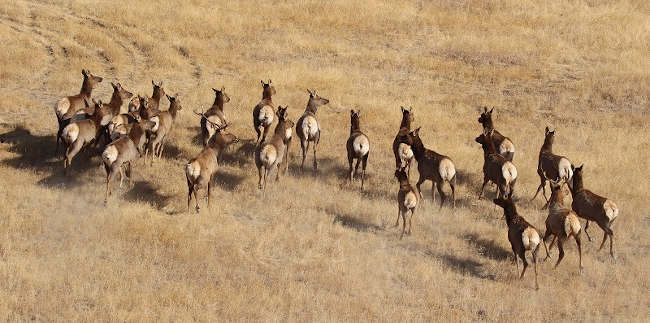
The California Department of Fish and Wildlife, or CDFW, is initiating annual helicopter surveys to inventory and monitor mule deer, elk, pronghorn antelope and bighorn sheep populations throughout the state.
Flights will be conducted in portions of Solano, Mendocino, Siskiyou, Modoc, Lassen, Inyo, Kern, Los Angeles, San Bernardino and Riverside counties during February and March.
CDFW utilizes a variety of survey methods to regularly monitor big game population size, distribution, demographics and trends over time. In more forested environments, CDFW employs the use of trail cameras and fecal DNA.
In more open habitats, aerial surveys provide an efficient and rapid method of data collection, affording CDFW biologists the ability to cover larger areas in relatively shorter time periods.
CDFW scientists use the survey data in statistical models to estimate the total population size of each species in different hunt zones or management units.
This information helps wildlife managers better understand population performance relative to a variety of factors including climate change, habitat quality, human-wildlife conflict and habitat fragmentation, among others.
Results are also used to make regulated harvest recommendations to the California Fish and Game Commission, which is the state regulatory authority that adopts tag quotas, hunting seasons and zone boundaries.
These efforts are important for managing California’s wildlife populations and are especially critical due to recent harsh winter conditions that may have had negative impacts on population numbers.
Big game hunters and other members of the public are encouraged to participate in the commission’s annual regulatory cycles. Information regarding upcoming meetings, including dates, locations, background documents and virtual meeting links are available at the California Fish and Game Commission website.
- Details
- Written by: California Department of Fish and Wildlife
The settlement, which was reached after a lengthy investigation, resolves violations by Joshua Sweet and his companies, The Hills LLC and Shadow Light Ranch LLC, that include: the owner’s destruction of wetland habitat and stream channels; conversion of oak woodland to grow cannabis; and failure to work with the State Water Resources Control Board, North Coast Regional Water Quality Control Board and CDFW to satisfy permitting requirements.
If Sweet completes restoration of the damaged property by 2026, $1 million of the penalty will be suspended.
This work includes the removal of three unauthorized reservoirs and the rehabilitation of stream channels and damaged wetlands.
“It is critical for all cannabis cultivators to be environmentally responsible and protect California’s water supply and water quality,” said Taro Murano, program manager for the State Water Board’s Division of Water Rights cannabis enforcement section. “Sweet chose to operate his business while ignoring regulations designed to protect the environment. He must now remediate the environmental damage he caused and pay a significant penalty. No one should get a business advantage by ignoring the law and harming the environment.”
“This case represents years of hard work by dedicated staff to remediate damage to streambed channels, wetland habitat and oak woodlands,” said Nathaniel Arnold, acting chief of law enforcement for CDFW. “The settlement also speaks volumes to the egregious nature of this case and should send a strong message to those working outside of state regulations to cultivate cannabis. Our natural resources deserve to be respected.”
According to the settlement, Sweet must pay $500,000 to the Division of Water Rights, $175,000 to the North Coast Water Board, and $75,000 to CDFW over five years. Additionally, he is required to obtain all the necessary permits, cease unauthorized water diversions and use of water, restrict future property development and comply with all applicable regulations.
More information on cannabis enforcement is available on the State Water Board and CDFW websites.
The State Water Board’s mission is to preserve, enhance and restore the quality of California’s water resources and drinking water for the protection of the environment, public health and all beneficial uses, and to ensure proper water allocation for present and future generations.
CDFW's mission is to manage California's diverse fish, wildlife, and plant resources, and the habitats upon which they depend, for their ecological values and their use and enjoyment by the public.
The North Coast region stretches from the Oregon border to Marin County and is characterized by remote wilderness and towering redwoods. The area accounts for 12% of the state’s land area and 35% of its freshwater runoff. Timber harvesting, agriculture, recreation and tourism are mainstays of the local economy.
- Details
- Written by: CALTRANS
The outdated welcome sign at the Oregon border is set to be replaced with a new monument, and Caltrans wants the community's feedback on its design.
As a component of Governor Gavin Newsom’s Clean California initiative, this project aligns with the broader mission of creating a welcoming atmosphere and enhancing public spaces throughout the Golden State.
To actively participate in shaping the visual identity of the new monument, community members are encouraged to complete a brief survey. The survey can be accessed here, and responses are requested through Sunday, January 28.
Caltrans values the public's insights and believes this collaborative effort will result in a monument that resonates with the community.
The installation of the new welcome monument is anticipated within the next year.
The Clean California initiative is a $1.2 billion, multiyear clean-up effort led by Caltrans to remove trash, create thousands of jobs, and engage communities to transform public spaces.
Visit CleanCA.com to learn more about how Clean California is transforming communities and educating the public.
- Details
- Written by: Lake County News reports
Dibean was living in a well-established makeshift metal structure in a homeless encampment at the dunes.
On Jan. 5, at about 4:52 p.m., the Humboldt County Sheriff’s Office Emergency Communications Center received a call regarding human remains in the area of the Manila Dunes homeless encampment. Humboldt County Sheriff’s deputies and a deputy coroner responded to the scene and recovered the remains.
An autopsy was conducted on Jan. 10 and the manner of death was determined to be a homicide.
This case is currently under investigation by the Sheriff’s Major Crimes Division.
The Humboldt County Sheriff’s Office extends our deepest sympathies to Pete Dibean’s family and friends during this difficult time.
This is an active investigation, and the Humboldt County Sheriff’s Office thanked those that have come forward with information relating to this case.
The agency encourages others that may have any information about this homicide to call the Humboldt County Sheriff’s Office at 707-445-7251 or the Sheriff’s Office Anonymous Crime Tip line at 707-268-2539.