 How to resolve AdBlock issue?
Regional
State lawmakers thank voters for rejecting measure to bypass law banning use of Native American slur
- Details
- Written by: Elizabeth Larson
The Fresno County Registrar of Voters reports Measure B failed on a 63.75% to 36.25% vote.
Ramos, who successfully authored AB 2022, the law banning use of the word said, “We are appreciative that Fresno County voters opposed efforts to circumvent a law that removes the ‘S word’ as a place name. As a state we stand opposed to a word that demeans women and Native Americans.”
He added, “This is a word that contributes to making Native American women appear less than others. That ignorance and bigotry is a factor in the epidemic of Missing and Murdered Indigenous People. I am happy to see that voters chose to close the door on this painful chapter of Native American history.”
Ramos, the first and only California Native American elected to the state legislature, is chairperson of the California Native American Legislative Caucus.
Arambula stated, “The people have spoken. Today’s results ensure that California’s first people are listened to and respected now and in the future.”
Caballero commented, “I sincerely want to thank Fresno County voters for rejecting a misguided effort to continue using the ‘S’ word. The ‘S’ word evolved in another century when violence and bigotry prevailed in the treatment of Native Americans. This word was used to demean and devalue Native American women and deserves to be banned and regarded as unacceptable expression of hate.”
- Details
- Written by: Elizabeth Larson
“Urban agriculture provides places for community gathering, skills-sharing, workforce development, agricultural literacy, and increased food security,” said CDFA Secretary Karen Ross. “This investment by Gov. Newsom and the Legislature brings a much-needed boost to local, innovative projects across the state dedicated to creating and enhancing local food production.”
Two types of grants have been awarded. Track 1 is the Systems Builder Community-Based Block Grant for community organizations, which will provide between $5,000 and $60,000 to urban agriculture projects in their regions.
Recipients of this grant include $783.933 to Agroecology Commons in the Bay Area to uplift and reduce barriers for marginalized farmers by providing farm seed grants, mentorship, and technical assistance.
Track 2 is the Urban Agriculture Practitioners Grant for direct funding to urban agriculture projects. The funded projects include infrastructure, workforce development, community engagement, community gardens and more. Track 2 grant awards include:
• $300,000 for Black Thumb Farm in Los Angeles County to provide an enriching after-school experience for BIPOC youth to learn sustainable farming approaches to improve food equity through mentorship, leadership training, and hands-on training workshops.
• $246,689 for the Dry Creek Rancheria Band of Pomo Indians in Sonoma County to increase indigenous food sovereignty through the creation of cultural demonstration areas, hosting gatherings to educate on traditional food production/harvesting methods, providing access to fresh fruits and vegetables, highlighting traditional food pathways, and restoring landscapes to include edible native vegetation.
All funded urban agriculture projects are either led by or serve priority populations as defined by the California Climate Investments Priority Population mapping tool.
This means 100 percent of the funding will serve communities that are especially vulnerable to the impacts of climate change, and include disadvantaged communities, low-income communities, and low-income households.
More than $68 million was requested during the application period, highlighting the interest and need for urban agriculture across California.
- Details
- Written by: Caltrans
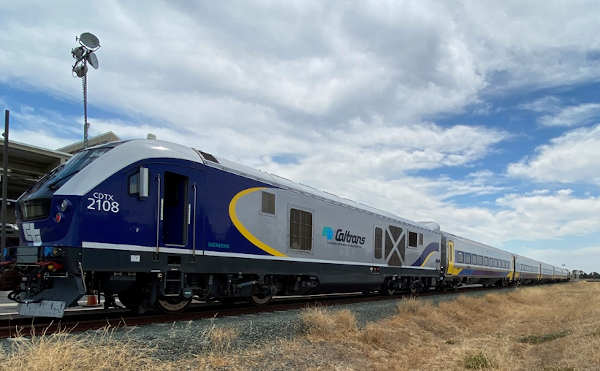
Train passengers traveling in Northern California and the Central Valley will be able to enjoy a more comfortable and modern ride with the launch of new Venture Passenger Rail Car trains unveiled during a Caltrans and San Joaquin Regional Rail Commission event today at the Stockton Regional Maintenance Facility.
The single-story, fully ADA-accessible passenger cars provide wider aisles, accessible restrooms and fully-automated doors, continuing California’s expansion of comfortable and convenient options for travelers and commuters.
“Our goal is to make traveling throughout our beautiful state by train as accessible, convenient and comfortable as possible, and these new train cars have us on the right track,” said California Transportation Secretary Toks Omishakin. “I thank the Federal Railroad Administration, San Joaquin Joint Powers Authority, San Joaquin Regional Rail Commission, Siemens, Sumitomo Corporation of Americas, and our many other partners who have worked tirelessly over the years to help improve passenger train travel for all Californians.”
“These trains are a giant leap forward in passenger experience,” said Caltrans Director Tony Tavares. “In addition, they have been built in California, providing economic prosperity to our region. They show our commitment to combating climate change and improving the multimodal transportation network for all Californians.”
“For decades, the San Joaquins has been a backbone of our regional transportation network,” said Pat Hume, Sacramento County Supervisor (D5) and Chair of the San Joaquin Joint Powers Authority Board of Directors. “We are committed to providing our riders with the highest quality service, equipment, and amenities. These new Venture Rail Cars move us forward into the next era of rider experience, comfort, and reliability. We are also pleased to have sourced the Venture Cars from Siemens, who manufactured these cars in Sacramento, one of our corridor cities. Local manufacturing not only contributes to the character of our service, but also to the local economy.”
The trains will be used on the Amtrak San Joaquins line, which runs five daily roundtrips between Oakland and Bakersfield, and two daily roundtrips between Sacramento and Bakersfield. The first six-car set is in operation on the Oakland-Bakersfield route and helps restore service to pre-pandemic levels and sets the course for future service improvements. These new rail cars are the first upgrade to the passenger riding experience on the Amtrak San Joaquins line in nearly three decades. They allow wheelchair users to move easily between cars.
Siemens Mobility, under contract to Sumitomo Corporation of Americas, built the rail cars at their facility in Sacramento, with finish work performed at the in Stockton Regional Maintenance Facility, owned by the San Joaquin Regional Rail Commission. Caltrans purchased the new rail cars with a $132 million in federal and state funds.
All seven trainsets are expected to be in operation on the San Joaquins line by the end of 2025. The San Joaquin Joint Powers Authority manages the Amtrak San Joaquins service.
- Details
- Written by: U.S. Environmental Protection Agency
The NPL is a list of known sites throughout the United States and its territories where historic releases of hazardous substances, pollutants or contaminants pose significant threats to human health and the environment.
Afterthought Mine operated from 1862 to 1952, producing copper, zinc, lead, silver, and gold. Historic mine features and structures remain onsite, and these mining efforts contaminated the site’s soil and nearby waterways. Contaminated soil and sediment are in direct contact with Little Cow and Afterthought creeks.
Little Cow Creek is used for fishing and provides wetland habitat including critical habitat for steelhead trout. EPA will evaluate these areas to better understand the contamination, and if and how the Agency can clean it up.
“The proposal of Afterthought Mine to the National Priorities List is a vital step in EPA’s work to assess contamination in the area and how best to address it,” said EPA Pacific Southwest Regional Administrator Martha Guzman. “Cleaning up contaminated land and water and returning them for productive use to communities, especially those which have borne the brunt of legacy pollution, is a win for public health and local economies.”
EPA is accepting comments on the proposal to add the Afterthought Mine to the Superfund NPL from March 7 until May 6, 2024. The public can submit comments online or by mail:
Online (preferred): Visit www.regulations.gov and search “Afterthought Mine” or “EPA-HQ-OLEM-2024-0066”
Mail: Send comments to:
U.S. Environmental Protection Agency, EPA Docket Center Superfund, [EPA-HQ-OLEM-2024-0066], Mail Code 28221T, 1200 Pennsylvania Avenue, NW, Washington, DC 20460
The National Priorities List includes sites with the nation’s most serious uncontrolled or abandoned releases of contamination. This list serves as the basis for prioritizing EPA Superfund cleanup funding and enforcement actions. Only releases at non-federal sites included on the National Priorities List are eligible to receive federal funding for long-term, permanent cleanup.
Before EPA adds a site to the National Priorities List, a site must meet EPA’s requirements and be proposed for addition to the list in the Federal Register, subject to a 60-day public comment period. EPA may add the site to the National Priorities List if it continues to meet the listing requirements after the public comment period closes and the agency has responded to any comments.
Superfund cleanups provide health and economic benefits to communities. The program is credited for significant reductions in both birth defects and blood-lead levels among children living near sites, and research has shown residential property values increase up to 24 percent within three miles of sites after cleanup.
Since taking office, the Biden-Harris Administration has followed through on commitments to update the National Priorities List twice a year, as opposed to once per year. Today’s announcement is the first time EPA is updating the National Priorities List in 2024.
Learn more about Superfund and the National Priorities List.
For Federal Register notices and supporting documents for the National Priorities List and proposed sites, please visit New Proposed and New Superfund National Priorities List Sites.