 How to resolve AdBlock issue?
Recreation
- Details
- Written by: Editor
NORTHERN CALIFORNIA – Tuleyome is happy to announce that it recently hired Nathan “Nate” Lillige as its new Home Place Adventures Activities Leader.
Lillige's entire professional career has been spent working with children and young adults in various aspects of outdoor education and conservation.
In addition to his work as a camp counselor and outdoor educator, he was the recycling program manager for the Sacramento Regional Conservation Corps. At the Corps, he worked with young adults on conservation efforts throughout the region.
“It is an exciting time to be joining Tuleyome,” Lillige said. “I am looking forward to joining others on the new trails of the Berryessa Snow Mountain National Monument. It's a treat to be a short drive from this wonderful natural area.”
Lillige grew up outside of Milwaukee, Wisc., and spent 12 summers as a camper and counselor at a summer camp surrounded by the Sleeping Bear Dunes National Lakeshore on Lake Michigan.
He received his Bachelor's of Science in natural science from the University of Wisconsin-Stevens Point, where he studied everything from the Point Reyes conglomerate to chemistry to glacial geomorphology.
His adventuring has taken him to Pictured Rocks National Lakeshore, rafting down the Yukon River, mountain biking in Denali National Park and exploring the Grand Canyon, Yellowstone and Yosemite.
When he is not working, Lillige enjoys photography, playing soccer, and spending his time with his wife and their two young children.
With Tuleyome, Lillige is returning to his first passion: getting people out in nature, where they can explore, learn and grow.
“Nature is an incredible classroom,” Lillige said. “It's one thing to look at pictures or videos of plants and animals, however seeing them with your own eyes and seeing how they interact with one another provides a unique learning experience.”
He will be sharing his love and enthusiasm for nature with the general public through Tuleyome’s upcoming events which include:
· Saturday, March 12: Tour the Silver Spur Ranch with Andrew Fulks.
· Saturday, March 19: The Berryessa Snow Mountain National Monument dedication celebration.
· Saturday, March 26: Trail building with Eric “Bam Bam” Barnett.
· Thursday, April 7: Lecture, the best trails and floats in the Berryessa Snow Mountain National Monument with Andrew Fulks.
· Saturday, April 9: Wildflower auto-tour with Glen Holstein.
· Saturday, April 16: Picnic day restoration work at Stebbins Cold Canyon.
For more details about each event, see Tuleyome’s Meet Up site at http://www.meetup.com/Tuleyome-Home-Place-Adventures/ .
Tuleyome is 501(c)(3) nonprofit conservation organization based in Woodland, Calif.
For more information about Tuleyome and the Home Place Adventures program, visit www.tuleyome.org .
- Details
- Written by: Editor
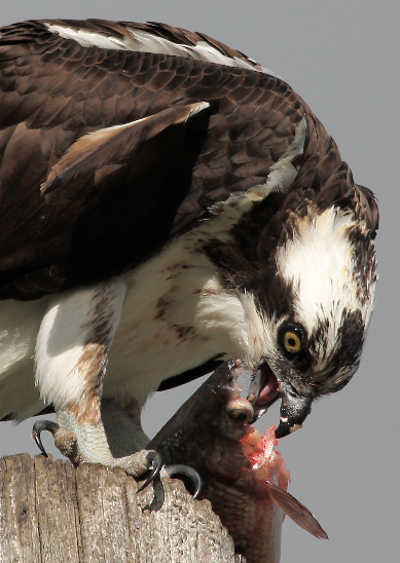
KELSEYVILLE, Calif. – Come to Clear Lake State Park and learn about the life of one of Lake County’s signature birds, the osprey.
Join Clear Lake State Park Docent Brad Barnwell as he gives a presentation on the osprey’s migration, breeding, special adaptations for fishing, general identification and history in the state park.
After the presentation Barnwell will lead a short bird walk.
The presentation will start at 9 a.m. Saturday, Feb. 27, in the Education Pavilion across the road from the visitor center.
The winter weather could be brisk and participants should dress appropriately and wear sturdy shoes and bring water and binoculars. Rain will cancel the walk.
Clear Lake State Park is located at 5300 Soda Bay Road, Kelseyville, and entry into the park is free for those attending the presentation.
Anyone having special needs should contact Clear Lake State Park Sector Office Tuesday through Thursday between 8 a.m. and 5 p.m. at 707-279-2267.
For further information on California State Parks go to www.parks.ca.gov .
- Details
- Written by: Editor
MENDOCINO NATIONAL FOREST, Calif. – Mendocino National Forest officials have determined that, due to advanced decay in branches and trunks as well as recent failures and near misses, select sycamore trees are currently being removed in order to maintain public safety at the Red Bluff Recreation Area.
These trees are located in a very high use recreation area and pose a risk to the public that use the facilities.
“Public safety is our primary concern in this popular recreation area,” said Grindstone District Ranger Eduardo Olmedo. “Given the current condition of these trees, removal is the best way for us to protect our visitors from the potential hazards.”
Forest personnel have witnessed large branches falling from trees in the Sycamore Grove day use area.
A plant pathologist was asked to examine the trees multiple times and after a detailed inspection in 2015, it was determined that the trees pose a very high risk to public safety and should be removed as soon as possible.
Tree removal has already begun on site and is planned to continue through March, depending on weather.
The forest is in the process of locating replacement trees and once identified they will be planted as soon as weather permits.
If you have questions or comments, please contact the Grindstone Ranger District at 530-934-3316.
- Details
- Written by: Carrie Wilson
Interfering with fishing/hunting vs. hazing from private property
Question: My girlfriend and I were recently surf fishing on a local beach when some other “fishermen” showed up demanding we leave as it was their fishing spot. Things escalated quickly when one of the anglers cast his line over mine and intentionally cut it.
From there the situation degraded with the other party making threats of death and bodily harm. All this over a barred perch fishing spot! The police got involved and the instigator ended up going to jail charged with a felony (for the threats).
I understand there are state laws that forbid individuals or groups from intentionally interfering with the legal hunting efforts of others.
I believe these regulations were primarily created in response to anti-hunting groups trying to both intimidate legitimate hunters and scare away game from being accessible. Do these same laws apply to legal fishing?
Are the above-mentioned laws Fish and Game codes or some other California state statute, and are violations of these laws misdemeanors or felonies? I’d like to know if my legal fishing efforts were interfered with and whether I should ask the City Attorney to add any additional charges. (Dan F., Venice, CA)
Answer: You are correct in your understanding of laws regarding interfering with hunting, and these same laws protect any individual engaged in shooting, hunting, fishing, falconry, hunting dog field trials, hunting dog training or trapping where the activity is taking place … even for surf perch!
According to California Department of Fish and Wildlife (CDFW) Lt. Todd Tognazzini, Fish and Game Code, section 2009, is the law you are referring to and it is punishable as an infraction, but escalates to a misdemeanor for a second conviction in a two year period.
The law is a little different than most Fish and Game Code sections in that the wildlife officer has to establish that the offender has specific intent to interfere with the activities listed.
In addition, “interfere with” is defined in the law as any action which physically impedes, hinders or obstructs the lawful pursuit of these activities, including but not limited to:
1. Actions taken for the purpose of frightening away animals from the location where the lawful activity is taking place,
2. Placing or maintaining signs, gates, locks or barricades that prohibit or deny access to lands without authorization from the landowner or lessee or an authorized designee of the landowner or lessee,
3. Placing food on lands not belonging to the person for purposes of eliminating the lawful ability to hunt due to the presence of bait.
Wildlife came with the property, so leave them alone
Question: My neighbor has lake front property and regularly chases away (or throws sticks and pine cones at) Canada geese during the nesting season.
His intent is to keep them off his dock, but he extends his harassment about one-tenth of a mile up the beach on several others’ private ground and PG&E property. Is this legal? I figure the wildlife came with the property location and should be left alone.
Love my neighbor but hate his treatment of our local geese. (Anonymous)
Answer: Your neighbor is within his rights to haze geese from his property. Canada geese are state and federally protected under laws and regulations within the Migratory Bird Treaty Act and California Fish and Game Code.
However, within those regulations, non-lethal hazing methods, such as harassment as done by this individual, are allowed to deter Canada geese from privately-owned property where property damage or a nuisance may occur to the landowner.
Resident Canada goose populations have increased considerably since the 1990s in California. In this time, Canada geese have expanded outside their historical nesting range.
Due to this increase, conflicts between landowners and resident Canada geese have expanded in many counties in California.
Your neighbor is allowed to scare resident geese away from his property with non-lethal means at any time. CDFW advocates that landowners take proactive non-lethal measures to reduce Canada goose use on impacted private property.
Possible suggestions for hazing geese away from properties during the breeding season include landscape modification to make the area less attractive to resident geese (e.g. keep grass short to discourage feeding), use of dogs, visual deterrents, such as scarecrows, predator decoys, mylar flagging and balloons, and fencing.
Additionally, waterfowl hunting can be an effective deterrent in problem areas outside the breeding season when state and local regulations allow this activity.
For additional questions regarding how private landowners can best control problem Canada geese, please contact CDFW’s Waterfowl Program staff at 916-445-0411.
Carrie Wilson is a marine environmental scientist with the California Department of Fish and Wildlife. While she cannot personally answer everyone’s questions, she will select a few to answer each week in this column. Please contact her at