 How to resolve AdBlock issue?
Recreation
- Details
- Written by: Elizabeth Larson
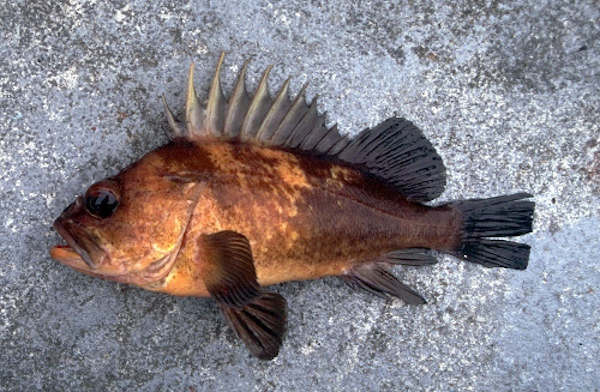
The California Department of Fish and Wildlife announced that as of 12:01 a.m. Monday, Aug. 21, the 50 fathom Rockfish Conservation Area, or RCA, boundary line for the Northern Groundfish Management Area, from the California/Oregon state line to Cape Mendocino, will take effect.
This will be the first “offshore only” fishery in the Northern Groundfish Management Area, or GMA.
In the Northern GMA, recreational boat-based groundfish fishing will only be allowed seaward (away from land) of the boundary line.
The 50-fathom RCA boundary line is defined by straight lines connecting a set of waypoints as adopted in federal regulations (50 CFR Part 660, Subpart G).
With the exception of sablefish and flatfish as described below, only shelf rockfish, slope rockfish and lingcod may be taken or possessed. It shall be unlawful to take or possess nearshore species (shallow and deeper nearshore rockfish, cabezon and greenlings) in the Northern GMA.
Fishing for and retention of sablefish and flatfish are not affected by this action and may be targeted, taken and possessed year-round in all depths.
However, no gear may be deployed shoreward of the 50-fathom RCA boundary line when shelf rockfish, slope rockfish or lingcod are possessed onboard the vessel.
Vessels may transit shoreward of the 50-fathom RCA boundary line with shelf rockfish, slope rockfish or lingcod in possession if no gear is deployed.
Additionally, vessels fishing in the adjacent Mendocino GMA and transiting back to the Northern GMA must adhere to the “offshore only” provisions effective in the Northern GMA and may not return with nearshore species aboard. Changes in retention allowances described here for boat-based modes do not apply to shore-based anglers or divers.
CDFW is carefully monitoring the harvest of quillback rockfish from both the recreational and commercial fisheries throughout the state.
The quillback rockfish harvest limit specified in federal regulation for 2023 has been exceeded in the Northern GMA, and additional in-season action authorized by Title 14, Section 27.20 (e) to adjust the fishing depth is necessary to prevent further overage.
CDFW took in-season action on Aug. 7 to prohibit retention of quillback rockfish, the first in what is likely to be a series of steps to reduce the total impacts to quillback rockfish.
CDFW anticipates that additional action(s) may be needed for this and other GMAs in the remainder of 2023 and in 2024, in response to the most recent quillback rockfish stock assessment indicating the population is in severe decline.
CDFW urges anglers to use best fishing practices to reduce impacts to quillback rockfish and other prohibited groundfish species. These include reducing mortality when releasing fish by utilizing a descending device and relocating to different fishing grounds or switching targets if quillback rockfish or other prohibited species are encountered.
CDFW recommends reviewing the Summary of Recreational Groundfish Fishing Regulations page before each trip to ensure anglers are up to date on the most recent groundfish regulations.
For information on groundfish visit CDFW’s Marine Region Groundfish page.
Pursuant to California Code of Regulations Title 14, section 27.20(e), when federal harvest limits are exceeded or projected to be exceeded, CDFW has authority to make in-season changes, including adjustments to bag and sub-bag limits, seasons and depths.
- Details
- Written by: Mendocino National Forest
Some facilities will remain under a temporary closure order until the hazards can be safely mitigated, according to Forest Order 08-23-05.
Recreation sites that are now opened include West Crockett Campground and Trailhead, Sugar Spring Campground, Smokehouse Ridge Trailhead and Soldier Ridge Trailhead.
Recreation sites that will remain closed are Cedar Camp Campground, Copper Butte Trailhead, Hammerhorn Campground, Lower Nye Campground and Plaskett Meadows Campground.
“The number of facilities closed is greatly reduced from our previous closure, and we are actively working on getting these available for public use,” said Grindstone District Ranger Loren Everest.
The Forest Service has crews and contractors working to address the large number of hazard trees still remaining in the closed recreation areas.
The public should be cautious around heavy equipment, which will be moving into project areas soon, particularly along Forest Highway 7 and near the Plaskett Keller and Hammerhorn Campgrounds.
Current information on campgrounds and trailheads can be found on the forest website at http://www.fs.usda.gov/goto/mendocino/rec.
Track chair now available at Prairie Creek Redwoods State Park for visitors with mobility challenges
- Details
- Written by: Elizabeth Larson
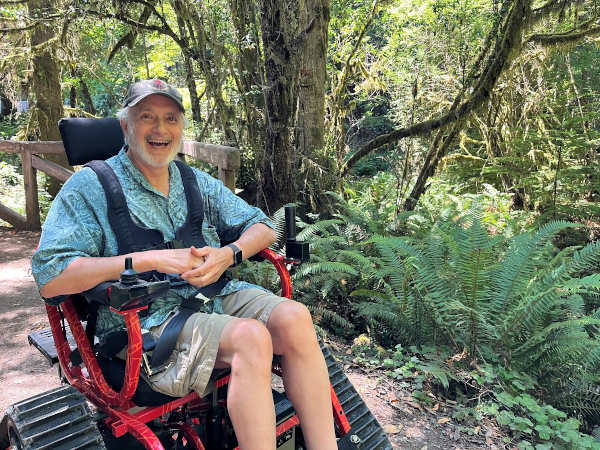
CRESCENT CITY, Calif. — Redwood National and State Parks and Redwood Parks Conservancy are excited to announce the arrival of a new Actiontrack electric all-terrain track chair to assist visitors with mobility challenges in exploring the trails and grandeur of the old growth redwood forests of Prairie Creek Redwoods State Park.
This new chair has been made possible thanks to a partnership with David’s Chair Outdoor Mobility Systems (David’s Chair) a 501 (C)3 nonprofit organization whose mission is “to enrich the lives of mobility impaired people with independence and freedom by empowering them to engage in outdoor activities they previously were unable to, free of charge.”
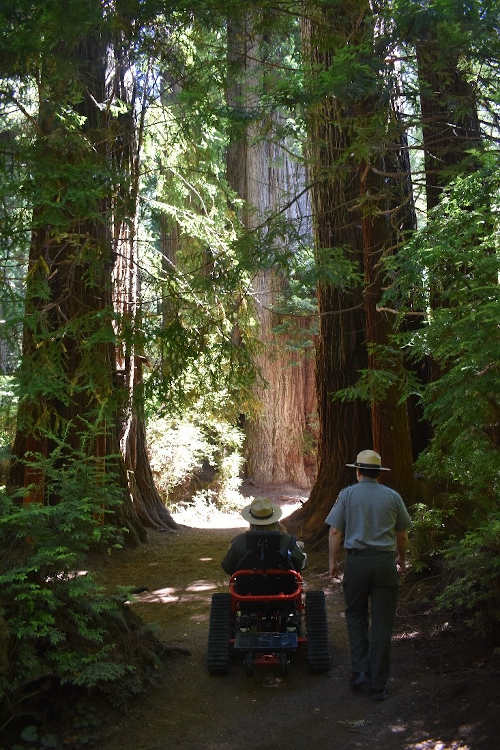
This track chair can be used on designated trails within the park. The new track chair at Prairie Creek Redwoods State Park will allow visitors to explore areas of the park in new ways, often on trails that are not suitable for regular wheelchairs.
Steve Mietz, Redwood National and State Parks superintendent, remarked that “by providing a track chair to be used for free by visitors, we are working to ensure that the incredible recreational experiences found within the park can be enjoyed by everyone, removing barriers to allow everyone to experience the majesty and solitude of the redwood forest independently.”
The track chair is available at Prairie Creek Visitor Center free of charge. The chair is reservable online for three-hour blocks, starting from 9 a.m. to noon and again from 1 to 4 p.m. To reserve a chair, visit https://www.redwoodparksconservancy.org/permits/davids-chair.
The track chair based out of Prairie Creek Visitor Center is the first location in California where David’s Chair has a permanent location for one of its chairs.
Resident David Hartrick was diagnosed with Amyotrophic Lateral Sclerosis, or ALS.
An avid hunter and fisherman, Hartrick immediately began searching for a way to enjoy the outdoors in the confines of a wheelchair.
With the help of CEO Steve Furst, the pair discovered Action Trackchairs and raised enough money to buy one. Hartrick recognized he wouldn’t be able to use it for long and dreamed of others benefiting from the chair as well; shortly after, the nonprofit David’s Chair was born.
Hartrick passed away on Jan. 11, 2018, just 11 months after his ALS diagnosis. However, David’s Chair continues to give the gift of independence and freedom to people with ALS and other mobility challenges.
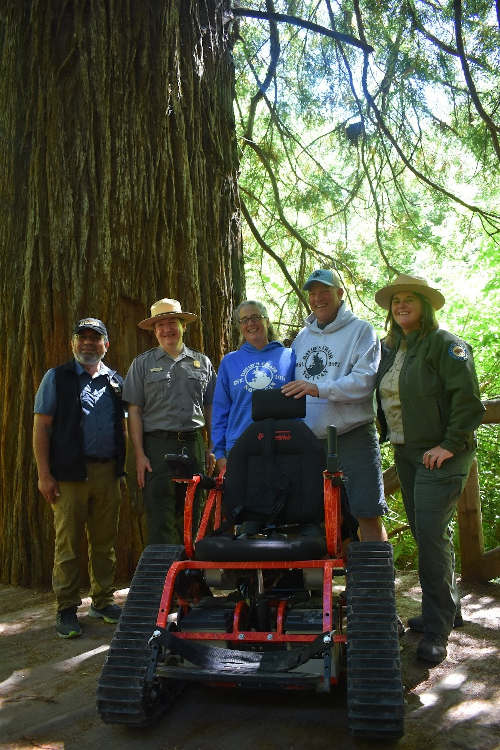
CEO and Founder Steve Furst said, “We are proud to place one of our track chairs at Prairie Creek to ensure that visitors with mobility challenges can enjoy the beauty of the Redwoods.” We could not have found a better location for our first track chair in California. Working with the many people and organizations to make this happen has been amazing and we hope to add more locations in the future.”
The track chair arrived at Prairie Creek last Monday, and within less than an hour after its arrival, David Echt visiting from San Rafeal, California, was the first visitor to take the chair out to explore the redwoods.
“I was once an avid hiker and have backpacked throughout the Sierra Nevada mountains before being diagnosed with multiple sclerosis (MS) at 35 years old,” he said. “I have lived with MS for half my life. This chair gave me freedom I haven’t had for many years.”
The partnership with David’s Chair would not have been possible without the direct support of Redwood Parks Conservancy, or RPC, the official nonprofit support organization of Redwood National and State Parks.
Sal Munoz, acting executive director of RPC commented that with the establishment of this new partnership, “RPC is proud to work directly with David’s Chair and alongside its partners to help make this key equity and inclusion initiative a reality.”
By establishing this partnership with David’s Chair and creating more opportunities for all visitors to experience Prairie Creek Redwoods State Park, both RNSP and the North Coast Redwoods District of California State Parks continue to work with David’s Chair on growing their reach into new parks both in this area, and across California.
“It is our hope that this first track chair at Prairie Creek serves as an example of a creative solution to removing barriers to parks that prevent equitable access and inclusion” said Erin Gates, interpretation and education program manager for California State Parks North Coast Redwoods District. “By using the power of partnerships with organizations like David’s Chair, state and national parks across the country can work towards ensuring that parks are places for everyone.”
- Details
- Written by: CALIFORNIA DEPARTMENT OF FISH AND WILDLIFE
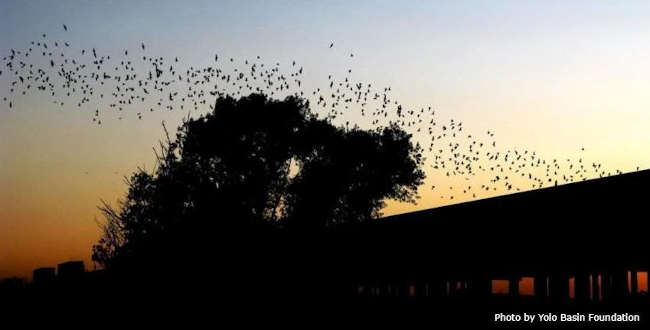
Why do bats live under the I-80 Yolo Causeway near Davis?
Q: Why do bats live under the I-80 Yolo Causeway near Davis instead of a more natural setting?
A: It is pretty amazing that around 250,000 Mexican free-tailed bats choose the Yolo Causeway as their home. There are several reasons why they do so, says Yolo Basin Foundation Program Coordinator Corky Quirk. First, Mexican free-tailed bats like heat and temperatures under the Yolo Causeway are warm and stable. The asphalt and causeway deck provide additional warmth. Second, the bats can keep relatively safe from predators by nestling in the causeway's expansion joints and crevices. However, the causeway isn’t totally protected. Predators sometimes hang out under the causeway to prey on fallen bats, especially during birthing and juveniles’ first flights. Peregrine falcons may also show up to hunt bats in the air. Third, bats choose the Yolo Causeway as their home because of its proximity to food. There are foraging opportunities nearby and the adjacent wetlands and rice fields are a good source for insects. The causeway is also just a short bat flight away from farm fields and orchards in Yolo and Sacramento counties.
Habitat loss may also be a factor as urbanization has reduced natural roosting locations such as hollow trees. In fact, the Yolo Causeway may have attracted bats from other areas by providing a safe, warm roosting place.
For more information on the Yolo Causeway bats visit the Yolo Basin Foundation’s website.
Crab casting
Q: Can I crab using a rod and reel with a trap attached to my line?
A: No. This style of trap, commonly known as a crabhawk or crabjaw trap, is sold in many places and our wildlife officers have encountered anglers using them. However, they are not legal in California because they are not listed as a method of take for saltwater crustaceans. California Code of Regulations, Title 14, section 29.80 lists approved methods of take for crabs which include taking by hand, crab loop traps (snares), hoop nets and traps.
Airbow hunting
Q: Can I hunt in California using an air gun that shoots arrows via pressure?
A: No. The device you’re referring to is often called an airbow, which is essentially an air gun that shoots arrows. An airbow is not considered a firearm and does not fall under the definition of a bow or crossbow outlined in California Code of Regulations (CCR), Title 14, section 354. Game mammals and birds may only be taken in California by methods listed in CCR, Title 14, sections 311, 507 and 353. Because an airbow does not fall under any of these sections, it may not be used to take game animals in California.
Lobster claws
Q: Is it true that California lobsters don’t have claws?
A: Yes, it’s true. The California spiny lobster is a species of lobster that does not have claws. In fact, there are far fewer clawed lobsters than spiny lobsters, says CDFW Environmental Scientist Jenny Hofmeister. Out of all the lobster fisheries in the world, there are only a few that target clawed lobsters. Most lobsters are spiny like the species that live in California. However, as the name suggests, California spiny lobsters are covered in spines. This feature presents its own unique challenge for scientists who work with the species. Scientists don’t have to worry about claws when handling lobsters for conservation purposes, but they do have to watch out for their spines!
California’s spiny lobsters are a rocky reef kelp forest species found mostly off the coast of Southern California in shallow waters to a depth of about 300 feet. For more information watch CDFW’s Introduction to Lobstering video or visit the department’s recreational lobster fishing web page.