 How to resolve AdBlock issue?
Recreation
CDFW accepting applications for special draw deer hunt on the Knoxville Wildlife Area in Napa County
- Details
- Written by: California Department of Fish and Wildlife
The 21,000-acre Knoxville Wildlife Area is located approximately 1.5 miles north of Lake Berryessa.
This special lottery draw deer hunt was created to limit the number of hunters on the wildlife area during opening week and to improve the hunting experience.
“This will be the second year of our special draw for the opening week of deer season. We essentially close the wildlife area to other uses and allow drawn hunters to have the whole area to themselves,” said Stacy Martinelli, wildlife biologist for Napa and Sonoma counties.
Only 120 hunt permits will be issued for the special lottery draw. The hunt permit is valid for the single hunt period, Aug. 8 to 14, 2020. The Knoxville Wildlife Area will be closed to all other users during the hunt period.
For more information and to apply for the lottery draw, visit here.
Applications are being accepted until June 20, 2020.
Successful applicants will be selected through a random computerized draw and will be notified by email four to six weeks before the hunt period. Up to four hunters may apply as one party by including all required information in the online application.
Multiple applications from any hunter will result in disqualification from the drawing. Substitutions of hunt party members will not be permitted.
Hunters must possess a valid 2020-21 California hunting license prior to applying for the lottery draw.
Deer hunt preference points will not be considered for this lottery draw, nor will preference points be affected if drawn for this special hunt.
- Details
- Written by: California Department of Fish and Wildlife
Beginning May 15, trout season will be open in the county.
The trout season was originally scheduled to open in Alpine County on April 25.
In April, CDFW had discussions with county leadership regarding trout fishing, which typically draws a high tourism influx to the area.
Local officials were concerned about the transmission of COVID-19 and its potential to put a strain on their healthcare systems. Further, all nonessential businesses including lodging, dining and camping options were closed in compliance with state and local public health officers' orders.
Thus, CDFW, in consultation with Fish and Game Commission President Eric Sklar, delayed the opener through May 31.
However, in a letter last week, Alpine County officials requested that CDFW shorten the delay from May 31 to May 15, indicating that the county was doing a soft opening of restaurants and other facilities and wished for the delay to lift sooner.
This decision does not affect the trout season in any other county.
CDFW reminds anglers to abide by all state and local health guidelines regarding non-essential travel and physical distancing. Staying home in order to stay healthy is still the best way to keep yourself and others safe. Anglers are also advised to check with local authorities on the status of access points as many site closures and access restrictions exist and may change daily.
Pursuant to the emergency regulation approved by the Commission, CDFW will provide accurate information for the angling public at this website or by phone at 916-445-7600.
- Details
- Written by: California Department of Fish and Wildlife
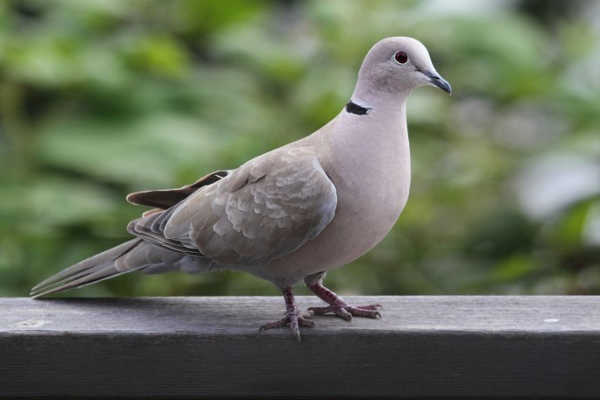
Hunting Eurasian collared-doves
Question: Do I need a hunting license and tags to take Eurasian collared-doves? (Charlotte)
Answer: To hunt Eurasian collared-doves, you need a license and an upland game bird validation (formerly known as a "stamp"). You don't need tags. Hunting season for most species of dove is Sept. 1 through Dec. 23. But you can hunt Eurasian collared-doves year-round, and there's no bag limit.
Why is there no bag limit? California Department of Fish and Wildlife Migratory Upland Game Bird Biologist Megan Crane explains that the Eurasian collared-dove is one of the most successful terrestrial invasive species on the planet.
Originally native to India and surrounding areas, the Eurasian-collared dove spread rapidly across Europe and Northwest Africa in the 1900s. In the 1970s, they were accidentally released in the Bahamas. They then dispersed to Florida and have been making their way across the continent ever since.
Expansion of the Eurasian collared-dove follows human development. They are very well adapted to human-dominated landscapes and thrive in agricultural areas. Because they are an invasive species, the greatest concern rests in their potential to outcompete native species and spread disease.
While there's not a ton of evidence that they're outcompeting native species in California, Eurasian collared-doves are known vectors of avian trichomoniasis, a virulent pathogen that can wipe out vast numbers of our native band-tailed pigeon and mourning dove. As you can see, Eurasian collared-doves can be a bit problematic - which is why there's no limit on taking them. Happy hunting, and we hope you bag a few!
Age change for junior hunting license
Question: How do you explain taking hunting opportunities away from 16- and 17-year-olds with the new age limitations on Junior Hunting Licenses to those 15 and younger? I was looking forward to enjoying two more years of youth hunting opportunities with my son. Now that's not possible. (Marcus)
Answer: Answer: The law allowing youths up to 18 years old to purchase a Junior Hunting License has changed. Per Fish and Game Code, section 3031, a California resident or nonresident now must be under 16 years of age on July 1, 2020, in order to be eligible for a 2020-21 Junior Hunting License. If your child turns 16 on or before July 1, he or she is not eligible to buy the junior hunting license, even if they would be purchasing it before July 1.
We understand your frustration with the age change. Not only are Junior Hunting Licenses available at a significantly reduced price – $13.53 compared to $51.02 for an adult Resident Hunting License – but the Junior Hunting License qualifies kids for many special youth hunting opportunities for big game, upland game birds and waterfowl throughout the year.
These high-quality hunts are sponsored by CDFW, the U.S. Fish and Wildlife Service and several nonprofit wildlife conservation groups.
The change to the Junior Hunting License age occurred in the State Legislature - not with CDFW or the California Fish and Game Commission. In 2014, state legislation was signed into law that increased the Junior Hunting License age eligibility from youths under 16 to those under 18, granting kids and their families two extra years of discounted licenses and opportunities for special youth hunts.
That legislation, however, included a five-year sunset provision that expired with the 2019-20 license year. Efforts to extend the Junior Hunting License age failed in the Legislature last year and eligibility reverted back to those under 16 for the 2020-21 hunting seasons.
Legislation has been introduced once again to increase the eligibility age for a Junior Hunting License back to those under 18. We are hopeful the issue will be addressed particularly in light of our well-received efforts to recruit, retain and reactivate (R3) hunters and anglers of all ages in California.
Redeeming a fishing license gift voucher
Question: I received a CDFW gift voucher for a Resident Sport Fishing License. How do I go about redeeming that to get my actual fishing license? (Luis)
Answer: Congratulations! California sport fishing licenses make terrific gifts. As you noted, a gift voucher is not a valid license and must be redeemed for a sport fishing license before fishing. There are a few ways to do this.
If you have access to a printer, you can redeem your voucher online at CDFW's website. After entering your voucher information, you will receive a temporary fishing license to print out and use immediately until your actual license arrives in the mail.
Ordinarily, you can also redeem your voucher at authorized retail license agents statewide or at one of CDFW's license sales offices. It's best to check ahead before heading out. CDFW has closed its license sales offices to help slow the spread of COVID-19 (coronavirus), and some retail license agents similarly have closed or reduced their hours of operation.
If you have a question for the California Department of Fish and Wildlife, email
- Details
- Written by: California Department of Fish and Wildlife
Federal regulations for Pacific halibut were published in 85 Federal Register 25317 on May 1, 2020, and were effective April 30, 2020, and ocean salmon regulations were published in 85 Federal Register 27317 on May 8, 2020, and were effective as of that date.
Pursuant to California Code of Regulations Title 14, section 1.95, ocean salmon and Pacific halibut sport fishing regulations in state waters automatically conform to these new federal regulations.
Both the ocean salmon fishery and the Pacific halibut fishery opened on May 1. Anglers are reminded to abide by all state and local health guidelines regarding non-essential travel and physical distancing. Anglers are also advised to check with local authorities on the status of harbor and access points as site closures and access restrictions may change daily.
The 2020 recreational ocean salmon season dates for the California coast are as follows: In the Klamath Management Zone, which is the area between the Oregon/California state line and Horse Mountain (40°05'00" N. latitude), the season will open June 6 and will continue through Aug. 9.
The Fort Bragg and San Francisco areas, which extend from Horse Mountain to Point Arena (38°57'30" N. latitude) and Point Arena to Pigeon Point (37°11'00" N. latitude), respectively, opened May 1 and will continue through Nov. 8.
The Monterey area between Pigeon Point and the U.S./Mexico border opened on May 1 and will continue through Oct. 4.
The minimum size limit is 20 inches total length in all areas north of Pigeon Point. In the Monterey area the minimum size limit is 24 inches total length. The daily bag limit is two Chinook salmon per day. No more than two daily bag limits may be possessed when on land. On a vessel in ocean waters, no person shall possess or bring ashore more than one daily bag limit. Retention of coho salmon (also known as silver salmon) is prohibited in all ocean fisheries off California.
Next year's April recreational ocean salmon season has also been determined at this time. In 2021, the recreational ocean salmon season will open April 3 south of Horse Mountain. The minimum size limit is 20 inches total length in the Fort Bragg management area and 24 inches total length south of Point Arena. The daily bag limit is two Chinook salmon per day. The remainder of the 2021 ocean salmon season will be decided in April of next year.
The 2020 Pacific halibut season is scheduled to be open statewide seven days per week from May 1 through Oct. 31, or until the quota has been met, whichever is earlier. There is no minimum size limit for this species. The daily bag and possession limit is one fish.
Again this year, the public can follow the progress of catch through the season on the California Department of Fish and Wildlife Pacific halibut webpage; however, updates to catch information may be offered less frequently than in prior years.
Public notification of any in-season change is made through the National Marine Fisheries Service Ocean Salmon and Pacific Halibut Hotlines.
Before engaging in any fishing activity for these species, please check one of the following resources for the most up-to-date information.
Ocean salmon resources:
CDFW webpage, www.wildlife.ca.gov/oceansalmon
NMFS Ocean Salmon Hotline, 800-662-9825
CDFW Ocean Salmon Hotline, 707-576-3429
Pacific halibut resources:
CDFW Pacific halibut webpage, www.wildlife.ca.gov/conservation/marine/pacific-halibut
NMFS Halibut Hotline, 800-662-9825
CDFW Recreational Groundfish and Pacific Halibut Regulations Hotline, 831-649-2801