 How to resolve AdBlock issue?
Recreation
- Details
- Written by: Carrie Wilson
Question: I’d like to try some cottontail rabbit hunting but hear they may carry some kind of disease. Is this true? If so, is this anything to be concerned about and what precautions should I take? (Jeff J., Stockton)
Answer: You may be referring to tularemia, a bacterial disease that wild rabbits occasionally carry. To be safe, hunters should take precautions by wearing latex gloves when field dressing their rabbits to minimize exposure to the disease. Be sure to properly cool the animal after field dressing it, and to always cook it thoroughly. Tularemia is named after the place where it was discovered – Tulare.
Carp rights
Question: I know that Department of Fish and Game (DFG) regulations make it illegal to waste game fish and other resources. Knowing that, since carp are considered in most waters to be an invasive species, does this regulation also pertain to the take of carp? Would it be illegal or against DFG regulations to simply dispose of a carp, say at a fish cleaning station? Ive heard debate on this one and I would like to clear it up. (Dale S.)
Answer: Yes, it would be illegal. There is a prohibition in the regulations against wasting fish, and this prohibition applies to all fish, including carp (California Code of Regulations Title 14, section 1.87). The California Fish and Game Commission regulations do not have a designation for "game fish." "Fish" as used in the regulations means any/all finfish and shellfish.
Reasonable accommodations for hunter ed exam?
Question: I have a question about hunter education requirements for a learning disabled hunter. I know a child with severe dyslexia (a reading and writing disability) to the point where he is only able to read and write very basic sentences. He would easily pass the hunter education exam if he could read it. However, I don't think that will be possible for some time. Is there an exception for people in these circumstances? Can someone read the test questions to him? He really wants to hunt but this disability is standing in the way of him being able to successfully pass the hunter education test. (Steven C.)
Answer: In California we provide reasonable accommodations for all entitled students. Anyone with a disability can ask the DFG for reasonable accommodation and it will be provided on an individual basis taking into consideration that person's specific needs. DFG Hunter Education Instructor (HEI) leader Lt. James Kasper recommends that the parent, guardian or mentor contact DFG before the course about requesting accommodations.
The key to success for any student is to study for the hunter education exam by assembling all of the pertinent information beforehand and tailoring it to their own learning approach. Here are a few resources to do this:
1. Get the hunter education manual in advance and work with a partner to complete the chapter reviews at the end of the book.
2. In addition to the manual, get the hunter education workbook and answer the questions. Both the manual and the workbook can be obtained ahead of time by contacting the HEI who will be teaching the course, or from a local DFG office.
3. Go to any of the DFG-approved home study online courses and study the material on their Web sites. The Web sites are
www.hunter-ed.com/ca/ or www.huntercourse.com/usa/california/ or www.ihea.com/hunter-education/online-courses.php .
Lt. Kasper recommends these Web sites for a couple of reasons.
First, the Today's Hunter in California ( www.hunter-ed.com/ca/ ) Web site belongs to the same company that makes the hunter education manuals we use in California, so the material is very similar.
This site has California-specific information, good animations and they will be adding video in the near future. Second, HunterCourse.com ( www.huntercourse.com/usa/california/ ) is a great Web site, especially for students without strong reading skills, because it incorporates more visual learning tools. The Today's Hunter and Huntercourse.com Web sites both have additional audio narration functions.
On a side note, these Web sites do not charge for using them unless the person wants to print out a voucher. Therefore, don't get scared away when it looks like a pay Web site. Lt. Kasper recommends using these Web sites for studying. A voucher is not needed for a traditional hunter education course.
For additional questions on what reasonable accommodations may be available, please contact DFG Reasonable Accommodation Coordinator Tina Johnson at 916-651-1214.
Limit on number of crab traps?
Question: Is there a limit to the number of crab traps a person can fish from a private boat? Is it unlimited? (Craig B.)
Answer: When fishing from a private boat, there are no limits on the numbers of traps a person can fish. Keep in mind though that you will also have to be able to manage and service each trap you deploy. And if fishing for Dungeness crabs, each person may only keep 10 crabs. On a good day you might get that many crabs in one trap. You’d still need to check all of the other traps regularly.
Carrie Wilson is a marine biologist with the California Department of Fish and Game. While she cannot personally answer everyones questions, she will select a few to answer each week. Please contact her at
- Details
- Written by: Editor

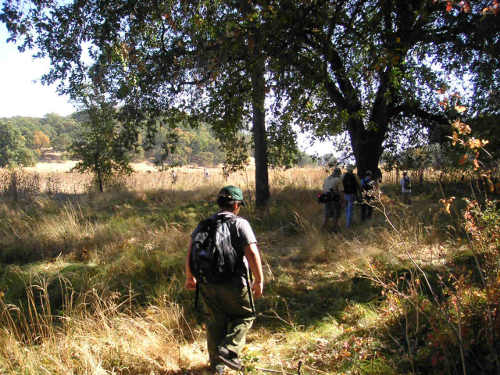
LOWER LAKE, Calif. – Anderson Marsh State Historic Park remains open and the Anderson Marsh Interpretive Association (AMIA) continues to hold its monthly guided nature walks, followed by a tour of the Historic Ranch House Museum, on the second Saturday of the month.
The next walk is scheduled for the morning of Saturday, July 14.
Docent Roberta Lyons will lead the July nature walk and tour.
Bring your binoculars and meet in front of the Ranch House at 8:15 a.m. for time to experience the early morning wildlife to be found in the Ranch House and Barn complex yard – walk begins at 8:30 a.m.
A tour of the historic Ranch House Museum begins immediately after the walk. If rain cancels the walk, the ranch tour will begin at 8:30 a.m.
Anderson Marsh State Historic Park is located on Highway 53, between Lower Lake and Clearlake.
For more information about the walks, email
For more information about the park, visit http://www.parks.ca.gov/?page_id=483 .
- Details
- Written by: Editor
The California Department of Fish and Game (DFG) invites anglers to celebrate summer by fishing for free this coming Saturday in California’s spectacular waters.
July 7 is the first of two Free Fishing Days in 2012, when people can try their hand at fishing without having to buy a sport fishing license.
All fishing regulations, such as bag and size limits, gear restrictions, report card requirements, fishing hours and stream closures remain in effect.
Every angler must have an appropriate report card if they are fishing for abalone, steelhead, sturgeon or spiny lobster anywhere in the state, or salmon in the Smith and Klamath-Trinity River systems.
DFG offers two Free Fishing Days each year – usually around the Fourth of July and Labor Day weekend – when it’s legal to fish without a sport fishing license.
This year, the Free Fishing Days were set for the Saturdays following Independence Day and Labor Day (July 7 and Sept. 8).
Free Fishing Days provide a low-cost way to give fishing a try. Some DFG Regions offer a Fishing in the City program where anglers can go fishing in major metropolitan areas.
Fishing in the City and Free Fishing Day clinics are designed to educate novice anglers about fishing ethics, fish habits, effective methods for catching fish and fishing tackle. Anglers can even learn how to clean and prepare fish for eating.
Anglers should check the rules and regulations at www.dfg.ca.gov/regulations/ for the waters they plan to fish. Wardens will be on duty to enforce them.
For more information on Free Fishing Days, visit www.dfg.ca.gov/licensing/fishing/freefishdays.html .
- Details
- Written by: Carrie Wilson
Question: I have heard that the gray wolf that recently wandered into California has been “hanging out” with coyotes. I have also heard that wolves sometimes breed with coyotes and produce offspring that is half wolf and half coyote.
Would such an offspring be protected under the endangered status of the wolf or open to hunting like a coyote? Either way, how would someone tell if the animal was 100 percent coyote or a hybrid?
Thanks for any insight you can provide. (Jeff S.)
Answer: We have been getting a number of inquiries regarding wolf-coyote hybrids after we observed and photographed the wolf known as OR7 in the company of coyotes.
According to Department of Fish and Game (DFG) Northern Region Wildlife Program Manager Karen Kovacs, genetic investigations have confirmed that wolves and coyotes have interbred elsewhere.
In the Northeast, tests have confirmed that gray wolves and coyotes have interbred. However, there is no evidence to date that gray wolves reintroduced to the Rocky Mountain region have hybridized.
Also, wolves are known to kill and consume coyotes and several studies show that coyote populations decrease when wolves become reestablished in the same habitat.
Remember, OR7 was documented near coyotes for only a short time. It would be speculation to suggest that OR7 was “hanging out” with them.
Coyotes in the Northeast that have wolf DNA are larger than average coyotes but clearly not as big as wolves.
Coyotes on average weigh about 15-30 pounds, wolves 70-100 pounds. Coyotes are about 1.5 feet tall; wolves about 2.5 feet tall.
Kovacs believes that a hunter is more likely to mistake a dog or wolf-dog hybrid for a wolf than confuse a wolf-coyote hybrid with a wolf.
Although gray wolves are listed under the federal Endangered Species Act, a wolf-coyote hybrid produced by one of those wolves would not be protected under that law, according to the U.S. Fish and Wildlife Service. Neither is currently listed under California’s endangered species act.
If coyote hunting in California, don’t shoot if you are in doubt of your target. If the animal doesn’t look 100 percent coyote, it’s more likely to be a domestic dog than a wolf or coyote-wolf hybrid. See our Web page for differences between coyotes and wolves. The size difference is pretty dramatic.
For all of the latest information on this lone gray wolf, please visit www.dfg.ca.gov/wildlife/nongame/wolf/.
Mantis shrimp
Question: What are the rules and regulations on the mantis shrimp? I accidentally snagged one with a hook and line and let it go because I knew nothing about it. I didn’t even know what it was until I got home and was able to research it. (Michael H.)
Answer: There are no specific regulations for these crustaceans, but they are protected by the general sport fishing regulations for all invertebrates and crustaceans (CCR Title 14, sections 29.05 and 29.80, respectively).
Invertebrates may not be taken by hook and line. Mantis shrimp can be taken in all ocean waters open to sport fishing, and everyone 16 years of age and older is required to have a fishing license. These feisty shrimp can only be taken by hand, and there is a bag limit of 35.
While these crustaceans may be legal to take by hand, please be extremely careful before trying to do so.
According to DFG Environmental Scientist Jerry Kashiwada, this is an animal that should not be handled.
Mantis shrimp have a front pair of appendages which look like a club, they open up like a switch blade knife and are sharp enough to cut through a neoprene dive glove. The movement is so fast, the person will not be able to react to avoid being cut.
Selling a taxidermy mount from another state
Question: I would like to get rid of a large bull elk mount that was given to me by an outfitter. I used the mount in my booth at sports shows, but I don’t do sports shows any longer. The elk was taken on a private ranch in Utah by another hunter. Is it legal to sell this mount in the state of California? (Joseph H.)
Answer: Unfortunately, even though the animal was legally taken in another state, it cannot be sold here. Game animals cannot be bought, sold, traded or bartered in our state if it is the same species that occurs here, regardless of where it was taken. Your best bet would be to contact a museum or service club to see if they might want it.
Gifting age limit
Question: If I want to gift abalone to a family member, is there a minimum age limit? (Bobby E.)
Answer: No. You are allowed to donate no more than one legal limit to anyone regardless of their age.
Carrie Wilson is a marine biologist with the California Department of Fish and Game. While she cannot personally answer everyone’s questions, she will select a few to answer each week. Please contact her at