How to resolve AdBlock issue?
Recreation
- Details
- Written by: Editor
LAKE COUNTY, Calif. – The Lake County Channel Cats are welcoming swimmers for the spring swim session beginning Monday, Feb. 4, through Thursday, March 21.
A second spring session will occur Monday, March 25, through Thursday, May 16.
Swimmers may sign up for either one-hour or two-hour blocks, with practices running from 5:30 p.m. to 7:30 p.m., Monday through Thursday.
Swimmers have the option of swimming as many days per week as they choose.
Rates for the two-month session range from $40 to $210 depending on the number of hours spent in the pool per week.
Rates do not include a yearly insurance fee of $65.
Adult swimmers are also welcome.
Spring session is not appropriate for beginners as practice occurs in deep water.
To register, come to the Westshore Pool located at Clear Lake High School during any swim practice and paperwork will be available.
Please call Jennifer Hanson at 707-263-3131 for more information.
Be sure to mark your calendars for Family Bingo Night on Saturday, March 9, at the Lakeport Senior Center, 527 Konocti Ave., to help support the pool. Doors open at 5 p.m.
- Details
- Written by: Carrie Wilson
Question: What are some of the new sturgeon fishing regulation changes that went into effect Jan. 1? I’ve heard measurement methods, size limits and methods of take are a few of them. What’s new? (Anonymous)
Answer: Sturgeon must now be measured by fork length, the straight-line distance from the tip of the head to the center of the tail.
Tip of the head shall be the most anterior point on the fish with the mouth closed and the fish lying flat on its side (California Code of Regulations, Title 14, Sections 1.62, 5.80, and 27.90).
Now no fish less than 40 inches fork length or greater than 60 inches fork length may be taken or possessed (CCR, Title 14, Sections 5.80 and 27.90).
For methods of take, only one single barbless hook may be used on a line when taking sturgeon. Use of a snare to assist in landing or killing any sturgeon is prohibited.
A snare is a flexible loop made from any material that can be tightened like a noose around any part of the fish (CCR, Title 14, Sections 5.80 and 27.90).
For more information about the life history of white and green sturgeon, please go to www.dfg.ca.gov/fish/Resources/Sturgeon/ .
To learn more about the new sturgeon regulations, please go to https://nrm.dfg.ca.gov/FileHandler.ashx?DocumentID=58288 .
Night driving with flashlights
Question: My wife and I are outdoors lovers and we don't want to break the law. We often drive back roads or dirt roads in and around Butte County armed with only a flashlight and no weapons to view and enjoy wildlife that wouldn't be possible to enjoy in the daylight. Is this legal? (Dan, Oroville)
Answer: Yes, as long as you do not have a method of take with you.
You may, however, attract the attention of wildlife officers that are on the lookout for poachers using spotlights to find game. These officers may pull you over and detain you to inspect your vehicle to ensure you do not have a method of take.
There also are some vehicle code provisions that prohibit the use of a flashlight or headlight on a public highway if it is shone into oncoming traffic or prevents other vehicles from seeing traffic control devices.
Acquiring fish for a 200 gallon aquarium
Question: I dive and want to collect various marine species to place in a 200 gallon tank at the Boys and Girls Club building in Lompoc. This would be for educational purposes for the children’s after school programs.
The fish and invertebrates would be supplied by local divers and fishermen and they would not be undersized. Most species would be released after a brief amount of time.
What would the permit fee be? How difficult would it be to obtain? These species would not be for sale. (Rick)
Answer: Fish and Game regulations prohibit transporting live finfish from the water where taken, including the ocean.
Shellfish are generally not covered by this regulation. However, returning or placing any live fish (including shellfish) into state waters (stocking) is illegal, especially if the fish is one that has been kept in a private aquarium.
This prohibition does not prohibit catch-and-release fishing or the immediate return of undersize fish to the water.
One option, as long as this is truly for educational purposes, you may apply for a scientific collecting permit to be authorized to collect specific species yourself. Go to www.dfg.ca.gov/wildlife/nongame/research_permit/ to learn more and see if you qualify.
Otherwise, Fish and Wildlife law does provide for individuals who are licensed to collect live fish for the marine aquaria trade to take and sell certain species of marine organisms.
This activity requires you to have a commercial fishing license, and if you use a boat it has to be registered. The total cost for this is approximately $1,000 per year.
Information regarding the various license and fees is available online at www.dfg.ca.gov/licensing/commercial/commdescrip.html .
One more option you may find practical is to purchase fish from a pet store that has obtained fish from a licensed Marine Aquaria Collector.
The California Department of Fish and Wildlife (CDFW) does not maintain a master list of such stores, but an online search or review of the phone book might help you find what you are looking for to place in the Boys and Girls Club tank.
How far away from the highways and parking lots must I be to shoot?
Question: I hunt the Napa-Sonoma Marsh regularly and have noticed that there are many birds that hang out just outside one of the parking lots off of the highway.
My question is how far do I have to be off the highway in order to legally discharge a firearm in pursuit of these birds? (James)
Answer: Firearms setbacks from highways or public roadways are generally established by local governments.
You will need to check with the local jurisdiction, which is usually the sheriff’s department, regarding distance away from a public roadway.
Keep in mind that you can’t shoot across any roads and you are not allowed to shoot within 150 yards of any building or structure without the consent of the owner (Fish and Game Code, section 3004(a) and (b)).
Carrie Wilson is a marine environmental scientist with the California Department of Fish and Wildlife. While she cannot personally answer everyone’s questions, she will select a few to answer each week in this column. Please contact her at
- Details
- Written by: Editor
Near-record numbers of Chinook salmon returned successfully to the Shasta River last fall despite daunting, drought-related environmental conditions and a large number of migrating fish that increased the threat of disease.
The California Department of Fish and Wildlife (CDFW) counted more than 29,000 adult Chinook salmon at video camera monitoring sites and fish weirs, making the return the largest on the Shasta River since 1962.
“Irrigation districts and individual landowners stepped up and contributed water to reduce disease risks to returning salmon,” said Neil Manji, CDFW Regional Manager. “The increased flow helped cool the river water and avert disease and a potential salmon kill.”
Drought conditions combined with large numbers of salmon, low stream flow and high temperatures posed a potential disease threat in the lower reaches of the Shasta River in September.
In 2002, similar environmental conditions caused more than 30,000 salmon and steelhead to die downstream in the lower Klamath River due the outbreak of two diseases, columnaris and Ichthyophthirius multifiliis or “Ich.”
With flows low in early September, large numbers of salmon began returning to the Shasta River. Irrigation season was slated to continue until Oct. 1, which could have caused further reductions in river flows.
Over a half dozen key landowners and irrigators with water rights recognized the threat and decided to reduce diversions from the Shasta River to increase flow in the river.
At one juncture their contributions increased the river flow to 44 cubic feet per second more than doubling the flow.
This helped move salmon through the system and reduce the vulnerability to disease outbreaks that are a threat when fish are highly concentrated. Increased flow also helped disrupt the life cycles of lethal disease pathogens.
CDFW environmental scientists closely monitored the health of returning salmon and reported no significant disease outbreaks.
The impressive return of Chinook salmon last fall year is attributed to good conditions in the ocean, where salmon live and feed for up to three years, and excellent juvenile reproduction and out-migration success to the ocean.
Environmental improvement projects throughout the watershed, including water diversion screening and riverbed enhancements, may also have contributed to this year’s return.
- Details
- Written by: Editor
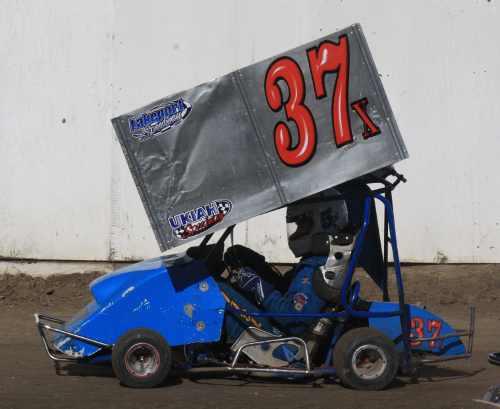
UKIAH, Calif. – The weather might have been a bit cold on this last weekend at Ukiah Speedway but the action on the track was anything but that.
On Saturday the next race in the Ukiah Dixon Go-Kart Series took place with drivers from all over attending.
The children were having fun in the pits with their families and then made it to the track for some exciting action.
In the beginner box stock division Joel Myers Jr. went on to take another main event win for the winter series.
The action in the box stock division saw Robbie Campbell put on an impressive performance to take the main event win.
The action went side by side for the first few laps in the 500 division, then Riley Matson jumped out to the lead not looking back to take another main event win.
Alec Justeson jumped out to the lead in the 250’s division taking the main event win in the class as one of the many drivers doing double duty for the weekend.
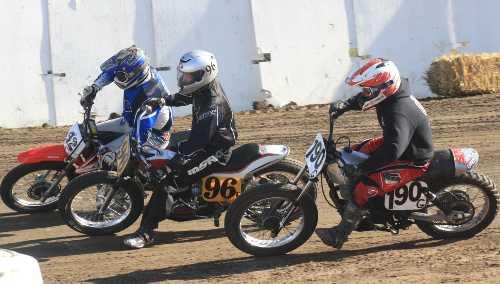
If the action was not exciting enough on Saturday night the action only went more sideways on Sunday when the Flat Track Motorcycles took to the track at the races.
The action saw riders from many different areas in California as well as many different age groups.
Everyone had a very fun day at the track and is looking forward to future events at the race track in the near future.
For the first event this one was off the charts for speedway promoter David Furia who was very happy at the outcome of the day and looking forward to being able to provide the track again in the future for the riders to practice on.
The next go-kart event will take place on March 2 at Ukiah speedway.
For the most recent event details and the complete event schedule for the up and coming 2013 racing season follow them on Facebook and make sure to visit www.ukiahspeedway.com .