How to resolve AdBlock issue?
Recreation
- Details
- Written by: California Department of Fish and Wildlife
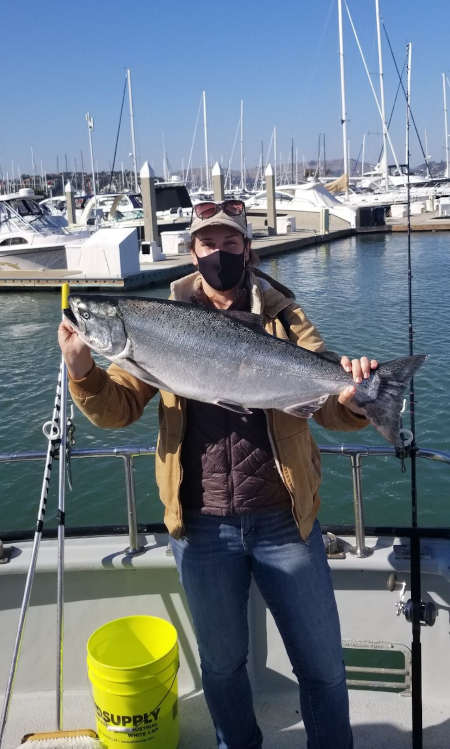
The California Department of Fish and Wildlife will hold its annual Salmon Information Meeting via webinar on Wednesday, March 2, from 10 a.m. to 4 p.m.
The public meeting will feature the outlook for this year’s sport and commercial ocean salmon fisheries, in addition to a review of last year’s salmon fisheries and spawning escapement.
Stakeholders are encouraged to provide input on potential fishing seasons to a panel of fishery managers, scientists and industry representatives who will be directly involved in the upcoming Pacific Fishery Management Council, or PFMC, meetings in March and April.
The 2022 Salmon Information Meeting marks the beginning of a two-month long public process used to develop annual sport and commercial ocean salmon fishing regulations.
The process involves collaborative negotiations between West Coast states, federal agencies, tribal co-managers, and stakeholders interested in salmon fishery management and conservation.
Public input will help California representatives develop a range of recommended season alternatives at the March 8 to 14 PFMC meeting. Final season regulations will be adopted at the PFMC’s April 6-13 meeting.
Meeting details, handouts and instructions on how to join the webinar will be published on CDFW’s Ocean Salmon webpage in advance of the event.
- Details
- Written by: California Department of Fish and Wildlife
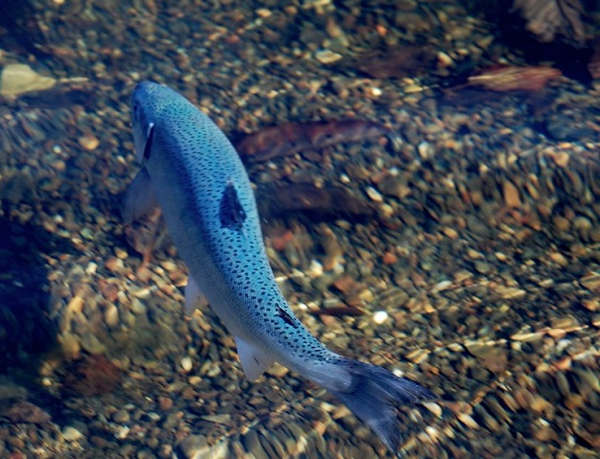
The California Fish and Game Commission has adopted emergency regulations allowing the California Department of Fish and Wildlife, or CDFW, to extend low-flow related fishing restrictions on portions of the Smith, Eel and Russian rivers and a number of other coastal rivers and streams through April 30 if needed to protect runs of salmon and steelhead.
“We’ve observed extended periods of drought and warming climate trends over the past decade,” said Jonathan Nelson, environmental program manager for CDFW’s Anadromous Fishes Conservation and Management Program. “The added flexibility to manage the health of our fisheries through extended angling restrictions on coastal waters when low flows create potentially lethal conditions is paramount to the long-term survival of our salmon and steelhead populations.”
The emergency regulations took effect Jan. 31.
Before the change, CDFW was allowed to enact low-flow specific angling closures on coastal rivers in Del Norte and Humboldt counties including the Smith, Mad, Eel, Van Duzen and Mattole rivers through Jan. 31 of each year and in Mendocino, Sonoma and Marin counties including the Gualala, Russian, Napa rivers and several others through March 31 each year.
The emergency regulations have been added to the 2021-2022 California Freshwater Sport Fishing Regulations online. For a complete list of the coastal rivers subject to low-flow restrictions, please review the California Code of Regulations, Title 14, section 8.00(a) and (b).
CDFW will make information available to the public by a telephone recorded message updated, as necessary, no later than 1:00 p.m. each Monday, Wednesday and Friday, as to whether any river or stream will be open or closed to fishing. It is the responsibility of the angler to call and obtain information on the status of any stream.
For information about coastal rivers in Del Norte, Humboldt and Mendocino counties, call 707-822-3164.
For information about coastal rivers in Marin and Sonoma counties, call 707-944-5533.
- Details
- Written by: California Department of Fish and Wildlife

Bay Area salmon
Q: Why are so many salmon showing up in Bay Area rivers and streams?
A: CDFW fisheries staff can confirm that hundreds of salmon — many of them Chinook — have been spotted over the past few months in Bay Area streams and rivers, especially in the east bay.
Chinook salmon stray for a lot of reasons, including natural repopulation strategies, lack of attraction flows coming from natal streams, release location and large attraction flows at the right time of year.
This fall, we had substantial early rain that coincided with the adult fall-run migration back into freshwater. This helped attract salmon to these areas. Salmon may attempt to spawn in these streams, but because they do not have sufficient year-round stream flows, they can’t maintain a run. Due to poor environmental conditions in the Central Valley rivers and Delta, the California Department of Fish and Wildlife typically trucks millions of juvenile salmon to the San Pablo, San Francisco and Monterey bays to help increase their chances of survival to the ocean.
When these fish return to spawn, the majority will find their native streams or be caught near their release location. However, a proportion of the hatchery-origin fish will stray into alternative streams. This straying is exacerbated by low natal stream flows and high localized flows in other locations.
Fish and Game Commission
Q: What’s the difference between CDFW and the California Fish and Game Commission?
A: Essentially, CDFW implements and enforces the Fish and Game Code, along with regulations adopted by the California Fish and Game Commission. CDFW also provides biological data and expertise to inform the Commission’s decision-making process.
The Commission was one of the first wildlife conservation agencies in the U.S. Established by California’s State Constitution, it is composed of five Commissioners appointed by the Governor and confirmed by the state Senate.
The Commission and CDFW are separate legal entities with a wide variety of authorities, some general in nature and some very specific.
Primary functions of the Commission are adopting policies and regulations that guide its work and the work of CDFW, listing and delisting threatened or endangered species, letting leases for shellfish cultivation and kelp harvest, and establishing seasons, bag limits, and methods of take for hunting and fishing.
CDFW’s law enforcement division enforces regulations adopted by the Commission, but CDFW also administers other programs, such as the streambed alteration program, that are unrelated to the Commission.
Visit the Commission’s webpage to learn more. Commission meetings are held bimonthly, with both video and audio coverage livestreamed and archived. During the COVID-19 pandemic, the Commission and its committees are conducting meetings by webinar and teleconference to avoid public gatherings and protect public health. Visit the Commission homepage on the day of the meeting to watch or listen live.
Deer poaching
Q: Can a deer hunter lose their license if they are convicted of a poaching offense?
A: Yes. Fish and Game Code section 4340(a) states: Any person who is convicted of a violation of any provision of this code, or of any rule, regulation or order made or adopted under this code, relating to deer, shall forfeit his or her deer tags, and no new deer tags shall be issued to that person during the then current license year for hunting licenses. Section 4340(b) also specifies that no person described in subsection (a) may apply for deer tags for the following license year.
In addition, the Fish and Game Commission can suspend or revoke hunting and fishing privileges when an individual is convicted of violating the Fish and Game Code or its implementing regulations (California Code of Regulations, Title 14, section 745.5).
Decades of wildlife law enforcement have provided anecdotal evidence that the potential loss of future hunting privileges is often more effective than fines to deter future poaching behavior.
- Details
- Written by: Nadine Strauss
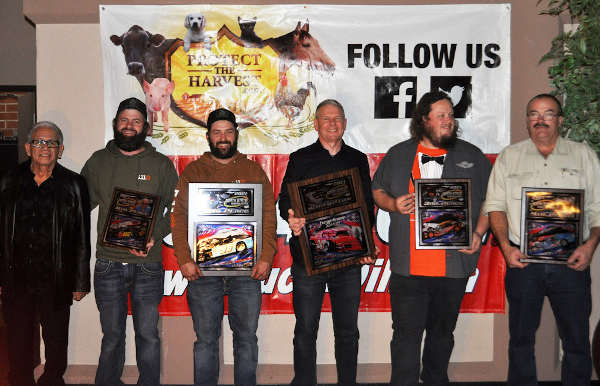
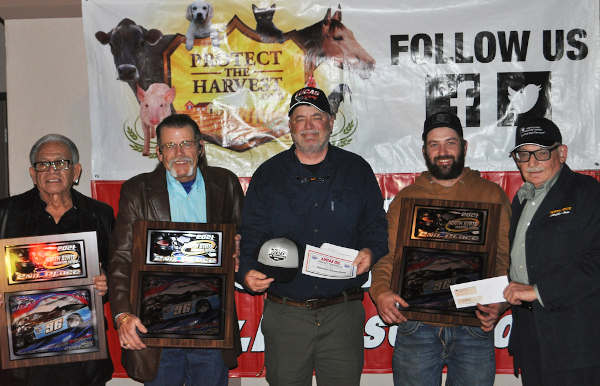
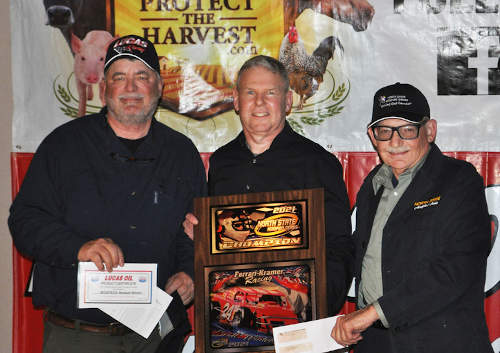
WILLIAMS, Calif. — The eighth annual awards banquet and concert honoring the top 10 drivers in the 2021 North State Modified Series, or NSMS, presented by Protect the Harvest, was held last Saturday night at Granzella's Banquet Facility in Williams.
Business Manager Nadine Strauss acted as master of ceremonies. Speakers were Mark Baldwin from O’Reilly Auto Parts, Shasta Speedway promoter Dave Twyman, and series promoters Jeff Stephens and Bob Strauss.
NSMS official Johnna Hensen presented all the ladies present with special gifts, and talked about how important women are to racing.
Scott Winters and the Ferrari-Kramer racing team were crowned 2021 NSMS champions. Winters, a veteran driver who for many years was a top-runner with the Lucas Oil Modifieds, has set many track records and captured many main events while competing with North State. In 2020 he finished second overall to Kyle Tellstrom.
Winters’ worst finish in 2021was a third place. He had 4 main event wins — two at Redwood Acres Raceway in Eureka, and one each at Shasta Speedway and Madera Speedway. He finished second in all the other races.
The team took home $1,000 in Hoosier points fund money, a $1,000 Lucas Oil products certificate, product from Scribner Plastics, and championship Hoosier Tires racing jackets.
Second place honors went to Keith Bloom of Anderson. Bloom drove for Sacramento car owners Sal Lopez and Steve Thomas. In 2020 he finished sixth overall with North State.
This year he finished in the top six at every race. His best finishes were second places, both of them at Shasta Speedway. He placed in the top three in five Lucas Oil Dash for Cash events. Bloom collected $700 plus a $1000 certificate from Lucas Oil.
Finishing third this year was Ian Elliott of Lakeport. Elliott ran in second place almost all season, but bad luck at the end saw him slip to third. He began racing with North State in 2018 where he earned the Sunoco Rookie of the Year title. Last year he finished ninth and swore he’d do better in 2021.
He finished in the top-six seven out of eight races, had a second place finish at Eureka, and three third place finishes at Shasta and both the Madera races. Elliott was presented with $600 from the Hoosier Tire points fund and $1000 in product from Lucas Oil.
Fourth place overall went to Rich Cobb of Klamath Falls, Oregon. Cobb finished tenth in overall points last year. He has been with North State since 2014 and for the most part has been our long-tow driver. He was the winner of the Lucas Oil Dash for Cash at Shasta Speedway in June, and finished second in the dash at the other 2 Shasta events.
He posted the third quickest time at All American Speedway in July, and finished third in main event action both at Redwood Acres and Shasta Speedway in June. Cobb only finished out of the top 10 twice all year. Cobb’s certificate from Lucas Oil for good for $600.
Ending up in fifth place in 2021 was Dustin DeRosier of Cloverdale. DeRosier finished fifth in points two year in a row. He was the winner of one Lucas Oil Dash for Cash in 2021, and had six top 10 finishes. His best efforts were fourth place finishes at Madera, Shasta and All American Speedway in Roseville. He led many laps in 2021, but just could not hold back the other top dogs.
Finishing in sixth place was Sal Lopez of Sacramento. Lopez is the oldest driver in the series, competing in 2021 at 77 years of age. He produced two cars for the better part of this season: He drove one (most of the time) and had Cody Braund, Foryst Souza and Chris Scribner drive the other. He had the best luck with Braund where, as a team, they won the Lloyd Burton Challenge at Shasta Speedway on October 9th. Braund also posted four top 10 main event finishes, running for Sal’s points. The top six drivers all collected Lucas Oil Product certificates.
Seventh place went to Kyle Tellstrom of Ukiah. Tellstrom was the North State Modified Series champion in 2020. This year he had a fast time at four events, and set new track records on his first three outings. He won 3 races in 2021, including the season opener at Shasta, the following race at Madera, and the July race in Roseville. Then he had back luck and missed a race while leading in points. Tellstrom has relocated to the state of Idaho.
Darrin Sullivan of Kelseyville finished eighth. Sullivan started racing with North State in 2016 where he chalked up the 2016 Sunoco Rookie of the Year title. He missed one race this season, but his biggest claim to fame was setting a new track record at Shasta Speedway during the Lloyd Burton Challenge in October. He is also one of six drivers to win that prestigious event and have his name engraved on the perpetual trophy that is housed in the NSMS Lucerne office. In 2021 his best feature finish was a third at All American Speedway. That same night he clocked in second fastest. He finished in the top 10 five times
Ninth place overall went to our youngest driver Kylei Keown of Ukiah. For the first half of 2021 she was only 15 years old. She teamed up with one of the best, and improved at each race. Had her car not broken at the spring race in Madera, she would have finished way up the ladder. As it was, she had four top 10 finishes, and won the 2021 Sunoco Rookie of the Year title.
Mike Neilson of Lakeport rounded out the top 10 NSMS drivers. Neilson only ran ½ the season with North State. After that he tried his luck at the local race track. In 2021 he finished seventh in his first race at Shasta, and was the winner of the Lucas Oil Dash for Cash at the very next race at Madera Speedway. His best finish was a sixth place at Shasta in June, and he had four top ten finishes.
Recognition also went to all the NSMS officials as well as the series sponsors Protect the Harvest, Lucas Oil, Hoosier Tire West, Terry Deal and Economy Heating & Air, Sullivan Masonry & Construction, O’Reilly Auto Parts, Mark and Sharon Baldwin, Ray Elliott, McMurray & Sons Roofing, Mort Houston, Naake Suspension, Sunoco Race Fuels, Five Star Bodies, Racer Bling, Scribner Plastics and Frank's Radios.
The North State Modified Series begins its 2022 season at Stockton 99 Speedway on April 23. The entire schedule can be found on the North State Modified Series Facebook page.