 How to resolve AdBlock issue?
Recreation
- Details
- Written by: Carrie Wilson
Deer hunting from a boat
Question: Is it legal to hunt deer from a boat drifting down a river? If so, what are the parameters? Do you have to be a certain distance from shore? (Eric S., Redding)
Answer: The main requirement when hunting from a boat is that the boat cannot be under power or still moving as a result of power. In addition, engines must be shut off and out of the water. Once you’ve done this, the boat may be drifting, beached, moored, resting at anchor, or propelled by paddle, oar or pole.
Aside from the requirements of using the boat as a platform, the shooter must consider what else may be around and beyond the deer.
You cannot hunt or shoot a firearm within 150 yards of an occupied dwelling, or hunt on private property or within prohibited areas such as municipalities. It is important to research your specific hunting area and know legal access points.
No person shall pursue, drive, herd or take any bird or mammal from any type of motor-driven air or land vehicles, motorboat, airboat, sailboat or snowmobile (California Code of Regulations Title 14, section 251). There may also be some Penal Code restrictions regarding loaded firearms in vehicles.
Handicapped abalone diving
Question: My dad is handicapped and someone told him if he gets a license and abalone report card, he can then have someone else catch abalone for him and hand it to him either while he’s on a boat or once back on shore. Is this true? (Janet R., Sacramento)
Answer: Unfortunately, no. A person who is unable to take their own abalone cannot purchase an abalone report card and have someone else take abalone for them using their report card.
A person licensed to take abalone can give some of their own catch to your father as long as the abalone are tagged and recorded on the actual diver’s report card.
Taking control of coyote problems
Question: I live in Fullerton and am having coyote problems. A coyote recently killed my cat, and some other pets have also been killed and/or attacked.
Is it legal to kill a coyote in my neighborhood if I feel it is a viable threat at the time? I'm not seeking them out and not trying to hunt. I just don’t want to lose any more animals.
We want to comply with all laws but aren't getting anywhere talking to the local police department or the animal shelters or humane society.
I’ve never had a hunting license and my parents’ licenses are expired but can be renewed if need be. We have registered handguns, rifles and shotguns that are all legal. I just want to make sure we won’t get into trouble with the law.
What are our rights? (Christina, Fullerton)
Answer: Under Fish and Wildlife laws, coyotes are classified as non-game animals and may be taken throughout the year with a hunting license. The offending animals may also be taken if they cause property damage.
That being said, laws generally prohibit the discharge of any firearm or other weapon in urban areas. You may want to verify this with your local police or sheriff’s agency. Some communities have hired licensed trappers to remove nuisance coyotes.
Limpet regulations
Question: What are the true regulations for collecting limpets? From what I can gather from reading the regs, there is no size limit, the bag limit is 35, and they can only be collected by hand or by hook and line.
In Hawaii, it is common practice to use a butter knife to pry the limpets or "opihi" off the rocks, and this is the most effective method. Without a knife, it’s pretty much impossible.
Therefore, is it legal to use a knife to collect limpets? If not, can the regulations be changed so that limpets are an exception? I don't believe that regulation was made with limpets in mind. (Orion G., Santa Barbara)
Answer: You are correct. You may take up to 35 limpets year round and you are allowed to take them only on hook and line or with the hands (CCR Title 14, section 29.10(a)). If you think this regulation should be changed, you are encouraged to propose amendments to the Fish and Game Commission.
For a list of upcoming meetings or to contact them directly, please go to www.fgc.ca.gov/ .
Carrie Wilson is a marine environmental scientist with the California Department of Fish and Wildlife. While she cannot personally answer everyone’s questions, she will select a few to answer each week in this column. Please contact her at
- Details
- Written by: Editor

BOGGS MOUNTAIN, Calif. – The Lake County Big Read Program, together with the Friends of Boggs, is presenting a “Hike and Read” event on Sunday, Oct. 20, at Boggs Mountain State Forest.
The Big Read provides citizens with the opportunity to read and discuss a single book at various events within their community over a period of a month.
The Lake County program month is October, and the reading selection is the popular “The Joy Luck Club” by Amy Tan.
The Lake County Big Read is a grant-funded program of the National Endowment for the Arts (NEA) designed to restore reading and the role of literature in American culture and to encourage citizens to read for pleasure and enlightenment. The NEA presents The Big Read in partnership with Arts Midwest.
To nurture these goals, the Boggs Mountain Event will feature a 2.9-mile hike, and at the half-way point, the group will take a break and enjoy a snack as they discuss “The Joy Luck Club” and share one of their favorite passages in the novel and listen to the readings presented by others.
This will be a moderate-level hike on moderate terrain with some elevation and will be led by the director of the Big Read for Lake County, Robin Fogel-Shrive, together with Darlene Hecomovich, a member of Friends of Boggs.
Attendees will have the additional benefit of exercise while they hike through the Douglas fir/ponderosa pine forest enjoying lovely vistas and the beauty of fall in the forest.
Wear sturdy shoes, dress appropriately for weather conditions, and bring water, your snack as well as a bundle of enthusiasm.
Meet at the parking lot kiosk promptly at 9 a.m. The forest entrance is located off Highway 175 just 1½ miles north of Cobb Village. Turn at the blue State Fire Station/Boggs Mountain Forest sign.
For further information phone Darlene at 707-928-5591 or email
- Details
- Written by: Editor
KELSEYVILLE, Calif. – The Kelseyville Tennis Club held a doubles fundraiser on Saturday, Oct. 12, at the Gard Street Courts in Kelseyville.
There was a good turnout for the event. They had a great time and look forward to the Spring Fundraiser Tournament to be held in March.
The group held a raffle for prizes that were donated.The group would like to thank the following merchants for their generous donations: Studebaker’s Coffee House, Wildhurst Winery, Chacewater Winery and Olive Oil, Disney’s Watersports and Awards and Kelseyville Pizza.
The players made donations to the Kelseyville Unified School District in order to contribute to the court repair fund. This is an ongoing effort and future tournaments will be held.
Anyone wishing to donate to the fund can make a donation in the name of the tennis club to the Kelseyville Unified School District. The club offered thanks for support of the community tennis courts.
For any person interested in becoming a member and gaining access to the tennis courts, please call Larry Larson at 707-279-8680.
- Details
- Written by: Editor
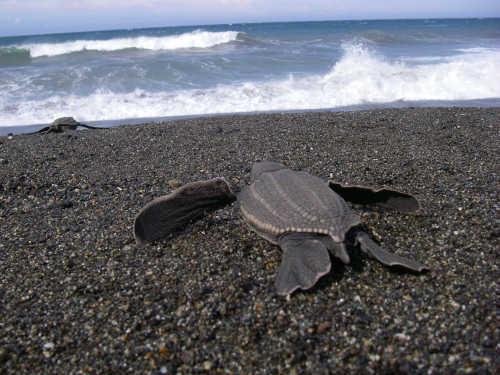
In an effort to bring awareness and protect the population for generations to come, California has designated Oct. 15 as Pacific Leatherback Sea Turtle Conservation Day.
As one of largest migratory sea turtles, the Pacific leatherback sea turtle (leatherback) mark an incredible journey each year, traveling more than 6,000 miles from nesting beaches in Indonesia to feed on California jellyfish during summer and fall months.
Listed as threatened on both federal and state lists, the species faces threats from capture in fishing gear, harvesting of eggs on nesting beaches, plastic pollution and climate change.
“Despite being listed as an endangered or threatened species since 1970, the leatherback population has decreased by approximately 90 percent over the last 20 years,” said CDFW Director Charlton H. Bonham. “Our hope with this celebration is to bring awareness to the plight of the leatherback to preserve it for years to come.”
Passed by the Assembly and signed into law by Gov. Brown in September 2012, Assembly Bill 1776 established leatherbacks as the official state marine reptile.
The bill encourages public schools to include leatherbacks in their curriculum and urges state and federal agencies to take proactive conservation measures to prevent further threats.
Scientists and government representatives from California and Indonesia will also convene in Monterey, California Oct. 14-16, 2013, for an historic summit on leatherbacks.
The conference will host more than a dozen Indonesian delegates, providing the opportunity to reaffirm each country’s commitments and forge new partnerships to prevent the extinction of this magnificent species that call both regions home.
Leatherbacks are the deepest-diving, longest-living and largest sea turtle.
An adult can weigh up to 2,000 pounds and measure more than 6.5 feet in length and can easily be differentiated from other turtle species by its lack of a bony shell.
According to National Marine Fisheries Service (NMFS) scientists, there are less than 5,000 leatherback breeding females left in the world today.