 How to resolve AdBlock issue?
Recreation
- Details
- Written by: Editor
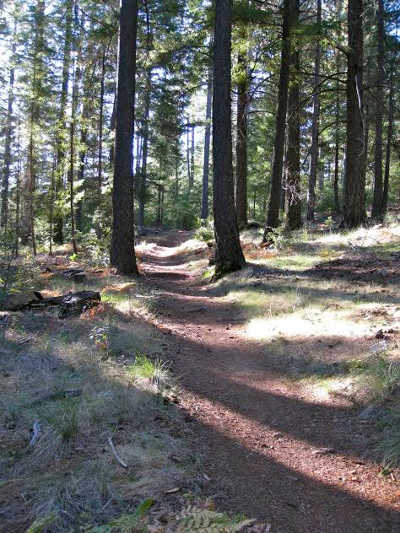
BOGGS MOUNTAIN, Calif. – The Friends of Boggs Mountain will be offering a 2.25-mile hike on various Boggs Trails on Wednesday, Feb. 19, at 9 a.m.
This will be moderate-level hike on moderate terrain with some elevation and will be led by Darlene Hecomovich.
This is an opportunity to get some exercise while you appreciate the outdoors and the wonders of nature.
Check out the forest flora in its winter aspect from the ground cover of bracken, bunch grass and mosses to the understory filled with coffeeberry and manzanita, and on to the upper story of magnificent Douglas fir and sugar and ponderosa pines.
Hikers can admire the silhouettes of the leafless deciduous trees and shrubs, and with all the recent rain, the mosses and lichens should be vibrant. Come and enjoy it all as we hike!
Wear sturdy shoes, dress appropriately for weather conditions, and bring water and enthusiasm.
Meet at the parking lot kiosk promptly at 9 a.m. The forest entrance is located off Highway 175 just one and one half miles north of Cobb Village. Turn at the blue State Fire Station/Boggs Mountain Forest sign.
For further information phone Darlene Hecomovich at 707-928-5591 or email at
- Details
- Written by: Carrie Wilson
Can a private boat owner be cited for a passenger’s violation?
Question: I have my own boat and take friends out lobster fishing with me. I always make sure each person has their license and report card. I also make sure each person has their own bag and keeps each lobster they catch separate as they catch them.
My question is, if the game warden finds a short lobster in one of their bags, am I held responsible as the boat owner or would the owner of that bag be responsible? Also, do boat limits apply when fishing for lobster? (Jerry E.)
Answer: Lobsters may be brought to the surface of the water for measuring, but no undersize lobster may be brought aboard any boat or retained. All undersize lobsters must be released immediately into the water (California Code of Regulations Title 14, section 29.90).
If the bag or undersized lobster is claimed by any person aboard the boat, that person would most likely be issued a citation for possession of an undersized lobster. If no one claims the lobster, the game warden can issue citations to everyone aboard the boat (joint possession). Or, since the boat is the property of the skipper, the skipper may be the only one cited because the undersized lobster is possessed aboard the skipper’s boat. Of course, prevention is the best solution, so if in doubt, set it free.
Sport fishing boat limits apply only to fin fish, not lobster. This means that once a lobster fisherman harvests the daily bag limit of seven, he or she may no longer fish for lobster.
Lead ammo for pistol in condor country?
Question: In the lead-free condor zone, can I carry a pistol that is loaded with lead ammo for self-defense, with the intention of NEVER using it for hunting purposes?
The purpose of carrying it is for self-defense only. Of course I’ll be carrying lead-free ammo for my rifles, but I want to know about the side arm. Personally, I carry either a Glock 20 in 10mm or a Ruger 44mag. (Brandon C.)
Answer: You may not use or possess lead ammunition in the condor zone while hunting, even if you have no intention of using the lead ammunition to shoot wildlife.
For more information on the non-lead requirements in condor country, please go to www.dfg.ca.gov/wildlife/hunting/condor/ .
Selling sturgeon eggs from a legally-taken sturgeon
Question: If I catch legal-sized sturgeons with eggs, can I sell the eggs because I don’t eat them? (Byron M.)
Answer: No. It is illegal to sell any portion of a sturgeon or any fish taken under the authority of a sport fishing license (Fish and Game Code, section 7121).
Grizzly bear tooth
Question: I received a grizzly bear tooth amongst some of my grandfather’s possessions after he passed away. My grandfather grew up here in California and was an amateur geologist and never hunted, so I think he either found or purchased the tooth, although I have no proof.
I was wondering if it is legal to possess or sell the tooth here in the state of California. I don’t want to break any laws. (Laura J.)
Answer: It is legal for you to possess it but you cannot try to sell it. The sale or purchase of any bear part in California is prohibited (FGC, section 4758 (a)).
Even offering it for sale over the Internet is a federal violation that could make you subject to prosecution under the Lacey Act.
You may possess the tooth or give it away, but you may not sell it.
Sounds to me like you have an interesting piece of California’s history, as grizzly bears are extinct in the state. Enjoy it!
Retrieving hoop nets with rod and reel?
Question: Is it legal to use a rod and reel as a retrieval device for a hoop net?
For instance, I would connect an 18-inch hoop net to the line of my rod and reel (without hooks) and this would allow me to cast the net in order to better fish for lobsters from a jetty. Is this OK? (Jeff C.)
Answer: Yes, you may use a rod and reel as a retrieval device for your hoop net. You are not required to pull your net by hand, nor are you prohibited from pulling it using a rod and reel.
Carrie Wilson is a marine environmental scientist with the California Department of Fish and Wildlife. While she cannot personally answer everyone’s questions, she will select a few to answer each week in this column. Please contact her at
- Details
- Written by: Editor
NORTHERN CALIFORNIA – The California Department of Fish and Wildlife’s (CDFW) Advanced Hunter Education Program is offering a turkey hunting clinic on March 1 at Gray Lodge Wildlife Area near Gridley.
Prospective hunters must register by 5 p.m. Friday, February 14.
Experienced instructors will instruct this exciting clinic on how to successfully hunt wild turkey. Topics to be covered are concepts of decoy placement, blind design, ballistics, calling, equipment, game care and cleaning, cooking tips and safety.
The clinic is 9 a.m. to 5 p.m. Saturday, March 1 and costs $45. Space is limited and registration is required so hunters are encouraged to apply early. Youths 16 years and younger are free but must be accompanied by a parent or guardian.
CDFW’s Advanced Hunter Education Program will provide all necessary class equipment.
Registration forms are available online at http://www.dfg.ca.gov/huntered/advanced/index.aspx . After registering, participants will receive an e-mail with a map to the facility and a list of items to bring.
Gray Lodge Wildlife Area is located approximately 60 miles north of Sacramento.
- Details
- Written by: Editor
The California Fish and Game Commission has adopted emergency regulations to close some waters to angling as recommended by the Department of Fish and Wildlife (CDFW) last week.
Specifically, the commission adopted the following emergency regulations:
- Closure of the American River from Nimbus Dam to the SMUD power line crossing at the southwest boundary of Ancil Hoffman Park until April 30.
- Closure of the Russian River main stem below the confluence of the East Branch of the Russian River until April 30.
- Extension of the low flow restrictions angling closures for the north coast and central coast areas (above San Francisco Bay) until April 30.
- In the South Coast District (i.e., San Mateo, Santa Cruz, Monterey and San Luis Obispo counties), close all portions of any coastal stream west of any Highway 1 bridge until April 30.
The above regulatory actions will become effective upon approval by the state Office of Administrative Law (OAL). At the earliest, these emergency regulations will become effective in mid to late February.
“We can’t make it rain, but we can take action to relieve our beleaguered salmon and steelhead populations from any additional stress,” said Commission President Michael Sutton. “I’m proud that the fishing community supports this action as essential for the conservation of our precious fishery resources.”
CDFW previously closed some waters to fishing in order to protect native salmon and steelhead from low water flows in California streams and rivers that have been significantly impacted by drought.
CDFW has the authority under Title 14, Article 4, Section 8.00(c) to close south central coast streams to fishing from December 1 through March 7 when it determines that stream flows are inadequate to provide fish passage for migrating steelhead trout and salmon.
As a result, the following waters are closed to angling until March 7 or until stream flows are sufficient to allow fish passage for returning adult steelhead and salmon (to determine whether or not these waters are open to fishing, please call the south central coast closure hotline at 831-649-2886:
- Pescadero Creek and all anadromous reaches of San Mateo County coastal streams normally open for fishing, from Elliot Creek through Milagro Creek.
- The San Lorenzo River and all its tributaries, as well as all anadromous reaches of coastal streams normally open for fishing in Santa Cruz County from the San Lorenzo River on North through Waddell Creek.
- Aptos and Soquel Creeks (Santa Cruz County).
- The Pajaro River and Uvas, Llagas and Corralitos Creeks (Santa Cruz, Monterey and Santa Clara counties).
- The Carmel River and those sections of San Jose, Gibson, Malpaso and Soberanes creeks west of Highway 1.
- The Big Sur River and those Big Sur area streams from Granite Creek to Salmon Creek west of Highway 1.
- The main stem of the Salinas River below its confluence with the Arroyo Seco River and the Arroyo Seco River (Monterey County).
In addition, CDFW has the authority under Title 14, Article 4, Section 8.00(a) to close north coast streams to fishing when it determines that the flow at any of the designated gauging stations is less than minimum flows stated in regulation through January 31.
The commission decided to extend the end date of that authority to April 30. As a result, the following north coast streams will be subject to angling closures until April 30 upon OAL approval (to determine whether or not these waters are open to fishing, please call the north coast closure hotline at 707-822-3164:
- The main stem Eel River from the paved junction of Fulmor Road with the Eel River to the South Fork Eel River.
- The South Fork of the Eel River downstream from Rattlesnake Creek and the Middle Fork Eel River downstream from the Bar Creek.
- The main stem Van Duzen River from its junction with the Eel River to the end of Golden Gate Drive near Bridgeville.
- The main stem Mad River from the Hammond Trail Railroad Trestle to Cowan Creek.
- The main stem of the Mattole River from the mouth to Honeydew Creek.
- The main stem of Redwood Creek from the mouth to its confluence with Bond Creek.
- The main stem Smith River from the mouth of Rowdy Creek to the mouth of Patrick Creek (tributary of the Middle Fork Smith River); the South Fork Smith River from the mouth upstream approximately 1,000 feet to the County Road (George Tyron) bridge and Craig’s Creek to its confluence with Jones Creek; and the North Fork Smith River from the mouth to its confluence with Stony Creek.
Under Title 14, Article 4, Section 8.00(b) the following central coast streams, which are currently subject to angling closures through April 1, upon approval by OAL will now be subject to angling closures until April 30 (to determine whether or not these waters are open to fishing, please call the central coast closure hotline at 707-944-5533):
- Sonoma Creek (Sonoma County), and all streams tributary to the Pacific Ocean (and its bay) in Mendocino, Sonoma and Marin counties, except the Russian River.
- Napa River (Napa County) between Trancas Avenue in Napa and Oakville Cross Bridge near Yountville.
“This is about keeping as many adult spawning salmon and steelhead in the rivers as possible,” said CDFW Fisheries Branch Chief Stafford Lehr. “We are fully aware of the impacts these closures will have on anglers and related businesses. However, anglers have overwhelmingly supported the decision to close fisheries because they are the original conservationists. They understand the severity of this drought.”
These closures affect recreational fishing only as there are no commercial fisheries in California’s inland rivers. This is the first time the Department and Commission have taken this type of emergency action due to drought.
The closures listed above represent only about five percent of the fishable rivers in the state. There are still plenty of opportunities for California anglers to catch fish in the state’s rivers and streams. Additionally, California’s coast offers substantial ocean fishing. Both are subject to current regulations already in place. For more on fishing in California, please visit http://www.dfg.ca.gov/fishing/ .
Current low stream flow conditions will prevent the movement of migrating anadromous fish. Stream flows in many systems are inadequate to allow passage of spawning adults, increasing their vulnerability to mortality from predation, physiological stress and angling.
Furthermore, survival of eggs and juvenile fish in these systems over the coming months is likely to be extremely low if the current drought conditions continue.
These angling closures on selected streams will increase survival of adult wild steelhead and salmon.