 How to resolve AdBlock issue?
Recreation
- Details
- Written by: Editor
NORTHERN CALIFORNIA – With extreme drought conditions reducing the cold water supply available, California Department of Fish and Wildlife (CDFW) are moving the last rainbow trout out of the American River Hatchery to avoid future losses of young fish to rising water temperatures.
CDFW biologists predict that by mid-summer the temperature of the water entering the hatchery will exceed tolerable temperatures for the growing fish, causing extensive – if not total – loss of all fish in the hatcheries.
The Fall Run Chinook salmon and steelhead from Nimbus Hatchery have all been released into State waterways.
“We are taking proactive actions to avoid catastrophic fish losses,” said Dr. William Cox, CDFW State Hatchery Program Manager. “It is an unavoidable change, and we need to look for unique opportunities to avert major losses. We will track all changes involved in the evacuation and evaluate how fish react to being released early. Ultimately we could develop new release strategies based on what we learn.”
American River Hatchery operations focus on taking rainbow trout eggs, while Nimbus Hatchery takes both salmon and steelhead eggs. Both hatcheries raise fish to release size.
This will be the first time all stocks of fish at both hatcheries have been evacuated. By the end of this week all fish from both hatcheries will be released with nearly 430,000 fingerling steelhead from Nimbus Hatchery released into the American River, six months ahead of the normal February release time.
The remaining 20 state-managed hatcheries are expected to make it through the summer months and into the winter season without having to evacuate fish.
Normally CDFW would call on the Bureau of Reclamation to draft water from what is known as the “Deep Water Pool,” in the depths of Folsom Lake. The transfer of cold late water helps to keep hatchery waters acceptably cool.
However, this year, the length and intensity of the drought is so extensive that little, if any water, in the lake is expected to be cool enough to utilize during sizzling summer months.
CDFW predicts water temperatures will exceed 78 degrees in the hatcheries – far too warm for the young trout and salmon to survive.
Throughout the fall and winter CDFW workers mark hundreds of thousands of steelhead trout at Nimbus Hatchery.
Unique markings will enable biologists to evaluate what happens to the fish throughout their life cycle and how the drought conditions will ultimately affect each type of fish.
Fall and winter rains, if received in sufficient amounts, will cool water temperatures enough to allow both hatcheries to come back online and resume operations.
- Details
- Written by: Editor
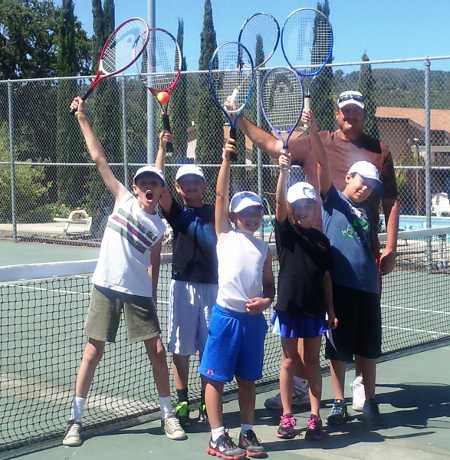
LAKEPORT, Calif. – Weekly tennis camps at Quail Run Fitness Center are scheduled through July.
Camps are taught by a certified tennis professional.
“We are having good success here at Quail Run Fitness and encourage the youth of Lake County to participate and have some fun,” said Coach Don Purdy.
Tennis racquets are available for those who need one, non-members welcome.
For more information or to register for a camp, call 707-245-0443 or email
- Details
- Written by: Editor
Are you or someone you know hunting for a gift for Father’s Day?
The California Department of Fish and Wildlife (CDFW) thinks giving dad a hunting or fishing license would make his day great.
“The gift of these licenses provides the recipient with a bounty of opportunities to enjoy hunting and fishing in California,” said Charlton H. Bonham, director of CDFW.
California is the third-largest state in the nation and about half of its land is publicly owned. That translates into millions of acres of huntable public property.
Fishing opportunities also abound in the more than 30,000 miles of rivers and streams, 4,172 lakes and reservoirs and 80 major rivers in California.
The state also features more than 1,100 miles of coastline that is home to hundreds of native fish and shellfish species.
Licenses can be purchased online via CDFW’s Automated License Data System (ALDS), which allows licenses to be instantly purchased and generated. If a fishing license purchaser does not have all of the licensee’s personal data, ALDS offers a sport fishing gift license voucher along with the ability to include a personalized message to the recipient.
This voucher can be purchased and redeemed at any ALDS license agent location but cannot be purchased online. Hunting license gift vouchers are not available. In addition, licenses are available from more than 1,400 license agents throughout the state.
A 2014-2015 California resident hunting license costs $46.44 and is valid from July 1, 2014, through June 30, 2015.
A 2014 California resident sport fishing license is $46.44 and is valid January 1, 2014, through Dec. 31, 2014.
To find a license agent near you, to purchase items online or for more information on ALDS, please visit www.dfg.ca.gov/licensing .
- Details
- Written by: Carrie Wilson
When wild turkeys attack
Question: I have lived in a rural area of Woodside for more than 20 years.
Although many different species of wild animals wander through our area searching for food, we have never seen wild turkeys. Never until one day about three years ago when two juvenile turkeys and a male pheasant wandered into our neighborhood scavenging for food.
Well, our neighbors began feeding them, and now there are at least two pairs of wild turkeys and 15 chicks between them. I suspect there are more but these were just on our patio last week.
And these turkeys can be mean! Recently, one of our neighbors was putting his garbage can out and was attacked by some large male turkeys! He fell down and broke his wrist trying to get away from them.
What can we do to rid our neighborhood of these pests? Can these turkeys be moved to another area? (Floyd B., Woodside)
Answer: Turkeys are now a part of many suburban neighborhoods in California. During the spring breeding season male turkeys can become aggressive, but this breeding behavior should pass.
Most of the complaints the California Department of Fish and Wildlife (CDFW) receives regarding turkeys can be traced to someone feeding the birds.
The single most important thing people can do to get rid of nuisance wildlife is to remove ALL potential food sources.
If possible, discuss the matter with the neighbors who are feeding the birds, too. It is illegal to feed wildlife.
Turkeys are habitat generalists and food opportunists, meaning they can thrive in a wide variety of conditions and can eat many types of foods. Adequate food is available to them naturally and so they do not need to be fed.
As with many wild animals, people feed them because they like watching them, but this practice puts them at risk.
To help persuade the turkeys to move on, you and your neighbors should remove any cat food, dog food and especially spilled birdseed that might be in the area.
CDFW has used turkey relocation as a tool in the past but found the effectiveness limited. It’s very unlikely that all the turkeys in the area will be successfully trapped as turkeys are quite wary, and often there are plenty of other wild turkeys living in close proximity that will move in to fill any void.
Once turkeys are trapped, they must be moved to a new location where they may end up just becoming a problem for someone else. These programs also require substantial resources and money for CDFW to maintain.
Generally, CDFW does not move nuisance wildlife for these reasons. As a last resort, you can get a depredation permit for the lethal removal of the birds, though methods may be limited in suburban areas where discharging firearms is prohibited.
Many people don’t want to go this route anyway, and so the most important thing to remember when coexisting with turkeys is to not feed them.
For more information, please refer to previous California Outdoors Q&A columns that pertain to and explain the issues surrounding feeding wildlife ( http://californiaoutdoorsqas.com/?s=feeding+wildlife ) or to CDFW’s Keep Me Wild campaign ( https://www.dfg.ca.gov/keepmewild/turkey.html ).
Crab season and whale migration do NOT mix
Question: Is there any way to END crab season for the year due to the early migration of the whales?
Recently, there were two whales stuck in crab netting in/near Monterey Bay and it seems absolutely asinine to continue crabbing under these conditions.
Whales are a protected species, not humans. We can find something else to eat and the crabs can have an early respite from our carnivorous habits.
Can’t something be done to end the crab season earlier? (Deb D., Soquel)
Answer: According to CDFW Senior Environmental Scientist Pete Kalvass, who is one of the Dungeness crab fishery managers, “We appreciate your concern regarding marine mammal interactions with crab gear. The federal government via NOAA is responsible for protecting marine mammals, including whales, and we work with them in trying to minimize these types of interactions with our state managed crab fisheries.
“Unfortunately, there is presently no way to guarantee zero interactions short of eliminating these fisheries. As it is, when you consider that there are approximately 150,000 commercial Dungeness crab pots set during the height of the fishery in November and December each season, entanglements are indeed quite rare. Closing a fishery prematurely as you suggest is not a simple proposition and would either take legislation or an extraordinary finding of harm to the mammals, and public hearings, before our Director could act.”
For further information, I suggest you contact one of the NOAA offices or check their Web site at www.westcoast.fisheries.noaa.gov/ .
Carrie Wilson is a marine environmental scientist with the California Department of Fish and Wildlife. While she cannot personally answer everyone’s questions, she will select a few to answer each week in this column. Please contact her at