 How to resolve AdBlock issue?
Health
- Details
- Written by: Editor
The National Multiple Sclerosis Society, Disability Rights Education and Defense Fund (DREDF), and Disability Rights California (DRC) commend the committee on protecting the rights of people living with disabilities and encourage the full Assembly to pass this important piece of legislation when it comes to vote later this month.
Whether one is born with or acquires a health condition later in life, there are many reasons why someone might need help with such basic functions as breathing, getting around, or using the restroom. To cope with these issues, patients use a variety of devices such as crutches, oxygen devices, wheelchairs, blood glucose monitors, hospital beds, walkers, and other reusable medical equipment.
While public insurance programs such as Medi-Cal and Medicare fully cover DME, up to 90 percent of California’s private group health insurance plans now have an annual $2000 benefit limit on DME that cannot be carried forward from one year to the next.
Individual health insurance plans often have an annual DME benefit cap imposed in addition to hefty monthly premiums and high deductibles. Over half of California’s three million people with disabilities have private heath insurance and an estimated 326,000 work age (18-64) Californians need some form of DME.
AB 214 requires health insurers to provide coverage of DME in group and individual plans, and prevents plans from placing special coverage limitations on DME. The bill will not change the general requirement that DME must be medically necessary and prescribed by a licensed health care provider before it is covered by private insurance.
The bill is authored by Assemblymember Wes Chesbro (D-Arcada) and co-sponsored by the National Multiple Sclerosis Society - California Action Network, Disability Rights Education and Defense Fund (DREDF), and Disability Rights California (DRC).
“Without this bill, people with disabilities and their families will continue to go into debt and be forced to forego saving for their future retirement or their children’s education in order to purchase this equipment,” says Assemblyman Chesbro. “This much-needed bill will dramatically decrease out-of-pocket spending for people with disabilities and reduce the financial hardship associated with their health condition and will hardly make a dent in overall private insurance costs.”
“The durable equipment cost limit has been a big problem for me,” says Jonathan Austin of Oakland who has been living with MS since 1998. “My physical therapist has recommended that I use an electronic knee brace that will enable me to walk farther and more efficiently, however the price of this device is over $6000 and my insurance carrier responded that they have a $2000 limit on devices. We’re hoping to try a less expensive device, however the efficacy of this less expensive device for treating my symptoms is unknown. I think it’s vital that the California State Legislature pass this important bill, as it would make a huge difference in the daily lives of those of us living with disabilities and chronic illnesses.”
Now that the bill has passed from committee, constituents and encouraged to contact their representatives in the state assembly and encourage them to vote for passage of the bill. To learn more about the bill, visit www.msconnection.org/advocacy.
- Details
- Written by: Editor
If not or you need a refresher course, Middletown High School senior Ashlyn Bradshaw is organizing a first aid training class for her senior project.
Sponsored by Middletown High School Interact Club, the event will be held at Middletown High School Library, 20932 Big Canyon Road, Middletown, on Saturday, April 25, from 9 a.m. to 1 p.m. Cost is $25 per person and space is limited.
Upon completion, you will receive an American Red Cross First Aid certificate.
For reservations or more information, call Susan Parker at 707-987-4140, Extension 4015.
- Details
- Written by: Editor
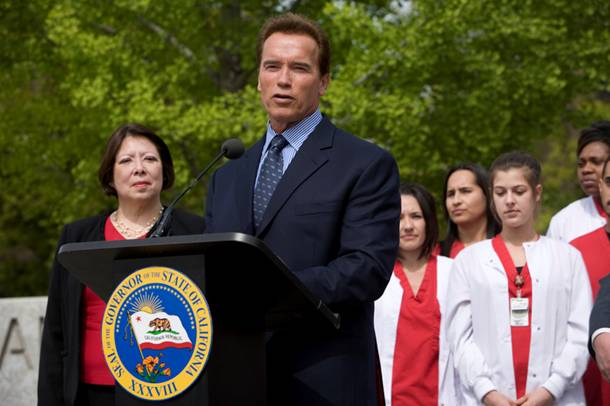
SACRAMENTO – As part of his commitment to creating jobs in California, Gov. Arnold Schwarzenegger on Monday announced his Allied Health Initiative – a $32 million public-private partnership aimed at reducing California’s critical health care worker shortage by adding thousands of additional professionals to California’s hospitals and health care facilities over the next three years.
This partnership is being led by the Labor and Workforce Development Agency and includes several state agencies, the California Community Colleges, along with the University of California and California State University systems, and the California Hospital Association and its member teaching hospitals.
The initiative will begin in the fall with 25 community colleges enrolling more than 700 additional allied health students in their classes.
“Today we are taking some great action to put Californians in jobs and pump up the economy, and at the same time, improve the quality of health care for Californians,” said Schwarzenegger. “The health care industry is one of the bright spots in our economy continuing to add jobs, and still our hospitals and community clinics struggle with massive shortages because our colleges and medical training program can’t keep pace with the rising demand. This public-private partnership will expand the number of pharmacists, lab technicians, imaging specialists and more – giving thousands of Californians the opportunity to pursue their dreams while making our state a healthier place to live.”
With this Initiative, regional industry and education leaders will work together to develop effective allied health partnerships. An allied health professional is a licensed individual that works in support of a nurse or doctor, such as lab technicians, dental hygienists and pharmacy technicians.
Funding for the three-year program consists of $16 million from the state, including $8 million federal Workforce Investment Act funding and $8 million Recovery Act federal stimulus funding. Private partners, such as schools and hospitals, will provide $16 million in matching funds or in-kind contributions.
“We are grateful that Gov. Schwarzenegger has once again put his full faith in California Community Colleges to help train the workers of tomorrow,” said California Community Colleges Chancellor Dr. Jack Scott. “California Community Colleges have over 72,000 students enrolled in health occupation programs, and we expect that this Initiative will increase our ability to educate even more students in the healthcare field.”
According to a Health Workforce Solutions study, more than 60 percent of the health occupations in California are in allied health and we are already experiencing shortages.
According to the most recent employment numbers available from California Labor Market Information Division and Federal Bureau of Labor Statistics, California only has 73 percent of the pharmacists, 65 percent of the Medical Lab Technologists, and 62 percent of the Radiation Technologists and Technicians of the national average per 100,000 people.
In spite of the economic downturn, the health care industry continues to grow in California, adding more than 27,000 jobs between February 2008 and February 2009.
By the year 2030, more than one million Californians will be 85 years of age or older which is going to increase the demand for health care services. As California’s population continues to age, more and more workers – including health care workers – are beginning to retire at a faster rate.
The California Labor and Workforce Development Agency and the Employment Development Department workforce projections include the need to educate over 206,000 additional health care professionals by 2014.
The Allied Health Initiative is going to be structured after Governor Schwarzenegger’s successful California Nurse Education Initiative created in 2005. That initiative was a $90 million, five-year public-private partnership, which has so far seen an increase of more than 54 percent in the number of Registered Nurse (RN) graduates (9,526 graduated in 2008), an increase of more than 56 percent new faculty members (over 1,240 new faculty members), an increase of more than 68 percent new student enrollments in RN programs and 22 new public and private RN programs since its inception.
- Details
- Written by: Editor
The community is invited to an open house on Sunday, April 19, from 12:30 p.m. to 4 p.m. to meet Dr. Sookra and tour the new building.
Located at 5290 State St., the $1 million center replaces the Kelsey Creek Clinic and offers family medicine, podiatry, diabetic education and behavioral health services in a 2,900-square-foot building with seven patient exams rooms, a new patient education and consultation room and easier street access with additional parking spaces.
Dr. Sookra is trained in both adult and pediatric medicine and is board certified with the American Academy of Family Practice. Her medical degree is from Loma Linda University School of Medicine. She completed her family practice residency at Florida Hospital, the largest hospital in the nation, and was named Family Medicine Resident Teacher of the Year.
“Our new building and the arrival of Dr. Sookra are visible symbols of St. Helena Hospital Clearlake’s commitment and investment to make sure Lake County residents have access to superior medical care,” said Linda Gibson, the hospital’s senior vice president of operations.
Kelseyville is one of three community health clinics operated by the hospital in Lake County.
For information or to make an appointment, call (702) 279-8813.