 How to resolve AdBlock issue?
Education
- Details
- Written by: Editor
California Attorney General Kamala Harris on Friday applauded the California Department of Education for its efforts to collect statewide data on students who are chronically absent.
The attorney general has made the fight against elementary school truancy and chronic absenteeism a top priority. She issued the first statewide report on California’s elementary school truancy crisis and sponsored legislation to address the issue.
“Until now, California was one of a handful of states that did not track student attendance. I applaud the California Department of Education for taking this monumental step toward addressing California’s elementary school truancy and chronic absence crisis,” Harris said.
“I have called for this data collection since 2013 and was proud to sponsor a legislative package in 2014 that aimed to modernize California’s attendance records system and establish the support that schools, parents and communities need to ensure our students are in school and on track from kindergarten through high school,” she said. “I look forward to working with our partners to build on this action and guarantee that every child has the opportunity to succeed.”
In 2013, Attorney General Harris issued the first statewide report, In School + On Track, on California’s elementary school truancy crisis, which made a direct link between public education and public safety.
Eighty-three percent of students who miss more than 10 percent of kindergarten and first grade cannot read at grade level by the end of third grad, which makes them four times more likely to drop out of high school.
Annually, dropouts cost California taxpayers an estimated $46.4 billion in incarceration, lost productivity and lost taxes.
The attorney general issued subsequent reports in 2014 and 2015, reporting on the state’s on-going elementary school truancy crisis and the progress that has been made to address the issue.
In School + On Track 2015 found that our state continues to face an attendance crisis, reporting that 230,000 students are chronically absent – missing more than 10 percent of the school year – and more than one in five are truant, having three or more unexcused absences.
In addition, the report highlighted stark disparities in attendance and discipline for vulnerable students, including students of color, low-income students, and students in foster care.
The report also highlighted the effects of chronic absenteeism in addressing issues such as unemployment, crime, economic development, public health and public safety.
Each of the attorney general’s reports stress the need to consistently and accurately track attendance data at the state level so that students do not fall through the cracks.
In 2014, Attorney General Harris sponsored legislation to help schools, parents and government leaders effectively intervene when children are chronically absent, and improve local school districts’ and counties’ ability to track attendance patterns.
The bills included efforts to assist school districts and county offices of education working with parents to address high truancy rates by giving them the tools to comply with attendance tracking requirements in the Local Control Funding Formula, and a proposal to modernize the way California collects and monitors student attendance data.
Two of the bills, AB 2141 (Hall, Bonta) and AB 1643 (Buchanan), were signed by the governor. AB 1866 (Bocanegra), which would have required the data collection announced on Friday, was vetoed.
- Details
- Written by: Editor
SACRAMENTO – The California Community Colleges Board of Governors and the Community College League of California have joined forces to co-sponsor legislation supporting the “California College Promise,” which includes an Assembly bill aimed at removing barriers to access to community colleges by improving existing financial aid programs.
The bill, AB 1721, by Assembly member Jose Medina (D-Riverside), Assembly member David Chiu (D-San Francisco), Assembly member Evan Low (D-Campbell), Assembly member Freddie Rodriguez (D-Pamona), Assembly member Miguel Santiago (D-Los Angeles) and Assembly member Phil Ting (D-San Francisco) would expand the Cal Grant program for community college students, increases access to the Board of Governors Fee waiver program and provides funding to community colleges to establish regional “promise” programs that would offer even more assistance.
“California already leads the nation when it comes to providing tuition assistance for higher education,” said California Community Colleges Chancellor Brice W. Harris. “This legislation builds on that promise and allows more low-income students the opportunity to pursue higher education, while strengthening the state’s workforce.”
The California College Promise builds on framework laid out by President Barack Obama’s America’s College Promise, a non-partisan initiative to increase access to higher education.
“By providing more financial aid resources to students in need, AB 1721 will help disadvantaged students take more classes, obtain their degrees and ultimately be more academically successful,” said Larry Galizio, president and CEO of the Community College League of California. “We strongly support this legislation and applaud the commitment to make college more affordable for all Californians.”
AB 1721 calls to expand the Cal Grant program to better serve community college students by increasing the number of competitive Cal Grant A and B awards from 25,750 to 30,000 and increasing the amount of the Cal Grant B Access award from $1,551 to $3,000.
It also seeks to expand access to the California Community College Transfer Entitlement Award by increasing the age limit to 31 from 28, and extending the application deadline.
The legislation also calls to increase access to the Board of Governors Fee Waiver program, which waives community college tuition fees for qualified students unable to afford it.
Through outreach programs, districts would work to ensure qualified students take advantage of all aid and waivers available to them.
Of the 2.1 million students currently enrolled in California Community Colleges, more than 1 million of them receive a fee waiver.
More information can be found on the California College Promise at http://calcollegepromise.org/ .
- Details
- Written by: Doyle J. Conatser

LOWER LAKE, Calif. – Carlé High School just finished up hazmat classes and certification.
The students who took the class were trained in the first responder “operations” or FRO level one.
There are three levels to the certifications: first responder “operations,” technician and specialist.
We are extremely fortunate in that our science teacher Angie Siegel is an officially certified trainer of the level one course.
The students who took the certification class are as follows: Jesse Adams, Doyle. J. Conatser, Kayla Doyle, Erik Fielden, A.J. Gelardi, Jasmine Heckard, Brianna Legg, Riley Nielsen, Ryan O’Bryan, Maria Pineda, Kedwin McAtter-Russel, Sierra Sell-McKay and Emily Simmons.
We would like to thank Chief Sapeta of Lakeshore Fire, Mark Hill the head of the hazmat team in Lake County, and firefighter Isom for the generous donation of their time and expertise to our learning process. We were able to visit them and taught us what equipment we would use in a hazmat situation.
In the class that our very own science teacher Angie Siegel taught, we learned the hazwoper regulations and what SINCIAPCPDDD is.
SINCIAPCPDDD is the operations we would follow when dealing with a hazardous situation. We also ran an exercise that helped us to learn how to cut off a the flow of the chemical to a storm drain by building a dam out of dirt and plastic bags.
Angie is very proud and happy to announce that every single student in the class succeeded in all the class hours and the final state certification test. They are now all certified as hazmat first responders.
Two students of the week were handed out for the first time in a year. The students of the week are Alicia Burgos and Doyle J. Conatser.
With the award comes a front of the lunch line pass, a free mini pizza from DJ’s pizza in Lower Lake (and we cannot express our gratitude enough for their long and continued support), and a free item from our school based enterprise. Both students are great students, who work hard towards their graduation.
The “Be Fresh” program is back on the Carlé campus to teach students about the importance of eating healthy. The program will be here for six weeks, and is run by Lake Family Resource Center. The effervescent instructor of the class is Jacque Fereer and we truly appreciate her energy and commitment to our students' health.
Student Kacy Barron won our CHILY award this week and he chose a football. He actually received the winning CHILY that morning from teacher Alan Siegel who has truly appreciated how responsible and community oriented Kacy is every day at school.
Secretary Barbara Dye and the staff changed the CHILY form recently. Barbara added check off boxes on it so staff members could express what the student did to achieve it. We added the new categories community, achievement, responsibility, lifelong learning and empowerment.
Valerie Peng, a counselor from Yuba College and a Carlé graduate stopped in to tell us and sign us up for the College Readiness class that is coming back for a second year to the Carlé campus.
Peng will teach the course for six weeks right here on our campus. The course runs an hour after school and students receive both college and high school credit for attending.
We truly appreciate Ms. Peng’s efforts to bring the class to our campus. This is the first college class in our history that has been brought to the Carlé campus.
Carlé truly appreciates all the people and groups who consistently donate time and effort to our students.
Our school-based enterprise trains our students that you always show appreciation to those who take care of you.
Our designers will make individual thank yous to each of these special people and groups.
In the last article about gold level we left one student out, the soon-to-be graduating Jasmine Heckard, who is a great student and has received gold level for seven consecutive grading periods!
Doyle J. Conatser is a student at Carlé Continuation High School in Lower Lake, Calif.
- Details
- Written by: Editor
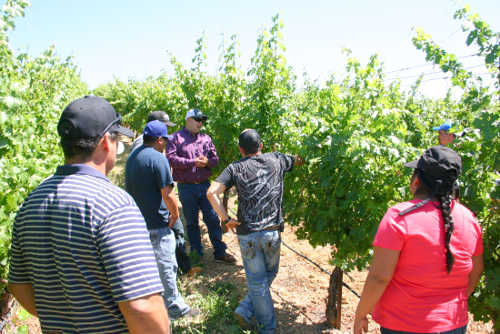
NORTH COAST, Calif. – “Viticulture Practices: Winegrowing for Mendocino and Lake Counties” will be offered this Spring 2016 semester by Mendocino College Agriculture Department as part of the new Viticulture Certificate Program.
Sustainable winegrowing principles and practices covered include pruning, training, frost protection, canopy management, grapevine water requirements and irrigation management, vine nutrition, soils, cover crops, integrated pest management (IPM), vineyard development, habitat conservation and enhancement, vine balance metrics and key practices affecting winegrape quality.
The Viticulture Practices course is one-hour of classroom lecture followed by three hours of hands-on vineyard experiences including field trips to nearby vineyards and wineries.
The course will make extensive use its own on-campus demonstration vineyard to enhance student learning with hands-on experiences.
The vineyard was established the summer of 2015 through the generosity of the Mendocino College Foundation, Inc.
The viticulture instructor is Paul Zellman, BS Viticulture UC Davis and MS Soil Science UC Riverside, who brings over 25 years of vineyard and winery experience in northern and southern California to the classroom and lab.
“Introduction to Viticulture,” offered in the Fall, and Viticulture Practices, form the core curriculum of the Viticulture Skill Certificate program designed to prepare students for careers in the North Coast wine industry.
The Viticulture Program develops students with: 1 – practical hands-on winegrowing skills; 2 – basic knowledge of the science involved in the growing of grapes; and, 3 – initial understanding of winegrowing business aspects.
The knowledge and skills gained from the Viticulture Skill Certificate program, together with job experience, will give individuals a competitive edge when applying for entry-level positions, and for current employees, the skills to advance to better paying vineyard and winery jobs.
The course (AGR112) runs Jan. 28 through May 26 and is held on Thursdays from 1:30 to 5:20 p.m. in Agriculture Department Room 6340.
For additional viticulture course or certificate program information, please contact either Jim Xerogeanes at 707-468-3218,