 How to resolve AdBlock issue?
Education
- Details
- Written by: Elizabeth Larson
Senate Bill 291, introduced today by state Sen. Connie M. Leyva, D-Chino, seeks to establish a California Community College Student Financial Aid Program that would base aid not only on the cost of tuition, but on the total cost of attendance – including the cost of housing, transportation and textbooks.
Awards would help cover expenses not being addressed by a student’s family contributions, employment, and other aid, such as Pell Grants and the Cal Grant program.
In addition, financial aid would be available whether a student is seeking a degree, certificate, or short-term career education program.
“The true cost of attending college is clearly more than just tuition,” Sen. Leyva said. “It is critically important that our community colleges remain an affordable option for all students. When non-tuition costs like housing, food, and textbooks are considered, community college is often more expensive for our lowest-income students to attend than other state universities. SB 291 addresses this issue by creating a financial aid program that helps to cover a community college student’s whole cost of attendance.”
“In most regions of California, the true cost of attending community college for low-income students is higher than for students at a nearby California State University or University of California campus,” said California Community Colleges Chancellor Eloy Ortiz Oakley. “Very few community college students qualify for financial aid to cover living expenses, transportation, or textbooks. Sen. Leyva’s bill seeks to address these inequities.”
Just 5 percent of community college students received a Cal Grant last year, compared to nearly 40 percent of undergraduates at the University of California and approximately 36 percent of students at the California State University system.
All told, California community colleges enroll about two-thirds of the state’s undergraduate students, yet they receive just 7 percent of Cal Grant funds.
While California’s community colleges offer among the least expensive tuition rates in the country at $46 per unit, the actual cost of attending a community college for a student living independently is more than $20,000 annually when housing, transportation, textbooks and personal items are taken into account.
Today, a California community college student receiving the maximum amount of aid possible would still face a deficit of more than $6,000. Very few community college students qualify for financial aid to cover living expenses, transportation or textbooks, and low-income students with unmet financial need have limited choices: work more hours, take fewer courses, accumulate what can become crushing debt, or drop out of school.
“Far too often community college students are left out of the conversation of equity especially when it comes to financial aid,” said Alexander Walker-Griffin, the voting student representative on the Community Colleges Board of Governors. “With the cost of living rising in California and the need for a college degree becoming more of a requirement for financial stability it is imperative that we give every student the financial ability to achieve their goals.”
SB 291 is co-authored by state senators Ben Allen, D-Santa Monica; Steven Bradford, D-Gardena; Hannah-Beth Jackson, D-Santa Barbara; Scott Wiener, D-San Francisco; as well as assembly members Richard Bloom, D-Santa Monica, David Chiu, D-San Francisco, Eloise Gómez Reyes, D-San Bernardino and Buffy Wicks, D-Oakland. For more information and to lend your voice in support of the bill, visit www.truecollegecost.com.
The California Community Colleges is the largest system of higher education in the nation, composed of 73 districts and 115 colleges serving 2.1 million students per year.
- Details
- Written by: Mendocino College
Students and staff are encouraged to use their own discretion based on the safety of roads when making the decision to attend classes.
Students are asked to contact their instructors if they are not able to attend class due to road closures and flooding.
- Details
- Written by: Jill Ruzicka
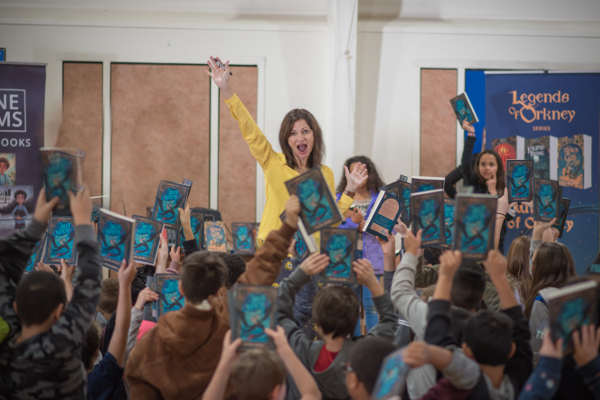
LAKE COUNTY, Calif. – Thousands of Lake County students from transitional-kindergarten through eighth grade participated in high energy assemblies earlier this month by author Alane Adams.
Last fall, after hearing about the Mendocino Complex fire, Adams reached out to Lake County Superintendent of Schools Brock Falkenberg.
Adams wanted to give back to Lake County by offering two to three school visits to the fire-affected schools.
When Adams realized that every Lake County school district had been impacted by at least one wildland fire over the last few years, she offered to visit as many schools as she could fit into her schedule.
Adams performed at 20 assemblies, in 12 schools, in each of Lake County’s six school districts during the week of Jan. 28 to Feb. 1. Adams said she was so busy that she often missed lunch.
Carly Swatosh, education specialist with the Lake County Office of Education, coordinated the visits.
“Alane is the kindest human. We just wish there were more hours in the day so she could have visited every school in Lake County,” Swatosh said.
Each student also received a grade-appropriate book written by Adams. Young adult readers received one of the books from her “Legends of Orkney” fantasy mythology series. The younger students received one of Adam’s picture books based on her father’s life during the depression.
In addition to the fun, high-energy assemblies, Adams in partnership with First Book, is donating $3,500 to each Lake County school district to purchase books from First Book’s online marketplace.
The Lake County Office of Education preschools will receive $3,000 to spend on books for their eight locations.
Adams also donated a complete set of her books to the libraries of each school visited. More than 3,500 books were donated to Lake County students and schools courtesy of Adams, the Rise Up Foundation, and First Book.
Adams created the Rise Up Foundation to impact the lives of children through the power of reading by supporting, funding, and helping create innovative and traditional literacy-based projects. More information can be found at www.riseupfoundation.org.
First Book is a nonprofit social enterprise committed to elevating educational opportunities for children in need. More information can be found at www.firstbook.org.
Jill Ruzicka is communications coordinator for the Lake County Office of Education.
- Details
- Written by: Elizabeth Larson
The LCFB Scholarship Program was organized to give financial aid to Lake County students who show a desire to pursue a career in the agricultural industry.
The scholarships are awarded annually and are based upon academic achievement, career goals, extracurricular activities, leadership skills, and a commitment to study agriculture.
In 2019, Lake County Farm Bureau is proud to partner with Wildhurst Vineyards in awarding scholarships to honor two outstanding families. The Hans and Carol Dobusch Scholarship is available to an eligible Lake County student who is pursuing a credential or degree in any field.
The Myron and Marilyn Holdenried Scholarship will be offered to a Lake County student who will pursue agriculture or science. In addition to these two scholarships, Lake County Farm Bureau will continue to offer multiple agriculture-focused scholarships to Lake County students.
Eligible students must be a resident of Lake County who are enrolled or plan to enroll in a college or vocational school during the 2019/2020 year.
To apply for the LCFB scholarship, students must complete an application, provide transcripts from each school attended and include two current and dated letters of recommendation. The entire packet must be received by LCFB on or before April 12 to be considered by the Scholarship Committee.
Applications are available at Lake County Farm Bureau’s website www.lakecofb.com and at the office located at 65 Soda Bay Road in Lakeport.
Students can also get an application by contacting their local high school counselor or through the Mendocino College scholarship Web page.
Lake County Farm Bureau is proud to serve the agricultural and rural interests of Lake County and is the county’s largest farm organization, representing over 500 farm families and individual
Members.
For more information, contact Brenna Sullivan, executive director, at 707-263-0911.