 How to resolve AdBlock issue?
Education
- Details
- Written by: Kimberly Walker
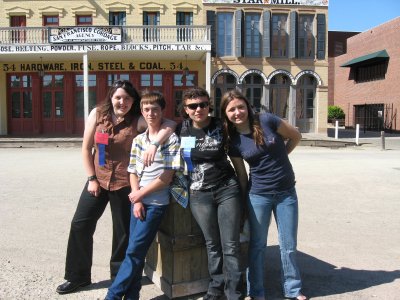
SACRAMENTO – Local 4-Hers Morgan Campbell, Bryce Hayes, Kimberly Walker, Emily Weiss and chaperone Karen Hayes attended 4-H “Cal Focus” in Sacramento from June 22 to June 26.
The trip offered the club members a chance to learn how the government works. They were part of a group of over 95 4-H members and leaders who came from many different areas of California to participate in the five-day event.
California Focus is a unique 4-H citizenship experience that combines hands-on participation in workshops, debates and simulations with outstanding speakers and visits to historical, cultural and governmental sites. California’s capital city becomes a “living classroom” for these five days. They did this by becoming registered voters of a mock state of “Sierra Cascade” and joining political parties of “Grizzly Bears” and “Golden Eagles” to help delegates learning through doing.
They participated in political campaigns, elected constitutional officers, created legislation, saw a Broadway musical and toured the California Supreme Court, State Capitol and Old Town Sacramento.
They also met with state Sen. Patricia Wiggins, conducted a mock trial and participated in a legislative action simulation discussing the problem of youth violence in schools.
They all enjoyed the trip and made friends from all over California while learning about the government.
4-H Youth Development is a program of the University of California Cooperative Extension. For more information on the 4-H program contact U.C. Cooperative Extension, 883 Lakeport Blvd., Lakeport, CA 95453, (707) 263-6838.
Kimberly Walker is a member of the Citizenship/Leadership 4-H Club.
{mos_sb_discuss:2}
- Details
- Written by: Editor

UKIAH – Although most college and university instructors assign textbooks in which they have no direct input, Mendocino College professors Roger Hock and Holly Brackmann each use textbooks they have written.
Hock has been a psychology professor at Mendocino College for the past 10 years and has published several books. His latest, Human Sexuality (2007), is currently being used in Psychology 206, Human Sexuality.
The book hit the shelves in late 2006 and is being used at both the Ukiah campus and Lake County center.
Many colleges and universities have adopted the text for courses this past spring and beginning next fall.
In the Bookbinders’ Guild of New York’s 2007 annual book show, Human Sexuality placed third out of several hundred entries for overall content and design.
Hock’s first book, Forty Studies that changed Psychology: Explorations into the History of Psychological Research originally published in1991, will be released in its 6th edition in January of 2008.
His second book, Insights-Human Sexuality (2005), is a compilation of over 150 professional journal articles, edited and annotated by Hock and is available from Pearson Custom Publishing for individual instructors to adapt and customize to fit their classes.
Hock co-authored his third book, It’s my life now: Starting Over After an Abusive Relationship or Domestic Violence (2006), along with Meg Kennedy Dugan, Director of the AmeriCorps Victim Assistance Program. Rather than a textbook, this is a self-help book aimed to help survivors of domestic violence.
“Our main goal in writing this book was to guide victims of domestic violence in the difficult and painful process of recovery and rebuilding their lives once they have freed themselves for the abusive relationship,” Hock said.
Although writing keeps him busy during the breaks and summers, Hock makes it clear that his first priority is the teaching and learning process with his students. He believes that both faculty and students benefit if professors are professionally active and stay current in their fields.
“When faculty are professionally beyond the classroom, their teaching, their work with students, and the overall reputation of the college are all enhanced,” Hock said.
Hock mentions, in addition to research and writing, professors often stay active in their fields by attending professional conferences and keeping up to date on the latest literature, research advances and creative endeavors in their areas of expertise.
Before Hock came to Mendocino College, he was professor of psychology at New England College in New Hampshire. Hock began teaching at San Diego State University in the early 1980’s and has also taught at Palomar College near San Diego, the University of California San Diego and San Diego State University.
Hock received his M.S. in Organizational Psychology from San Diego State University in 1984 and his Ph.D. in Experimental Social Psychology from the University of California San Diego in 1989.
His books are available on amazon.com, in most major bookstores and at the Mendocino College bookstore. For additional information, Professor Hock can be contacted at www.mendocino.edu.
When Brackmann was approached by an editor for Handwoven Magazine in 2003 about writing a book, she jumped at the opportunity.
“There are not many books in print about fabric printing and dyeing. I had the opportunity to bring together all my knowledge in a text book. Basically, it is a culmination of 30 years of teaching dyeing and weaving,” Brackmann said.
Brackmann began writing The Surface Designer’s Handbook: Dyeing, Printing, Painting and Creating Resists on Fabric in 2004, and it was released in October of 2006. It is used in her Art 176 and Art 177 Fabric Printing and Dyeing I and II classes.
Former students, local artists and international textile artists all contributed artwork for the book.
Local commercial photographer Tom Liden did a two-day photo shoot for the book, while the rest of the photos were submitted by the artists or taken by the publisher’s photographer.
Brackmann’s book received two glowing reviews from Shuttle Spindle and Dyepot (2007) and Textile Forum by European Textile Network (2007) and won the award for the “Best How-To Textile Book of 2006” by the Library Journal Editors.
At a surface design conference in Kansas City, MO last month, Brackmann was informed by many college professors that they are using her text in their classes.
Brackmann has led study tours to Europe, Peru, Egypt, Greece, Turkey, Australia and India, while also contributing to exhibits, workshops, and been a guest lecturer in the U.S., Korea and Australia.
With Mendocino College ceramics instructor Doug Browe, Holly has co-curated two Mendocino County craft exhibits at the Grace Hudson Museum, where she is now on the Sun House Guild Board of Trustees.
In 1983, Holly chaired the Conference of Northern California Handweavers (CNCH), which brought 3,000 people to Ukiah for their annual meeting. She has won the Award of Excellence and Teacher’s Award from CNCH in 2002. Brackmann had her textiles published in numerous publications, as well as written articles in Handwoven Surface Design Newsletter, Weavers and Fabrics that Go Bump.
Brackmann, who was the first art instructor hired at Mendocino College in 1973, first developed her interest in textiles while taking a weaving class as a college student.
“While at San Jose State, I took a summer school weaving class and I got hooked. I started learning about textiles and have never stopped,” Brackmann said.
Her passion for art history and weaving has led her to study weaving techniques in Europe, the Middle East, Asia and Central and South America.
Brackmann received her BA in Art History from San Jose State University in 1969 and her MA in Art History from the University of California Los Angeles in 1972.
Brackmann began her teaching career as an Art History instructor at Ohlone College in Fremont in 1972 and, before arriving at Mendocino College, she was an art instructor at College of the Sequoias in Visalia from 1972-1973.
For more information about her book, visit The Mendocino Book Co. or www.fiberartsmagazine.com/books/surface_handbook.asp.
{mos_sb_discuss:5}

- Details
- Written by: Editor
WASHINGTON – On July 12, the House of Representatives passed the largest single investment in college financial aid in more than 60 years, which will help millions of students and families pay for college – at no cost to the American taxpayer.
The College Cost Reduction Act of 2007 (HR 2669) increases college aid by $18 billion over the next five years. This bill pays for itself by reducing the excessive federal subsidies being paid to the college loan industry. The House voted in favor of this legislation 273-149.
Among those voting to support the bill was Rep. Mike Thompson (D-CA).
"The best way to grow our economy and strengthen our middle class is by helping more people attend college," said Thompson. "Unfortunately, every year, about 200,000 American students hold off on going to college or skip it altogether because they can't afford it. Our country was built on the principle that everyone can better themselves, and I'm proud that we are taking this step to make higher education accessible to more Americans."
This legislation reduces the cost of college in three important ways:
First, the maximum value of the Pell Grant scholarship will increase by $500 over the next five years. About 6 million low- and moderate-income students would benefits from this increase.
Second, this legislation would cut student loan interest rates in half, which will benefit millions of borrowers. Like legislation passed by the House earlier this year, interest rates will be cut from 6.8 percent to 3.4 percent, saving the average borrower $4,400 over the life of the loan.
Third, this bill prevents student borrowers from facing unmanageable levels of federal student debt by guaranteeing that borrowers will never have to spend more than 15 percent of their yearly discretionary income on loan repayments and by allowing borrowers in economic hardship to have their loans forgiven after 20 years.
"Tuition prices have skyrocketed for years, meaning more and more students and families are taking on increasing amounts of debt," added Thompson. "Their debt burden makes it extremely hard to fulfill dreams of homeownership, a family and retirement security. This bill will make it easier for millions of Americans to achieve the goal of a college education."
The College Cost Reduction Act includes a number of other provisions that will ease the financial burden imposed on students and families by the cost of college, including:
Tuition assistance for excellent undergraduate students who agree to teach in the nation's public schools;
Loan forgiveness for college graduates that go into public service professions;
Increased federal loan limits so that students won't have to rely as heavily on costlier private loans;
New tuition cost containment strategies; and
Landmark investments in Historically Black Colleges and Universities, Hispanic Serving Institutions and minority serving institutions.
{mos_sb_discuss:3}
- Details
- Written by: Pat Hopper
LAKE COUNTY – Clear Lake Trowel and Trellis Garden Club is proud to announce the two winners of their annual "Elizabeth Whitehead Memorial Scholarship." Each student will be presented with $1,000 toward their education in college.
Heather Jameson is a junior at Sonoma State University. She is the daughter of David and Mei-Ling Jameson of Lakeport. Heather is majoring in Environmental Education and plans to continue to obtain a teaching credential. She is on the Dean's List, maintaining a 4.0 grade average. While attending Clear Lake High School she participated in many activities and was senior class president.
Eric Green is a senior at Cal Poly San Luis Obispo. He is the son of Richard and Jane Green of Lakeport. Eric is majoring in Landscape Architecture. His goals are in the fields of landscape design and construction, sculpture, furniture design, and architecture design. He is active in supporting the homeless shelter, and he is a member of the American Society of Landscape Architecture, plus four other college clubs. He is holding down three paying jobs also.
Clear Lake Trowel & Trellis Garden Club is a member of Mendo-Lake District, California Garden Club, Inc., Pacific Region, and National Garden Clubs Inc.
Pat Hopper is the Trowel and Trellis Club's scholarship chair.
{mos_sb_discuss:2}