 How to resolve AdBlock issue?
Education
- Details
- Written by: Editor
Biola students are placed on the dean's list to honor those with a GPA of 3.6 or higher while enrolled in 12 or more credits and whose cumulative GPA is at least 3.2.
Among those named to the dean's list were Catherine Nowak of Kelseyville and Oscar Quilala II of Lakeport, both majoring in cinema and media arts.
“Inclusion in Biola University's Dean's List is reserved for students who demonstrate exceptional performance in their academic studies. This honor signifies hard work, engagement, and investment in scholarship,” said Tamara Anderson, associate provost of academic effectiveness and administration. “These attributes are the building blocks of continued success, not only in the classroom, but in the workplace and in the student's personal lives. We celebrate these students and their achievement, looking forward to their future accomplishments.”
Biola University is a nationally ranked Christian university in the heart of Southern California. It was recently recognized as one of America's best colleges, earning a spot in the top tier of the "best national universities" category of U.S. News and World Report's Best Colleges 2021 rankings.
Founded in 1908, Biola is committed to the mission of biblically centered education, scholarship and service — equipping men and women in mind and character to impact the world for the Lord Jesus Christ.
With more than 6,000 students at its Southern California campus and around the world, Biola's nine schools offer more than 150 academic programs at the bachelor's, master's and doctoral levels. For more information, visit www.biola.edu.
- Details
- Written by: Editor
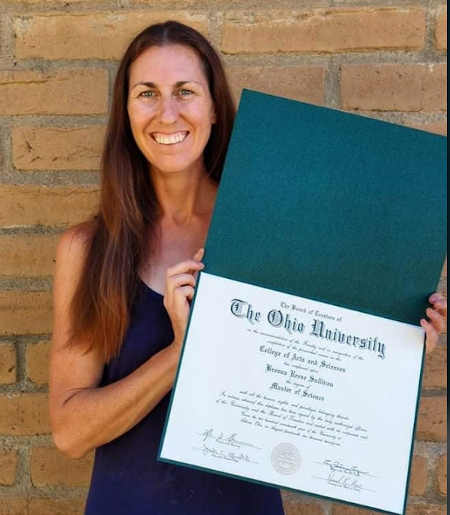
KELSEYVILLE, Calif. — Brenna Sullivan of Kelseyville has graduated with a Master of Science in geological sciences from the College of Arts and Sciences at Ohio University during the summer 2021 semester.
Sullivan, who has a bachelor’s degree in geological and earth sciences from the University of California, Santa Cruz, is the executive director of the Lake County Farm Bureau.
She’s also an accomplished athlete and horsewoman who has ridden in endurance competitions including the Tevis Cup.
More than 1,900 students graduated with bachelor's, master's or doctorate degrees from Ohio University for summer semester 2021.
The graduates represented many areas of the United States and an abundance of countries, including Bangladesh, China, Germany, Ghana, India, Netherlands and Nigeria, among others.
- Details
- Written by: Editor
Known as America’s College Promise, this provision would usher in the most significant expansion of access to higher education in the United States in decades.
The proposal includes a federal-state matching agreement making up to two years of community college tuition-free, recognizing the extraordinary value of two-year colleges in the United States.
“For too long, community college students have been unable to access the financial aid they need to thrive in our system,” said Board of Governors President Pamela Haynes. “America’s College Promise recognizes the need to rectify this longstanding disparity and invest federal dollars in community college students and their success.”
California stands to benefit significantly from the legislation, bringing in up to $2 billion in additional student aid to the state. Provisions in the latest version considered by the House Education and Labor Committee would ensure that states like California, which already invest in keeping tuition low and providing generous state-funded financial aid, are rewarded.
After eliminating all tuition for a student’s first two years of attendance, states like California would be able direct funds to additional forms of need-based financial aid to address the total cost of success.
Research indicates that mandatory costs such as food, housing, and transportation, not tuition, are the highest cost California students face to attending and succeeding in higher education.
An analysis from the Institute for College Access and Success shows that the net out-of-pocket cost to attend a California community college — total cost of attendance minus average grant aid — is generally higher than it is for a student to attend the University of California or California State University.
California may be eligible to receive up to $2 billion in federal funds over and above the cost of eliminating tuition throughout the system. These funds could be redirected to support students’ total cost to attend and reduce the need to either work excessive hours — which experts agree limits students’ ability to focus on their studies — or take out high amounts of loan debt.
Additional provisions of America’s College Promise would advance equity and student success include a $500 increase to the maximum federal Pell Grant award. The legislation would also expand eligibility for federal financial aid to undocumented students with Deferred Action for Childhood Arrivals status, a critical equity measure that the California Community Colleges have urged Congress to adopt for years.
“California’s 116 community colleges represent so much to our two million students — hope for a better future, a ticket out of poverty, and a critical tool for remedying long-standing racial and social inequities that still persist,” said Acting Chancellor Daisy Gonzales, PhD. “As much as we talk about the ‘total cost of attendance,’ we prefer to think of it as the ‘total cost of success.’ That is what the Build Back Better agenda represents an opportunity for us to finally address.”
The California Community Colleges is the largest system of higher education in the nation, composed of 73 districts and 116 colleges serving 2.1 million students per year.
- Details
- Written by: California Community Colleges
Undocumented Student Action Week is a statewide effort that engages and activates students, faculty and staff to support the needs of the more than 72,000 undocumented students enrolled at California Community Colleges.
This year’s theme, “Change in Action,” empowers students, faculty and staff to engage in state, federal and local action to support undocumented students in their goal of earning a college education.
The “Change in Action” theme reflects the ongoing need to scale evidenced-based student-centered policies and practices every day of the year.
The July 16, 2021, court ruling in the State of Texas, et al., v. United States, which held that the Deferred Action for Childhood Arrivals, or DACA, Program is unlawful, also creates an additional layer of uncertainty for undocumented students across the country.
The week-long event will be held during the same month as the 20th anniversary of the passage of Assembly Bill 540, the landmark legislation that opened the doors of higher education for thousands of undocumented students by removing the burden of out-of-state tuition.
To commemorate the anniversary, Immigrants Rising will host “20 Year Anniversary AB 540 Conference and Beyond” on Oct. 18 starting at 10 a.m.
At 1 p.m., the Chancellor’s Office will lead a plenary with higher education segment leaders to celebrate the success of AB 540 and discuss opportunities to address remaining challenges.
“As the nation’s largest post-secondary education system serving the largest number of undocumented students within the state, California Community Colleges are committed to serving all students, regardless of immigration status,” said California Community Colleges Acting Chancellor Daisy Gonzales, PhD. “Undocumented students enrolled at our colleges are aspiring teachers, doctors, artists and entrepreneurs and are poised to make significant contributions to help our nation recover from the pandemic. To be successful in their quest for a college education and career, students need and deserve stability.”
The Chancellor’s Office is calling on students, faculty and staff at all 116 colleges across California to advocate for Congress to include a comprehensive pathway to citizenship for undocumented students and make them eligible for federally funded financial aid within budget reconciliation. The Chancellor’s Office is also calling on institutional leaders, college staff, and UndocuLiaisons to further cultivate their policies and practices to create change that is student-focused and equity centered.
In the last five years, the collective budget and legislative advocacy of the California Community Colleges during USAW has led to funding for Dream Resource Centers and UndocuLiaisons, the establishment of an Immigration Legal Services Project, the expansion of AB 540 eligibility and the protection of DACA.
The 2021 USAW will build on these investments by empowering colleges to seek institutional reforms that will lead to more welcoming campus environments for all students, regardless of their immigration status.
The Chancellor’s Office will hold daily webinars at 1 p.m. during USAW on several critical topics, including a review of state undocumented student policies, the importance of program evaluation to measure undocumented student success, and innovative use of funds to support undocumented student efforts. Webinars will feature student speakers and campuses leading the way.
For more information, including a full schedule of events, visit Undocumented Student Action Week webpage.
Also available in our website the California Community College's Resolution Declaring October 18 to 22 as Undocumented Student Action Week.
The California Community Colleges is the largest system of higher education in the nation, composed of 73 districts and 116 colleges serving 2.1 million students per year.