 How to resolve AdBlock issue?
Community
- Details
- Written by: Eleven Roses Ranch
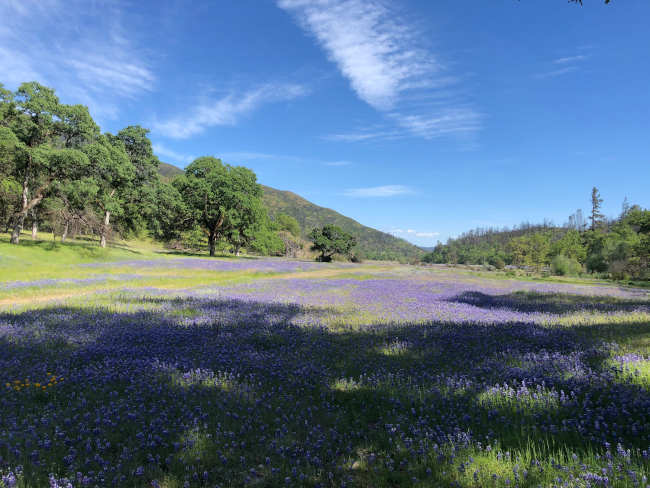
CLEARLAKE OAKS, Calif. — Eleven Roses Ranch will offer their spring wildflower tours from April 9 through 24.
This lovely day-trip includes a narrated ranch-wagon tour through this historic ranch, featuring springtime wildflowers and scenic beauty.
The day includes music by Don Coffin on guitar and Andi Skelton on fiddle.
A complimentary chuck wagon barbecue with Lake County wines for adults rounds out the day.
All tours begin at 11 a.m.
The cost is $65 per adult and $45 for children 10 years and under. Under 5 years is free with an adult.
This tour has limited availability and is by reservation only.
Please contact Eleven Roses Ranch at 707-998-4471 or email
- Details
- Written by: California Water Service
Cal Water secured funding from the California Water and Wastewater Arrearage Payment Program, which enabled water suppliers to apply for financial support on behalf of customers unable to pay their water bills.
In late November 2021, Cal Water had requested more than $20 million in relief from the Program’s administrator, the State Water Resources Control Board, for customers with past-due balances incurred between March 4, 2020, and June 15, 2021, across its service areas.
The utility received the requested funding amount and will apply credits to affected customers’ accounts by the end of March. Customers are being notified directly if a credit will be applied to their accounts.
Customers with remaining balances that predate the pandemic or have accrued after June 15, 2021, can take advantage of Cal Water’s interest- and penalty-free payment plans or extensions, subject to certain terms and conditions, to help prevent them from becoming subject to potential disruptions in water service in the future. Income-eligible customers may also enroll in Cal Water’s Customer Assistance Program, which provides qualifying customers a discount on their monthly service charge.
“At Cal Water, we recognize the financial impact COVID-19 has had on many of our customers. To reduce the burden caused by the pandemic, we applied for funding from the state of California to help offset customers’ past-due balances incurred during the pandemic,” said District Manager Evan Markey. “We believe that these credits will help give peace of mind to many of our customers who continue to struggle financially and encourage them to apply for our other financial assistance programs, if needed.”
Cal Water serves about 3,600 people through 1,900 service connections in Lucerne and parts of Duncans Mills, Guerneville, Dillon Beach, Noel Heights and Santa Rosa and about two million people through 492,600 service connections in California.
The utility has provided water service in the area since 2000. Additional information may be obtained online at www.calwater.com.
- Details
- Written by: Governor’s Office
In an executive order signed Monday, the governor ordered the State Water Resources Control Board, or SWRCB, to evaluate the adoption of regulations banning irrigation of “non-functional” turf (or grass), such as decorative grass adjacent to large industrial and commercial buildings.
The ban would not include residential lawns or grass used for recreation, such as school fields, sports fields and parks.
The Department of Water Resources estimates this ban alone will result in potential water savings of several hundred thousand acre-feet. An acre-foot of water serves the needs of approximately three households for a year.
“While we have made historic investments to protect our communities, economy and ecosystems from the worsening drought across the West, it is clear we need to do more,” said Gov. Newsom. “Today, I am calling on local water agencies to implement more aggressive water conservation measures, including having the water board evaluate a ban on watering ornamental grass on commercial properties, which will drive water use savings at this critical time. Amid climate-driven extremes in weather, we must all continue to do our part and make water conservation a way of life.”
As the drought persists into a third year and conditions worsen amidst dry, hot weather, the order called on the SWRCB to consider requiring urban water suppliers to activate, at a minimum, Level 2 of their customized Water Shortage Contingency Plans.
These plans, required by state law, are developed by local water agencies to navigate drought and each plan is customized based on an agency’s unique infrastructure and management.
Triggering Level 2 of these plans involves implementing water conservation actions to prepare for a water shortage level of up to 20 percent. For example, in many communities, this would mean reducing the number of days that residents can water outdoors, among other measures.
To further conserve water and strengthen drought resiliency in this critically dry year, the Governor is encouraging suppliers, where appropriate, to consider going above and beyond the Level 2 of their water shortage contingency plans, activating more ambitious measures.
The governor has also ordered state agencies to submit funding proposals to support the state’s short- and long-term drought response, including emergency assistance to communities and households facing drought-related water shortages, facilitating groundwater recharge and wastewater recycling, improvements in water use efficiency, protecting fish and wildlife, and minimizing drought-related economic disruption.
The executive order includes several other provisions that will protect all water users:
• Ensuring vulnerable communities have drinking water: Cuts red tape so communities that need access to emergency hauled or bottled water can get it immediately
• Safeguarding groundwater supplies: Requires local permitting authorities to coordinate with groundwater sustainability agencies to ensure new proposed wells do not compromise existing wells or infrastructure, as 85% of public water systems rely heavily on groundwater during drought; streamlines permitting for groundwater recharge projects that help to refill aquifers when rains come.
• Protecting vulnerable fish and wildlife: Expedites state agency approvals for necessary actions to protect fish and wildlife where drought conditions threaten their health and survival.
• Preventing illegal water diversions: Directs the water board to expand site inspections in order to determine whether illegal diversions are occurring.
The Governor’s California Comeback Plan invests $5.2 billion over three years to support the immediate drought response and build water resilience, including funding to secure and expand water supplies; bolster drought contingency planning and multi-benefit land repurposing projects; support drinking water and wastewater infrastructure, with a focus on small and disadvantaged communities; advance Sustainable Groundwater Management Act implementation to improve water supply security and quality; and support wildlife and habitat restoration efforts, among other nature-based solutions.
Earlier this month, Gov. Newsom advanced an additional $22.5 million to bolster the state’s drought response. Of this funding, $8.25 million will be used to increase educational and outreach efforts, including through the Save Our Water campaign, which is providing Californians with water-saving tips via social media and other digital advertising.
The Governor’s California Blueprint proposal includes $750 million in additional drought funding, $250 million of which was set aside as a drought reserve to be allocated in the spring, based on conditions and need.
More information on the state’s response to the drought and informational resources available to the public are available at https://drought.ca.gov/.
- Details
- Written by: Office of Sen. Bill Dodd
“Prescribed burning is one of the most effective means of wildfire prevention, which is why I wrote the law last year to encourage greater use of this proven technique,” Sen. Dodd said. “My new bill continues our efforts to encourage greater use of prescribed fire by ensuring those who practice this time-tested technique can have some protection from any unintended costs. I thank committee members for seeing the value in this proposal.”
Prescribed fire, also known as controlled burning, has been used for centuries to clear tinder-dry trees and brush that are known to fuel runaway wildfires.
Rarely do prescribed fires escape their bounds and cause damage to neighboring properties. If they do, Sen. Dodd’s new bill, Senate Bill 926, would establish a fund to help cover costs.
It is a followup to Senate Bill 332, written by Sen. Dodd and signed into law last year, which protects landowners and prescribed fire managers from having to pay fire suppression expenses unless they have acted with gross negligence.
SB 926 is sponsored by The Nature Conservancy. It passed the Senate Natural Resources committee with overwhelming support.
“Returning beneficial fire to the landscape is essential to both forest health as well as reducing the impacts of megafires to our communities,” said Jay Ziegler, director of policy and external affairs at The Nature Conservancy. “SB 926 will establish a prescribed fire claims fund allowing for the implementation of $20 million included in last year’s budget for this purpose. This measure is critical to reducing the risks and impacts of massive and severe wildfires that are only expected to grow with climate change.”
"Reintroduction of ‘good fire’ — prescribed burns — is an important component of strengthening the resilience of our forests and communities to climate changed fueled wildfire and drought,” said Michael Wara, director of the Climate and Energy Policy program at Stanford University. “With SB 926, Sen. Dodd proposes a practical path to overcome one of the major barriers -- lack of available insurance coverage -- that has kept many private prescribed burners on the sidelines and slowed down work that will keep all Californians safer during wildfire season.”