 How to resolve AdBlock issue?
Letters
- Details
- Written by: John Daniels
This option brings about increased cost, unqualified candidates (get on the money train) and other various fraud schemes. Additionally the Supreme Court's concern is that any new rules can not limit speech.
The following four simple steps will limit cost and meet the Court's objection. Please support this for a California initiative.
1. No individual may contribute funding and/or services to a political/election campaign of another individual for public office unless he/she is eligible to vote for that individual candidate.
2. Political parties, companies, labor unions, political action committees and groups of individuals cannot vote, and therefore they cannot contribute to the election campaign of an individual for public office.
3. No individual can contribute to election campaign(s) in any one year, an amount exceeding his/her reported federal income tax adjusted gross income for the previous tax year. This includes candidates themselves. Contributions to political campaigns are not tax-deductible.
4. Political parties, companies, labor unions, political action committees and groups of individuals may provide any amount of financial or other support, to educate and inform their employees, membership and the general public on any issue in public discussion. All communications must identify the sponsor. In addition, no mention will be made of any public office holder(s), and /or candidate(s) position(s) on or related to any issue(s) under public discussion.
John Daniels lives in Lakeport.
- Details
“Before AIM (the American Indian Movement), Indians were dispirited, defeated and culturally dissolving. People were ashamed to be Indian. You didn’t see the young people wearing braids or chokers or ribbon shirts in those days. Hell, I didn’t wear them. People didn’t Sun Dance, they didn’t sweat, they were loosing their languages. Then there was that spark at Alcatraz, and we took off. Man, we took a ride across this country. We put Indians and Indian rights smack dab in the middle of the public consciousness for the first time since the so called Indian wars…AIM laid the groundwork for the next stage in regaining our sovereignty and self-determination as nations, and I am proud to have been part of that.” – Russell Means, Oglala Lakota
In Nov. 20, 1969, until June 11, 1971, more than 5,600 Indians joined in the occupation of Alcatraz, from many different backgrounds and nations, claiming it as Indian land under the 1868 Fort Laramie Treaty, which promised Lakota people surplus Federal land.
In a background of US policies of Relocation and Termination, of the government attempting to dissolve all remnants of Indian cultural and racial identities in America’s “melting pot” and to end all treaty rights in order to grab the little land and resources Indians still had, fed up with economic, social, political neglect and with widespread racist policies of harassment and abuse, the Indian youth of the sixties was ready to take a stand and make a difference, and they did.
They ignited a spark that fed many fires of activism, and that reasserted Indian identity.
No longer were Indians going to submit to the dominant culture’s ideas of what an Indian should think, how he should act, what she should feel … specifically, no longer were Indians going to let themselves be coerced into pretending to be White.
“If you wanted to make it in America as an Indian, you had to become a hollow person and let them (the government and White American society) remold you…Alcatraz put me back into my community and helped me remember who I am. It was a rekindling of the spirit.” – John Trudell, Santee Lakota
A few years after Alcatraz, Congress passed 52 legislative proposals on behalf of Indians to support tribal self-rule. They included passage of the Indian Self-determination and Education Act, revision of the Johnson O’Malley Act to better educate Indians, passage of the Indian Financing Act, passage of the Indian Health Act and the creation of an Assistant Interior Secretary post for Indian Affairs.
Mount Adams was returned to the Yakima Nation in Washington State, and 48,000 acres of the Sacred Blue Lake Lands were returned to Taos Pueblo in New Mexico.
During the occupation Nixon quietly signed papers canceling the policy of termination, which was designed to end federal recognition of tribes and of all treaties.
“Indian lands were being drained. Indians were marked for destruction so that the government could take over the lands and the coal, uranium, timber and water on them.” – Fortunate Eagle, Red Lake Ojibwa
While the FBI busied itself with its secret anti-dissident operation COINTELPRO and in listing Indian activists as “enemies of the state”, popular support for their causes poured from many quarters ... many wanted to see them succeed, and went out of their way to help them.
After the occupation, AIM began a series of national protests, among them the takeover at Wounded Knee in 1973 and the Longest Walk in 1978, demanding that the government honor treaty obligations. Since then, Indian activists have fought on many fronts, for fishing rights, land and grazing rights, for sacred sites, protesting athletic teams Indian mascots, working for the repatriation of sacred objects taken from Indian lands, of thousands of Indian remains kept in museums throughout this nation. And in an era of energy crisis, Indian are still forced to resist the corporate takeovers of their natural resources and the pollution or draining of water tables under their lands by industry.
The yearly reunion and ceremony at Alcatraz is meant to honor and give thanks to the individuals who, by taking such a stand, helped Indian people remember who they are, and paved the way for the revival of the Indian spirit. It is officially an “Un-Thanksgiving” as far as the dominant culture’s holiday is concerned, yet is it truly an Indian Thanksgiving.
Raphael Montoliu lives in Lakeport.
- Details
- Written by: Lori Patotzka
If there will be a turkey on your table this Thanksgiving, you can be almost certain that he or she suffered a miserable life and death for your brief pleasure. There are no laws for the humane treatment of turkeys on farms or in the slaughterhouse. (Neither chickens nor turkeys are included in the Humane Slaughter Act.)
In the wild, turkeys have complex language – more than 20 different vocalizations – and can recognize one another’s voices. Rescued farm turkeys show affection toward humans and, like cats, they purr when content.
But on modern “farms” – including organic farms – turkeys live their entire lives in windowless sheds with about 1 square foot of space per bird.
While wild turkeys can fly, farmed turkeys cannot. In fact, because they are bred for excessive growth, many cannot walk. En route to slaughter, 10 to 15 percent of turkeys die from suffocation (an accepted industry standard). Many others arrive in extreme pain with broken bones.
Because of the fast pace of slaughterhouses, turkeys and chickens are often insufficiently stunned before slaughter. Government estimates are that about four million birds per year are still conscious when dropped into the scalding tanks.
Conditions for organically-produced animal foods are no better. (The Vermont slaughterhouse that was closed this month after employees were filmed kicking and electro-shocking two-day old calves – who were too weak to stand – was one that slaughtered animals from local organic dairy farms).
Most Americans say that they care about animals, that they would never hurt or abuse an animal. The hard truth is that when you eat meat, eggs and dairy, you participate in animal abuse.
Thanksgiving – an expression of gratitude and a celebration of family and abundance – is the ideal time to consider going vegetarian.
In his book “Eating Animals,” Jonathan Safran Foer says this about a vegetarian Thanksgiving: “There is no turkey. Is the holiday undermined? Or would Thanksgiving be enhanced? Would the choice not to eat turkey be a more active way of celebrating how thankful we feel? Try to imagine the conversation that would take place. This is why our family celebrates this way. Would such a conversation feel disappointing or inspiring?”
Vegetarians know the answer. It feels good when our choices reflect our true values about compassion for animals.
Lori Patotzka lives in Clearlake.
- Details
- Written by: Nina Marino
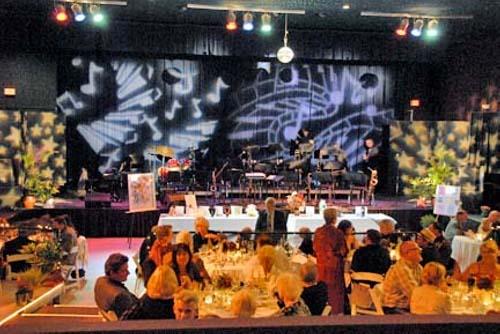
The Soper-Reese Fundraising Committee is grateful for the support of the following businesses and individuals who made generous donations to our annual fundraising event in the fall, held for the first time at the Soper-Reese Community Theatre. For our Harvest Moon Dinner & Dance on Oct. 3, the theater was transformed into a dinner/dance club and showcased another use of your performing arts theater.
We thank our major sponsors who include the Blue Wing Saloon & Café in Upper Lake, the Lake County Winegrape Commission and Ceago Vinegarden. Wineries, as always, were generous in their donations of wine: Brassfield Estate, Ceago Vinegarden, Gregory Graham, Six Sigma, Tulip Hill and Zoom Wineries. The Early Lake Lions Club provided an inviting cocktail bar for our guests. Applerain Nursery loaned many plants to enhance the ambiance of the theater, with florist Sabrina creating the beautiful centerpieces.
Shaun Hornby of Hornby Furniture Restoration was our auctioneer extraordinaire. Live auction items were donated by the following: Lakeport English Inn, Park Place Restaurant, Ann and George Linn, Enrico and Kris Frediani, Karl and Sharon Nicoll, Chuck Farrell, R.B. Peters and Kelseyville Lumber.
Silent auction items were donated by Brad Barnwell, Clear Lake B&B, T.J.’s Restaurant, Tom Jordan, Guy Strohmeier’s Auto Center, Mackey Tire, Buckingham Golf & Country Club, Disney’s Water Sports, Ciao Thyme, Steele Winery, Wildhurst Winery, Cindy Carr, Pieces Boutique, Hans Dobusch, Debi Freeland, Betty Lou Surber, the estate of Joan Holman, Lakeview Market and Edgewater Resort.
Lovely music during the reception and dinner was performed by Dan Meyer. Following dinner and the live auction, the Mendocino Jazz Band, under the direction of John Parkinson, played their big band music, to the delight of the guests.
The entire event was a success, thanks to our donors and those individuals and organizations mentioned above. We appreciate the support of this generous community as we continue the renovation of the Soper-Reese Community Theatre.
Nina Marino chairs the Soper-Reese Community Theatre's fundraising committee.