 How to resolve AdBlock issue?
Business News
- Details
- Written by: Editor
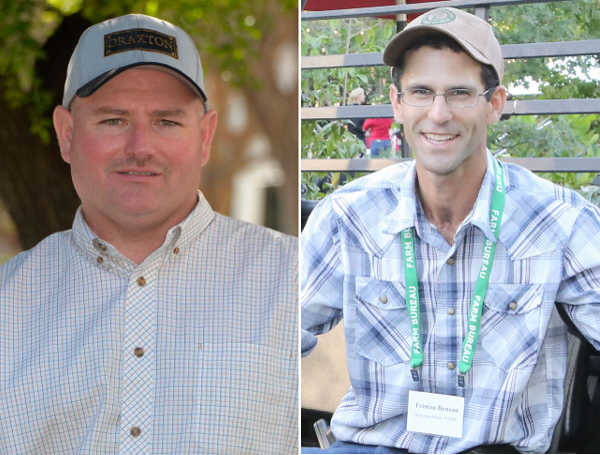
SANTA ROSA, Calif. – Pat Burns and Tristan Benson have joined the Board of Directors for Sonoma County Farm Bureau, the county's largest agricultural organization.
Burns, a Healdsburg native, started his term with Sonoma County Farm Bureau in August 2017, having previously attended board meetings as a Farm Bureau member. Burns chairs Sonoma County Farm Bureau's Labor & Safety committee and serves on the membership committee.
Burns grew up surrounded by agriculture, but wasn't actively involved in the industry until 1993 when he started working for Bevill Vineyard Management where he worked as a vineyard manager for the next 20 years.
Since 2013, Burns has worked as the general manager of Vineyard Operations for M. Draxton Wines where he oversees the vineyard operations of 250 acres of Cabernet in Alexander Valley. Additionally, Burns is in charge of grower relations and purchasing grapes for Draxton Wines.
Burns joined Sonoma County Farm Bureau's board to stay current on issues affecting agriculture. He is looking forward to the opportunity to educate the general public about agriculture and how it affects them. For Burns, water and labor are two of the most critical issues affecting local agriculture.
Benson, 34, joins the board as the chair of the Sonoma-Marin Young Farmers & Ranchers (YF&R), a committee of Sonoma County Farm Bureau for active agriculturists between the ages of 18 and 35 who are involved in production, banking, business, and many other areas of the agriculture industry.
Benson succeeds Andrew Ryan who served on the Sonoma County Farm Bureau Board for the 2016-2017 term. Benson's term on the Sonoma County Farm Bureau Board will coincide with his one year term as chair of the Young Farmers & Ranchers committee.
The YF&R committee chair began serving on the Sonoma County Farm Bureau board last year when Sonoma County Farm Bureau saw an increased need to involve future leaders in the current issues and regulations facing Sonoma County agriculture.
Benson is the foreman of Benson Ranch, a family business that produces plums, Asian pears and grain. Benson produces seed grain with a business partner that gets sold to millers. Benson also considers himself a mechanic, repairing equipment for his custom farming operation and other farmers.
Benson is passionate about agriculture and wants to see the industry thrive. While he sees challenges, he also sees many opportunities in Sonoma County. It is particularly important to Benson to encourage the next generation of farmers to continue in agriculture and ensure they are successful.
"Sonoma County Farm Bureau is excited to welcome Pat Burns and Tristan Benson to our Board of Directors," said Steve Dutton, president of Sonoma County Farm Bureau. "Pat brings years of experience in the industry, a strong passion for agriculture and commitment to watching and contesting regulations that could harm agriculture. Tristan represents the next generation of agricultural leaders and his enthusiasm to support Sonoma County ag is welcome on our board."
Sonoma County Farm Bureau currently has 17 board members, with one spot reserved for the chair of the Sonoma-Mary Young Farmers and Ranchers committee. A full list of board members is available at www.sonomafb.org/directors.
- Details
- Written by: Editor
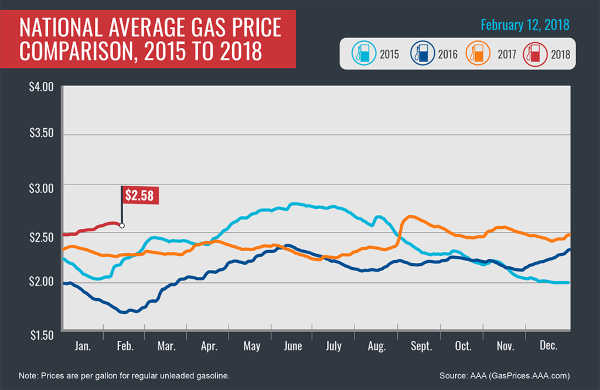
Gas prices in California dropped for the first time in 2018, but it's unclear whether this one-week decline is a signal that cheaper gas is on the horizon for the Golden State.
California's average price for a gallon of unleaded gasoline was $3.34 on Tuesday, just one cent lower on the week.
But that small decrease put an end to 45 straight days of rising gasoline prices; California started the year with an average price of $3.10 per gallon and peaked at $3.35 last week.
U.S. gas prices typically decrease in January and February as travel demand falls after the holiday season, but rising oil prices the last few months resulted in abnormally high prices at the pump.
Crude oil prices hovered around $50 a barrel for most of 2017, but jumped to $70 a barrel by early January 2018 after Saudi Arabia and other OPEC countries began to cut oil production.
Some analysts predicted that rising oil prices could hit $80 a barrel and push California gasoline to $4 by this May, but AAA believes that is speculative.
The Oil Price Information Service said in its 2018 outlook that $70 prices for crude oil are likely unsustainable in 2018, and after last week's stock market volatility, crude oil prices dropped nearly 8 percent. On Tuesday crude oil was selling for about $62 a barrel.
Another factor in this year's higher prices has been a strong economy on the West Coast, which means more people driving and consuming energy. Gasoline demand registered at 9.1 million barrels per day, a 169,000 barrel-per-day increase year-over year.
"California consumers should be prepared for prices to increase this year another potential 10 to 15 cents, but many market factors will drive that. Without a crystal ball, it's too soon to determine," said Michael Blasky, spokesman for AAA Northern California.
AAA’s Fuel Gauge Report is the most comprehensive retail gasoline survey available, with over 100,000 self-serve stations surveyed every day, nationwide. Data is provided in cooperation with OPIS Energy Group and Wright Express, LLC.
- Details
- Written by: Editor
Personal income taxes, or PIT, and corporation taxes, two of the “big three” sources of general fund dollars, exceeded estimates for the second consecutive month and are both surpassing assumptions for the fiscal year.
For the first seven months of the 2017-18 fiscal year, total revenues of $74.56 billion are higher than expected in the January budget proposal by 4.0 percent, 7.5 percent above the enacted budget’s assumptions, and 11.7 percent higher than the same period in 2016-17.
For January, PIT receipts of $15.60 billion were $2.25 billion, or 16.9 percent, above the proposed budget’s projections and $1.33 billion ahead of 2017-18 Budget Act estimates.
For the fiscal year, PIT receipts of $54.70 billion are higher than anticipated in last summer’s budget by $3.61 billion, or 7.1 percent.
Corporation taxes for January of $551.6 million were $211.3 million, or 62.1 percent, higher than expected in the proposed budget and $143.4 million above the enacted budget’s estimates. This variance is partially because refunds were approximately $38.0 million lower than anticipated.
For the fiscal year to date, total corporation tax receipts of $4.81 billion are $1.08 billion, or 28.8 percent, above assumptions in the 2017-18 Budget Act.
Sales tax receipts of $1.01 billion for January were $138.0 million, or 12.0 percent, lower than anticipated in the governor’s budget proposal unveiled last month.
Notably, for the fiscal year, sales tax receipts of $13.03 billion are $151.2 million lower than January’s assumptions but $396.6 million, or 3.1 percent, above the enacted budget’s expectations.
Unused borrowable resources through January exceeded revised projections by $7.83 billion, or 30.8 percent. Outstanding loans of $5.64 billion were $5.19 billion, or 47.9 percent, less than the 2018-19 proposed budget estimates and $5.02 billion, or 47.1 percent, less than the 2017-18 Budget Act assumed the state would need by the end of January. The loans were financed entirely by borrowing from internal state funds.
- Details
- Written by: Editor
BBB warns those who use dating Web sites to be wary of scammers who prey on unsuspecting victims.
The study – “Online Romance Scams: A Better Business Bureau Study on How Scammers Use Impersonation, Blackmail and Trickery to Steal from Unsuspecting Daters” – says the scheme can take a number of months to play out as the scammer gains the victim’s trust.
The scammer eventually will begin to ask for small amounts of money to test the victim, then will ask for more and more. Victims often turn into unknowing accomplices of money laundering.
The study recommends that law enforcement agencies share more information about successful romance fraud prosecutions, do more training, and prosecute more cases.
BBB recommends online dating and social media apps and sites do more to screen, identify, and remove profiles used for scams. There also needs to be more support services offered for romance fraud victims.
“We believe that this is an under-reported crime with many victims too embarrassed to report what has happened to them,” said Lori Wilson, president and chief executive officer of BBB serving the San Francisco Bay Area and Northern Coastal California. “Victims can be wiped out financially and emotionally. If you are going to use an online dating site, it’s vital that you know that the person on the other end of the conversation is who they say they are.”
Wilson added that “while many people have great success online, be sure to use common sense and listen to your internal radar.”
A California woman, Ann, lost $22,000 to a romance scam and is now totally broke, in credit card debt, and living with her daughter.
A year after her husband died, Ann decided to try online dating. Before long she heard from a man who called himself “Wayne King.” They began communicating, first through a dating Web site and then over text. King claimed to be a 66-year-old living in Pasadena who owned a company in Maryland.
He tried to gain Ann’s confidence by showing her “evidence” that proved his bank account contained more than $1 million. When King said his daughter was in the hospital, Ann sent some money to help.
Then King said he was in Beijing, but was having trouble shipping goods for his business to the U.S. He asked Ann to help him pay to ship the goods through Malaysia to the U.S.
Over the course of a month, Ann sent King $22,000 on the strength of his promises to pay her back. Later, King asked her to buy him four iPhones and a Macbook Pro. She maxed out her credit cards to buy these and ship them to him, again on the promise that King would pay her back. He never did.
At 69 years old, she is now taking medication for anxiety, may need heart surgery and is filing for bankruptcy. Her daughters told her she needed to report this, and Ann went to the police and also reported it to BBB. Despite the heartache she has suffered, she agreed to share her story to help keep others from suffering through a similar experience.
Among the report’s key findings:
– There is no “typical” victim of romance fraud. They can be any gender, age, or sexual orientation. The common denominator is that they are seeking a loving relationship, and they believe they have found it.
– Scammers often pretend to be U.S. military members. Military officials say they receive thousands of complaints yearly from scam victims around the world. Officials note military members will never need money for leave or health care.
– The majority of romance fraud has its home in West Africa, particularly Nigeria. There also are groups that operate in Russia and the Ukraine that employ online dating sites to defraud victims.
At any one time, there may be 25,000 scammers online working to defraud victims. A company that screens profiles for dating companies told BBB that 500,000 of the 3.5 million profiles it scans monthly are fake – around 15 percent.
The report was prepared by C. Steven Baker, BBB International Investigations Specialist. Baker is the retired director of the Federal Trade Commission’s Midwest Region.
In his role with BBB, Baker is working with an alliance of five BBB’s, including the Oakland office, in analyzing and reporting on some of the most pervasive fraud issues that impact American consumers. This is his third study released through BBB. A September 2017 study on puppy scams and a December 2017 study on tech support scams he authored each were met with worldwide media coverage.
BBB offers the following tips for daters to avoid being caught in a romance scam:
– Protect your identity and your wallet. Scammers prefer prepaid cards and money transfers. Never send money or any personal information to someone you’ve never met in person. Phone conversations or “meeting” someone via a video call doesn’t mean they’re not a scammer. Also, be cautious revealing any personal information or doing anything you might regret later when using video applications. Some scammers use software to record video calls and then use it to extort money from victims. Don’t succumb to pleas of financial crisis.
– Think before going from public to private. Be hesitant if the conversation moves from a social media or a dating site to a more private form of communication like email, instant messaging, or texting. Dating sites often monitor messages to prevent scams, and scammers will try to use this strategy to draw you in without other people interfering.
– Do your research. Pour over the profile image and description. If it sounds too good to be true, verify it. You can perform a reverse image search to see if profile photos have been used on other websites. You can also copy a portion of their biography and search to see if it’s been used on other sites. Scammers often use the same profile details and photos on multiple sites.
– Ask for details and get specific. Request other forms of identification, like a photo of them holding a piece of paper with their username on it. Ask specific questions about details in their profile. If they claim to be a military member, ask for their official military address as those all end in @mail.mil. Scammers likely will make excuses for why they can’t provide you more information.
Pay attention to communication. Be wary of bad grammar and misspelled words. No one is perfect, but if mistakes often are repeated, it may suggest they aren’t from where they claim. Be on guard for use of pet names, discussions of marriage, or professions of love early in correspondence.
– Report it. If you feel like you’ve been victimized, report it to BBB Scam Tracker, the Federal Trade Commission and FBI.