 How to resolve AdBlock issue?
Business News
- Details
- Written by: Elizabeth Larson
The funds will help support disaster relief operations for people impacted by the Camp fire in Northern California, and the Woolsey and Hill Fires in Southern California.
The American Red Cross will receive $125,000 to support those across the state that have been affected by wildfires.
Additionally, $50,000 is allocated to the United Way of Northern California, $50,000 is being granted to the Ventura County Community Foundation and $25,000 is being donated to the Los Angeles Fire Department Foundation.
Wells Fargo encourages customers experiencing hardship due to the wildfires to contact Wells Fargo Customer Support at the number on their credit card, debit card or statement to discuss their options.
Affected customers can also contact their banker by visiting their nearest Wells Fargo branch.
California Wells Fargo customers who wish to support American Red Cross wildfire relief efforts may also donate through Wells Fargo ATMs through Nov. 26 or by redeeming any amount of available Go Far Rewards for donation from Nov. 14 through Nov. 28.
· Customers can go to any Wells Fargo ATM in California and select the option to donate. There is no fee and 100 percent of contributions will be sent to the American Red Cross.
· Go Far Rewards customers can access their rewards account at www.GoFarRewards.wf.com or by calling the service center at 877-517-1358.
“Last year, I lost my home in one of the Northern California fires,” said Northern California Region Bank President Thomas Sands. “I know of the challenges many families are facing in impacted areas. I am proud that Wells Fargo is providing funding to nonprofits across California so they can help families with immediate needs.”
“These devastating fires are impacting our customers, neighbors and our own team members,” said Central Coast Region Bank President Ernie Pineda. “Our hearts go out to all those who have been affected, and we want to do our part to support the organizations who are helping victims of these fires. With the fires still burning and potentially more devastation, we will continue to work with nonprofits and those focused on recovery efforts, as we determine any additional assistance and support Wells Fargo may be able to provide in the coming weeks.”
- Details
- Written by: California Controller's Office
This month, sales tax was the only major revenue source to come in higher than projected in the enacted budget. Personal income tax (PIT) and corporation tax – the two other revenue sources in the “big three” – were lower than assumed in the enacted budget.
Four months into FY 2018-19, revenues of $35.28 billion are 3.0 percent ($1.02 billion) higher than projected in the budget enacted at the end of June. Total revenues for FY 2018-19 thus far are 8.1 percent ($2.63 billion) higher than through the first four months of FY 2017-18.
Sales tax receipts of $1.03 billion for October were 8.2 percent ($77.9 million) more than anticipated in the FY 2018-19 budget.
For October, PIT receipts of $5.13 billion were 8.4 percent ($472.0 million) less than expected in the FY 2018-19 Budget Act.
October corporation taxes of $254.8 million were 10.9 percent ($31.1 million) below FY 2018-19 Budget Act estimates.
- Details
- Written by: California Department of Fish and Wildlife
The commercial Dungeness crab fishery south of this area will open as scheduled on Thursday, Nov. 15.
State health agencies determined that Dungeness crab in state waters from Bodega Head, Sonoma County north to the Sonoma/Mendocino county line have elevated levels of domoic acid and recommended a delay of the commercial fishery in this area.
The commercial delay includes ocean waters from the southern boundary of Bodega Head State Marine Reserve, Sonoma County (38° 18' N. latitude) north to the Sonoma/Mendocino county line (38° 46.125' N. latitude).
Commercial take and/or possession of Dungeness crab is prohibited in these waters. North of the Sonoma/Mendocino county line, the Dungeness crab commercial season is not scheduled to open until Dec. 1. That opener is also subject to delay pending test results both for domoic acid as well as crab quality.
The area south of the southern boundary of the Bodega Head State Marine Reserve, Sonoma County to the California/Mexico border will open at 12:01 a.m. on Thursday, Nov. 15, to be preceded by an 18-hour gear setting period that would begin no earlier than 6:01 a.m. on Wednesday, Nov. 14.
This delay shall remain in effect until the Director of the Office of Environmental Health Hazard Assessment, or OEHHA, in consultation with the State Public Health Officer at the California Department of Public Health, or CDPH, determines that domoic acid no longer poses a significant risk to public health and recommends opening the fishery in this region.
CDFW will continue to coordinate with CDPH and OEHHA to test domoic acid levels in Dungeness crab to determine when the Dungeness crab commercial fishery in this area can safely be opened.
Once a positive determination is made to open the fishery, CDFW may provide the fleet a minimum of 72-hour advance notice announcing when trap gear can be set.
Additional information on the commercial Dungeness fishery can be found here.
The recreational fishery for Dungeness crab opened in most areas of the state on Nov. 3 under a health warning issued by CDPH for Dungeness crab caught in Sonoma County. The recreational fishery remains closed in state waters from Patrick's Point in Humboldt County north due to elevated levels of domoic acid.
Domoic acid is a potent neurotoxin produced by a naturally occurring marine alga, whose levels can be increased under certain ocean conditions, and can accumulate in shellfish, other invertebrates and sometimes fish.
It causes illness and sometimes death in a variety of birds and marine mammals that consume affected organisms. At low levels, domoic acid exposure can cause nausea, diarrhea and dizziness in humans. At higher levels, it can cause persistent short-term memory loss, seizures and death.
- Details
- Written by: Elizabeth Larson
WALNUT CREEK, Calif. – Gas prices across the country are finally dropping after months of unseasonal increases, which were driven by stock market speculation over how U.S. sanctions against Iran would impact the global oil supply.
But oil prices have held steady since the sanctions took effect on Monday, surprising some analysts who predicted Iran's reduced exports would cause oil prices – and subsequently gas prices – to rise even further to end the year.
That hasn't happened, in part because oil prices on the stock market had been increasing all year as traders anticipated the Iran sanctions, mitigating potential sticker shock.
"Crude oil prices have been rising all year in anticipation of sanctions against Iran, which means motorists likely already experienced the worst effects of these sanctions on the price of gasoline," said Michael Blasky, spokesman for AAA Northern California. "If these oil prices continue to hold, we could see another 10-cent price drop in retail prices before Christmas."
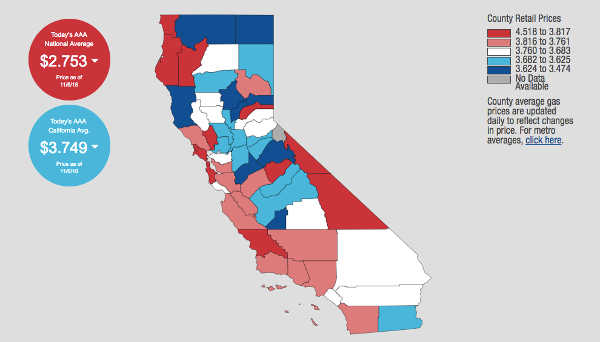
California gasoline prices have dropped nearly 8 cents since reaching a 2018-high of $3.82 on Oct. 16. Most of the recent decrease can be attributed to California gas stations beginning to sell the state's winter blend of gasoline this month, which is cheaper for refineries to produce and costs about 6-10 cents less per gallon.
California's average price for unleaded gasoline on Tuesday was $3.74, according to AAA. Nationally, the average price for gasoline has dropped from $2.91 to $2.75 in just a few weeks.
Analysts predict the full impact of Iran sanctions may not be felt until next summer, when the travel season increases market demand for fuel. The Iran sanctions, as currently enforced, will remove about 2 percent of the global oil supply from the market, and it remains to be seen whether other oil producers can make up the difference.