 How to resolve AdBlock issue?
Business News
- Details
- Written by: California Controller’s Office
Total revenues of $74.42 billion for the first seven months of FY 2018-19 were lower than expected in the proposed and enacted budgets by $2.87 billion and $1.32 billion, respectively. In the fiscal year to date, state revenues are just 0.2 percent lower than the same time last year.
Sales tax and corporation tax – two of the state’s “big three” revenue sources – came in higher than assumed in last month’s proposed budget.
For January, personal income tax, or PIT, receipts of $16.36 billion were $2.53 billion, or 13.4 percent, less than the Department of Finance forecasted last month but $403.6 million, or 2.5 percent, higher than assumed in the budget enacted last June. PIT revenue was still 4.8 percent higher than in January 2018.
Sales tax receipts of $1.59 billion for January were $602.8 million higher than anticipated in the proposed FY 2019-20 budget and $647.4 million higher than in the FY 2018-19 Budget Act.
Last month’s $579.2 million in corporation taxes were 9.0 percent higher than estimates in the FY 2019-20 budget proposal and 12.0 percent higher than in the enacted FY 2018-19 budget.
For more details and comparisons, read the monthly cash report. This month’s edition of the Controller’s California Fiscal Focus newsletter focuses on how the state can maintain its leadership on climate change and how California could conform to the federal tax code.
As the chief fiscal officer of California, Controller Yee is responsible for accountability and disbursement of the state’s financial resources. The Controller also safeguards many types of property until claimed by the rightful owners, and has independent auditing authority over government agencies that spend state funds.
- Details
- Written by: Elizabeth Larson
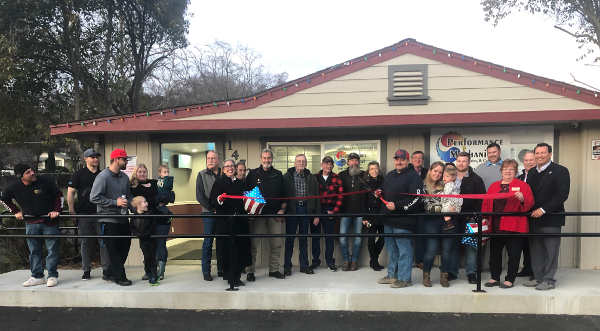
LAKE COUNTY, Calif. – The Clear Lake Chamber of Commerce hosted a ribbon cutting ceremony for Performance Mechanical on Wednesday, Feb. 6.
City Manager Greg Folsom and Mayor Nick Bennett, among other community leaders, loyal customers, friends and family gathered to celebrate the opening of Performance Mechanical’s new location at 14728 Emory Lane in Clearlake.
“It is great to see local businesses like Performance Mechanical expand locally and reinvest in the community,” said Folsom. “It’s a double win for our city to see our businesses succeed and improve properties in our commercial core.”
Bennett added, “I am pleased to see a growing business in Clearlake that supports our community programs in so many ways.”
Performance Mechanical is involved in community youth programs. The company has donated thousands of dollars to the Little League baseball program and the youth center.
Performance Mechanical shows that they are serious about helping our community.
“We’d like to thank everyone for attending, it was a great turn out. We appreciate the support from our community,” said company owner Phil Harris, also a member of the Clearlake City Council.
Formed in 1947, the Clear Lake Chamber of Commerce is the original business chamber in Lake County located at 14295 Lakeshore Drive in Clearlake.
The Chamber is a network of active business owners who work together to provide support and advocacy for Lake County businesses in order to promote Lake County’s growing economy.
Businesses interested in expanding their market share are encouraged to join the chamber by contacting Office Manager Patrick Prather at 707-994-3600.
- Details
- Written by: Elizabeth Larson
Unlike personal vehicles, current law does not require heavy-duty vehicles to have the same types of smog checks that have been required for passenger cars for decades.
Around one million heavy-duty trucks drive on California roads annually and are major contributors to the state’s poor air quality conditions, Leyva’s office said.
Over the next decade, SB 210 will assist in the removal of approximately 1,600 tons of harmful particulate matter, equivalent to taking 375,000 trucks off the roads in the state.
“SB 210 is a critical next step to reduce pollution from the many big diesel trucks that travel on the roads and highways across California. Applying similar responsibilities to truck operators to maintain their emission controls, just like we already require for everyone else, is common sense,” Sen. Leyva said. “As new trucks with modern technology hit the roads, we have a unique opportunity to ensure long lasting air quality improvements and improve the competitiveness of the California trucking industry. SB 210 can be a real win-win for California residents and the air we breathe.”
Many California-based truck owners and operators strive to meet our nation-leading air quality standards by modernizing and properly maintaining their fleets.
Consequently, these operators can be at a competitive disadvantage with noncompliant vehicles, including many out-of-state trucks.
California already has some of the worst air quality in the nation, including areas such as the Central Valley and the Inland Empire – which serves as the primary route for transporting goods from the Ports of Long Beach and Los Angeles to the rest of the nation.
Today, heavy-duty trucks operating in California account for nearly 60 percent of the harmful nitrogen oxides (NOx) emissions from mobile sources and are the largest source of diesel particulate matter (PM 2.5), a carcinogenic and toxic air contaminant.
Across California, approximately 12 million residents live in communities that exceed federal ozone and PM standards.
Increased exposure to harmful emissions has been directly associated with serious health impacts, particularly for the elderly, small children, and people with pre-existing respiratory issues. SB 210 is a key step toward combating these harmful pollutants and improving air quality in California.
Following Monday’s introduction, SB 210 will be considered by the appropriate Senate committee later this spring.
- Details
- Written by: Elizabeth Larson
The meeting will be held from 10 a.m. to 2:30 p.m. at the California Department of Food and Agriculture, 1220 N St. – Main Auditorium, Sacramento.
“Advances in gene editing technology have great potential for food and agricultural production across the globe,” said President Don Cameron, California State Board of Food and Agriculture. “Better understanding this technology and how it complements current production practices will benefit California’s farmers and ranchers.”
Invited speakers include: Becky Mackelprang, The CLEAR Project (UC Berkeley); Dr. Richard Michelmore, Genome Center (UC Davis); John Lindbo, HM.Clause; Dr. James Murray, UC Davis Department of Animal Sciences and a representative from the Non-GMO Project.
The California State Board of Food and Agriculture advises the governor and the CDFA secretary on agricultural issues and consumer needs.
The state board conducts forums that bring together local, state and federal government officials, agricultural representatives and citizens to discuss current issues of concern to California agriculture.
All meetings are open to the public and attendance is welcome.
Follow the board on Twitter at www.twitter.com/Cafood_agboard.