 How to resolve AdBlock issue?
Business News
- Details
- Written by: Lake County News reports
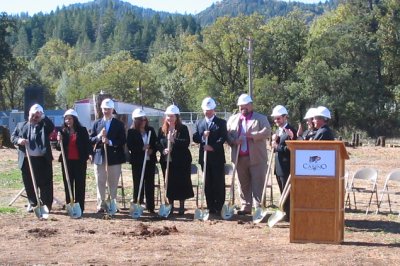
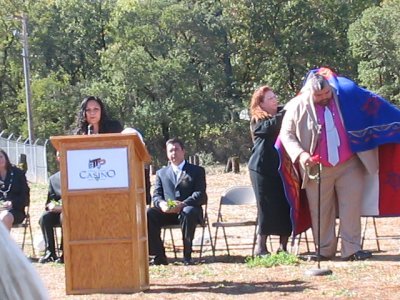
MIDDLETOWN – The Middletown Rancheria of Pomo Indians held a groundbreaking for a new facility at its Twin Pine Casino in Middletown on Saturday, and announced a new alliance with the Mohegan Tribe.
Middletown Rancheria's new alliance with the Mohegan Tribe will allow the Middletown tribe to construct a 90,000 square foot expansion, including a new hotel and casino facility to replace the current temporary structure.
The new facility will include 50,000 square feet of gaming space to accommodate up to 700 gaming slot machines, 12 table games, 10 poker tables, a 60-room hotel, retail space, a wine tasting room and three food areas.
Twin Pine Casino currently offers 12,000 square feet of gaming space, with 438 slot machines and 8 table games.
The relationship between the two tribes is part of the overall Native American initiative in the United States for economic self-reliance and an improved sense of community and communication, according to a report from Middletown Rancheria. The alliance also shows the far reach and concern between Native American peoples, stretching across the nation for cultural and economic enrichment for both tribes.
“We are very fortunate that a connection was made with the Mohegan Tribe and hope that other tribes perceive this unity and support as a strong bond within our tribal communities regardless of stature or location,” Simon said.
Middletown Rancheria established Twin Pine Casino in November 1994 and with the economic opportunity, the tribe has provided many social services for its members, such as full health benefits, educational assistance, housing, elders/disability program and minor trust savings. The casino has also provided many jobs to the small community of Middletown, as well as numerous monetary donations and sponsorships in our surrounding area.
Simon said in a statement that he is delighted to announce this long-awaited historic event for the tribe and a major stepping stone that will secure the future for generations to come.
“It has always been a priority of this tribal council to enhance and protect the economic development for our people,” he said. “In hopes that our future generations will not endure the struggles we have faced, we are grateful that we are able to fulfill the goals and dreams of our casino expansion project.”
After its federal recognition in 1994, the Mohegan Tribe created Mohegan Sun, the world’s largest and most successful casino destinations. Located in southeastern Connecticut on land that has been returned to Native American ownership, it opened its doors in October of 1996, and has been continuously owned and operated by the Mohegan Tribe since that time.
Mohegan Sun is currently involved in Project Horizon, the third phase of continued growth in just over a decade. The business has created a more secure economic base for Mohegan tribal members, with comprehensive medical and educational benefits.
The tribe’s federal recognition has also paved the way for the revival of Mohegan culture and language, and for more social interaction among the tribal membership, seen most dramatically at the tribe’s annual Wigwam gathering every August.
Bruce Bozsum, chairman of the Mohegan Tribal Council, said he is especially pleased about the new relationship between the Mohegan Tribe and Middletown Rancheria.
“The mission of the Mohegan Tribe has always been to respect the land, improve the community, and to create a self-reliant, proud population,” said Bozsum. “We are happy to be part of the plan to help the Middletown Rancheria reach their goals, and it’s an honor to join with them as we work together on a path to continued success for all our Native American nations.”
Middletown Rancheria's building project is estimated to take 14 months to complete.
The tribe thanked Supervisor Ed Robey, who helped coordinate a turn lane with Caltrans and a hookup to the LACOSAN sewer system that serves Middletown.
Middletown Rancheria was established with the purchase of 110 acres of land, initiated by members of the tribe in July of 1910, and appropriated Congressional Act for California landless Indians in 1906.
The original people of the Middletown Rancheria, also known as Lake Miwok Indians, found themselves landless and homeless during the 1800s, when newcomers settled in the area of Middletown and throughout Lake County.
With the establishment of the rancheria at the turn of the century, members of other tribal groups, such as Pomo, Wappo and Wintun, joined with the people of Middletown, either through marriage or customary adoption.
From the original five families, the present tribal membership is composed of 96 adult voting members of the General Council, with five elected members of the Tribal Council and 75 minor children.
{mos_sb_discuss:2}
- Details
- Written by: Elizabeth Larson
The Lakeport Planning Commission on Sept. 12 approved the application for the 7,666 square foot commercial building, to be located on the north side of the existing Bruno’s Shop Smart grocery store at 355 Lakeport Blvd., according to city Community Development Director Richard Knoll.
The proposed building will be oriented to the north towards Lakeport Boulevard, and will have a similar appearance to the two buildings on that site that were constructed in 2004, Knoll reported.
The new building will include three to six retail spaces for individual store fronts, said Knoll.
Knoll said the project developer, Jon Snyder of Snyder Commercial Real Estate of Sacramento, has reported that construction is slated to begin early 2008.
E-mail Elizabeth Larson at
{mos_sb_discuss:2}
- Details
- Written by: Lake County News reports
Specifically, SB 773:
Extends the allowable kingpin-to-rear axle (KP-RA) length for exempted cattle haulers from 40 feet to 43 feet.
Limits the length of the semi-trailer to 48 feet.
Requires the SR 101 livestock truck exemption to sunset before Jan. 1, 2012, if the Secretary of State (SOS) is notified that the California Department of Transportation (Caltrans) director has determined that the only possible adjustment to SR 101 to accommodate the truck sizes allowed to use these sections of the highway is the removal of any tree with a diameter of at least 42 inches, measured outside the bark at 12 inches above the ground.
Provides that if prior to Jan. 1, 2012, the Caltrans director determines that safety improvements to the portion of SR 101 have resulted in the reclassification of the entire segment as a terminal access route, the director is to notify the SOS of that determination.
Existing law provides an exemption to the vehicle length limitation until Jan. 1, 2012, for licensed carriers of livestock on portions of SR 101 in the counties of Del Norte, Humboldt, and Mendocino, if the travel is necessary and incidental to the shipment of livestock. The exemption allows a truck tractor-semi-trailer combination of up 70 feet provided that the distance from the KP-RA does not exceed 40 feet.
Wiggins noted that since most of the beef grown in Northern California is shipped out-of-state, North Coast ranchers need to use out-of-state trailers to move their product.
She thanked Schwarzenegger for signing SB 773, which is now the sixth Wiggins bill that the Governor has signed into law this year.
“Livestock ranchers in Humboldt, Del Norte, and Mendocino counties have operated at a greater economic disadvantage when compared with livestock ranchers throughout the rest of California because they are limited by statute to use trailers with a KP-RA of 40 feet,” Wiggins said. “Approximately 90 percent of the equipment used to transport cattle and other livestock to out-of-state markets are trailers with a kingpin of up to 43 feet.
“Several tighter than normal turns along three very short sections of SR 101 at Richardson's Grove, Confusion Hill and Big Lagoon have prevented the North Coast livestock industry from utilizing 43-foot trailers to haul cattle. I appreciate the support of my colleagues and the Governor on SB 773, which will provide for the longer semi-trailers on this section of SR 101.”
Prior to 1999, the length restrictions on highways leading into and out of the Counties of Del Norte, Humboldt, and Mendocino made the travel of most interstate trucks illegal.
The governor has until midnight on Sunday, Oct. 14 to decide whether to sign or veto 470 remaining bills passed by the Legislature in 2007.
{mos_sb_discuss:2}
- Details
- Written by: Editor
Locally, there are many fields growing only weeds that could be growing good hay. Hay could earn some income for the landowner, make their property look better and reduce the summer fire hazard all at the same time.
If you are interested in learning more on the subject, come to the Hay Meeting sponsored by University of California Cooperative Extension and Agro Tech on Wednesday, Oct. 10, at Rancho de la Fuente (a wheelchair accessible facility), 2290 Soda Bay Road in Lakeport.
The meeting takes place from 9 a.m. until noon.
The featured speaker is Farm Advisor Steve Orloff, a hay expert from Siskiyou County who will talk about farming practices, markets and costs of growing irrigated hay in Northern California.
Local UC Plant Science Farm Advisor Glenn McGourty will discuss options for dry land hay growing. UC Livestock Farm Advisor John Harper will present information on important considerations of animal feed quality and, finally, local growers Brent Holdenried and Frank Perez along with Dave Hatanaka of Dave’s Hay Barn will share some of their experiences growing hay.
There is no charge to attend, however, please call Marc Hooper at Agro Tech, 279-4654, to register.
{mos_sb_discuss:2}