 How to resolve AdBlock issue?
Business News
- Details
- Written by: Editor
“We must act in the best interests of Californians and our state’s economy,” Perata said in a written statement. “The mortgage crisis has hit like a tornado, and it’s imperative we do everything we can to prevent this cyclone from devastating more families and their communities.”
North Coast Sen. Patricia Wiggins (D-Santa Rosa) co-authored the bill.
“California is facing a serious threat to our state and local economies as a result of skyrocketing home foreclosure rates,” Wiggins, who represents Lake County in the state Legislature, said in a statement issued by her office. “I am glad to help lead legislative efforts by co-authoring Sen. Perata’s bill. Solving the mortgage crisis is critical not only for affected homeowners but for the well-being of our communities as a whole."
Seven of the nation’s 16 metropolitan areas with the highest rates of foreclosure are in California. Foreclosures are not only painful for the families who are forced from their homes but for the neighborhoods surrounding them that can see vacancies increase, properties fall into disrepair and housing values decline.
Lake County hasn't been untouched by the spike in foreclosures. Foreclosure rates in 2007 nearly doubled over 2006, as Lake County News has reported.
Perata's and Wiggins' measure, Senate Bill 926, requires lenders to meet in person with borrowers to discuss restructuring options. Borrowers must also be provided a list of Housing and Urban Development (HUD)-certified financial counselors to help them sort through their options.
The legislation steps up notice requirements, giving homeowners more advanced warning that a change in their mortgage payments is coming. To help limit the impact of a foreclosure on the surrounding neighborhood, the bill mandates that lenders maintain foreclosed properties or face a $1,000 per day fine.
SB 926 passed the Banking, Finance and Insurance Committee Wednesday and the Judiciary Committee on Tuesday. The bill moves next to the Senate Appropriations Committee for consideration.
Key provisions of the bill include:
– Notice to consumers regarding resets: Loan agents must provide borrowers a notice 120, 90 and 45 days prior to a change in mortgage payments due; notices must meet certain criteria; including being in the language the loan was originally negotiated.
– Lender requirements to help borrowers avoid foreclosure: Lender must contact the borrower to provide restructuring options at an in-person meeting before a notice of default can be filed. The lender must also provide the borrower a list of HUD-certified credit counselors available to assist the borrower. The notice of default must include a sworn statement that the lender met with the borrower or tried with due diligence to contact the borrower for an in-person meeting. The notice must also include the terms of the existing loan, including the reset amount and the restructuring options that were offered.
– Notice to property residents that the foreclosure process has begun: Require a party filing a notice of foreclosure sale to also mail a notice to tenants in order to alert them that the property owner is facing foreclosure and that the tenant may lose their ability to live in the house.
– Give tenants additional time to move from a foreclosed property: Increase the current notice required to be given to residential tenants of foreclosed properties to 60 days prior to eviction.
– Require maintenance of foreclosed properties to diminish the impact on the value of the neighboring homes: Failure to maintain a foreclosed property is a nuisance and violators shall be subject to civil fines and penalties of up to $1,000 per day. “Failure to maintain” includes failure to adequately care for the property including but not limited to, permitting excessive foliage growth that diminishes the value of surrounding properties, allowing trespassers or squatters, or permitting mosquito larva to grow in standing water. Fines and penalties collected pursuant to this section shall be directed to local nuisance abatement programs. These provisions shall not preempt stronger local ordinances.
– This is an urgency measure.
– All provisions will sunset on December 31, 2012.
For more information on the crisis and the bill, go to Senator Perata’s Web site, at www.senate.ca.gov/perata. Visit Wiggins' Web site at http://dist02.casen.govoffice.com/.
{mos_sb_discuss:3}
- Details
- Written by: Editor
PG&E is the first utility in the nation to put the Kenworth T800 LNG-powered trucks into service. The effort is part of the company’s commitment to reduce its environmental footprint and improve California’s air quality.
“Natural gas is one of the cleanest alternative fuels available today,” said David Meisel, director of transportation services at PG&E. “The Kenworth LNG-powered trucks will reduce greenhouse gas emissions by 15 to 20 percent over equivalent diesel engines. We’re thrilled to be adding these LNG trucks to our fleet and for the environmental benefits it will provide to the communities in which we live and work.”
PG&E purchased the Class 8 heavy-duty trucks from Bay Area Kenworth as diesel units and collaborated on the upgrade to liquid natural gas operation with Kenworth and Westport Innovations Inc., a leader in the development of natural gas engines and fuel systems.
The unique fuel system developed and manufactured by Westport and called High Pressure Direct Injection (HPDI), uses a small amount of diesel to ignite the natural gas in the engine and provides diesel-equivalent torque, horsepower and a range of 400-450 miles. The result is reduced NOx, Particulate Matter and greenhouse gas emissions and less reliance on diesel fuel by running the cleaner LNG fuel.
The LNG-powered trucks are based at PG&E’s Fremont service warehouse from where all the utility’s supplies are shipped and are being put into service for routes to Fresno, Marysville, Ukiah and Templeton.
Four of the Class 8 LNG trucks will be used for two shifts per day, representing approximately 800 miles per day per truck. Using LNG will cut the fuel costs for these trucks by approximately 50 percent. The fifth LNG truck serves as a customer demonstration truck to educate PG&E’s large trucking customers about the economic and environmental benefits of LNG-powered heavy-duty trucks.
PG&E operates 36 natural gas fueling stations throughout its northern and central California service territory, 27 of which are open to the public. The new LNG-powered trucks fuel up at PG&E’s Fremont Service Center from a proven above-ground LNG fueling system produced by Chart Industries, a leader in the development of safe LNG fueling systems.
In addition, PG&E utilizes a mobile trailer mounted system for LNG vehicle fueling which is also manufactured by Chart Industries. A significant benefit of LNG fuel stations is that LNG is non-toxic, non-corrosive and poses no risk of ground contamination unlike conventional liquid fuels.
For nearly two decades, PG&E has been advocating alternative transportation technologies including electric, fuel cell and natural gas vehicles. With more than 1,300 vehicles, PG&E maintains one of the largest utility natural gas fleet in the nation and has helped more than three hundred fleet customers adopt alternative transportation methods.
Over the last 15 years, PG&E’s clean fuel fleet has displaced more than 3.4 million gallons of gasoline and diesel, and helped to avoid 6,000 tons of carbon dioxide from entering the atmosphere.
For more information about PG&E, visit the company’s Web site at www.pge.com.
{mos_sb_discuss:2}
- Details
- Written by: Editor
Langtry divided the gift between Spirit of the Season, an organization that provides holiday baskets for the needy; Totes for Teens, a charity similar to Toys for Tots that offers holiday gifts to underprivileged teenagers, and Operation Tango Mike, a community effort that sends care packages and support to United States troops.
During the holiday season Langtry employees collected toys for the Spirit of the Season, and food items to donate to the Rural Food Project. This effort culminated in the first annual Langtry Victorian Christmas charity drive, which generated more than $1,400.
Guests who attended the event were encouraged to donate toys or food items. The day’s activities included Victorian games, a guest appearance by Santa, PACK carolers and a silent auction. All of the proceeds from the events were presented to the three charities.
“Langtry Estate & Vineyards would like to thank its employees and the community for their contributions to the success of the inaugural Victorian Christmas Charity event,” said JoAnn Schwartz, Langtry’s tasting room manager. “Our hope is that the donations helped bring some joy to the holidays for people who are less fortunate and people serving our country.”
Additional information on the winery is available at www.langtryestate.com or by calling 707-987-2385.
Langtry Estate & Vineyards is located at 21000 Butts Canyon Road, Middletown.
{mos_sb_discuss:2}
- Details
- Written by: Nancy Brier

LAKEPORT – Forty years ago Kelseyville resident Don Lampson taught a teenager named Noatake Manaka how to fly at a local airfield.
Lampson was an expert aviator and dedicated instructor. Manaka was a remarkably talented student who was a foreign exchange student from Japan. Today that local airfield field is named after the Lampson family, and Manaka is just retiring after a distinguished career as a Boeing 747 captain for Nippon Airlines.
As the years passed, Manaka never forgot Lakeport. He had deep roots in the community and would often call down to the field from the cockpit of his 747 just to say hello. Some friendships, particularly one with local businessman Sandy Falconer, flourished over the years. The conversations from 40,000 feet at 400 miles per hour were short, but those local roots and Lakeport memories were not.
The Lakeport-Japan ties were strengthened again recently when Manaka sent two young Japanese business associates to Solo Flight School in Lakeport to follow in his footsteps. He wanted them to experience the Lake County he grew to love while learning to fly in our near perfect flying conditions.
Lake County has grown since the days of Lampson and Manaka, but its crystal clear skies, light air traffic and close proximity to major airports still makes it a perfect training base.
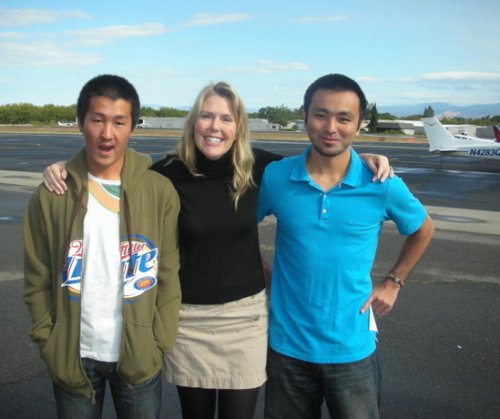
Gary Trippeer, owner of Solo Flight School, welcomed 24-year-old Souichiro Yamashita from Yokohama and 32-year-old Noboru Watanabe from Tokyo to the world of aviation on a beautiful morning this fall.
Their Visas were valid for only three months, and they both wanted to leave with a command of the English language, a taste of American culture and a private pilot’s license – a tall order for even an English-speaking student.
After a brief conversation, it was apparent that both students would need total immersion in the English language and American culture before their flying lessons could even start.
Solo Flight School’s retail store at Lampson was quickly converted into an English classroom, and a hangar office was set up for ground school lessons. Certified English teacher Nancy Brier provided English instruction everyday at the store.
Two additional evenings each week were spent with Rebecca and Mike Patterson of Lakeport, who took the two young men to their home, local restaurants, parks and other points of interest, and encouraged them to practice, practice, practice.
“At first the guys were so shy, we didn’t know what we’d talk about,” Rebecca Patterson recalled. “But after a couple of sessions, we couldn’t get them to stop talking!”
As for American culture, Yamashita and Watanabe experienced the Kelseyville Thursday night street dances, the Lakeport County Fair, the Taste of Lakeport, the Seaplane Festival, the Steele Winery Farmer’s Market and even the Blue Angels in San Francisco.
“Noboru and Souichiro became fixtures at almost every event Lake County offered,” said Trippeer. “Scores of local residents volunteered to meet, teach and entertain Noboru and Souichiro during their stay and we want to thank all of them.”
English is the universal language in aviation, and all radio calls, around the world, are done in English.
“Radio calls are an important part of flying,” explained Solo Flight Instructor Tom Wilkerson.
Yamashita and Watanabe needed to learn how to make and understand radio transmissions in order to fly safely. “At first just the reading back the tail number '3480Q' was a challenge for them,” remembered Wilkerson.
Wilkerson accepted the challenge of teaching the young men in the air. A pilot and Certified Flight Instructor for over 30 years, Wilkerson speaks several languages and has experience training Japanese teachers how to teach English.
“He holds a doctorate in language and has more than 22,000 hours of flight time, in over 100 different aircraft and is a huge asset to Solo Flight School,” said Trippeer.
“The key to teaching a student to fly is to determine early what makes that person tick,” Wilkerson said. After that, the rudimentaries of flying can come naturally to anyone.”
While Wilkerson was busy with training and the students were immersing themselves in the world of English language and aviation, Trippeer had a huge task of his own.
Since Sept. 11, 2001, the Federal Aviation Administration (FAA) and other government agencies have developed strict new guidelines. Flight schools with foreign students are closely scrutinized, and each student must submit to a thorough background check.
As the owner of Solo Flight School, Trippeer managed that process. A mountain of time-consuming requirements must be met before a foreign student experiences even one minute of in-air instruction. After the FAA and Transportation Security Administration gave the green light, the students began their lessons.
Yamashita and Watanabe completed their first solo flight with just over seven hours of flight instruction. They flew Solo Flight School’s Piper 140 aircraft. It was a remarkable accomplishment for both the young pilots in training and their instructor, Wilkerson.
“The first solo is critical,” Wilkerson explained. “It provides the motivation and confidence students need to propel them forward. That first solo flight is a thrill for everyone involved. You never forget your first solo.”
From that point on, Yamashita and Watanabe flew nearly every day, sometimes with their instructor, sometimes on their own, or “solo.”
They landed the airplane over and over again at airports far and near. They practiced radio calls at Santa Rosa’s towered airport, flew solo cross country flights, and practiced flight maneuvers required for the FAA flight test.
After just 50 hours of training, the pilot candidates were signed off by their instructor to take their final FAA flight test in Santa Rosa.
With just three days left before their Nov. 1 flight back to Japan, Yamashita and Watanabe passed their FAA oral test and then the FAA flight test. They flew back to Lampson from Santa Rosa at sunset as licensed private pilots.
Less than 1 percent of the world’s population has a pilot’s license. There are about 450,000 private pilots in the U.S. Since Solo Flight School opened two years ago, approximately 20 people, mostly from Lake County, have earned their license or an additional pilot rating at the school.
Aviation experts predict that over the course of the next decade, more than 10,000 new pilots will be needed to fill Asia’s growing demand. Trippeer hopes to fill some of that demand here in Lake County.
What's next for Noboru Watanabe and Souichiro Yamashita? Watanabe wants to return and live in Lakeport, and Yamashita wants to get married and become a millionaire. Only time will tell, but Lake County will be waiting, if necessary, for another 40 years.
Nancy Brier is a co-owner of Solo Flight School.
{mos_sb_discuss:2}