 How to resolve AdBlock issue?
Business News
- Details
- Written by: Editor
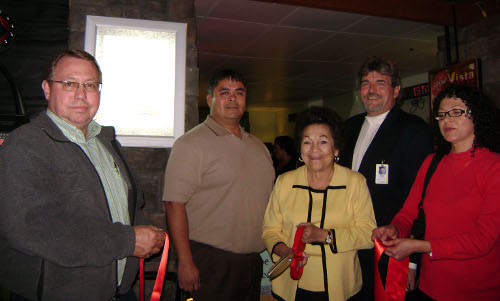
LAKEPORT – Konocti Vista Casino marked the grand opening of its new Vista Steakhouse on Nov. 5.
The Lake County Chamber of Commerce held a ribbon cutting for the new restaurant.
Konocti Vista Casino Resort, Marina and RV Park is located at 2755 Mission Rancheria Road, Lakeport, telephone 707-262-1900.
Visit the casino online at www.konocti-vista-casino.com/index2.html .
- Details
- Written by: Editor
CLEARLAKE – The grand opening for the new Villa La Brenta winery will be held Saturday, Nov. 21.
The Lake County Chamber of Commerce will host an open house from 3 p.m. to 5 p.m. at the winery, 1780 Highway 53, Clearlake.
The ribbon cutting will be held at 3:30 p.m.
Refreshments will be served.
- Details
- Written by: Governor's Office
State-by-state data released by the federal government confirms that over 110,000 direct jobs have been saved or created in California through Recovery Act spending – more jobs than in any other state in the nation – and approximately 17 percent of the over 640,000 direct jobs reported to be saved or created nationwide.
Federally released data includes Recovery Act funds administered directly from the federal government to local governments, nonprofits and other organizations in addition to funding routed through state government entities. The White House has made this data available today on the federal Recovery Act Web site www.recovery.gov . Once provided to states, this information will also be uploaded and made available on the California Recovery Act Web site.
“This is not a Republican or Democrat issue – it’s about people, their jobs and our economy,” said Governor Schwarzenegger. “While Californians are still feeling the effects of the national economic downturn, the Recovery Act has slowed job loss and stimulated economic growth – important steps in helping drive our economy down the road to recovery. We are working hand-in-hand with the Obama Administration to pump this funding into California quickly and responsibly to not only save and create jobs, but help heal our economy as a whole.”
California was the first state in the nation to be approved for billions of Recovery Act education funding aimed at preventing the need for laying off teachers, professors and other school employees – and to protect education funding and reform efforts in this difficult economic time.
Through Sept. 30, state education agencies (higher education and K-12) self-reported saving or creating over 62,000 education related jobs in the state of California – over 27,000 of which were in K-12 education.
Additionally, more than 1,800 state-government related infrastructure jobs (transportation, water etc.) were saved or created through Sept. 30. The California Department of Transportation has obligated funds for over 600 transportation infrastructure projects alone – which will save or create more jobs in the coming weeks and months as additional construction jobs break ground throughout the state.
Recipients of Recovery Act funding – which include local governments, non-profits and other organizations that receive funds directly from Washington, as well as state government entities – are required to report directly to the federal government on the status of their funding on a quarterly basis.
The federal government provided reporting requirements that specify how Recovery Act funding recipients must report the number of jobs saved and created through Recovery Act spending.
Overarching federal requirements were provided by the White House Office of Management and Budget and issue-specific reporting requirements were provided by each individual federal agency overseeing specific funding. To view federal reporting guidelines visit http://www.recovery.gov/FAQ/recipient/Pages/Recipient_Reporting.aspx .
Federal guidelines mandate that Recovery Act funding recipients report only direct jobs saved or created through the spending of Recovery Act funds. Examples include a local education authority using Recovery Act education funds to retain teachers, a Public Housing Authority employing workers to weatherize a housing development or a University receives an NIH grant and uses it to hire lab technicians.
Funding recipient jobs reports do not include indirect or “ripple effect” jobs saved or created through Recovery Act spending, like jobs created when a Recovery Act funded contractor hires a supplier to provide materials for a construction project – causing the supplier to hire additional full or part time staff.
Federal government reports also do not include information on Recovery Act spending on direct payments to individuals (such as increased Unemployment Compensation and Pell Grants), grants and awards under $25,000 per recipient, Federal Medicaid Assistance Program funding or tax cuts provided by the Recovery Act. Billions of dollars have been pumped into the California economy from these federal programs.
- Details
- Written by: California Attorney General's Office
"Shell Oil Company disregarded the state's underground fuel storage and hazardous waste laws, committing hundreds of environmental violations at its gasoline stations across California," Brown said. "This judgment requires the company to pay $19.5 million in penalties, comply with state law and improve its spill monitoring, employee training and hazardous waste management."
In 2006, the Attorney General's Office launched a statewide investigation into Shell and its gasoline stations after the San Diego and Riverside County District Attorneys settled cases with the company following numerous underground fuel storage violations.
Working with the California State Water Resources Control Board, the Attorney General's Office investigated more than 1,000 Shell gasoline stations throughout California, including numerous stations in Sonoma County and some Napa County stations as well.
The investigation uncovered hundreds of violations at the company's gasoline stations. For example:
– In February 2007, an inspector discovered that a Shell gasoline station located at 4355 Pacheco Blvd. in Martinez failed to properly maintain the required leak detection monitoring system for its gasoline tanks. The Shell station is located next door to the office of the Contra Costa County Hazardous Materials Program.
– In May 2006, an inspector discovered that a Shell gasoline station located at 7899 Greenback Lane in Citrus Heights, 20 miles northeast of Sacramento, failed to properly maintain spill alarms for its gasoline tanks. Inspectors observed similar violations in October 2005, September 2003 and April 2003.
– In August 2005, an inspector discovered that a Shell gasoline station located at 12398 Los Osos Valley Road in San Luis Obispo failed to maintain the required leak detection monitoring system for its gasoline tanks.
– In March 2005, an inspector discovered that a Shell gasoline station located at 30245 Agoura Road in Agoura Hills failed to properly conduct and maintain secondary containment testing and monitoring for its gasoline tanks. The inspector also found liquid and hazardous substances in the containment sump. Shell's own inspector found liquid in the sump on previous visits to the station.
The judgment requires Shell, its subsidiaries, corporate parents, affiliates and successors to pay $19.5 million in civil and administrative penalties and immediately comply with state underground fuel storage and hazardous waste statutes, regulations and permits.
The company must also take immediate steps to improve spill and alarm monitoring, employee training, hazardous waste management and emergency response at its gasoline stations by:
Implementing a "smart" monitoring system with programmable sensors to monitor for fuel leaks and other environmental alarms;
Utilizing a continuous remote alarm monitoring, diagnosis and notification system;
Providing annual compliance and emergency response training sessions to employees, contractors, consultants, retailers and operators;
Implementing risk management software systems to drive improved underground storage tank compliance;
Working with a third-party contractor to manage and oversee hazardous material business plans and underground storage tank monitoring response plans;
Working with a third-party contractor to provide onsite underground storage tank permitting, registration and testing services;
Completing a health, safety, security and environmental checklist to monitor, assess and address compliance issues; and
Maintaining an underground storage tank equipment database and checklist.
The $19.5 million judgment includes: $7.8 million in civil and administrative penalties to district attorneys and regulatory agencies; $5 million in civil penalties to the Attorney General's Office; $5 million in civil and administrative penalties to the California State Water Resources Control Board; $700,000 to fund the Sacramento County Abandoned Well Restoration Project; $500,000 to the California Climate Action Registry; $400,000 in investigative costs and attorneys' fees to the Attorney General's Office; and $100,000 in investigative costs to the California State Water Resources Control Board.