 How to resolve AdBlock issue?
Business News
- Details
- Written by: Editor
The plan will eliminate a “toxic tax loophole” that rewards businesses who move jobs out of state, and uses this savings to give working families an income tax break; lower taxes for California manufacturers; and provide more than $300 million in permanent tax relief to small businesses.
“The agreement reached today with the cooperation of members of both parties closes the toxic tax loophole that rewards businesses for locating jobs outside California. These funds will help California manufacturers buy the equipment they need and reduce the tax burden on families as well as small businesses,” said Gov. Brown.
The cornerstone of the bipartisan plan is the application of the Mandatory Single Sales Factor (SSF) to all businesses in California.
This change levels the playing field by eliminating what Governor Brown has called “an outrageous and perverse tax incentive that encourages multi-state businesses to create jobs outside of the state.”
Shifting to SSF will put California-based businesses at a competitive advantage and encourage out-of-state businesses to locate jobs here.
The bipartisan plan provides hundreds of millions in tax relief to businesses that purchase new manufacturing equipment by exempting start-ups in their first three years from the state portion of sales tax (3.9375 percent) – and provides an exemption of 1 percent for all other firms – on manufacturing equipment purchases.
It helps working families and infuses hundreds of millions into the California economy by increasing the standard deduction that individuals and couples can claim on their income tax returns.
Individuals can claim an additional $1,000 and couples can claim an additional $2,000. This change will help more than 4 million working Californians.
The bipartisan plan helps employers across the state by providing more than $300 million a year in permanent tax relief to small businesses.
In 2011, job creation by small employers has outpaced job creation by larger employers. According to the ADP National Employment Report, 64 percent of jobs created from July to August were in firms with fewer than 50 employees.
The bipartisan plan:
Applies the Mandatory Single Sales Factor (SSF) to all businesses in California.
Reduces the tax rate by a half percent for the first $50,000 in taxable income for most corporations (from 8.84 percent to 8.34 percent). Estimated tax relief: $18 million.
Offers a 10 percent exemption for the first $50,000 in business income for Personal Income Tax taxpayers. Estimated tax relief: $255 million.
Cuts the minimum tax from $800 to $750—a 12.5 percent reduction. Estimated tax relief: $59 million.
Increases the standard deduction of $1,000 for individuals and $2,000 for couples. Estimated tax relief: $306 million.
Enacts a sales tax exemption on manufacturing—approximately 4 percent reduction for start ups and 1 percent reduction for established businesses. Estimated tax relief: $299 million.
- Details
- Written by: Editor
California gasoline consumption declined 4.1 percent in May compared to May last year.
This is the second consecutive month of declines at or over 4 percent.
“High gasoline prices in May continued to impact consumption in California,” said First District Board Member Betty T. Yee. “Californians already experiencing financial stress are particularly vulnerable to high gas prices.”
In California, gasoline consumption in May 2011 was down 4.1 percent to 1.24 billion gallons compared to May 2010’s total 1.29 billion gallons.
The California average price for a gallon of gasoline was up $1.09 to $4.23 in May 2011, a 35 percent increase over May 2010’s average price of $3.14 per gallon.
The national average price of a gallon of gasoline rose $1.07 to $3.96 in May 2011, a 37 percent increase over May 2010’s national average price of $2.89 for a gallon of gasoline.
California’s diesel fuel consumption figures for May 2011 show an increase of 3.9 percent to 213 million gallons compared to May 2010’s total of 205 million gallons.
However, the May 2010 diesel figures included 13.2 million in refunds. After adjusting for the refunds, diesel consumption decreased 2.4 percent in May 2011.
The California average price for a gallon of diesel was up $1.15 to $4.36 in May 2011, a 36 percent increase over May 2010’s average price of $3.21 per gallon of diesel.
Nationally, the average price for a gallon of diesel rose 98 cents to $4.05 in May 2011, a 32 percent increase over May 2010’s national average price of $3.07 per gallon of diesel.
Gasoline and diesel fuel figures are net consumption that includes the State Board of Equalization’s audit assessments, refunds, amended and late tax returns, and the State Controller’s Office refunds.
The BOE is able to monitor gallons through tax receipts paid by fuel distributors in California. For all monthly, quarterly and annual fuel reports, visit www.boe.ca.gov/sptaxprog/spftrpts.htm.
Taxable Gasoline Gallons: www.boe.ca.gov/sptaxprog/reports/MVF_10_Year_Report.pdf.
Taxable Diesel Gallons: www.boe.ca.gov/sptaxprog/reports/Diesel_10_Year_Report.pdf.
- Details
- Written by: Editor
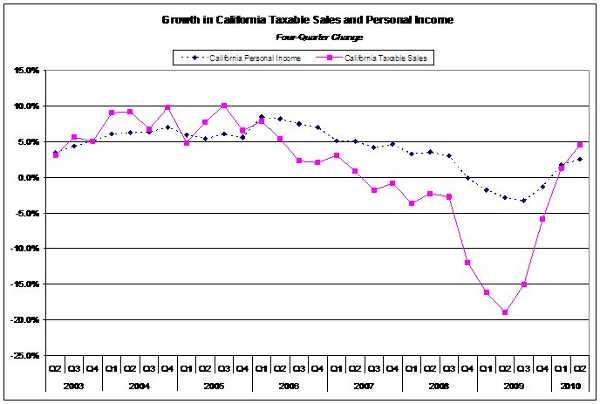
The State Board of Equalization has reported that taxable sales in California totaled $118.5 billion in the second quarter of 2010, up $5.2 billion, a 4.6 percent increase from the same quarter the previous year.
California taxable sales rose faster than personal income for the first time since 2005.
Additionally, more recent data indicate that a more pronounced recovery in taxable sales continues in second quarter 2011.
BOE’s estimate of statewide taxable sales for the second quarter of 2011, based on cash receipts, shows that taxable sales are estimated to have risen 9 percent in the second quarter of 2011 over the same period a year earlier.
“The latest report shows many positive signs,” said Betty T. Yee, who represents the First District on the Board of Equalization, which includes Lake County. “The statewide taxable sales show signs of growth. But success will depend on continued economic expansion throughout the year.”
The second quarter 2010 taxable sales report shows regionally that the nine-county San Francisco Bay Area had the strongest growth, rising 6.6 percent, while the region’s major cities varied widely, for example, San Jose increased 10.7 percent, San Francisco rose 7.1 percent, while Oakland increased by 1.6 percent in second quarter 2010.
The second quarter 2010 taxable sales report shows that most counties in the First Equalization District had increases in taxable sales, including the counties of Humboldt (+13.3%), Santa Clara (+12.3%), Monterey (+7.7%), San Francisco (+7.1%), Marin (+6.8%), San Mateo (+6.4%), Alameda (+6.1%), Yolo (+5.7%), Santa Cruz (+3.4%), Sonoma (+3.2%), Napa (+3.0%), Santa Barbara (+2.9%), San Benito (+2.5%), Mendocino (+2.0) and Contra Costa (+0.9%).
Conversely, in the second quarter 2010, some counties in the First Equalization District saw taxable sales decline including the counties of Trinity (-6.5%), Lake (-3.9%), San Luis Obispo (-3.5%), Del Norte (-3.1%) and Solano (-2.9 %).
In constant dollar terms, taxable sales increased 2.5 percent from the same quarter the previous year. The California Taxable Sales Deflator, which measures the rate of change of all taxable sales in the state, was up 2.0 percent. In comparison, the California Consumer Price Index, which measures the rate of change of common consumer goods, was up 1.8 percent.
California gasoline station sales in the second quarter of 2010 increased 15.5 percent, the largest gain of any major category. Most of this growth is attributable to an increase in the price of gasoline. The average price of gasoline at the pump increased 19.4 percent during the second quarter of 2010, while gasoline consumption for the same period increased only 0.9 percent.
Second quarter 2010 taxable sales by California motor vehicle and parts dealers increased 13.3 percent. Most of that gain is attributable to both new car dealers that increased 16.6 percent and used car dealers that increased 11.4 percent.
Other motor vehicle dealer sales that include RVs, motorcycles, boats, and aircraft, decreased by 2.2 percent, this might possibly be due to Californians having less “disposable income” in the second quarter of 2010.
Taxable sales made by electronic and appliance store sales did well during the second quarter of 2010, growing 7.9 percent from a year ago, with most of that increase due to sales from computer and software stores, which grew at 13.4 percent during the second quarter of 2010 in California.
The second quarter of 2010 taxable sales report shows that sales from “all other outlets” (comprised primarily of manufacturing and wholesale businesses in California) grew at a sluggish 2.9 percent, buoyed by wholesale trade that grew 5.8 percent, and manufacturing that had 8.3 percent growth. Growth in this period was constrained mainly by real estate and rental leasing (that declined 1.6 percent) and construction (declining 0.7 percent).
Furniture and home furnishings stores showed a modest growth in sales over the same quarter a year ago at 4.3 percent, mostly due to furniture store sales growing 6.7 percent, while the home furnishings segment grew only 0.8 percent in California during the second quarter of 2011.
General merchandise store sales, which represent the largest non-durable retail category, showed virtually no growth for the second quarter of 2010.
Taxable Sales in California is a quarterly report on retail sales activity in California, as measured by transactions subject to sales and use tax. It includes data about statewide taxable sales by type of business, as well as data about taxable sales in all California cities and counties. To view all taxable sales in California, visit: www.boe.ca.gov/news/tsalescont.htm.
To view the second quarter of 2010 taxable sales in California, visit www.boe.ca.gov/news/tsalescont10.htm.
- Details
- Written by: Editor
The “A-B-Cs of Business Startups” series is hosted by the North Coast SCORE chapter which serves entrepreneurs in Sonoma, Napa, Mendocino, Lake and Humboldt counties.
SCORE, a resource partner of the U.S. Small Business Administration (SBA), provides free business counseling and offers a variety of low-cost small business workshops.
About 70 percent of the North Coast SCORE chapter’s clients are involved with startup businesses.
Sessions will be given in five seminars and cover such topics as startup business basics, business plans, marketing, financial projections and access to capital.
There’s a $30 charge for each training session.
Experienced SCORE mentors will serve as instructors and will be available for private, no-cost mentoring to students after the classes.
Session No. 1: Start-Up Basics, Oct. 1, 9 a.m. to noon.
Session No. 2: Writing Your Business Plan, Oct. 8, 9 a.m. to noon.
Session No. 3: Marketing, Oct. 15, 9 a.m. to noon.
Session No. 4: Financial Projections, Oct. 22, 9 a.m. to noon.
Session No. 5: Funding Sources, Oct. 29, 9 a.m. to noon.
All classes will be held at the Sonoma Mountain Business Cluster, 1300 Valley House Drive, Rohnert Park, CA 94928.
To register for classes, go to http://northcoast.score.org, send an e-mail to