 How to resolve AdBlock issue?
Arts & Life
- Details
- Written by: Middletown Art Center
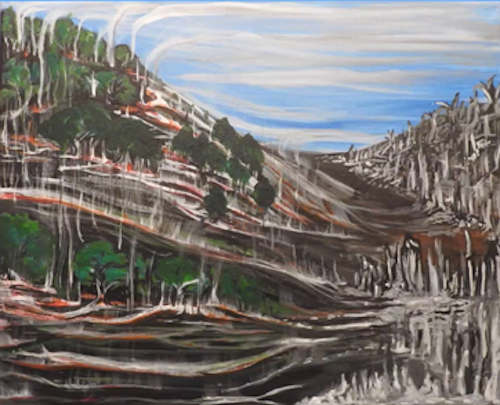
MIDDLETOWN, Calif. — The Middletown Art Center will host a panel discussion this weekend on traditional ecological knowledge, or TEK, and fire management.
The event will take place via Zoom from 4 to 6 p.m. Saturday, March 5.
The panel discussion will feature Meyo Marrufo, Ali Meders-Knight and Jessica Brown and be facilitated by Corine Pearce, lead artist of the Weaving Project. All are TEK practitioners, cultural educators, cultural artists and basket weavers.
In their work on the land, they have tended gathering sites and helped people restore native plants and ecological balance to areas impacted by wildfires. There is much to learn and put to practice from TEK, to live more sustainably in a region where fire is part of life.
“People have to understand that we'll never win. Fire will always win. And so what we have to do is work in accordance with the fire to be able to defend our space, doing what we need to do before we get to catastrophic fires,” said Brown, a Southeastern Pomo land steward who has been working in ecorestoration and fire ecology in Lake County and on a food sovereignty project for the Elem Tribe.
TEK is based on 20,000 years of place-based Indigenous knowledge of local ecosystems and watersheds.
“It is the ancestral knowledge that our people have practiced over time,” said Maruffo. “It's a new word but not a new theory.”
Marrufo, an Eastern Pomo from the Clear Lake Basin, also works to restore and protect environmental and cultural landscapes and tribal ways of life as the environmental director for Guidiville Rancheria in Mendocino County and is the California Representative for the EPA National Tribal Caucus.
“My people managed this land collectively to achieve peace, prosperity and health for all who lived here. This is why it’s important now to educate the whole community on how to manage the land, as it sustains our economy,” explained Meders-Knight, Mechoopda tribal member in the Chico area and advocate for community resilience and shared prosperity through community land management.
Register for Zoom access to this invaluable discussion at www.bit.ly/TEKlake. Preregistration is required so that the Zoom room can accommodate all virtual attendees. Fees are sliding scale and support the project and project documentation. No one turned away for lack of funds.
This event was previously scheduled for Feb. 26 and due to unforeseen circumstances has been rescheduled for March 5 from 4 to 6 p.m. If you have already registered, the same Zoom link will work.
For more information visit www.middletownartcenter.org.
- Details
- Written by: Kwame Dawes
It is not entirely clear what has arrived, here in this poem “Psalm For Arrival.”
What is clear, is the familiar sense that sometimes, after a long effort, we are able to “find sounds/ for words” — to articulate, the difficult stuff of memory.
And perhaps this is what has arrived, the voicing of the difficult things.
In the end, however, Khaled Mattawa finds no great relief in speaking these words. Somehow the deadening effects of memory can be persistent, despite our necessary efforts to disavow “old sentiments”.
Psalm For Arrival
By Khaled Mattawa
When we find the sounds
for words we need, their death
rattle begins to echo in our throats.
Memory creeps up on old sentiments,
finds them lurking like blind fish
in the twilight of our blood.
Dead and living on—ancient prophecies
or frozen microbes—something we disavow
continues to feed on us.
American Life in Poetry does not accept unsolicited manuscripts. It is made possible by The Poetry Foundation, publisher of Poetry magazine. It is also supported by the Department of English at the University of Nebraska-Lincoln. Poem copyright ©2020 by Khaled Mattawa, “PSALM FOR ARRIVAL” from Fugitive Atlas (Greywolf Press, 2020.) Poem reprinted by permission of the author and the publisher. Introduction copyright ©2022 by The Poetry Foundation. The introduction’s author, Kwame Dawes, is George W. Holmes Professor of English and Glenna Luschei Editor of Prairie Schooner at the University of Nebraska.
- Details
- Written by: Tim Riley
‘BLACKLIGHT’ RATED PG-13
One question that fans of Liam Neeson need to consider is whether following the career path of Steven Seagal in action pictures is worthy of emulation for a talented actor just shy of being a septuagenarian.
The Northern Irish thespian’s starring role in 2008’s “Taken,” in which he played a retired CIA operative who employed his “particular set of skills” to harshly deal with abductors of his teenage daughter kidnapped while on a trip to Paris, was followed by a series of similar films.
“Taken” turned into a trilogy, where he saved family members before having to finally save himself after being framed for the murder of his ex-wife and then using his talents to track down the real killers.
This brings us to “Blacklight,” where Neeson’s Travis Block is a deep undercover agent and a “fixer” for the FBI under the direction of its director Gabriel Robinson (Aidan Quinn), both of whom served together during the Vietnam War.
The film’s opening would seemingly appear to cleverly recall the paranoia of political thrillers from the 1970s when charismatic Congressional candidate Sofia Flores (Mel Jarnson) ends in the crosshairs of a shadowy conspiracy.
On the scene of the Flores political rally in the nation’s capital is Dusty Crane (Taylor John Smith), who we soon learn is an undercover FBI agent working for Director Robinson on a covert assignment of dubious origins.
A chain of events propels Crane to take drastic measures to reveal the foreboding conspiracy dubbed “Operation Unity” at high levels in the FBI, leading the agent to connect with website news reporter Mira Jones (Emmy Raver-Lampman).
As seen before in other films of the genre, Block tries to make amends as an absentee parental figure to his single mom daughter Amanda (Claire van der Boom) and young granddaughter Natalie (Gabriella Sengos).
To that end of seeking more quality time with family, Block wants out of his extraction duties, but Director Robinson won’t hear of it and insists that he must bring the errant Crane back into the fold.
Without giving away some twists, Block begins to harbor doubts about his superiors, and with a little push from journalist Jones, a light begins to shine on the sinister truth of “Operation Unity.”
Soon enough, Block is on a collision course with his old war buddy Robinson when his daughter and granddaughter mysteriously vanish from their home that Block had outfitted with cameras and sensors.
As expected, the obligatory gunfights and high-speed car chases add to the thrills, and Block delivers a few catchy lines, the best one being telling the menacing Robinson, protected by two agents, “you’re gonna need more men.”
According to the dictionary, blacklight is invisible ultraviolet light or infrared radiation. Given that blacklight could be used to detect that which is not visible to the naked eye, perhaps the title “Blacklight” is a metaphor for the unmasking of the bad guys.
Frankly, this generic Liam Neeson thriller does not merit any serious thought about the meaning of the film’s title. It’s so indistinctive that the only proper thing is for it to fall quickly into a black hole of one’s memory.
Having enjoyed the ride with many of Neeson’s previous forays into the genre, particularly with the original “Taken,” my suggestion is that anyone tempted to see “Blacklight” should save a few bucks and wait for its inevitable appearance on a streaming service.
‘RUBY AND THE WELL’ ON BYUtv
BYUtv is a free streaming service that produces a number of original series. “Ruby and the Well” is a 10-episode family drama, premiering on Sunday, Feb. 27, that follows the adventures of 14-year-old Ruby O’Reilly (Zoe Wiesenthal) in the rural town of Emerald.
After inheriting her great uncle’s apple orchard, Ruby and her dad Daniel (Kristopher Turner) arrive in Emerald, flush with hope for the future. To their surprise, the orchard and the town are in disrepair, and everyone seems to be going through a rough patch.
All that starts to change when Ruby discovers a profound way to impact the lives of the townspeople by granting their innermost wishes, which have been captured and stored in a magic well on their property.
While Ruby and her new best friends Mina (Lina Sennia) and Sam (Dylan Kingwell) work on solving the wishes one by one, Daniel toils in the disheveled apple orchard, determined to make their new lives work, even if it means taking side gigs to support the family.
But as the town’s rejuvenation draws attention from outside, a stranger from the city shows up with an offer that threatens everything Ruby has been working for. She and her friends must figure out a way to fight back while still honoring the well’s purpose.
“Ruby and the Well” invites viewers to a place where new beginnings and second chances have room to grow. Fittingly enough, this series is intended as entertainment for the whole family.
Tim Riley writes film and television reviews for Lake County News.
- Details
- Written by: Kwame Dawes
Here is what one might call a most witty anti-Valentine’s Day poem, which, tellingly, turns out to be an exuberant and witty pro-love poem.
Kalamu Ya Salaam’s “civilization” should be read as an over-protestation against sentiment, for in the end, “As Serious as a Heart Attack,” is a lovely and defiantly optimistic celebration of the abundance of love.
As Serious as a Heart Attack
By Kalamu Ya Salaam
i have never been fully domesticated
but i have been civilized
by women taught that the heart
is more than a muscle
a life drum whose function is
both physical blood pumping
and spiritual longing to be embraced
but love, ah love is a river
we may get wet
but we can never drink it all
love always flows on
more than we can ever swallow
no matter how thirsty
we claim to be
American Life in Poetry does not accept unsolicited manuscripts. It is made possible by The Poetry Foundation, publisher of Poetry magazine. It is also supported by the Department of English at the University of Nebraska-Lincoln. Poem copyright ©2020 by Kalamu Ya Salaam, “AS SERIOUS AS A HEART ATTACK” from Cosmic Deputy, poetry and context 1968-2019 (University of New Orleans Press, 2020.) Poem reprinted by permission of the author and the publisher. Introduction copyright ©2022 by The Poetry Foundation. The introduction’s author, Kwame Dawes, is George W. Holmes Professor of English and Glenna Luschei Editor of Prairie Schooner at the University of Nebraska.