 How to resolve AdBlock issue?
Arts & Life
- Details
- Written by: Geri Williams
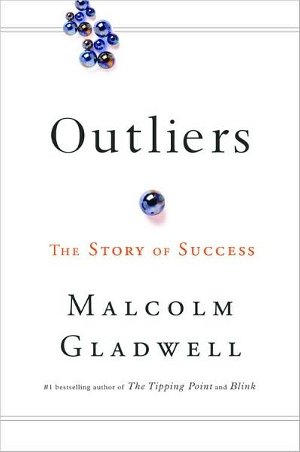
Outliers: The Story of Success
By Malcolm Gladwell.
(NY: Little, Brown and Company Hachette Book Group, 2008. 210 pp. $27.99, ISBN 978-0-316-0192-3)
You have read the stories about successful people – now it is time to read the story of success.
out-li-er \noun
1: something that is situated away from or classed differently from a main or related body
2: a statistical observance that is markedly different in value from others is the sample
A year after publication Malcolm Gladwell’s book “Outliers” is still on dozens of best seller lists. This week it dropped to number two on the New York Times best seller list but even at our local Blockbuster (why does a dvd rental store have a best seller book rack?) it’s still in the top ten. Every airport book kiosk travelers passed by over the Thanksgiving holiday held “Outliers” and I suspect the same will be true for Christmas travelers as well. What is it about the story of success that has everyone “wanting to know?”
Perhaps our obsession with books about successful people is that we hope by reading their stories, some of their success will some how rub off on us. Self-made millionaires – we want to be one. An overnight success, we dream of the possibilities. Someone who “pulled themselves up by their own bootstraps …” we secretly think we have the chutzpah to pull it off. But are these “true stories” real?
The hypothesis of “Outliers” is contrary to every overnight success fantasy you have ever heard or hoped for. For Gladwell there are no self made men or women and no one pulls themselves up by their own bootstraps, not just because it’s a physical impossibility but because success is a group endeavor.
Beginning with hockey stars in Canada and ending with the very personal story of his grandmother Daisy in Jamaica, Gladwell takes us literally around the world and through time looking at success stories.
In between these you will enjoy his foray into the lives of Microsoft mogul Bill Gates and the heartthrobs of the 60s – the Beatles. The things that hold these stories together are the circumstances and contributions of the people around the outliers (the successes); they were in the right place at the right time with the support of the right people.
When I first read “Outliers” I was disturbed at the notion that success is so utterly dependent upon community and circumstance. I have always believed the “it takes a village to raise a child” concept, but still at heart I wanted to believe that someone completely disadvantaged by circumstance and birth could change their fortunes.
Gladwell completely destroys this myth so you may wonder why the book is still so successful. People don’t like having their hopes and dreams dashed, unless, that is, they are replaced with something better. Gladwell does give us something better.
In an interview about the book he contends, “When outliers become outliers it is not just because of their own efforts. It's because of the contributions of lots of different people and lots of different circumstances, and that means that we, as a society, have more control about who succeeds – and how many of us succeed – than we think. That's an amazingly hopeful and uplifting idea.”
We as a society can control how we enable more people to succeed! The most astonishing example of this in the book is the chapter about airplane crashes caused by culture.
Yes, you read that right – but to find how they got that information from the black boxes you’ll have to read the book.
When the cultural problem was identified the corporations went to work retraining key people to act differently. It was expensive work. It met with heavy resistance, but it saved lives.
Is that more hopeful than a dream about bootstraps? This book reviewer says, “Yes!”
Geri Williams is a local book fancier.
- Details
- Written by: Shelby Posada
California's Poetry Out Loud competition builds on the resurgence of poetry as an art form and, as seen in the slam poetry and hip-hop music movements, by inviting the dynamic aspects of the spoken word and theater into the classroom.
Students in grades nine through 12 have the opportunity to learn about the great poets through memorization and performance, giving them an opportunity to master public speaking, build self-confidence and learn about their literary heritage.
Instructors have the opportunity to guide the students while fulfilling their teaching requirements and adding a new dimension to the classroom. Students may also be home schooled or enrolled in an alternative teaching program, as was Rachael Weiss, the winner of the 2008 Lake County competition.
The competition works on a pyramid structure with first the school competition, and then with the winner proceeding to the county competition and then on to state competition.
First place at the state competition receives $200, and the school receives $500 for poetry books. The runner up receives $100 and the school $200 for poetry books. The first place contestant continues on to the national competition in Washington D.C.
If you'd like to learn more about POL, please call Michael Krueger at 707-928-6768 or visit the California Arts Council's Web site, www.cac.ca.gov .
- Details
- Written by: Lake County News Reports

- Details
- Written by: Geri Williams
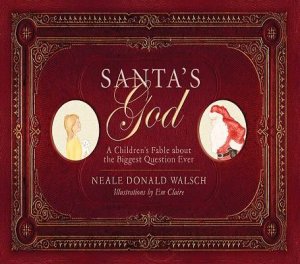
Santa’s God: A Children’s Fable About the Biggest Question Ever
By Neale Donald Walsch. Illustrations: by Em Claire.
(OR: EnNin Books, October 2009. 32 pp. $19.95, ISBN 978-1-57174-596-5)
Children’s Picture Book/Christmas
If you could ask Santa one questions what would it be?
In “Santa’s God” little Melinda is just certain that this is her night to meet Santa and she has her question ready.
Well – like any child she has many questions at the tip of her tongue, but when she finally asks all of the questions you might imagine a child would want to know (How do you get to every house in one night? How do you get down the chimney and what do you do when there is no chimney?) she asks the big one.
Little Melinda wants to know, “Who is the real God?”
Santa is so surprised he drops his cookie!
In addition to asking surprising questions, our young heroine also has a startling knowledge of Santa in many cultures.
She knows the names of Santa around the world. Many will be familiar to you, like the Dutch Sinterklaas or the English Father Christmas but you may learn some new names for Santa like Kurohsu in Japan or Joulupkki in Finland! Em Claire’s illustrations of these Santas are also charming.
People looking only for the biblical Christmas story may be disappointed, but if you are looking for a Santa story that teaches about God’s love and the sacred worth of all people, this may be the Christmas book you’ve been looking for.
Geri Williams is a local book fancier.