How to resolve AdBlock issue?
Arts & Life
- Details
- Written by: Ted Kooser
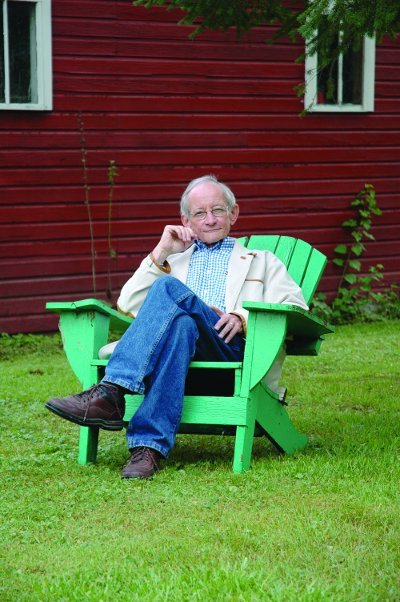
Some of us are fortunate to find companions among the other creatures, and in this poem by T. Alan Broughton of Vermont, we sense a kind of friendship without dependency between our species and another.
Great Blue Heron
I drive past him each day in the swamp where he stands
on one leg, hunched as if dreaming of his own form
the surface reflects. Often I nearly forget to turn left,
buy fish and wine, be home in time to cook and chill.
Today the bird stays with me, as if I am moving through
the heron’s dream to share his sky or water—places
he will rise into on slow flapping wings or where
his long bill darts to catch unwary frogs. I’ve seen
his slate blue feathers lift him as dangling legs
fold back, I’ve seen him fly through the dying sun
and out again, entering night, entering my own sleep.
I only know this bird by a name we’ve wrapped him in,
and when I stand on my porch, fish in the broiler,
wine glass sweating against my palm, glint of sailboats
tacking home on dusky water, I try to imagine him
slowly descending to his nest, wise as he was
or ever will be, filling each moment with that moment’s
act or silence, and the evening folds itself around me.
Ted Kooser was US Poet Laureate from 2004 to 2006. He is a professor in the English Department of the University of Nebraska-Lincoln. He lives on an acreage near the village of Garland, Nebraska, with his wife Kathleen Rutledge, the editor of the Lincoln Journal Star.
American Life in Poetry is made possible by The Poetry Foundation, publisher of Poetry magazine. It is also supported by the Department of English at the University of Nebraska-Lincoln. Poem copyright ©2010 by T. Alan Broughton from his most recent book of poetry, A World Remembered, Carnegie Mellon University Press, 2010. Reprinted by permission of T. Alan Broughton and the publisher. Introduction copyright ©2010 by The Poetry Foundation.
- Details
- Written by: Lake County News Reports

- Details
- Written by: Ted Kooser
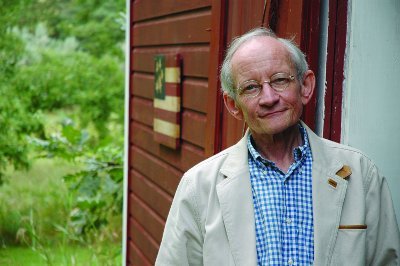
I realized a while back that there have been over 850 moons that have gone through their phases since I arrived on the earth, and I haven’t taken the time to look at nearly enough of them.
Here Molly Fisk, a California poet, gives us one of those many moons that you and I may have failed to observe.
Hunter's Moon
Early December, dusk, and the sky
slips down the rungs of its blue ladder
into indigo. A late-quarter moon hangs
in the air above the ridge like a broken plate
and shines on us all, on the new deputy
almost asleep in his four-by-four,
lulled by the crackling song of the dispatcher,
on the bartender, slowly wiping a glass
and racking it, one eye checking the game.
It shines down on the fox’s red and grey life,
as he stills, a shadow beside someone’s gate,
listening to winter. Its pale gaze caresses
the lovers, curled together under a quilt,
dreaming alone, and shines on the scattered
ashes of terrible fires, on the owl’s black flight,
on the whelks, on the murmuring kelp,
on the whale that washed up six weeks ago
at the base of the dunes, and it shines
on the backhoe that buried her.
Ted Kooser was US Poet Laureate from 2004 to 2006. He is a professor in the English Department of the University of Nebraska-Lincoln. He lives on an acreage near the village of Garland, Nebraska, with his wife Kathleen Rutledge, the editor of the Lincoln Journal Star.
American Life in Poetry is made possible by The Poetry Foundation, publisher of Poetry magazine. It is also supported by the Department of English at the University of Nebraska-Lincoln. Poem copyright ©2000 by Molly Fisk, whose most recent book of poetry is The More Difficult Beauty, Hip Pocket Press, 2010. Poem reprinted from The Place That Inhabits Us, Sixteen Rivers Press, 2010, by permission of Molly Fisk and the publisher. Introduction copyright ©2010 by The Poetry Foundation.
- Details
- Written by: Lake County News Reports