 How to resolve AdBlock issue?
Arts & Life
- Details
- Written by: Editor
KELSEYVILLE, Calif. – The last event of the Summer Poetry Series is this Wednesday, Aug. 26, at 6 p.m. at the Saw Shop Gallery Bistro, 3825 Main St. in Kelseyville.
Hosted by Lake County Poet Laureate Casey Carney, the reading features poets KC Patrick, Fran Ransley and Sandy Stillwell, with a collaborative performance by poet Sam Flot and saxophonist Jim Leonardis.
Open mic sign-ups are at 6 p.m.
Five poets will be invited to share up to five minutes of poetry each.
The $10 admission includes a glass of wine, an appetizer and $20 in Saw Shop bucks, to be redeemed at the patron’s convenience.
- Details
- Written by: Ted Kooser

Twenty years ago my wife and I had visitors from New York, and their car broke down on a country road about a mile from our home.
One of them panicked because there were no phone booths from which to call for help. Nebraska is a place where there can be a lot of room between one land-line and the next.
Carol V. Davis of California did a residency at Homestead National Monument, and this is one of the poems that came out of it.
Animal Time
I do better in animal time,
a creeping dawn, slow ticking toward dusk.
In the middle of the day on the Nebraska prairie,
I’m unnerved by subdued sounds, as if listening
through water, even the high-pitched drone of the
cicadas faint; the blackbirds half-heartedly singing.
As newlyweds, my parents drove cross country to
Death Valley, last leg of their escape from New York,
the thick soups of their immigrant mothers, generations
of superstitions that squeezed them from all sides.
They camped under stars that meant no harm.
It was the silence that alerted them to danger.
They climbed back into their tiny new car, locked
its doors and blinked their eyes until daylight.
American Life in Poetry is made possible by The Poetry Foundation ( www.poetryfoundation.org ), publisher of Poetry magazine. It is also supported by the Department of English at the University of Nebraska-Lincoln. They do not accept unsolicited submissions. Poem copyright 2013 by Carol V. Davis, “Animal Time,” from Harpur Palate, (Vol. 13, No. 1, summer/fall 2013). Poem reprinted by permission of Carol V. Davis and the publisher. Introduction copyright 2015 by The Poetry Foundation. The introduction's author, Ted Kooser, served as United States Poet Laureate Consultant in Poetry to the Library of Congress from 2004-06.
- Details
- Written by: Tim Riley
THE MAN FROM U.N.C.L.E. (Rated PG-13)
The sixties, which to this day generates feelings of nostalgia for what many view as the coolest decade, enjoyed a long run of spy capers that might have been, in certain ways, the antidote to anxiety about the tensions underlying the height of the Cold War.
Early in the decade, James Bond, the suave, cool superspy, made his debut with “Dr. No,” quickly followed by “From Russia with Love,” “Goldfinger,” and an endless stream of 007 adventures.
Less serious efforts mimicked the Bond popularity, with James Coburn as master spy Derek Flint and Dean Martin as secret agent Matt Helm.
Like James Bond, both Flint and Helm, exuding sixties cool, were popular with the ladies.
The spy business was not confined just to the big screen.
Of course, there was the hugely popular 1960s television series “The Man from U.N.C.L.E.,” starring Robert Vaughn and David McCallum, which has now been adapted by director Guy Ritchie for a fresh take on the stylish spy genre.
Set in 1963 at the height of the Cold War, Ritchie’s “The Man from U.N.C.L.E.,” developed as an origin story, centers on the seminal yet reluctant alliance of two agents on both sides of the Iron Curtain given the mission to stop a mysterious international criminal organization.
Henry Cavill’s debonair CIA agent Napoleon Solo, dressed in a natty suit, is first seen crossing Checkpoint Charlie into East Berlin.
His mission is to extract the daughter of a vanished German scientist, who is the key to infiltrating the criminal organization.
Armie Hammer’s rough-edged KGB agent Illya Kuryakin, a volatile yet loyal soldier for communist Russia, has also been sent to East Berlin to snatch the same vital German asset.
When Solo and Kuryakin first meet, they are trying to kill each other.
Meanwhile, in an exciting, breakneck, winner-take-all street chase, Solo makes his way to the free world with Gaby Teller (Alicia Vikander), a whip-smart East German auto mechanic who is the estranged daughter of Dr. Udo Teller, once Hitler’s favorite rocket scientist.
The German scientist has gone missing, presumably now in the clutches of the secretive criminal cabal, which happens to be organized by neo-fascist Italian heiress Victoria Vinciguerra (Elizabeth Debicki), an attractive ice queen who looks like a model in Vogue magazine.
Given the high stakes of dealing with a rogue terrorist group with Nazi ties, the Soviet and American agents are forced by their handlers to work together to find the missing scientist and avert nuclear disaster.
Sworn rivals, Solo and Kuryakin vent their national and professional antagonism in a bare-knuckled, bust-up-the-furniture fight designed to convey in no uncertain terms that they might be stuck with each other, but they don’t have to like it.
What results from lingering hostility is a strange sort of buddy movie, with Solo as the suave and often self-serving agent (we learn that he was an art thief after World War II, then given a job in the CIA rather than jail time).
Solo’s background sounds very much like the premise for Robert Wagner’s thief-cum-agent Alexander Mundy in the late Sixties TV series “It Takes a Thief.” Both Solo and Mundy are the sophisticated playboy types.
For his part, the petulant Kuryakin, faithful foot soldier for his authoritarian homeland, deals awkwardly with his newfound role of cooperative spy, and yet he manages to pretend to be an architect engaged to Gaby as a cover when they arrive in Italy.
Using his playboy charm and skills as a thief, Solo gets close to the villainous Victoria, finagling his way into her exclusive party held during an auto race where her husband (Italian actor Luca Calvani) spends his time mostly on the track.
In the hands of Guy Ritchie “The Man from U.N C.L.E.” proves to be an interesting and entertaining summer action film.
As a director, Ritchie has an interesting career, starting with great crime films “Lock, Stock & Two Smoking Barrels” and “Snatch.”
More recently, Ritchie directed the acclaimed blockbusters “Sherlock Holmes” and “Sherlock Holmes: A Game of Shadows.”
However, he is not immune to bad judgment; while married to Madonna, he co-wrote and directed the execrable “Swept Away” for this then-spouse.
Fortunately, the director knows how to stage impressive set pieces and thrilling action sequences where the stunts are remarkably striking in their execution. “The Man from U.N.C.L.E.” has plenty enough of both.
The best of “The Man from U.N.C.L.E.” involves many moving parts, from the chemistry that develops with the trio of Gaby, Solo and Kuryakin to the sometimes playful, lighthearted tone where humor is an important ingredient.
The film is also visually dazzling, where the setting of 1963 appears so authentic that the scenic locations in “The Man from U.N.C.L.E.” are indistinguishable from the style of the predecessor movies and TV shows that were actually filmed during the sixties.
Tim Riley writes film and television reviews for Lake County News.
- Details
- Written by: Ted Kooser
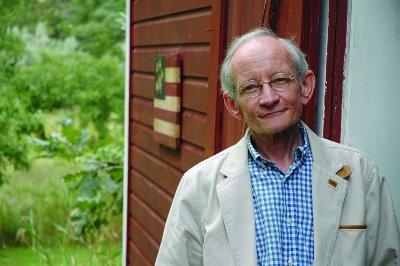
Several years ago I published a children’s book about a bag in the wind, so it’s no wonder I love this poem by April Lindner, who lives in Pennsylvania.
Once you start noticing these wind-blown bags, you see them everywhere.
Lindner's most recent book is “This Bed Our Bodies Shaped” (Able Muse Press, 2012).
Carried Away
One rainy night we sat in traffic
and, overtired in back, you saw
a wind-whipped grocery bag afloat
beyond the clutch of jagged branches,
swept by gusts and whirled in eddies.
A sudden downdraft swooped it earthward,
where it danced till with a whoosh
a current luffed it past the power lines.
Disowned by gravity, small ghost
not yet snagged by twiggy fingers,
it couldn’t reach the earth. Thin-skinned,
it pulsed, translucent jellyfish.
You wept and pled to be let out
into the dark and slanted rain,
somehow to save that desolate thing.
The light turned green and still you begged,
Go back, go back, on its behalf,
caught and held, bossed and tossed
by a will much greater than its own.
American Life in Poetry is made possible by The Poetry Foundation ( www.poetryfoundation.org ), publisher of Poetry magazine. It is also supported by the Department of English at the University of Nebraska-Lincoln. They do not accept unsolicited submissions. Poem copyright 2010 by April Lindner, “Carried Away,” from The Hudson Review, (Vol. LXIII, no. 1, Spring 2010). Poem reprinted by permission of April Lindner and the publisher. Introduction copyright 2015 by The Poetry Foundation. The introduction's author, Ted Kooser, served as United States Poet Laureate Consultant in Poetry to the Library of Congress from 2004-06.