LAKE COUNTY, Calif. – Lake County Animal Care and Control has a new group of dogs waiting to be adopted this week.
Dogs available for adoption this week include mixes of dachshund, hound, husky, Labrador Retriever and pit bull.
Dogs that are adopted from Lake County Animal Care and Control are either neutered or spayed, microchipped and, if old enough, given a rabies shot and county license before being released to their new owner. License fees do not apply to residents of the cities of Lakeport or Clearlake.
If you're looking for a new companion, visit the shelter. There are many great pets hoping you'll choose them.
The following dogs at the Lake County Animal Care and Control shelter have been cleared for adoption (additional dogs on the animal control Web site not listed are still “on hold”).
“Smokey” is a male dachshund mix in kennel No. 6, ID No. 11555. Photo courtesy of Lake County Animal Care and Control. ‘Smokey’
“Smokey” is a male dachshund mix with a short black and brown coat.
He already has been neutered.
He is in kennel No. 6, ID No. 11555.
This male pit bull terrier is in kennel No. 10, ID No. 13507. Photo courtesy of Lake County Animal Care and Control. Male pit bull terrier
This male pit bull terrier has a short brindle coat and brown eyes.
He is in kennel No. 10, ID No. 13507.
This young female pit bull-Labrador Retriever mix is in kennel No. 12, ID No. 13555. Photo courtesy of Lake County Animal Care and Control. Female pit bull-Labrador Retriever mix
This young female pit bull-Labrador Retriever mix has a short black coat and brown eyes.
She is in kennel No. 12, ID No. 13555.
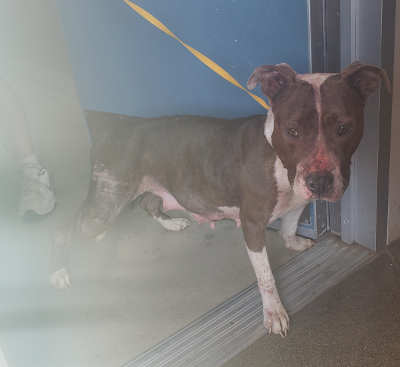
This male pit bull terrier is in kennel No. 15, ID No. 13546. Photo courtesy of Lake County Animal Care and Control. Male pit bull terrier
This male pit bull terrier has a short blue and white coat and brown eyes.
He is in kennel No. 15, ID No. 13546.
“Nook” is a female hound mix in kennel No. 23, ID No. 11790. Photo courtesy of Lake County Animal Care and Control. ‘Nook’
“Nook” is a female hound mix with a short tricolor coat and brown eyes.
She has already been spayed.
She is in kennel No. 23, ID No. 11790.
This female pit bull terrier mix is in kennel No. 29, ID No. 13568. Photo courtesy of Lake County Animal Care and Control. Female pit bull terrier
This female pit bull terrier mix has a short brindle and white coat and gold eyes.
She is in kennel No. 29, ID No. 13568.
This female pit bull terrier mix is in kennel No. 30, ID No. 13569. Photo courtesy of Lake County Animal Care and Control. Female pit bull terrier
This female pit bull terrier mix has a short gray and white coat with gold eyes.
She is in kennel No. 30, ID No. 13569.
“Chase” is a male husky-pit bull terrier mix in kennel No. 32, ID No. 13541. Photo courtesy of Lake County Animal Care and Control. ‘Chase’
“Chase” is a male husky-pit bull terrier mix with a short tan coat and blue eyes.
He is in kennel No. 32, ID No. 13541.
Lake County Animal Care and Control is located at 4949 Helbush in Lakeport, next to the Hill Road Correctional Facility.
Office hours are Monday through Friday, 11 a.m. to 5 p.m., and 11 a.m. to 3 p.m., Saturday. The shelter is open from 11 a.m. to 4 p.m., Monday through Friday and on Saturday from 11 a.m. to 3 p.m.
For more information call Lake County Animal Care and Control at 707-263-0278.
Email Elizabeth Larson at This email address is being protected from spambots. You need JavaScript enabled to view it.. Follow her on Twitter, @ERLarson, or Lake County News, @LakeCoNews.
2019 NASA Human Exploration Rover Challenge college/university division winner, University of Puerto Rico Mayagüez - Team 1. Credits: NASA/Emmett Given. Teams from around the globe will compete April 17 to 18 in NASA's Human Exploration Rover Challenge at the U.S. Space & Rocket Center in Huntsville, Alabama.
More than 100 teams are expected to participate, including teams from 27 states, the District of Columbia, Puerto Rico, and 11 countries, such as Brazil, Germany, Egypt, Singapore, India and Mexico.
The 26th edition of the annual event, managed by the Office of STEM Engagement at NASA's Marshall Space Flight Center in Huntsville, features students from high schools, colleges and universities around the world designing, engineering and testing a human-powered rover to take on a course simulating terrain found on the Moon and Mars, as well as other planets, moons and asteroids.
One female and one male driver will pilot each team’s lightweight rover across a grueling half-mile course that features obstacles and scientific challenges designed to force teams to think like NASA mission planners and planetary explorers.
While previous contests focused on finishing the course as quickly as possible, the challenge now focuses on strategy over speed. Participants are given a course map and task descriptions prior to the event, allowing them to devise a plan of attack that best suits each team’s strengths.
Teams are given a time limit – simulating spacewalking astronauts’ oxygen supplies – to attempt as many obstacles and tasks as possible, thereby accumulating points. If teams fail to cross the finish line under the time limit, they will lose any points accrued during that run on the course.
Among the rule changes for the 2020 challenge is the addition of one minute – for a total of eight minutes – to finish the course, which gives teams a greater opportunity to complete more of the optional 14 obstacles and five science tasks. Additionally, NASA no longer allows teams to utilize pneumatic tires or other commercially purchased wheels on their vehicles.
The obstacles will simulate the terrain found throughout the solar system, and the tasks will challenge teams to collect and return samples, take photographs and deploy scientific instruments. Teams must decide which tasks and obstacles to attempt or bypass before their clock expires.
Each team will compete for the top three finishes, best overall design, rookie team and other technical challenges.
NASA’s Office of STEM Engagement and NASA’s Human Exploration and Operations Mission Directorate at NASA Headquarters in Washington, along with NASA partners Boeing, Jacobs Engineering and Lockheed Martin in Huntsville provide leadership and funding for the Human Exploration Rover Challenge.
Rover Challenge reflects the goals of NASA’s Artemis Program, which seeks to put the first woman and next man on the Moon by 2024. Like the Artemis Program, the event draws the best and brightest minds from around the world. Through the event, NASA hopes to engage, inspire and develop the next generation of engineers, scientists, astronauts, mission planner and NASA team members.
LAKE COUNTY, Calif. – The Lake County Public Safety Power Shutoff Committee on Friday hosted local and state leaders in conversation with Pacific Gas and Electric Co. to discuss how to mitigate the impacts of public safety power shutoffs.
The Friday afternoon meeting was held in the Board of Supervisors’ chambers at the Lake County Courthouse in Lakeport.
The committee formed last year to address the repeated public safety power shutoffs that impacted the entire county. In October, all county PG&E customers – more than 37,000 accounts – were off at the same time for several days due to two overlapping shutoffs. A small, more focused shutoff, occurred in November.
The committee, which held its first meeting in December, includes representatives from Clearlake, Lakeport and the county. On Friday, Mayor Russ Cremer and Vice Mayor Dirk Slooten represented the city of Clearlake, and council members Stacey Mattina and Mireya Turner represented the city of Lakeport. Moke Simon and Bruno Sabatier – the latter the alternate sitting in due to the absence of Rob Brown – attended on behalf of the county.
Clearlake City Manager Alan Flora, Lakeport City Manager Margaret Silveira and County Administrative Officer Carol Huchingson also were in attendance.
California Public Utilities Commissioner Martha Guzman Aceves and Aaron Johnson, PG&E’s vice president of customer energy solutions, offered updates and took community input.
Guzman Aceves said they are hearing input from residents up and down the state who have been impacted by the public safety power shutoffs.
“We also find it unacceptable. It is not a new normal, as far as we’re concerned,” she said, noting it was a time of transition to get utilities up to speed. She said much-needed collaboration and communication are missing from PG&E.
“One of the areas that we’re working on is the rules for the shutoffs,” she said.
Those include proposals to create working groups to improve communication with local governments, provide 24-hour community resource centers, improve outreach, system hardening and vegetation management.
Guzman Aceves said there is now a whole new set of requirements for utilities when it comes to hardening infrastructure and vegetation management. The state also wants micro gridding of infrastructure, which relates to putting backup generation next to substations so as many communities – and critical facilities – can stay energized as possible.
Lake County’s state legislators, Sen. Mike McGuire and Assemblywoman Cecilia Aguiar-Curry, sent representatives to weigh in on the situation.
Taylor Morrison, McGuire’s district representative, said McGuire’s “whole mission is to hold this utility and other state utilities accountable.”
McGuire has been named co-chair of two state working groups that have been meeting since the fall, one on energy market and insurance stability, the second on wildlife fire response and resilience, including and forest health strategies. The State Senate also has launched an action plan to address the situation, Morrison said.
PG&E’s Johnson said the corporation is improving real-time monitoring and intelligence in its wildfire safety center, installing more cameras, and instituting new safety practices and enhanced vegetation management. He said the way the system was designed does not now meet the needs of the communities the company serves.
Johnson, who said he is one of the architects of the public safety power shutoff program, agreed with Guzman Aceves. “We too believe this is not an acceptable way to move forward.”
He added, “Our focus was very much on how do we safely do something that we are not built to do, which is to turn off the power. That was the lion’s share of our focus.”
Johnson said the company missed the mark when it came to anticipating the impacts on the communities they serve, admitting they didn’t do enough to meet needs and hardship as the shutoff events unfolded.
“We do believe this is a necessary tool in these current conditions in order to safely operate the grid, but these events need to be less frequent, they need to be shorter and smaller in scope as we move forward,” he said.
Johnson said initiatives include improving weather data analysis to allow them to target weather in smaller geographical areas and speeding up restoration.
They’re also working to improve information sharing and website functioning, which he said were among the most embarrassing elements of the company’s performance last fall.
He said PG&E also wants to expand community resource centers and move them out of tents and into hard-sided structures with air conditioning and heat.
Mattina asked about whether PG&E is looking at narrowing its timeline of system hardening and vegetation management from 10 years to three years.
Johnson pointed to challenges in doing that and how the company is looking at shutoffs going forward.
“I’m not convinced in these fire conditions that public safety power shutoff comes out of the toolkit of the utility, ever,” he said, adding that they need to happen much less frequently, and the windstorms that trigger them need to be much more severe.
He said they increased the number of employees in vegetation management from 3,000 to 6,000 and inspected all of their lines in tier two and tier three areas, where fire risk is highest, and prioritized repairs there.
Slooten said there had been no discussion up to that point about undergrounding. “Obviously, that’s the ultimate solution. Wouldn’t you agree with that?”
Johnson did agree. “I think it is the ultimate solution. It is a part of the long term plan to harden the assets,” he said, and he expected them to do significantly more of it, although it’s three to 10 times as expensive as hanging wire.
The places where undergrounding needs to be done the most are the most challenging – steep, rocky areas, he said.
In addition to considering undergrounding in some areas, they are also looking at removing wire where they can, and putting in solar batteries and generators rather than running miles of wire through fire-prone terrain, Johnson said.
Sabatier said he doesn’t want to lose focus on the future, but he raised issues with PG&E’s past performance – from its pole that caused the Sulphur fire in Clearlake Oaks and Clearlake in 2017, to the tower that caused the Camp fire that destroyed the town of Paradise in November 2018, to the San Bruno pipeline disaster in September 2010.
He said he wants PG&E to let the county know where its problems are so local officials can work with them, noting that words aren’t enough. Sabatier said he wanted to see more transparency from PG&E and to know what their plan is so Lake County can be part of it.
Johnson said that, as someone who is proud of the work he does, he doesn’t relish hearing those past stories about the company. “But it’s the reality,” he said, acknowledging they have a lot of work to do to regain people’s trust.
“We are also tired of the words and want to see some actions and commitments,” said Guzman Aceves, who invited Johnson to come to the CPUC with action and specifics.
She said the CPUC had put forward plans for working groups with local governments. “That can start today,” she said, adding that PG&E should have a list of community resource centers in place.
Clearlake City Manager Alan Flora told Johnson that in public safety power shutoffs, which are not declared disasters, PG&E’s practice of putting out information through the county’s Office of Emergency Services doesn’t help the cities, and that the company needs to plan to communicate directly with municipalities.
Local officials ask for help, partnership
During public comment, Lake County Public Health Officer Dr. Gary Pace raised his concerns with PG&E’s past performance and how it’s planning for what is ahead.
He said that when he was talking to PG&E last year about the potential shutoffs, “Pretty much the message was, you’re gonna be on your own, kinda figure it out.” As they started getting into the events, he said it was a matter of last-minute “flailing” and trying to get generators out.
He said now there is a lot of skepticism that PG&E is going to follow through. It was hard to understand last year what PG&E was thinking and the company seemed more focused on liability than helping local officials plan for the community at large, Pace added.
Pace said now, months later, with possible shutoffs ahead, “We’re still talking about planning and possibilities,” while his department is working on different strategies in parallel.
He pointed to the importance of 24-hour power accessibility for the medically fragile. What’s needed are more than community resource centers which PG&E previously had offered during daylight hours, with water, chairs and device charging. Rather, Pace said, what’s needed are cots and adequate power strips because some of these people will need to come in and sleep for the night.
“We’re actively working on setting up shelter possibilities,” and getting memorandums of understanding in place, Pace said.
He asked for transfer switches for generators, cots, power strips, security and partnering.
Pace said they are very concerned about the loss of life. “It’s hard to trust you at this point as we’re halfway to the next one and we don’t see anything yet.”
Lake County Superintendent of Schools Brock Falkenberg said that in polling colleagues around the state, there seems to be a philosophy of not opening schools if there is no power.
“I believe we need to open schools, with or without power,” he said, explaining they can mitigate the risks.
Addressing Johnson directly, Falkenberg said, “I need your help to do that.”
He asked PG&E for support and consultation to keep schools open. Falkenberg said if schools don’t open, people have a hard time going to work.
During the committee members’ closing statements at the end of the nearly three-hour meeting, Mattina said, “I’m not OK with this being a new reality for us. It is outrageous what we’ve been through.”
She said focusing on the power grids to have less impact on city centers will be important.
“We’re really your partner in this and we weren’t treated that way. We look forward to that changing and making it a lot less painful,” Mattina said.
Turner also asked community members to start preparing their private properties – including dealing with growing vegetation – so they don’t contribute to fire danger.
“We need to all be working together to find these solutions,” she said.
Email Elizabeth Larson at This email address is being protected from spambots. You need JavaScript enabled to view it.. Follow her on Twitter, @ERLarson, or Lake County News, @LakeCoNews.
LAKE COUNTY, Calif. – Authorities have released the name of the second person to die from injuries sustained in a solo-vehicle crash last weekend.
Ronda Gullickson, 59, of Clearlake Oaks died after she was flown by air ambulance to Kaiser Vacaville on Saturday, Feb. 15, according to the Solano County Coroner’s Office.
Earlier this week, the Lake County Sheriff’s Office identified Richard Joseph Adams, 69, of Nice as the driver who died at the scene of the wreck, as Lake County News has reported.
The third victim in the crash, 33-year-old Justin Hendrix of Woodland, is reported to be stable, said California Highway Patrol Officer Joel Skeen. Hendrix was flown to Santa Rosa Memorial Hospital.
The CHP said Adams was driving a blue 2002 Chevrolet Trailblazer westbound on Highway 20, east of the intersection of Morine Ranch Road in Clearlake Oaks, at an unknown rate of speed just before 5 p.m. Saturday when he went off the road and hit three separate trees.
Adams died at the scene, while Gullickson and Hendrix were flown out of county by separate air ambulances, the CHP said.
The CHP said neither drugs nor alcohol are suspected as factors in the crash.
Gullickson had previously been involved in a traffic incident when she and her dog had been seriously injured in a January 2010 crash when they were hit by a car while walking across Highway 20 in Clearlake Oaks in a marked crosswalk.
Email Elizabeth Larson at This email address is being protected from spambots. You need JavaScript enabled to view it.. Follow her on Twitter, @ERLarson, or Lake County News, @LakeCoNews.
LAKEPORT, Calif. – The four candidates in the District 5 supervisorial district took part in a forum on Wednesday in Lakeport.
Kevin Ahajanian of Cobb, Bill Kearney of Kelseyville, Jessica Pyska of Cobb and Lily Woll of Kelseyville took part in the forum, hosted by Lake County News and moderated by Editor and Publisher Elizabeth Larson.
The four are running in the March primary to succeed retiring incumbent, Supervisor Rob Brown.
The video of the forum is featured above.
The questions and the times when they appear in the video area published below.
QUESTIONS:
Opening statements: 2:29
1. To start off, I’d like to understand more about your thinking process and what motivates you. Please take us back to your “lightbulb” moment – when it was you made the firm decision that you were going to run for local office, and some of the background to that decision. Has this been something you had looked at doing for some time, or was there a particular event or an idea that encouraged you to take the step of putting your name on the ballot?
Answers begin: 6:32
2. Here is a multipart question from a Cobb resident: What do you know of our county's Community Wildfire Protection Plan laid out in 2009, with recommended updates for every five years – and the failure to implement it that led to the recent wildfire disasters each of the past four years? What are you going to do about our county's apparent inability to keep track of its critically important plans, convene the proper entities to make them effective, ensure timely updates with proper public input, and get the funding for the implementation of these plans?
Answers begin: 13:24
3. The county of Lake has had ongoing friction and disagreements with the city of Lakeport over the city’s plans to annex the remaining portion of South Main Street that has been part of its sphere of influence for decades. Key issues are water service and public safety, and a large amount of sales tax from what is reported to be the most lucrative commercial corridor in the unincorporated county. While Lakeport is not in your district, the issue of the annexation is an issue that the board has discussed as a whole, with the county having recently agreed to a good faith negotiations process requested by the Lake Local Area Formation Commission. Do you have an approach to this situation that you think is fair and equitable and could bring the county and city into partnership, rather than opposition?
Answers begin: 19:58
4. Do you support the Middle Creek Flood Damage Reduction and Ecosystem Restoration Project? How would you help move this long term project forward?
Answers begin: 24:12
5. The city of Clearlake has raised issues with the county’s sales of tax-defaulted property, asking for a greater number of sales to be held annually and pointing to less-than-consistent scheduling of the sales in recent years, which in the past have been held on an annual basis. The Clearlake city manager has argued that the failure to hold these sales regularly contributes to blight, harms local agencies and governments, and hampers development. Do you agree with the city’s stance on this issue? If you do agree that it’s a problem, how would you address it as a member of the Board of Supervisors?
Answers begin: 29:42
6. How will you address the updating of the county's legal plans (general plan, area plans, community wildfire protection plan, watershed and stormwater management plans), outdated ordinances and missing links to available state and federal funding for which these are critical documents?
Answers begin: 34:08
7. Last year, the nonprofit humanitarian organization Direct Relief created a map of communities that are especially vulnerable to wildland fire and could be the hardest hit based on a number of factors that make up what they call “social vulnerability risk.” That risk assessment is based on things like income, age and mobility. There were a number of California communities shown on that map, and three of those communities are in Lake County: Clearlake, Lower Lake and the Clearlake Riviera in Kelseyville. What plans do you have as a District 5 supervisor to tackle this threat for the Kelseyville area?
Answers begin: 39:24
8. How will you address invasive species infestation threat from mussels that could destroy our surface water infrastructure systems and ruin the recreational water bodies in Lake County? Do you think the county is doing enough under its current prevention program?
Answers begin: 46:21
9. Four years ago this month, the supervisors hired Carol Huchingson as county administrative officer. Huchingson’s tenure has been marked by a number of controversies, including her interference with other department heads, most notably the registrar of voters, which destabilized that critical county department for more than a year. The board gave her control of the Human Resources Department and now she in her individual capacity and the county are facing a multimillion-dollar tort claim from the former HR director who has made 19 allegations – including retaliation, wrongful termination and race discrimination – and is demanding a jury trial. A year ago this month, Huchingon tried to convince the board to make her county chief executive officer in a meeting that was not recorded and had no minutes. Huchingson has also led the effort to push through a classification and compensation study that, if followed, is expected to hand out hefty raises to the county’s highest-paid employees – including her – and could lead to the county becoming financially insolvent. Unfortunately, indications are that the study isn’t going to be released publicly until after the primary election. So far, the board has not taken decisive action to reel her in. Do you have concerns about Huchingson and how will you approach resolving what is becoming a growing problem in county leadership?
Followup question: Has Huchingson reached out to any of you to offer you an orientation on county government as she has with past supervisorial candidates?
Answers begin: 51:26
10. Are you opposed to or of supportive of banning law-abiding citizens from owning the AR15 rifle in California? What features do you know of (if any) that make it more dangerous than any other rifle, pistol or revolver? Would you be supportive of approving indoor shooting ranges in Lake County?
Answers begin: 56:26
11. Recently in the area of Staheli Drive and Gold Dust Drive in Kelseyville, very close to many homes, a large amount of hemp was planted in various fields. Due to this, the residents are subjected to a foul odor for much of the growing season. At times the odor is so strong that they cannot keep doors and windows open. With the presence of this odor, there are concerns that it would make it very difficult to sell a property. What will you do to help the citizens of Lake County with this?
Answers begin: 1:00:41
12. What is the proper role of the Board of Supervisors to preserve, protect and defend Lake County agriculture? In conflicts over water use between agricultural and residential interests, what are your priorities?
Answers begin: 1:06:20
13. Many District 5 residents speak Spanish as their primary language. Will you be able to represent those residents?
Answers begin: 1:11:36
14. What role should the Board of Supervisors take in regards to addressing the fire insurance crisis in Lake County?
Answers begin: 1:14:00
15. How will you address the dismal funding for life-sustaining programs serving the very poor, elderly and caregivers federally funded (but just barely) by the Older Americans Act?
Answers begin: 1:19:42
16. The candidates come from three distinct neighborhoods – Cobb, Big Valley and Buckingham. All three have different demographics, issues and concerns. How will you be able to represent the vast majority of District 5 residents?
Answers begin: 1:24:14
17. In recent years the Board of Supervisors has been considering department consolidation or reconsolidation. Last summer, the board voted to reconsolidate Water Resources with Public Works and last year they requested state legislation, AB 632, which was passed to allow them to consolidate the auditor-controller with the treasurer-tax collector at some point in the future. So far, these consolidations have appeared to be more of a matter of the inability to retain employees, and the result is that more responsibilities are being placed on fewer people. While the county has said consolidation offers efficiencies and cost savings, they’ve offered no evidence that that is the case. Do you think consolidation is the right approach? If so, why? Or do you have alternative ideas you would pursue as supervisor?
Answers begin: 1:29:40
18. Last year we didn’t have huge fires causing us to have to evacuate, but we had a manmade issue, public safety power shutoffs, which impacted Lake County heavily in the fall. Share what your experience was, if any, in those protracted shutoffs, how would you sum up the shutoffs’ impacts on your community and, as a member of the Board of Supervisors, what would you want to try to do address the issue?
The Australian black flying fox is a reservoir of Hendra virus, which can be transmitted to horses and sometimes humans. Photo courtesy of Linfa Wang. It’s no coincidence that some of the worst viral disease outbreaks in recent years — SARS, MERS, Ebola, Marburg and likely the newly arrived COVID-19 virus — originated in bats.
A new University of California, Berkeley, study finds that bats’ fierce immune response to viruses could drive viruses to replicate faster, so that when they jump to mammals with average immune systems, such as humans, the viruses wreak deadly havoc.
Some bats — including those known to be the original source of human infections — have been shown to host immune systems that are perpetually primed to mount defenses against viruses. Viral infection in these bats leads to a swift response that walls the virus out of cells. While this may protect the bats from getting infected with high viral loads, it encourages these viruses to reproduce more quickly within a host before a defense can be mounted.
This makes bats a unique reservoir of rapidly reproducing and highly transmissible viruses. While the bats can tolerate viruses like these, when these bat viruses then move into animals that lack a fast-response immune system, the viruses quickly overwhelm their new hosts, leading to high fatality rates.
“Some bats are able to mount this robust antiviral response, but also balance it with an anti-inflammation response,” said Cara Brook, a postdoctoral Miller Fellow at UC Berkeley and the first author of the study. “Our immune system would generate widespread inflammation if attempting this same antiviral strategy. But bats appear uniquely suited to avoiding the threat of immunopathology.”
The researchers note that disrupting bat habitat appears to stress the animals and makes them shed even more virus in their saliva, urine and feces that can infect other animals.
“Heightened environmental threats to bats may add to the threat of zoonosis,” said Brook, who works with a bat monitoring program funded by DARPA (the U.S. Defense Advanced Research Projects Agency) that is currently underway in Madagascar, Bangladesh, Ghana and Australia. The project, Bat One Health, explores the link between loss of bat habitat and the spillover of bat viruses into other animals and humans.
“The bottom line is that bats are potentially special when it comes to hosting viruses,” said Mike Boots, a disease ecologist and UC Berkeley professor of integrative biology. “It is not random that a lot of these viruses are coming from bats. Bats are not even that closely related to us, so we would not expect them to host many human viruses. But this work demonstrates how bat immune systems could drive the virulence that overcomes this.”
The new study by Brook, Boots and their colleagues was published this month in the journal eLife.
Boots and UC Berkeley colleague Wayne Getz are among 23 Chinese and American co-authors of a paper published last week in the journal EcoHealth that argues for better collaboration between U.S. and Chinese scientists who are focused on disease ecology and emerging infections.
Vigorous flight leads to longer lifespan – and perhaps viral tolerance
As the only flying mammal, bats elevate their metabolic rates in flight to a level that doubles that achieved by similarly sized rodents when running.
Generally, vigorous physical activity and high metabolic rates lead to higher tissue damage due to an accumulation of reactive molecules, primarily free radicals. But to enable flight, bats seem to have developed physiological mechanisms to efficiently mop up these destructive molecules.
This has the side benefit of efficiently mopping up damaging molecules produced by inflammation of any cause, which may explain bats’ uniquely long lifespans. Smaller animals with faster heart rates and metabolism typically have shorter lifespans than larger animals with slower heartbeats and slower metabolism, presumably because high metabolism leads to more destructive free radicals. But bats are unique in having far longer lifespans than other mammals of the same size: Some bats can live 40 years, whereas a rodent of the same size may live two years.
This rapid tamping down of inflammation may also have another perk: tamping down inflammation related to antiviral immune response. One key trick of many bats’ immune systems is the hair-trigger release of a signaling molecule called interferon-alpha, which tells other cells to “man the battle stations” before a virus invades.
Brook was curious how bats’ rapid immune response affects the evolution of the viruses they host, so she conducted experiments on cultured cells from two bats and, as a control, one monkey.
One bat, the Egyptian fruit bat (Rousettus aegyptiacus), a natural host of Marburg virus, requires a direct viral attack before transcribing its interferon-alpha gene to flood the body with interferon.
This technique is slightly slower than that of the Australian black flying fox (Pteropus alecto), a reservoir of Hendra virus, which is primed to fight virus infections with interferon-alpha RNA that is transcribed and ready to turn into protein. The African green monkey (Vero) cell line does not produce interferon at all.
When challenged by viruses mimicking Ebola and Marburg, the different responses of these cell lines were striking. While the green monkey cell line was rapidly overwhelmed and killed by the viruses, a subset of the rousette bat cells successfully walled themselves off from viral infection, thanks to interferon early warning.
In the Australian black flying fox cells, the immune response was even more successful, with the viral infection slowed substantially over that in the rousette cell line. In addition, these bat interferon responses seemed to allow the infections to last longer.
“Think of viruses on a cell monolayer like a fire burning through a forest. Some of the communities — cells — have emergency blankets, and the fire washes through without harming them, but at the end of the day you still have smoldering coals in the system — there are still some viral cells,” Brook said. The surviving communities of cells can reproduce, providing new targets for the the virus and setting up a smoldering infection that persists across the bat’s lifespan.
Brook and Boots created a simple model of the bats’ immune systems to recreate their experiments in a computer.
“This suggests that having a really robust interferon system would help these viruses persist within the host,” Brook said. “When you have a higher immune response, you get these cells that are protected from infection, so the virus can actually ramp up its replication rate without causing damage to its host. But when it spills over into something like a human, we don't have those same sorts of antiviral mechanism, and we could experience a lot of pathology.”
The researchers noted that many of the bat viruses jump to humans through an animal intermediary. SARS got to humans through the Asian palm civet; MERS via camels; Ebola via gorillas and chimpanzees; Nipah via pigs; Hendra via horses and Marburg through African green monkeys. Nonetheless, these viruses still remain extremely virulent and deadly upon making the final jump into humans.
Brook and Boots are designing a more formal model of disease evolution within bats in order to better understand virus spillover into other animals and humans.
“It is really important to understand the trajectory of an infection in order to be able to predict emergence and spread and transmission,” Brook said.
Other co-authors of the eLife paper are Kartik Chandran and Melinda Ng of Albert Einstein College of Medicine in New York City; Andrew Dobson, Andrea Graham, Bryan Grenfell and Anieke van Leeuwen of Princeton University in New Jersey; Christian Drosten and Marcel Müller of Humboldt University in Berlin, Germany; and Lin-Fa Wang of Duke University-National University of Singapore Medical School.
The work was funded by a National Science Foundation fellowship, the Miller Institute for Basic Research at UC Berkeley and a grant from the National Institutes of Health (R01 AI134824).
Robert Sanders writes for the UC Berkeley News Center.
 How to resolve AdBlock issue?