 How to resolve AdBlock issue?
News
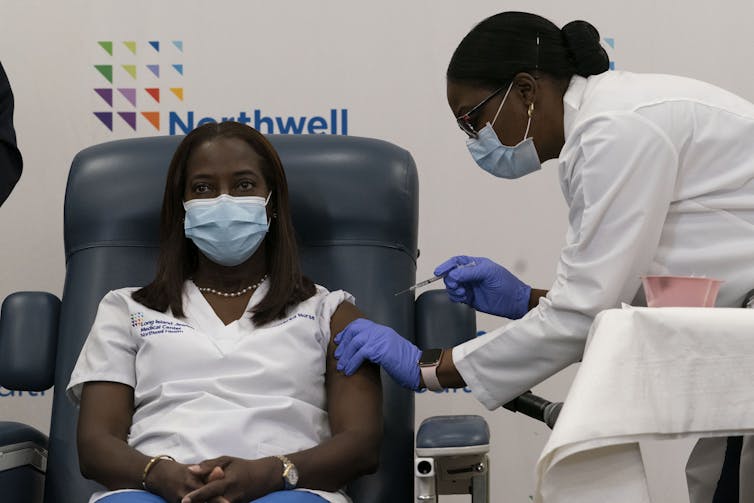
Editor’s Note: With a coronavirus vaccination effort now underway, you might have questions about what this means for you and your family. If you do,
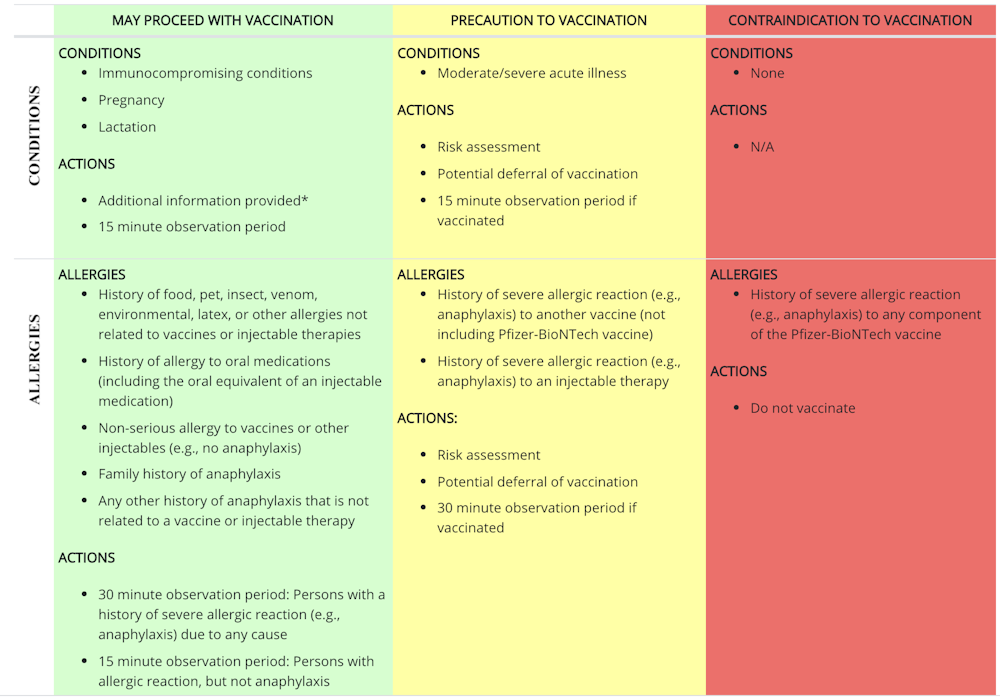
If I have allergies, should I still get the vaccine?
If you have a history of allergies to food, pets, insects or other things, the Centers for Disease Control and Prevention recommends that you proceed with vaccination, with an observation period. If you have a history of severe allergic reaction, or what is called anaphylaxis, to another vaccine or injectable therapy, your doctor can do a risk assessment, defer your vaccination, or proceed and then observe you after vaccination. The only reason to avoid vaccination is a severe allergic reaction to any component of the COVID-19 vaccine. The CDC has specific recommendations for post-vaccine observation.
As the vaccine goes out to a broader population, how will adverse events be tracked?
The CDC and Food and Drug Administration encourage the public to report possible adverse events to the Vaccine Adverse Event Reporting System, or VAERS. This national system collects these data to look for adverse events that are unexpected, appear to happen more often than expected or have unusual patterns of occurrence. Anyone who has experienced an adverse event should report it to the system.
Reporting an adverse event is a crucial step to ensuring safety and to help the CDC monitor the vaccines. Safety is a top priority, and scientists and public health officials need to know about adverse reactions.
An adverse event is different in most cases from a typical vaccine side effect. Vaccines may cause a side effect, such as soreness at the injection site or redness. Adverse events are more serious and can sometimes be life-threatening. If you are unsure whether you have experienced a side effect or adverse event, you can still report the event.
Participants are given a fact sheet when they are vaccinated. Health care providers who vaccinate people will be required to report to VAERS certain adverse events following vaccination. In addition, under the terms of the emergency use authorization, health care providers also must follow any revised safety reporting requirements that may arise.
The CDC is also implementing a new smartphone-based tool called v-safe to check in on people’s health after they receive a COVID-19 vaccine. When you receive your vaccine, you should also receive an information sheet telling you how to enroll in v-safe. If you enroll, you will receive regular text messages directing you to surveys where you can report any problems or adverse reactions you have after receiving a COVID-19 vaccine.
When might kids younger than 16 be vaccinated?
It is likely to be several months. The currently authorized Pfizer and soon-to-be-authorized Moderna vaccine are not applicable for children. More research and clinical trials need to be done to include younger children in COVID-19 vaccine trials.
According to the American Academy of Pediatrics, Pfizer has enrolled children down to age 12 and submitted a request for emergency use authorization for vaccination down to age 16. Moderna, whose vaccine is expected to receive emergency use authorization from the FDA any day, is about to start a similar study.
In the United Kingdom, AstraZeneca has approval to enroll children ages 5 to 12 in clinical trials, but the pharmaceutical company has not yet enrolled any children in trials in the U.S.
Mona Hanna-Attisha, Professor of Medicine, Michigan State University
This article is republished from The Conversation under a Creative Commons license. Read the original article.
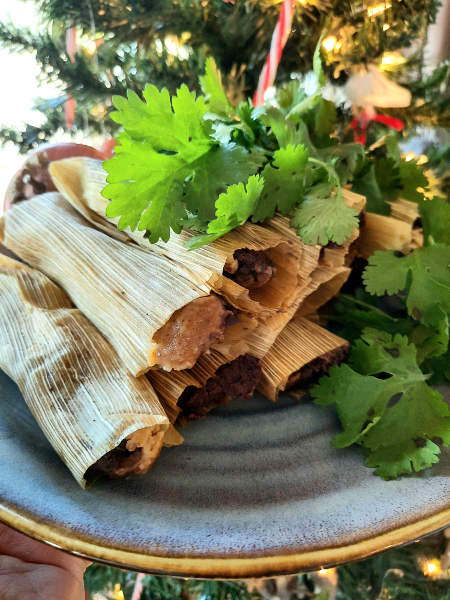
LAKE COUNTY, Calif. – With pillowy soft dough surrounding a succulent filling, some consider tamales the perfect comfort food. And while we love them all year long, there’s no time when they’re more ubiquitous than during the Christmas season.
December means it’s time for families with roots in Mexico or Central America (as well as people of all backgrounds throughout the American Southwest) to gather together and make tamales for Christmas.
There’s even a name for this time-honored tradition – such gatherings are called tamaladas in Spanish.
And remember – for most Mexican families, the holiday season extends from Dec. 12, the Feast of Our Lady of Guadalupe, to Jan. 6, the Feast of Epiphany or Three Kings’ Day, making tamales a necessity for more than just one celebration.
Tamale-making is notoriously time-consuming and, depending on ingredients and method, can also be quite complex. (An Oaxacan-inspired tamale recipe, for example, contains more than 120 distinct steps.)
While most tamale recipes aren’t as elaborate, the process is still labor-intensive, with simmering meats and sauces that can take up to a day to bring to perfection. And then there’s the assembling – the rhythm of spreading masa dough on softened corn husks, adding just the right amount of filling, and the folding, wrapping, and tying that, while fairly simple to execute, takes patience and a lot of time.
It’s for this reason that when families gather, many dozens of tamales are created, not only to have handy for celebrations but to share with family and friends.
In one instance, a two-day tamalada involved 22 family members from multiple states, where a full 225 dozen tamales were made! That massive feat couldn’t have been accomplished without the cooperation and camaraderie of many working together to make the task lighter.
Tamales have been eaten in the Americas for an inordinately long time, with the first ones consumed as far back as 9,000 years ago, before corn was fully domesticated. Researchers believe they predate even the tortilla, another ancient food.
Tamales originated in Mesoamerica, a historical region and cultural area covering a swath of land that stretches from modern-day central Mexico southward through what is now Belize, Guatemala, El Salvador, Honduras, Nicaragua, and northern Costa Rica.
With wrappings of corn husks or plantain leaves, tamales were a highly portable food and were eaten by Olmec and Toltec hunters. Both of these civilizations predate the Aztecs, who later ate them, as did the Mayans.
In those days, tamales were filled with such things as quail meat, squash and varieties of fungus. When Spanish colonizers arrived, the ingredients shifted to pork, beef and chicken, with lard used as a binder for the dough.
Corn was considered sacred in Mesoamerican – it was literally the substance of life for the people there – and Mesoamerican civilizations had common creation myths identifying humans with corn.
For this reason, preciously wrapped, corn-based tamales were used as ritual offerings for the various gods of the Aztec and Mayan civilizations.
Masa (the Spanish word for dough) is the foundation of a tamale – it’s the delightfully cushiony base that surrounds the filling - and is made by grinding sun- or fire-dried corn which has been cooked and soaked in limewater (that is, water with dissolved limestone). The process is called nixtamalization and was invented by ancient Mexicans after corn was domesticated.
We may be used to seeing pork, beef or chicken in tamales (these are the most popular fillings in Mexico), but there are literally hundreds (perhaps thousands!) of ways to fill a tamale. The variations could be endless.
For example, in the southwestern Mexican state of Oaxaca, tamales are wrapped in plantain leaves and filled with chicken and onions and flavored with mole negro, a sauce made of poblano peppers and chocolate.
In Tabasco, on the Gulf Coast, they’re filled with garfish.
My El Salvadorian friends made them with white masa and filled them with potatoes, carrots and green olives.
They can be filled with beans, cheese, squash or sweet corn.
Sweet tamales, traditional at Christmas, can include such ingredients as pineapple or raisins.
The truth is that each region has its own version, depending on what’s available in their ecosystem. Tamales offer a culture in and of themselves, providing a direct connection to the most ancient traditions of Mexico and Central America.
If you’ve spent time in a fragrant kitchen elbow to elbow with friends or family, laughing and sharing stories while assembling tamales, you’ve been lucky indeed!
I hope you enjoy your holiday season, whether filled with tamales or not.
Today’s recipe is a twist on traditional tamales. Most masa dough is made with lard or shortening, neither of which is easy on the heart. Instead, this version uses pumpkin as the binder for the dough.
These are vegetarian tamales (vegan, actually), but you can feel free to add shredded chicken or cheese.
Enjoy!
Pumpkin Tamales with Black Bean ‘Mole’
Ingredients:
1 bag corn husks (24 needed for this recipe)
For the filling:
1 whole dried Chipotle chile, split open and most seeds removed
1 large garlic clove
½-inch slice small yellow onion
1 jalapeno chile, halved and seeds removed
1 Roma tomato, halved and seeds removed
1 teaspoon whole cumin seeds
1 teaspoon smoked paprika or cayenne pepper
1 teaspoon salt
1/2 teaspoon Mexican oregano
2 cups cooked black beans (from a can, only slightly drained, or cooked from dry beans)
For the dough:
3 cups masa for tamales
1 teaspoon baking powder
1 15-ounce can pumpkin puree
1 1/2 tablespoons jarred salsa
1 teaspoon salt
To garnish:
1/2 cup sour cream (vegan or otherwise)
Lime wedges
Cilantro sprigs
Instructions:
1. Place corn husks into a deep container and cover with warm water; weigh down the husks and let stand at least 30 minutes until all are softened.
2. In a dry non-stick skillet or medium-high heat, lay the chile pepper flat and toast until it darkens and you just begin to see wisps of smoke, holding it flat with a spatula if necessary. Remove the chile and place in a small bowl with water to cover for 10-15 minutes to soften.
3. Add the garlic, onion, fresh chile and tomatoes to the pan. Continue roasting until vegetables are charred, turning to brown all sides and removing any that begin to burn.
4. Add the cumin seeds and continue to toast for 1 more minute until browned.
5. Place all into a blender or small food processor and pulse to small chunks. Add the dry spices and continue to blend 1 more minute.
6. Add the black beans and blend until the mixture is fairly smooth. Taste for salt and adjust to your taste, adding more heat (i.e., with additional paprika or cayenne pepper) if you like. Set aside.
7. In a stand mixer, combine the masa and baking powder and stir. Add the pumpkin, salsa, and salt. Mix well – it should have the texture of Play-Doh. Keep the dough covered with a slightly moist towel as you proceed so it does not dry out.
8. Using any softened husks that are too small or damaged, tear about 20 thin strips which will be the ties for the tamales.
9. One by one, pat corn husks dry with towels and lay flat on the work surface with the thin end nearest you. Dip out 1/4 cup dough and spread, using an offset spatula or your fingers, into a scant 1/4” thickness, into a square shape about 4-inch by 4-inch, leaving at least 1 inch of husk free on the sides.
10. Spoon one tablespoon of the “mole” down the center. Carefully pull the long sides together which will roll the dough over the filling and enclose it. Smooth and squeeze slightly into an even tube shape, then fold up about 2 inches of the narrow end. Tie securely but not too tightly with one of the torn husk strips.
11. Reserve any remaining filling to serve with the tamales
12. Assemble a steamer set up with at least 1 inch of water at the bottom, a steam basket at least 6” deep above and a tight lid. Position the tamales, open end up and packed closely together, into the steam basket, close the lid and bring water to a boil. Steam at a consistent low boil for 1 hour, checking after 40 minutes or so to be sure the water has not all evaporated. (see note, below)
13. Once finished steaming, turn off heat and allow to sit undisturbed for 10-15 minutes to firm up.
14. Serve tamales immediately, with some of the extra filling, and drizzled with sour cream.
15. Add lime wedges to be squeezed over the tamales and cilantro to garnish.
16. Tip: Drop a quarter coin into the bottom of the steamer where it will rattle as the water boils; if you notice there is no noise coming from the steamer it is a warning that the water has evaporated and you need to add more.
Esther Oertel is a writer and passionate home cook from a family of chefs. She grew up in a restaurant, where she began creating recipes from a young age. She’s taught culinary classes in a variety of venues in Lake County and previously wrote “The Veggie Girl” column for Lake County News. Most recently she’s taught culinary classes at Sur La Table in Santa Rosa. She lives in Middletown.
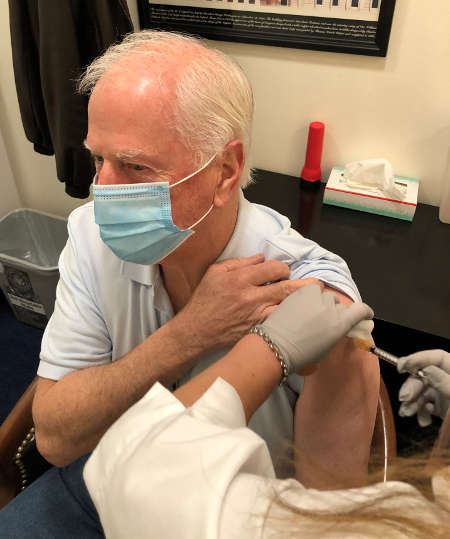
On Saturday, one of Lake County’s members of Congress said he has received the first of two injections for the COVID-19 vaccine.
Rep. Mike Thompson (CA-05) received the vaccine at the advice of the house attending physician for continuity of government purposes and he will receive the second dose in three weeks.
“At the strong recommendation of the Office of the House Attending Physician, I received the first injection of the COVID-19 vaccine. I plan to get my second and final dose in three weeks. These doses were made available to members of Congress for continuity of government purposes, consistent with direction from the National Security Council. I have no reservations about the science and research behind this vaccine and I’m grateful to all the scientists who made this possible. I encourage everyone to get it after consulting with their physician and following local guidance on distribution timetables,” Thompson said.
Thompson’s wife, Jan, is a nurse at St. Helena Hospital and she is to receive her vaccination on Sunday.
“We feel very lucky to get these early doses and I’m going to do everything I can to deliver Federal funding to help speed up the rollout of this vaccine. We both want to remind everyone that we still need to continue safety protocols to keep every safe and crush the virus. Please continue washing your hands frequently, watching your social distance and wearing your masks. Let’s get through this together,” Thompson said.
You can click here to read the guidance from the House Attending Physician regarding COVID-19 vaccines for Members of Congress pursuant to continuity of government purposes.
Thompson represents California’s Fifth Congressional District, which includes all or part of Contra Costa, Lake, Napa, Solano and Sonoma counties.
Editor’s note: Dr. William Teets is the director of Vanderbilt University’s Dyer Observatory. In this interview, he explains what does and doesn’t happen during the winter solstice on Dec. 21. Another cosmic phenomenon is also going to occur on the same day called “the great conjunction,” where Saturn and Jupiter, both of which can be seen with the naked eye, will appear extremely close to one another.
What happens on the winter solstice?
The winter solstice this year happens on Dec. 21. This is when the Sun appears the lowest in the Northern Hemisphere sky and is at its farthest southern point over Earth – directly over the Tropic of Capricorn. For folks living at 23.5 degrees south latitude, not only does this day mark their summer solstice, but they also see the Sun directly over them at local noon. After that, the Sun will start to creep back north again.

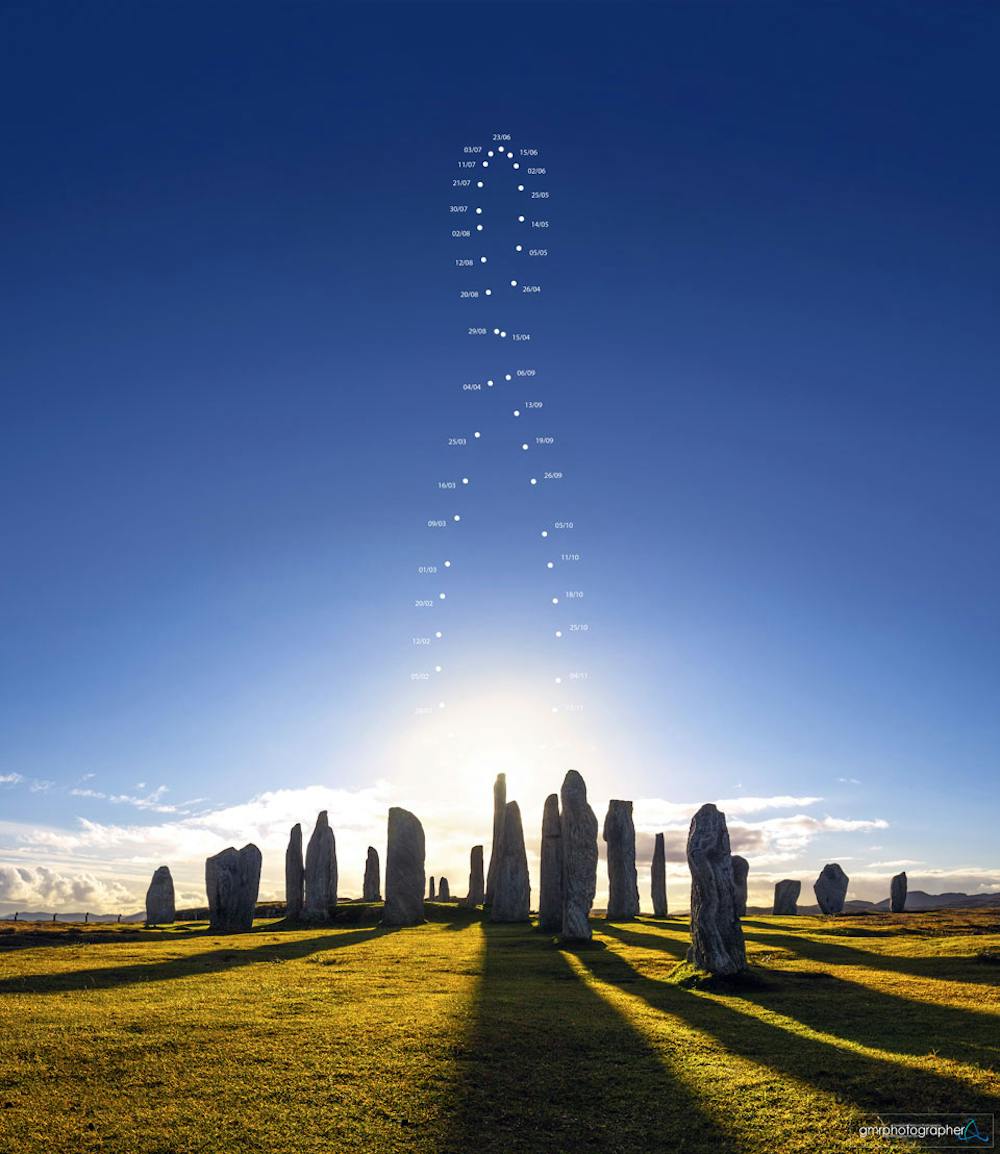
The sequence of images below shows the path of the Sun through the sky at different times of the year. You can see how the Sun is highest in the Northern Hemisphere sky in June, lowest in December, and halfway in between these positions in March and September during the equinoxes.

The winter solstice is the shortest day in the Northern Hemisphere but not the day with the latest sunrise and earliest sunset. How is that possible?
The winter solstice doesn’t coincide with the latest sunrise or the earliest sunset. Those actually occur about two weeks before and two weeks after the winter solstice. This is because we are changing our distance from the sun due to our elliptical, not circular, orbit, which changes the speed at which we orbit.
If you were to look at where the Sun is at exactly the same time of day over different days of the year, you would see that it’s not always in the same spot. Yes, the Sun is higher in the summer and lower in the winter, but it also moves from side to side of the average noontime position, which also plays a role in when the Sun rises and sets.
One should also keep in mind that the seasons are due to the Earth’s axial tilt, not our distance from the Sun. Believe it or not, we are closest to the Sun in January.
What is ‘the great conjunction’?

Saturn and Jupiter have appeared fairly close together in our sky throughout the year. But on Dec. 21, Saturn and Jupiter will appear so close together that some folks may have a difficult time seeing them as two objects.
If you have a pair of binoculars, you’ll easily be able to spot both planets. In even a small telescope, you’d see both planets at the same time in the same field of view, which is really unheard of. That’s what makes this conjunction so rare. Jupiter and Saturn appear to meet up about every 20 years. Most of the time, however, they’re not nearly as close together as we’re going to see them on Monday, Dec. 21.
For a comparison, there was a great conjunction back in 2000, but the two planets were separated by about two full-Moon widths. This year, the orbits will bring them to where they appear to be about one-fifth of a full-Moon diameter.

We have been encouraging folks to go out and look at these planets using just their eyes between now and Dec. 21. You’ll actually be able to see how much they appear to move over the course of a single day.
The next time they will get this close together in our sky won’t be for another 60 years, so this is going to be a once-in-a-lifetime event for many people. In fact, the last time they got this close together was in the year 1623, but it was really difficult, if not impossible, to see them then because they appeared much closer to the Sun and set soon after it. Go back another 400 years to 1226 and this would have been the last time that we would have had a good view of this type of conjunction.
What advice would you give to people who want to see the great conjunction?
If weather permits at Dyer Observatory, we’ll be streaming a live view of the conjunction from one of the observatory’s telescopes, and I’ll be available to answer questions. Even if you don’t have a telescope or a pair of binoculars, definitely go out and check out this very rare alignment with your own eyes. Remember that they set soon after sunset, so be ready to view right at dusk!
[Understand new developments in science, health and technology, each week. Subscribe to The Conversation’s science newsletter.]
William Teets, Acting Director and Astronomer, Dyer Observatory, Vanderbilt University
This article is republished from The Conversation under a Creative Commons license. Read the original article.
Dogs available for adoption this week include mixes of Australian Cattle Dog, heeler, husky, Labrador Retriever, mastiff and pit bull.
Dogs that are adopted from Lake County Animal Care and Control are either neutered or spayed, microchipped and, if old enough, given a rabies shot and county license before being released to their new owner. License fees do not apply to residents of the cities of Lakeport or Clearlake.
The following dogs at the Lake County Animal Care and Control shelter have been cleared for adoption (additional dogs on the animal control Web site not listed are still “on hold”).
Call Lake County Animal Care and Control at 707-263-0278 or visit the shelter online at http://www.co.lake.ca.us/Government/Directory/Animal_Care_And_Control.htm for information on visiting or adopting.

Male mastiff
This young male mastiff has a short tan coat.
He is in kennel No. 18, ID No. 14240.

Male pit bull
This male pit bull has a short brindle and brown coat.
He is in kennel No. 20, ID No. 14218.

Male husky
This male husky has a medium-length black and white blue eyes.
He has been spayed.
He’s in kennel No. 22, ID No. 14194.
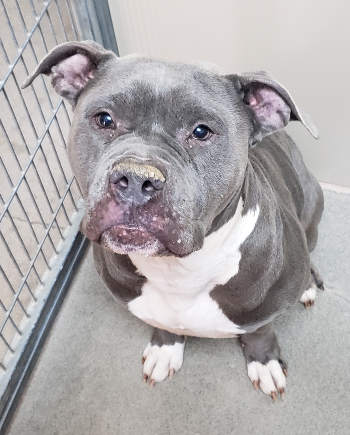
Male pit bull terrier
This male pit bull terrier has a short gray and white coat.
He’s in kennel No. 23, ID No. 14196.

Pit bull terrier-Australian Cattle Dog mix
This male pit bull terrier-Australian Cattle Dog mix has a short tricolor coat.
He is in kennel No. 24, ID No. 14197.

Male shepherd mix
This male shepherd mix has a medium-length tricolor coat.
He has been altered.
He’s in kennel No. 28, ID No. 14241.
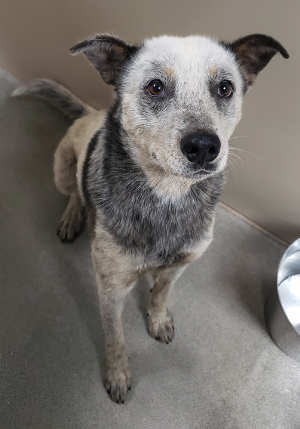
Male heeler-Labrador Retriever
This male heeler-Labrador Retriever mix has a short black and white coat.
He is in kennel No. 29, ID No. 14178.
Email Elizabeth Larson at

Scientists are finding new mysteries since the geophysics mission landed two years ago.
NASA's InSight spacecraft touched down Nov. 26, 2018, on Mars to study the planet's deep interior.
A little more than one Martian year later, the stationary lander has detected more than 480 quakes and collected the most comprehensive weather data of any surface mission sent to Mars.
InSight's probe, which has struggled to dig underground to take the planet's temperature, has made progress, too.
There was a time when the surfaces of Mars and Earth were very similar. Both were warm, wet, and shrouded in thick atmospheres. But 3 or 4 billion years ago, these two worlds took different paths.
The mission of InSight (short for Interior Exploration using Seismic Investigations, Geodesy and Heat Transport) has been to help scientists to compare Earth to its rusty sibling. Studying what the depths of Mars is made of, how that material is layered, and how quickly heat seeps out of it could help scientists better understand how a planet's starting materials make it more or less likely to support life.
While there's more science to come from InSight, here are three findings about our red neighbor in the sky.
NASA's InSight used its Instrument Context Camera (ICC) beneath the lander's deck to image these drifting clouds at sunset.
Faint rumblings are the norm
InSight's seismometer, which was provided by the French space agency, Centre National d'Études Spatiales, or CNES, is sensitive enough to detect slight rumblings from great distances. But it wasn't until April 2019 that seismologists with the Marsquake Service, coordinated by ETH Zurich, detected their first marsquake. Since then, Mars has more than made up for lost time by shaking frequently, albeit gently, with no quakes larger than magnitude 3.7.
The lack of quakes larger than magnitude 4 poses something of a mystery, considering how frequently the Red Planet shakes due to smaller quakes.
"It's a little surprising we haven't seen a bigger event," said seismologist Mark Panning of NASA's Jet Propulsion Laboratory in Southern California, which leads the InSight mission. "That may be telling us something about Mars, or it may be telling us something about luck."
Put another way: It could be that Mars is just more static than anticipated – or that InSight landed in an especially quiet period.
Seismologists will have to keep waiting patiently for those larger quakes in order to study layers deep below the crust. "Sometimes you get big flashes of amazing information, but most of the time you're teasing out what nature has to tell you," said InSight Principal Investigator Bruce Banerdt of JPL. "It's more like trying to follow a trail of tricky clues than having the answers presented to us in a nicely wrapped-up package."
The wind may hide quakes
Once InSight started detecting quakes, they became so regular that, at one point, they were happening every day. Then, in late June of this year, the detections essentially stopped. Only five quakes have been detected since then, all of them since September.
Scientists believe Mars' wind is responsible for these seismically blank periods: The planet entered the windiest season of the Martian year around June. The mission knew that winds could affect InSight's sensitive seismometer, which is equipped with a domed wind and heat shield.
But the wind still shakes the ground itself and creates literal noise that covers up quakes. This could also have contributed to what seems like the long seismic silence before InSight's first quake, since the spacecraft landed while a regional dust storm was settling down.
"Before landing, we had to guess at how the wind would affect surface vibrations," Banerdt said. "Since we're working with events that are much smaller than what we'd pay attention to on Earth, we find that we have to pay much closer attention to the wind."
Surface waves are missing
All quakes have two sets of body waves, which are waves that travel through the planet's interior: primary waves (P-waves) and secondary waves (S-waves). They also ripple along the top of the crust as part of a third category, called surface waves.
On Earth, seismologists use surface waves to learn more about the planet's internal structure. Before getting to Mars, InSight's seismologists expected these waves to offer glimpses as deep as 250 miles (about 400 kilometers) below the surface, into a sub-crustal layer called the mantle. But Mars continues to offer mysteries: Despite hundreds of quakes, none has included surface waves.
"It's not totally unheard of to have quakes without surface waves, but it has been a surprise," Panning said. "For instance, you can't see surface waves on the Moon. But that's because the Moon has far more scattering than Mars."
The dry lunar crust is more fractured than Earth and Mars, causing seismic waves to bounce around in a more diffuse pattern that can last for over an hour. The lack of surface waves on Mars may be linked to extensive fracturing in the top 6 miles (10 kilometers) below InSight. It could also mean that the quakes InSight detected are coming from deep within the planet, since those wouldn't produce strong surface waves.
Of course, untangling such mysteries is what science is all about, and there's more to come with InSight.
More about the mission
JPL manages InSight for NASA's Science Mission Directorate. InSight is part of NASA's Discovery Program, managed by the agency's Marshall Space Flight Center in Huntsville, Alabama. Lockheed Martin Space in Denver built the InSight spacecraft, including its cruise stage and lander, and supports spacecraft operations for the mission.
A number of European partners, including France's Centre National d'Études Spatiales, or CNES, and the German Aerospace Center, are supporting the InSight mission.
CNES provided the Seismic Experiment for Interior Structure, or SEIS, instrument to NASA, with the principal investigator at Institut de Physique du Globe de Paris, or IPGP. Significant contributions for SEIS came from IPGP; the Max Planck Institute for Solar System Research in Germany; the Swiss Federal Institute of Technology in Switzerland; Imperial College London and Oxford University in the United Kingdom; and JPL.
DLR provided the Heat Flow and Physical Properties Package instrument, with significant contributions from the Space Research Center of the Polish Academy of Sciences and Astronika in Poland. Spain's Centro de Astrobiología supplied the temperature and wind sensors.