 How to resolve AdBlock issue?
News
The California Employment Development Department said unemployment statewide was 9 percent in December, up by 0.9 percent, with the state’s employers losing 52,200 jobs following a gain of 5,200 jobs in November.
The California unemployment rate was 8.1 percent in November 2020 and 3.9 percent in December 2019, the agency reported.
California’s slight jobless rate rise in December was the state’s first month-over rate increase since April 2020.
The report said California payroll jobs totaled 16,144,400 in December 2020, down 52,200 from December 2020, and down 1,410,000 from December of last year.
Despite last month’s losses, California has regained more than 44 percent of the 2,615,800 nonfarm jobs that were lost due to the COVID-19 pandemic in March and April, the Employment Development Department said.
The Bureau of Labor Statistics said the nationwide jobless rate was 6.7 percent in December, unchanged from November. The nationwide unemployment rate in December 2019 was 3.6 percent.
In Lake County, unemployment rose in December to 9 percent – matching the state’s number. That’s up from 7.2 percent in November and 5.1 percent in December 2019.
Lake County’s civilian labor force in December totaled 26,050 individuals, down from 26,640 in November and 27,320 in December 2019, according to state data.
In December, 2,560 Lake County residents were unemployed, compared to 2,070 in November and 1,470 in December 2019, the report said.
Lake County’s job sectors that showed improvement in December included total farm, up by 7.9 percent. In the total nonfarm subcategories, manufacturing rose by 6.1 percent; retail trade grew by 2.2 percent; and trade, transportation and utilities was up by 2.1 percent.
The categories with the largest decreases were state government, which dropped by 14.3 percent, while information showed an 11.1-percent decrease.
In December, Lake County ranked No. 37 out of the state’s 58 counties for its jobless rate.
Lake’s neighboring counties’ jobless rates and ranks in the latest report are Colusa, 15.5 percent, No. 57; Glenn, 7.7 percent, No. 22; Napa, 7.3 percent, No. 14; Sonoma, 6.5 percent, No. 6; and Yolo, 7 percent, No. 10.
Half of state job categories show improvement
The report said the number of Californians with jobs in December totaled 17,260,100, a decrease of 91,700 jobs since November, and down 1,469,000 from December of last year.
At the same time, the state reported that the number of unemployed Californians was 1,700,400 in December, an increase of 163,700 over the month, and up by 945,700 in comparison to December of last year.
Total nonfarm jobs in California’s 11 major industries totaled 16,144,400 in December. Total nonfarm jobs decreased by 1,410,000, or an 8.0 percent decrease, from December 2019 to December 2020 compared to the U.S. annual loss of 9,374,000 jobs, a 6.2-percent decrease.
At the same time, the number of jobs in the agriculture industry increased by 24,300 from November 2020 to 380,800 jobs in December. The agricultural industry has lost 49,300 farm jobs since December 2019.
Six of California’s 11 industry sectors saw job gains in December:
– Construction had the state’s largest month-over increase (+31,600) thanks to strong gains in specialty trade contractors and construction of buildings.
– Professional and business services had the state’s second-largest month-over increase (+29,600) due to large gains in accounting, tax preparation and bookkeeping, as well as management, scientific and technical consulting.
– Trade, transportation and utilities rose by 8,600 jobs.
– Education and health services were up 6,100.
– Information increased 5,200.
– Government showed growth of 700 jobs.
Leisure and hospitality showed the largest month-over loss (-117,000) largely due to severe losses in accommodation and food services, which accounted for 83.2 percent of the industry sector’s overall loss, the report said.
As for unemployment claims, there were 1,007,331 people certifying for Unemployment Insurance benefits during the December 2020 sample week. That compares to 1,278,220 people in November 2020 and 327,751 people in December 2019.
Concurrently, the state said 159,092 initial claims were processed in the December 2020 sample week, a month-over decrease of 9,896 claims from November 2020, but a year-over increase of 108,976 claims from December 2019.
Email Elizabeth Larson at
The following dogs are ready for adoption or foster.

‘Toby’
“Toby” is a friendly senior male boxer mix.
He has a short tan and white coat.
He is dog No. 4389.

‘Yule’
“Yule” is a male husky with a black and white coat.
Yule is dog No. 4432.

‘Rudolph’
“Rudolph” is a male shepherd mix.
He has a short tan and black coat.
He is dog No. 4436.

‘Jerry’
“Jerry” is a male American Pit Bull terrier with a short brindle coat.
He is dog No. 4455.

‘Inky’
“Inky” is a male German Shepherd mix with a long black coat.
He has been neutered.
He is dog No. 4324.

‘Bumble’
“Bumble” is a male Siberian Husky with a gray and black coat.
He is dog No. 4452.

‘Breeze’
“Breeze” is a female American Pit Bull Terrier mix.
She has been spayed.
She is dog No. 4445.

‘Ben’
“Ben” is a male American Pit Bull terrier mix.
He has a short brindle coat.
He is dog No. 4454.
Call the Clearlake Animal Control shelter at 707-273-9440, or email
Visit Clearlake Animal Control on Facebook or on the city’s website.
Email Elizabeth Larson at

A bad year for flu can mean tens of thousands of deaths in the U.S. Getting vaccinated can protect you from influenza, but you have to get the shot every year to catch up with the changing virus and to top up the short-lived immunity the vaccine provides. The vaccine’s effectiveness also depends on correct predictions about which strains will be most common in a given season.
For these reasons, a one-and-done universal vaccine that would provide lasting immunity over multiple flu seasons and protect against a variety of strains has been a long-term goal for scientists.
Researchers are now one step closer to hitting that target. Scientists recently completed the first human trial of a vaccine created by recombinant genetic technology to fool the immune system into attacking a part of the virus that does not change so fast and is common among different strains.
I am a microbiologist interested in infectious diseases, and I’ve followed the seasonal flu epidemic for several years. I’m excited by this news, which could mark the turning point in the quest for a universal flu vaccine. Here’s how it all works.
Biology of the invading influenza virus
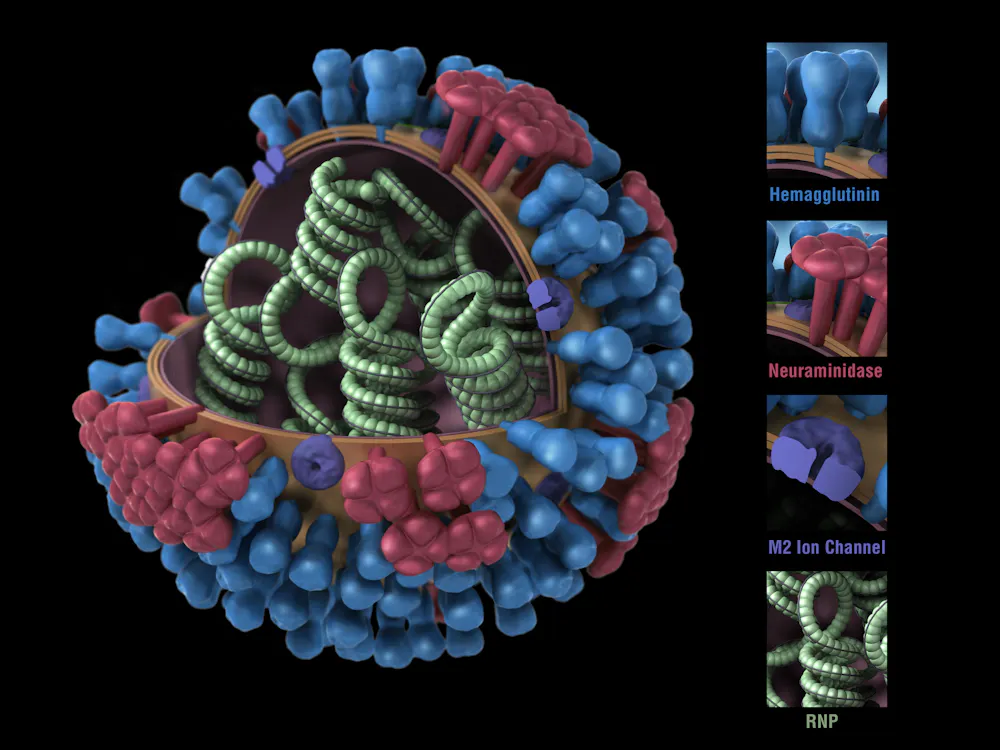
Like the virus that causes COVID-19, the influenza virus has a protein shell that is coated by a lipid membrane. Sticking through the membrane are multiple copies of three types of proteins: haemagglutinin, abbreviated as HA; neuraminidase, abbreviated as NA; and the matrix protein, M2.
It’s the properties of the HA and NA proteins that distinguish the different strains of the virus. You’ve probably heard of strains like H1N1 and H3N2, both of which are infecting people in the U.S. this year.
The HA molecule is shaped a bit like a flower bud, with a stalk and a head. Once someone inhales the virus, the tip of the HA molecule’s head binds to a receptor on the surface of the cells that line the person’s respiratory passages.
This initial binding is crucial as it induces the cell to engulf the virus. Once inside, the virus gets to work replicating its own genetic material. But the enzyme that copies its single-strand RNA is very sloppy; it can leave two or three mistakes, called mutations, in every new copy.
Sometimes the genetic changes are so drastic that the progeny viruses don’t survive; other times they are the start of new flu strains. Based on viral samples collected from around the world, the flu virus that arrives one year will have about seven new mutations in the gene for HA and four in the gene for NA compared to the previous year’s virus. These differences are a big part of why the same influenza vaccine won’t be as effective from one year to the next.
Fighting off a flu infection
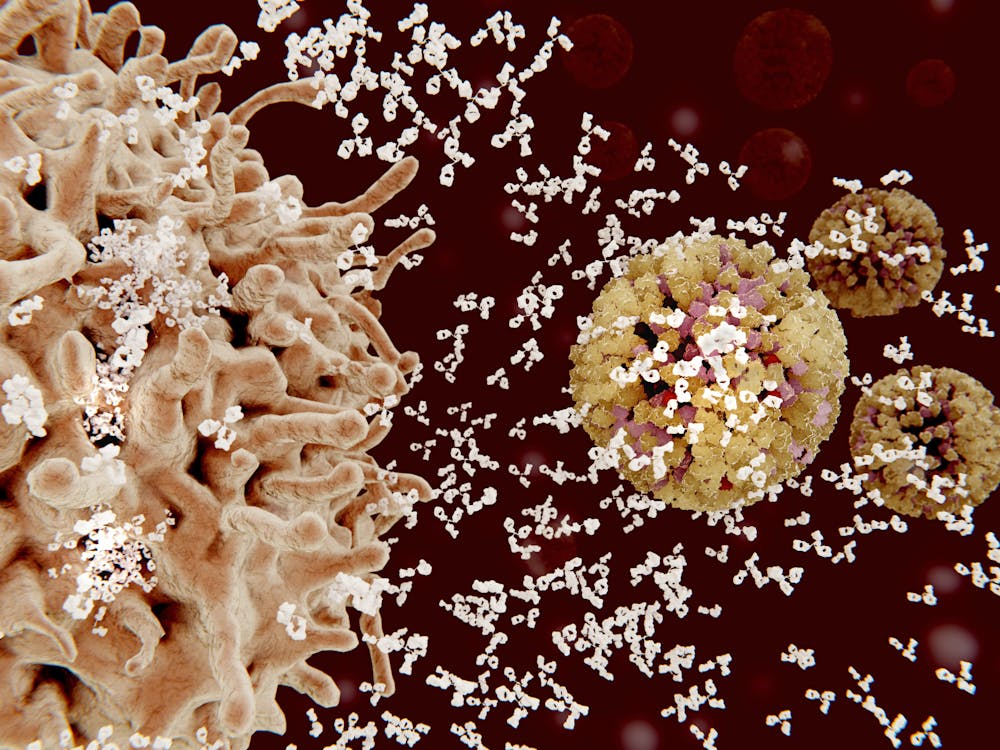
When infected with the flu virus, your immune system produces antibodies to fend it off. Most of these antibodies interact with the HA head and prevent the virus from getting into your cells.
But there’s a downside to that strong reaction. Because the immune response to the virus’s head is so vigorous, it pays little attention to other parts of the virus. That means that your immune system is not prepared to fend off any future infection with a virus that has a different HA head, even if the rest of the virus is identical.
Current flu vaccines are inactivated versions of the influenza virus and so also work by inducing antibodies targeted to the HA head. And that’s why each version of the vaccine usually works only against a particular strain. But, as the flu spreads, the rapid rate of genetic change can produce new versions of the HA head that will evade the antibodies induced by the vaccine. These newly resistant viruses will then render even the current season’s vaccine ineffective.
The stalk portion of the HA molecule is much more genetically stable than the head. And HA stalks from different flu strains are much more alike than their head regions are.
So, an obvious way to protect people against different flu strains would be to use just the HA stalk in a vaccine. Unfortunately vaccination with only a headless stalk doesn’t seem to prevent infection.
Scientists are currently pursuing several different solutions to this problem.
A new kind of flu vaccine
A team of scientists led by Florian Krammer at the Icahn School of Medicine at Mount Sinai just completed the first human clinical trial of what they hope will be a universal flu vaccine.
The researchers used recombinant genetic technology to create flu viruses with “chimeric” HA proteins – essentially a patchwork quilt built from pieces of different flu strains.
Volunteers for the clinical trial received two vaccinations separated by three months. The first dose consisted of an inactivated H1N1 virus with its original HA stalk but the head portion from a bird influenza virus. Vaccination with this virus induced a mild antibody response to the foreign head, and a robust response to the stalk. This pattern meant that the immune systems of the subjects had never encountered the head before, but had seen the stalk from previous flu vaccinations or infections.
The second vaccination consisted of the same H1N1 virus but with an HA head from a different bird virus. This dose elicited, again, a mild antibody response to the new head, but a further boost in response to the HA stalk. After each vaccine dose the subjects’ stalk antibody concentrations averaged about eight times higher than their initial levels.
Researchers found that even though the vaccine was based on the HA stalk of the H1N1 virus strain, the antibodies it elicited reacted to HA stalks from other strains too. In lab tests, the antibodies from vaccinated volunteers attacked the H2N2 virus that caused the 1957 Asian flu pandemic and the H9N2 virus that the CDC considers to be of concern for future outbreaks. The antibodies did not react to the stalk of the more distantly related H3 viral strain.
The antibody response also lasted a long time; after a year and a half, the volunteers still had about four times the concentration of antibodies to the HA stalk in their blood as when the trial started.

Since this was a phase 1 clinical trial testing only for adverse effects (which were minimal), the researchers didn’t expose vaccinated people to the flu to test if their new antibodies protected them.
However, they did inject the subjects’ blood serum, which contains the antibodies, into mice to see if it would protect them against the flu virus. Getting a shot of serum taken from volunteers a month after receiving the booster shot, when antibody levels were high, led to mice being 95% healthier after virus exposure than mice who got blood serum from nonvaccinated volunteers. Even the mice who received serum that was collected from vaccinated volunteers a year after the start of the trial were about 30% less sick.
These results show that vaccination with a chimeric flu protein can provide long-lasting immunity to several different strains of the influenza virus. Scientists will need to continue optimizing this approach so it works for different types and strains of influenza. But the success of this first human trial means you may one day get a single shot and, at last, be free from the flu.
[The Conversation’s science, health and technology editors pick their favorite stories. Weekly on Wednesdays.]
Patricia L. Foster, Professor Emerita of Biology, Indiana University
This article is republished from The Conversation under a Creative Commons license. Read the original article.
The meeting will take place beginning at 6 p.m. Thursday, Jan. 28.
The physical meeting location in the boardroom at the Lakeport Unified District Office, 2508 Howard Ave., will be limited to the board of trustees and selected senior administration to ensure recommended guidelines for social distancing are practiced.
All other members of the public can participate in the public session of the meeting via Zoom: https://lakeportusd.zoom.us/j/86090868306.
The agenda can be found here.
At its Jan. 14 meeting, the board accepted the resignation letter of Superintendent Jill Falconer, effective June 30, as part of its consent agenda.
During Thursday evening’s meeting, the school board will discuss the process to select Falconer’s successor.
Falconer, who had worked in the district for 25 years by the time of her hire as superintendent in 2019, told Lake County News that she plans to retire in June.
“Originally the plan was to be able to care for my husband after a heart transplant. Things don’t always go as planned, but I decided that life is always shorter than we expect and I wanted to be available to help care for my new grandchild,” she said.
Her husband of 36 years, Todd Falconer – a veteran of the United States Air Force, pilot, local businessman and gentleman farmer – died Jan. 2 while awaiting a heart transplant.
The couple met while attending college at California State University, Chico. After his service in the Air Force, they moved to Lake County, where they raised their family and Jill Falconer built a long and respected career in education.
In May of 2019, the Lakeport Unified School Board hired Falconer as superintendent – then the principal of Clear Lake High School – after she topped a field of nine finalists.
Since then, she’s helped the board navigate the challenges of school closures in response to COVID-19 while working to address the concerns of teachers, staff, students and families regarding reopening schools.
Board members on Thursday will consider proposals from two consultants to assist in the new superintendent search – Education Leadership Solutions of Kelseyville and Leadership Associates of Santa Barbara.
The Konocti Unified School District hired Education Leadership Solutions, headed up by founder and chief executive officer Dr. C. Richard Smith, to oversee its search for a superintendent two years ago.
That search resulted in the hire of Superintendent Dr. Rebecca Salato in May 2019, just a week before Lakeport Unified hired Falconer, as Lake County News has reported.
Also on Thursday, Falconer will update the board on the full implementation of stage two hybrid learning, which will see most students return to school for in-person instruction, and the board will consider the district’s revised calendar for the 2020-21 school year.
Email Elizabeth Larson at
The main impacts of the storm were felt across Lake County and much of the rest of the state on Tuesday and Wednesday.
Locally, high winds, rain and snow led to road closures and power outages that were still being resolved on Wednesday night and into Thursday.
The National Weather Service’s Eureka office told Lake County News that it had received reports of 8 inches of snow in Kelseyville; 6 inches in Cobb; 4.5 inches in Hidden Valley Lake; 2 inches in Clearlake, the Clearlake Riviera and Spring Valley; and 1 inch in Lower Lake.
Lake County Public Works crews on Wednesday were plowing snow and clearing roads, from Lower Lake to Kelseyville to Upper Lake.
Stormy conditions are far from over.
The forecast calls for up to half an inch of rain on Thursday, along with light winds.
Rain also is expected on Friday and Saturday, and from Sunday through Tuesday. In the higher elevations, especially in the northern part of the county, snow also is in the forecast on Tuesday.
On Wednesday, conditions are forecast to be clear and sunny.
Temperatures over the next several days are anticipated to range from the high 30s to low 40s at night, and from the high 40s and low 50s during the daytime.
Email Elizabeth Larson at
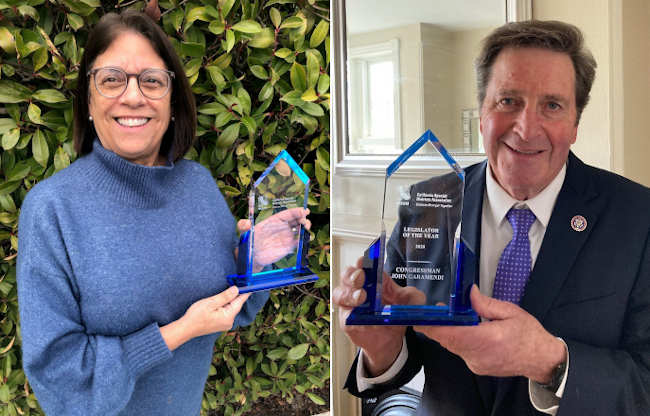
NORTHERN CALIFORNIA – On Wednesday, special districts throughout California recognized Representative John Garamendi (D-Walnut Grove) and Assemblymember Cecilia Aguiar-Curry (D-Winters) as their Legislators of the Year at a virtual event.
This is the first year that the California Special Districts Association, or CSDA, has chosen to recognize both a state and federal lawmaker with this distinction.
Garamendi was selected for his drafting of legislation to include special districts in future COVID-19 relief funding, as well as formally defining special districts in federal code.
Aguiar-Curry was honored for her leadership as chair of the California State Assembly Local Government Committee, consistent support of local authority measures and her efforts to coordinate with local governments throughout the COVID-19 pandemic.
In 2020, both lawmakers went above and beyond in their support of communities served by special districts, the association said.
There are just over 2,000 independent special districts in California. They are community formed, owned and governed local governments that serve virtually every Californian with specialized local services ranging from fire protection, water, sewer, and trash, to parks, mosquito abatement, libraries, ports, harbors, electricity, and others that cities and counties don’t always provide.
“Rep. Garamendi has long been an advocate in helping special districts, and particularly water agencies, fulfill their mission of delivering reliable resources to our communities,” said Cary Keaton, general manager for the Solano Irrigation District.
“Cecilia understands the natural resource challenges people in her district face. She has been consistently supportive of our work to provide our communities with technical assistance to improve forest health, watersheds and agricultural sustainability,” said Heather Nichols, executive director of the Yolo County Resource Conservation District.
On June 1, Garamendi introduced H.R. 7073, the “Special Districts Provide Essential Services Act.”
The legislation specifically includes special districts in COVID-19 relief funding. Special districts were excluded from direct access to Coronavirus Aid, Relief, and Economic Security, or CARES, Act funding for state and local governments.
This bill is also the first legislation to propose a codified definition of special districts in federal law, the lack of which had been a reason for their previous exclusion.
In the 116th Congress, 43 members of Congress cosponsored H.R. 7073, and it received the support of a national coalition of more than 80 organizations. A bipartisan U.S. Senate bill, S. 4308, was later introduced in companion with Representative Garamendi’s legislation.
The Special Districts Provide Essential Services Act will be reintroduced early in the 117th Congress as part of ongoing efforts for districts to gain access to critical relief funding. If communities served by special districts ultimately secure relief funding, it will be, in large part, thanks to Garamendi’s leadership, the association reported.
In presenting CSDA’s Legislator of the Year award to Representative Garamendi, Ryan Clausnitzer, president of CSDA’s Board of Directors said, “We are so fortunate to have a member of Congress who understands the value that special districts bring to a community and is willing to advocate for their equitable access to funding for all communities.”
“I am honored to be the first Member of Congress to receive CSDA’s Legislator of the Year Award,” said Garamendi. “We must support all of California’s communities and the front-line workers who deliver our essential services by working to secure COVID-19 relief for state and local governments including special districts.”
The association said Aguiar-Curry has a strong understanding of the challenges faced by special districts and other local governments. She has long guarded against overly burdensome mandates that make it harder for local governments to do their jobs.
They also credited her for advocating in favor of improving local governments’ ability to fund new housing and infrastructure.
In 2020, as the pandemic broke, she convened representatives from CSDA, League of California Cities, California State Association of Counties and rural counties through regular conference calls. These calls provided a venue for associations to discuss COVID-19 response measures, communicate with state agencies, and relay the critical needs of their members.
“Assemblymember Aguiar-Curry’s guidance throughout her tenure in the Assembly and most recently during the pandemic has made a difference in the communities our special districts serve. Our members and their residents are better off for her leadership,” said Neil McCormick, CSDA’s chief executive officer.
In her acceptance, Aguiar-Curry said, “I’m honored for this recognition and gratified to be able to help my local government colleagues during these times of crisis. As Chair of the Assembly Local Government Committee, and a former Mayor and Councilmember, it is important to me to help shape policy empowering local government leaders with the flexibility they need to continue to provide essential services to Californians in rural and urban communities alike.”
CSDA invites the public to get to know the special district leaders from the over 2,000 special districts throughout the state who provide essential services to local communities. For more information visit www.districtsmakethedifference.org.