 How to resolve AdBlock issue?
News
Citizens of Lucerne recently approached Dills to see if the Coordinated Resource Management and Planning (CRMP) process might work for their watershed, as it has in so many other areas of the county.
This voluntary, grassroots approach to land management and planning originated in the 1950s and is still an effective problem-solving method today.
This system of management has seen successful throughout the entire state, but perhaps nowhere more than Lake County. Many of the sub-watersheds in the Upper Cache Creek Watershed have formed successful groups; if the citizens of Lucerne decide to adopt the process, it would be the tenth such group in the county.
The neighboring Nice Watershed Group was recently nominated for the Stars of Lake County Volunteer Group Award, and has been extremely instrumental in cleaning-up the Nice area.
It also was influential in the passage of the new OHV ordinance. The group's concerns about erosion and subsequent damage to water quality, caused by illegal off-road vehicles, put a spotlight on this serious trespassing issue.
Other groups have also made valuable contributions to their local watersheds.
The Big Valley CRMP, Lower Lake Watershed Council, Middle Creek CRMP and Scotts Creek Watershed Council all participate in annual creek cleanups in their areas. Along with watershed group volunteers, local high school students, 4-H members, Boy Scouts and other concerned community members participate in these events. It's hard work, but very rewarding, and their dedication contributes to the reduction of illegal dumping.
The different groups may focus on different concerns, but the approach is the same. Volunteers work together with the tribal, city, county, state, and federal governments, their neighbors, local businesses and other service organizations to solve local problems at the local level, in a cooperative manner.
The Scotts Creek Watershed Council worked with the West Lake Resource Conservation District, Bureau of Land Management, State Department of Conservation, and private landowners to secure grants to complete a fire break on the ridge line of Cow Mountain. They also held meetings for fire safety education.
The Lower Lake Watershed Council works with award-winning Carle High School students, and has developed a student water quality monitoring team. The group is also in the process of implementing a stream-bank restoration project. The project entails working with local, county, state, and federal agencies, but is accomplished by volunteers at the local level.
The Middle Creek CRMP quite literally dug an abandoned earth moving equipment out of the creek. These dedicated volunteers worked diligently with county officials and local business owners to see this task accomplished.
The group also designed and installed road signs along a dangerous stretch of road for the protection of wildlife and unsuspecting motorists. In addition, they join together with the Scotts Creek Watershed Council to support West Lake RCDs very popular "Kids in the Creek" program.
The Chi Council for the Clear Lake Hitch monitors and collects data on this historic fish. Volunteers all over the county stop at bridges and creekside turnouts to track the Clear Lake Hitch, found only in Lake County.
Volunteers from all of the groups in the Upper Cache Creek Watershed trained and participated in a citizens' water quality monitoring team. This team was given special recognition by the Upper Cache Creek Watershed Alliance at the recent Year in Review; an event that celebrates and highlights the accomplishments of the watershed volunteers throughout the entire county.
The list of contributions that East Lake and West Lake Resource Conservation Districts and their various watershed groups make to the communities in Lake County is long and impressive. Citizens of Lucerne who attend this meeting may choose to adopt the same path to problem-solving success that these other groups have enjoyed.
Voris Brumfield, code enforcement manager for the County of Lake, will also address those in attendance. Brumfield will report actions the county will be taking on Morrison Creek and other areas.
Don't miss this informative meeting at the Lucerne Alpine Senior Center, located at 10th and County Club Drive in Lucerne.
Be sure to mark March 7, 6:30 to 8 p.m. on your calendar, and plan to attend.
Contact Dills at 263-4180 x12 for questions or additional information.
{mos_sb_discuss:2}
MENDOCINO NATIONAL FOREST – Two men reportedly lost overnight in the Mendocino National Forest were found Monday afternoon.
Lt. Pat McMahon of the Lake County Sheriff's Office reported Monday that the Lake County Search and Rescue Team found 29-year-old Cody Dobbs of Clearlake and Nicholas T. Lolonis, 24, of Upper Lake, who had gotten lost in the forest on Sunday.
At 8:57 a.m. Monday Dobbs' girlfriend, Jenny Sutherland of Upper Lake, had reported that Dobbs and Lolonis had driven to the forest's Bear Creek area on Sunday, looking for a piece of property, McMahon said.
They had last spoken to Sutherland via cell phone at 4 p.m. Sunday, when they reported they had gotten lost but obtained a map for a forest ranger, reported McMahon.
Authorities early on Monday hadn't been able to identify the ranger with whom the men had reportedly been in contact, McMahon added.
Search and Rescue, along with U.S. Forest Service personnel, began searching the area Monday, and were concerned that weather – including possible snowfall – might complicate the search.
However, the men were located early Monday afternoon, McMahon said. No injuries to the men were reported.
E-mail Elizabeth Larson at
{mos_sb_discuss:2}
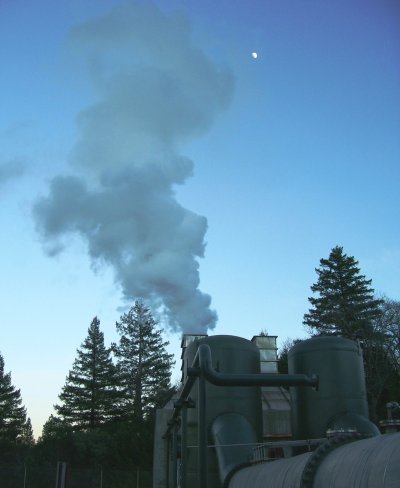
KELSEYVILLE – A long-closed geothermal plant is expected to be online once again in early March.
Santa Monica-based US Renewables Group (USRG) purchased the Bottle Rock Power plant in September 2005, said Lee Bailey, USRG's co-founder and a partner in the firm.
USRG is involved with a number of alternative power operations, said Bailey. Their holdings include biomass, landfill methane, ethanol and biodiesel plants.
Bottle Rock is USRG's only geothermal plant, Bailey said, although the company is proposing to build two to three other such plants in California.
Last June, Riverstone Holdings and The Carlyle Group, in the form of the Carlyle/Riverstone Renewable Energy Infrastructure Fund I, acquired from USRG a "significant stake" in the Bottle Rock plant, according to a company statement.
Riverstone is a New York-based private equity firm that focuses on energy and power.
The Carlyle Group, based in Washington, D.C., is a multinational firm that has major defense and aerospace contracts. Some of those connected with the company over the years have included former President George Bush and Secretary of State James Baker, along with former British Prime Minister John Major. Some critics of the current war in Iraq have accused the company of war profiteering.
The Bottle Rock plant was built and operated by the Department of Water Resources (DWR), said Bailey, who used the power for its own operations.
Gary Snedaker, the Bottle Rock plant's project manager, said DWR closed the plant in 1990 due to a "lack of steam." However, he said, the plant required significant repair, cleaning and new drilling, and DWR wasn't receiving very much compensation for the energy it was producing.
When the plant shut down at noon on Sept. 16, 1990, it was producing 12 megawatts, said Snedaker, although its capacity is 55 megawatts, a level it had operated at when it opened in 1985.
Fifty-five megawatts, he said, can power about 55,000 homes, he said. When the plant comes back online, it will produce 20 megawatts.
"We fully intend on getting the plant past 30 megawatts," said Snedaker.
Bailey said USRG already has an exclusive contract with Pacific Gas & Electric, who will purchase the power the plant generates.
After DWR closed the plant, Bailey said, it changed hands, eventually purchased for $5 million by partners from Little Rock, Ark., and New Orleans.
Those owners, he said, were found to be involved in an illegal pyramid scheme scheme, and were arrested by the Federal Bureau of Investigation. At the same time, he said, the Securities Exchange Commission put the plant into trusteeship.
Bailey said USRG found out about the plant and bid for it through court proceedings.
The purchase was scheduled to close Sept. 1, 2005, but Bailey said the stock certificates and ownership documents were located in New Orleans. In a safe. Underwater.
USRG had to wait until the documents could be retrieved and brought to California, said Bailey; in the mean time, more bidders were trying to come forward.
"It was a colorful transaction," he said.
Plant renovation, said Bailey, began in February 2006. The three-story plant is located on 160 acres that are leased from the Coleman family.
An East Coast native, Snedaker is partner in Integral Energy management, a company partially owned by USRG that has the Bottle Rock plant's operations and maintenance contract. He was sent out to lead the renovation because of his extensive experience with energy production, from coal and gas turbine plants to a Nevada geothermal plant.
Snedaker said when the plant was closed, some of the major equipment was mothballed, and the geothermal wells plugged. For the most part, he said, most of the major pieces of equipment had been left sitting, with little attention.
There's been a lot of work involved in getting the plant back online, said Snedaker.
"It has been a significant overhaul," he said. "We have gone over every system in the plant."

When DWR operated the plant, Snedaker said, they had 10 production wells that produced steam. DWR had plugged those wells, seven of which have been successfully reopened, Snedaker said, and two new ones are now being drilled.
The wells, between 8,000 and 9,000 feet deep, produce water that averages 345 degrees, he said. When the plant reaches the 30 megawatt level, it will produce between 500,000 and 600,000 pounds of steam per hour.
The plant's 19 permanent employees are local, said Snedaker, with a former Calpine employee appointed to the plant manager spot.
There have been a number of regulatory requirements at all different levels of government, including county and state, in order to get the plant back producing geothermal power again, said Snedaker.
Those included public hearings, he said, which had good turnout.
"The residents of this area are very well-informed about geothermal," he said.
The result was intelligent questions. "We were very pleased with the feedback from the community," he said.
That doesn't mean there were no objections or concerns, and Snedaker.
However, he said, community members treated them fairly with their questions. The public hearings were held this past September, he said, and the plant eventually got the approval to move forward.
The company doesn't anticipate concerns with increased seismic activity as a result of geothermal power production, although that concern has been raised in the community in recent years.
Bailey said he doesn't believe there's any evidence to show that steam reinjection increases seismic activity.
However, Calpine has acknowledged that reinjection at the Geysers has increased frequency and magnitude of seismic activity in the area.
The Web site for The Geysers, owned by Calpine, states: “The phenomenon of seismicity associated with geothermal power production has been known and acknowledged for decades. With the expanded geothermal development beginning in the in the 1970's, there was a measurable increase in the frequency of 'microearthquakes,' or earthquakes registering under 3.0 on the Richter scale.”
When it comes to geothermal production, Snedaker said Lake County is a key area.
"This is the largest area of geothermal in the world," he said.
E-mail Elizabeth Larson at
{mos_sb_discuss:2}
This is the time of year when, for many homes, it's common to have a fire in the woodstove.
However, it's important to be aware of wood smoke's possible health impacts, because the smoke can result in substantial air pollution, and improperly maintained wood stoves and heaters can result in health problems for those who use them.
The Environmental Protection Agency (EPA) Web site reports that wood smoke includes carbon monoxide, organic compounds including air toxins, and fine particles, which the EPS said are formed when unburnt gases cool as they go up the chimney. Those fine particles can be seen as white smoke, the EPA reported.
While the EPA says that wood smoke pollution affects everyone, risk depends on a person's exposure to the smoke, along with age and health.
Certain populations are at special risk, according to the EPA, including infants and young children; those with cardiac or respiratory conditions (such as asthma); the frail elderly; and anyone with diabetes-related vascular conditions.
Wood smoke can affect people both inside and outside of their homes, the EPA reported.
"Wood smoke is not good for you," said Bob Reynolds, director of the Lake County Air Quality Management District (LCAQMD).
Reynolds said the greatest health risks are for people exposed to wood smoke in their homes due to improperly maintained stoves or for those who burn wood treated with chemicals such as creosote.
The smoke is a particular health concern, he said, because dangerous toxins enter the lungs and then go directly to the bloodstream and lymph nodes.
The LCAQMD Web site says, “Generally wood stoves and fireplaces are not clean from an air emissions perspective; even when the burning devices are EPA approved they are likely to create localized degradation and air quality impact when used in dense residential areas.”
The EPA report on wood smoke reported that poorly installed or leaking wood heaters can cause excessive levels of carbon monoxide in the home. Carbon monoxide, EPA explained, deprives the body of oxygen, impairing thinking and reflexes.
Symptoms can range from headaches and fatigue at low exposure levels, to flu-like symptoms at moderate levels, to carbon monoxide poisoning and death in high-exposure cases.
Particulate matter generated by burning can cause short-term health concerns, the EPA reported, such as throat and eye irritation, runny nose or bronchitis. In addition, it makes existing heart and lung conditions – bronchitis, asthma and emphysema – worse, according to the EPA.
Air toxics can cause eye irrigation and headaches, or have much worse affects, such as permanent damage to the body's systems – respiratory, nervous, reproductive, immune and developmental, the EPA reported.
Even worse, the EPA said that certain air toxics generated by burning can cause cancer.
What to do? First, both the EPA and Reynolds urge making sure your stove is cleaned and in proper working order.
A major caveat from Reynolds: Avoid burning treated wood.
Reynolds said his department has dealt with only about 10 complaints in the last year from people who say their neighbors' wood burning is causing them discomfort. Most of these complaints, he added, have arisen within residential developments.
When confronting such a problem, he urges people with complaints to first approach the woodstove owner.
Reynolds said he's found that, generally, people try to be cooperative when problems are brought to their attention, and are willing to make modifications, including raising chimney heights.
The EPA suggests making sure that stoves are properly assembled, that flues are the right size and the stoves are properly located and configured.
LCAQMD suggests operating wood stoves and heaters according to manufacturers' recommendations, and having the chimney swept annually. The agency offers guidelines for what woods to burn (they suggest seasoned hardwood rather than softwood), and urges consideration of alternatives fuels, including wood pellets and propane.
For more information on health concerns and stove safety, visit the EPA Web site, www.epa.gov/woodstoves/healtheffects.html or www.epa.gov/woodstoves/efficiently.html; or the Lake County Air Quality Management District Web site, www.lcaqmd.net/.
E-mail Elizabeth Larson at
{mos_sb_discuss:2}

CLEARLAKE – For educator Bill MacDougall, successful education relies on smaller classrooms, and allowing teachers to get to know, understand and nurture their students.
MacDougall knows what he's talking about. For 13 years he's been principal of William C. Carle Continuation High School, which the state Department of Education last week named a model continuation high school for the third time.
“We've been on a good run,” he said.
MacDougall has been an educator for 28 years; for 20 of those years, he's worked in administration. He started his career in a one-room Humboldt County continuation high school.
His belief in nurturing his students has created family bonds. He said that on Thursday one of the students from that one-room schoolhouse walked into Carle to say hello.
Carle's successes in educating at-risk students isn't the result of luck or an accident. MacDougall put together a faculty of five teachers who he said are among the top professionals in the county. They include Steve Hamann, Martha Bakerjian, Verna Rogers, and Alan and Angie Siegel. Keeping the school office running smoothly is secretary Barbara Dye.
All of Carle's teachers have been mentor teachers, or have been selected as a Northern California Continuation Educator of the Year, said MacDougall.
Angie and Alan Siegel were both named county teachers of the year, with Alan Siegel winning State Teacher of the Year honors in 2005.
“This is an amazing group of educators,” MacDougall said.
MacDougall said his team of teachers is crucial to the success of Carle's students. He said he didn't want teachers of average skill.
“I wouldn't want my child to be taught by someone who was an average teacher,” said the father of five, four of them students he welcomed into his family.
MacDougall said the time for education change in the U.S. is now. Schools have gotten too big and impersonal, he said, with teachers expected to educate hundreds of students without being able to get to know them.
MacDougall said Carle, and other continuation schools like it, need to be replicated throughout education. These smaller schools, he said, can try new things and not be afraid to fail, and the result is that they've all come to the same conclusions about the need to focus on students.
At Carle, where there are 95 students this year, MacDougall said they've been able to prove that the formula for successfully reaching students includes smaller teacher-student ratios, with increased emphasis on creating relationships between teachers and students.
“We spend 80 percent of our staff time weekly talking about each and every student,” said MacDougall.
They don't focus on tardies and policies, he said, but on what actually works for the kids.
MacDougall said it's also important to look at parents and students as clients, and for teachers to be mindful of the “gift and responsibility” of time with students, which becomes even more crucial for kids whose parents are absent.
He said his staff is constantly amazed by their students.
These are kids, said MacDougall, who, in many cases, have had terrible hardships to overcome. Most come from backgrounds of poverty. Eighty-seven percent of their students receive free or reduced-price lunches, he said.
Students come on a voluntary basis. Many are referred by counselors at other schools, he said, or make the request themselves. They must, however, qualify to attend, which includes showing the proper maturity level and desire to succeed, which can be shown through attendance and a lack of discipline referrals.
Eighty-percent attendance is required at Carle, he said. The students also are required to do community service, he added.
MacDougall said there's only one rule at school: respect.
The result is students who want to connect, and actually like being at school.
During a recent session of Saturday school, at which only two students who needed to make up attendance time were expected to show up, MacDougall said 10 kids came, because they found out school was open and they enjoy the activities there.
That's because the school provides food, shelter and intellectual stimulus, said MacDougall. “Why wouldn't you want to come?”
MacDougall said it takes three things to be a successful adult: show up, put in extra effort and be nice (it doesn't hurt, he said).
“If I can get the kids to do those three things, I know they're going to be successful in their work,” he said.
Part of the school's family atmosphere, included Carle's own cat, Jack, who died last May. MacDougall said Jack wandered into the school several years ago, sick and hungry, and missing an eye and an ear.
With love and care, Jack blossomed. “He was a tremendous symbol of our school,” said MacDougall.
He said it was inspirational to him to see the kids interact with Jack, who brought out their compassion and acceptance.
MacDougall said 95 percent of Carle students go to college, trade school,s the military or directly into employment, a number he believes is high compared to other schools across the county.
The other 5 percent, he said, get constant phone calls and other communication from school staff in order to encourage them toward school or jobs. “We do not let up,” he said.
MacDougall said substance abuse is the No. 1 reason that the members of that 5 percent don't make it. Crank is the most devastating drug by far, he said, followed by alcohol, although the more troubled students abuse several substances.
Although many of Carle's students going to college, MacDougall said they found that many of those same students weren't going back for a second year.
The way to change that, he said, was to go beyond the educational basics and increase the rigor of Carle's curriculum, in order to give students a better foundation. MacDougall credits that decision with giving Carle some of the highest Academic Performance Index scores in the county.
The safe, encouraging atmosphere at Carle isn't just rewarding for the kids; for MacDougall, it's also been a place of growth and reward.
“I have never been in an environment where I have grown more as a human being and as a man,” he said. “You can't help but be a better human being after watching the kids.”
He added, “I'm very, very grateful to be here. It does something for your soul and your spirit, and that's not something that you usually see in schools.”
E-mail Elizabeth Larson at
{mos_sb_discuss:2}

CLEARLAKE OAKS - The California Highway Patrol has arrested a Clearlake Oaks man who allegedly left the scene after hitting a bicyclist with his vehicle on Saturday.
Josh Dye, public affairs officer for the Clear Lake Area CHP office, reported that Jon Somdahl, 58, of Clearlake Oaks was arrested Monday for felony hit and run.
Somdahl was charged with hitting Joshua Lundquist at 7:15 p.m. Saturday, Dye reported, as Lundquist rode his BMX bicycle on the right shoulder heading eastbound on Highway 20.
Lundquist was just east of Oak Grove Avenue in Clearlake Oaks when he allegedly was struck from behind by Somdahl's vehicle. Dye reported that it was raining when the collision is alleged to have taken place.
Somdahl then allegedly fled the scene, according to Dye's report.
Lundquist was transported to Sutter Lakeside Hospital where he was treated for his injuries, including head trauma.
CHP Officers Domby and Barnes analyzed the evidence at the scene and developed leads on the suspect vehicle, Dye said.
Their investigation led them to a suspect vehicle at a Clearlake Oaks residence, less than half a mile from where the Saturday collision occurred.
At the residence they located Somdahl, who was arrested and transported to the Lake County Jail, Dye reported.
Somdahl is being held on $10,000 bail, according to the jail's arrest records.
E-mail Elizabeth Larson at
{mos_sb_discuss:2}