 How to resolve AdBlock issue?
News
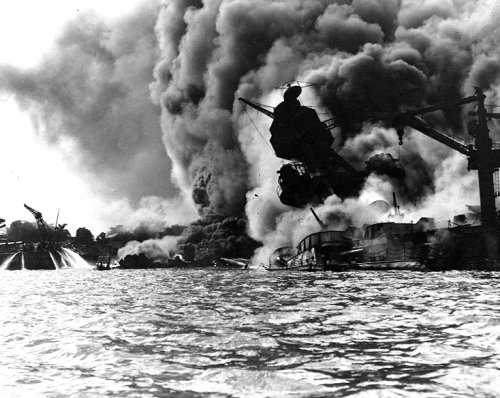
0745 hours, Sunday, Dec. 7, 1941
Shortly before 8 a.m. on the morning of Sunday, Dec. 7, 1941, 16-year-old Jim Harris was standing on the quarter deck of the USS Dobbin AD3.
Harris was part of the command allowance for the Com DES Flot 1 – which stands for Commander Destroyer Flotilla 1 – the group of men who traveled with the admiral.
The Dobbin was a repair ship and mother ship for destroyers. “We we would travel from ship to ship, as the flag travels,” he said.
As he stood on the Dobbin that morning, across the way a church service and flag-raising ceremony was about to take place on the deck of the USS Arizona.
“I had just eaten breakfast, I was standing on the quarter deck when the first flight of planes arrived,” he said.
“We thought they were from the USS Enterprise, which we knew was returning from Christmas Island and Wake Island,” said Harris, now 83.
There, the Enterprise had dropped off Marines and Marine aircraft, said Harris, and the ship was expected back. According to a Naval chronology of the day, the Enterprise was indeed en route to Pearl Harbor, and had launched scout planes at 6:18 a.m.
But the planes that Harris saw come in over the 'Aiea Hills weren't from the Enterprise.
When the planes banked, Harris said, “We could see the red meatball.”
The “meatball” was a sailor's term for the red sun, the imperial seal of the Empire of Japan.
“After a few cuss words we identified them,” he said.
0750 hours
Seaman First Class Walt Urmann, 18, was on watch on the destroyer USS Blue DD387.
He had taken the flag from the quarter deck to the stern, where he was waiting for the ship's whistle to blow, the signal to raise the flag.
“At about seven minutes to eight I heard a horrible explosion over on Ford Island,” he said.
He looked up to see a Japanese plane, flying so low over the Blue's deck that he could see the pilot waving at him, and the big red suns on the side of the plane.
“I knew we were at war,” he said.
The pilot that waved at him had just dropped a torpedo that hit the USS Utah, said Urmann.
On the USS West Virginia, 23-year-old Fire Controllman Dean Darrow was getting ready to go on liberty in Honolulu, recalls his widow, Alice. Standing at his locker, he looked up and saw planes coming over, and heard the alarm sounded over the radio.
He later said that if he'd had a rock he could have thrown one and hit one of the Japanese planes, they were so close, Alice Darrow said.
Dean Darrow and his shipmates ran to get ammunition to return fire, only to discover the ammunition was locked up.
Seventeen-year-old WK Slater had joined the USS Pennsylvania in October 1941. On Dec. 7, the ship was in drydock. Slater, who said he was “just a deckhand,” was below decks when the bombs started.
At first he thought it was battle exercises, but that seemed unusual because it was Sunday.
Back aboard the Dobbin, Harris said the officer of the deck hit the alarm for general quarters and called all boats away, because many of the battleships had smaller boats tied to their sides, and couldn't move or do combat until those boats had moved off.
“We all got on the admiral's barge and came around to the ship's landing and took orders from the flag officer,” Harris said.
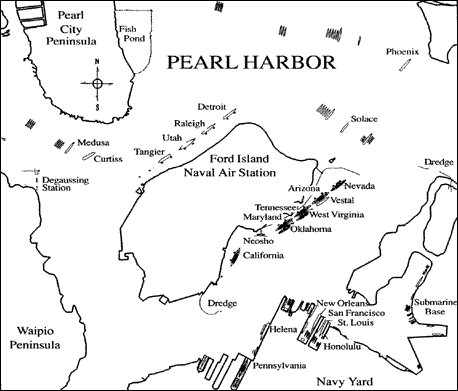
The admiral's barge moved around the USS Solace, a hospital ship anchored off the Dobbin, as well as two destroyers and the old Spanish American War battle cruiser Baltimore, which had been set to become scrap metal. The USS Nevada was tied at Ford Island, he said.
By 7:55 a.m. the Naval chronology said that the attack was well under way, with most of the ships having sounded general quarters.
0756 hours
On the Blue, Urmann said he and the other sailors rushed to their battle stations, and, like Darrow and those aboard the West Virginia, found the magazines locked. Urmann said they had to break the locks to get at the ammunition for the Blue's anti-aircraft guns.
Heavy shocks hit the West Virginia at 7:56 a.m.; Darrow said her husband's ship had been torpedoed. Naval records report that the West Virginia listed rapidly to its port side. That's when Dean Darrow went into the water.
He swam under the burning layer of oil on the water's surface, and came up on the other side. As he was being pulled from the water and into a boat by a group of rescuers, the Japanese planes began strafing the water's surface, Alice Darrow explained. A machine gun bullet struck him in the back and he was taken to the hospital.
0806 hours
Urmann said the Blue's guns got going at five minutes after 8 a.m.
Harris said the USS Vestal, a repair ship, had been moored to the port side of Arizona and was pulling away when both ships were struck. Naval records showed they were hit at 8:06 a.m.
The Vestal's captain was blown off the ship's bridge, said Harris. “We were in shock.”
As the admiral's barge made its way toward the captain, the man – still alive and swimming – waved them off toward the Arizona, said Harris.
“Stranger things happened,” he said.
0808 hours
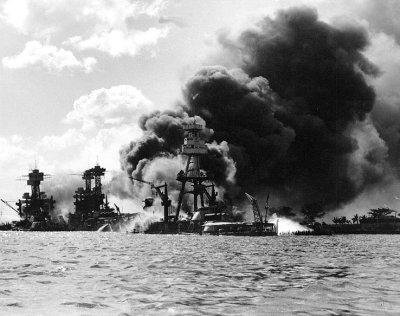
“We started toward the Arizona to pick up survivors, and that's when she exploded,” said Harris.
The ship's two magazines ignited, creating what Urmann called a “horrible explosion.”
While Slater didn't see the Arizona blow up, “you couldn't miss it otherwise,” because it blew up for quite a while, he Slater.
By the time they got to the Arizona, “There were no survivors to pick up as far as we could find,” said Harris.
Most of those who survived the Arizona explosion were on liberty, Harris said.
Harris and his comrades made a number of trips, hauling survivors back to 'Aiea. At first, they had tried to take the men to the hospital ship Solace, but the men were covered with oil and couldn't get up the ship's polished staircase.
0840 hours
Urmann said it was close to 8:40 a.m. when the Blue got under way, after returning fire on the Japanese and shooting down two planes.
As the Blue moved out of the harbor, “They tried to bomb us all the way out,” said Urmann.
0906 hours
Shortly after 9 a.m., the Japanese launched a second attack, this time aiming for the ships in drydock, according to Naval records.
Aboard the Pennsylvania, Slater and his fellows were busy returning fire.
“My battle station was to take shells from a locker and bring them out to guys that were loading the gun,” he said.
A hoist used to bring the shells to the deck had broken down, so Slater said it forced he and other ammunition handlers to bring the shells up manually.
“When we were down getting those shells manually the one bomb that hit the ship went right through where my battle station was,” he said.
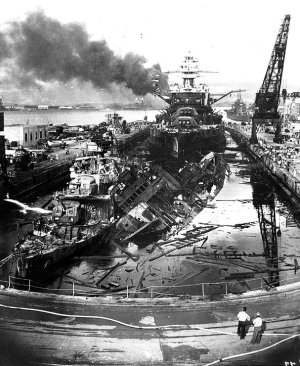
Naval records show a bomb hit the destroyer USS Downes in dock ahead of Pennsylvania. Another bomb then hit Pennsylvania's boat deck, a few feet from gun No. 7. The bomb passed through the boat deck and detonated near the No. 5 gun and the No. 9 casement. Pennsylvania still managed to hit two Japanese planes.
Slater said a number of men were killed by the bomb; had he still been on deck, he was sure that he would have been hit as well. “That's the most harrowing thing that happened to me that day,” he said.
Explaining how he felt, Slater said, “Frightened isn't the word.”
As he came up from below, Slater also saw that the Oklahoma had already rolled over.
Meanwhile, after 20 minutes, the USS Blue had managed to get out of Pearl Harbor, starting on patrol around the time the Pennsylvania was hit.
While on patrol, they got an underwater sound contact on a full-sized Japanese submarine, Urmann said and began dropping depth charges.
“We sunk that submarine but we never got credit for it,” he said.
However, they saw the oil and debris come to the surface.
Said Harris, “The whole attack must have gone over an hour and 20 minutes.”
1005 hours
A still-shaken Slater watches as the USS Shaw, also in drydock, explodes after it was first hit with a bomb at 8:15 a.m., according to Navy records.
While on patrol Urmann said the Blue met up with the USS St. Louis, the USS Helena and three other destroyers.
“We looked all the rest of that day for the Japanese,” said Urmann, who turned 84 on Nov. 27. “Luckily, we never found them.”
The aftermath of the attack
The following day, Monday, Dec. 8, the Blue linked up with the USS Enterprise, arriving back from Wake Island.
By 8 p.m. on Dec. 8 the Blue was back in Pearl Harbor. “We couldn't believe the damage that we saw,” said Urmann. “It was a mess.”
Naval records report that the Arizona, California and West Virginia were sunk at berth; the Oklahoma capsized, the Oglala was sunk by an aircraft torpedo, the Utah capsized and sank. Also damaged were the Maryland, Nevada, Pennsylvania, Tennessee, Helena, Honolulu, Raleigh, Shaw, Curtiss and Vestal.
The bomb that hit the Cassin in drydock caused it to fall off its blocks and onto the Downes.
The human toll was extreme. More than 2,400 Americans died in the attack, according to US Navy records.
Slater, who had gone to get something to eat at the enlisted club, was given a rifle and two bandoliers of shells by a big Marine and told to patrol the area around the hospital.
He said until that day he had felt safe amidst the might of the US Navy, but the “mouth dropping” effects of the attack changed his mind in a hurry.
As many as 24 men on the Pennsylvania were killed, said Slater.
After the attack, Slater said an officer gave him a pan with a pair of boots in it and told him to take it down and dump it in a trash receptacle off the ship. He said he looked down at the boots and realized a man's feet were still in them.
That night, three US planes came in were shot down by friendly fire, said Slater.
Wires had been put up to keep people off the lawns, said Slater. As he was patrolling that night he tripped over a wire, his rifle went up in the air and came down, hitting him on the head.
“The Japanese didn't get me that day but I did a pretty good job on myself,” he laughed.
Tomorrow, where they went after the attack and where they are today.
E-mail Elizabeth Larson at
{mos_sb_discuss:2}
Caltrans employee Timothy Mooney of Upper Lake was honored for rescuing a severely injured man trapped in the trunk of a car in January, according to a report from Schwarzenegger's office.
In the early morning on Jan. 13, Mooney, an equipment operator, was sanding the icy areas of the roadway between Hopland and Lakeport on Highway 175 when he noticed a vehicle located approximately 50 to 80 feet down a steep slope.
Mooney got his flashlight and climbed down the hill in the dark to investigate. While at the scene he heard a noise coming from the trunk of the vehicle. He opened the trunk and discovered an injured man with severe head lacerations.
Not knowing if the perpetrators were still in the area, Mooney contacted the California Highway Patrol, and then assisted the man to a sitting position. The temperature was 17 degrees; to protect the man from the cold Mooney gave him his raincoat.
The Hopland Fire Department responded to the scene and airlifted the victim to the hospital, where he was hospitalized for a month for treatment of head trauma and hypothermia. The Mendocino County Sheriff's Office is investigating the incident as a kidnapping and an attempted murder case.
Along with Mooney, Schwarzenegger honored four other state employees who hail from the North Coast counties of Mendocino, Napa and Humboldt: Department of Conservation – Dave Longstreth of Ukiah rescued two passengers from a car that was sinking 100 feet offshore in Lake Mendocino on April 28, 2006; Department of Forestry and Fire Protection – David Shew of St. Helena stopped a suicidal man from jumping off a freeway overpass on April 27, 2007; California Highway Patrol – Brent Weese of Crescent City rescued a woman from a fast-moving grass fire on July 3, 2006; Department of Mental Health – Phillip Scott Nixon of Napa prevented an attempted carjacking and robbery on Jan. 22, 2007.
State Sen. Patricia Wiggins offered up her own praise for the five state workers from her district.
"These people are real heroes,” Wiggins said. “Through their bravery and their willingness to get involved, they made a difference to the lives of others, and they offer proud examples of the remarkable kinds of people that work for our state government.”
The Medal of Valor, which started in 1959, is the highest honor that California bestows on its public servants and is awarded to California state employees who have performed an extraordinary act of heroism above and beyond the normal call of duty, at great risk to their own personal safety or life, to save the life of another. Award nominations are made by the employee's department.
{mos_sb_discuss:2}
On Thursday morning, traffic issues started with the report of traffic signal problems at Highway 29 and Soda Bay Road. Caltrans was called to fix the problem.
A vehicle versus pedestrian crash was reported in front of the Nice Market at 2:40 p.m., with a male subject injured. No further information was available Thursday.
Other collisions reported Thursday:
4:37 p.m. – Two-vehicle collision resulting in major injuries on Highway 20 in front of Sentry Market.
5:48 p.m. – A solo vehicle spin out on Highway 20 just east of Red Hill Lane. No injuries.
6:14 p.m. – A collision with one victim trapped and expected to be transported to the hospital. The crash occurred on Highway 29 at mile marker 15.
6:27 p.m. – A crash with no injuries on Highway 20 in front of the Lake Marina Motel. The vehicle reportedly went between 40 and 50 feet off the roadway.
7:33 p.m. – Traffic collision with no injuries on Tenaya at Soda Bay Road.
No further information on the crashes was available Thursday evening.
E-mail Elizabeth Larson at
{mos_sb_discuss:2}
In addition, the Energy Independence and Security Act (H.R. 6) is poised to reduce energy and gas prices, create new jobs and strengthen national security. It also provides historic tax incentives for businesses and homes that become more energy efficient or switch to clean, renewable energy sources.
“The steps we took today to promote energy independence and the protection of our natural resources will improve the lives of generations of Americans,” said Congressman Mike Thompson, who voted in favor of the bill. “Our dependence on foreign oil has serious consequences for our economy and national security. And our dependence on greenhouse-gas-emitting energy sources is putting the health of the entire planet at risk. This Congress has made an historic commitment to redefining American energy consumption, and this legislation is a large step toward achieving that goal.”
One of the bill’s most groundbreaking provisions would increase fuel economy standards (also known as CAFE standards) to 35 miles per gallon by 2020 for new cars and trucks, which will save Americans money at the pump.
In addition, it will reduce oil consumption by 1.1 million gallons per day in 2020 (one-half of what we currently import from the Persian Gulf) and reduce greenhouse gases equal to taking 28 million of today’s average cars and trucks off the road. This is the first increase in CAFE standards by Congress since 1975.
The legislation would also make a robust investment in American biofuel production. This includes a focus on diversifying the crops used in biofuels so that states from coast to coast will benefit from the provision.
It would require utility companies to generate 15 percent of their energy from renewable sources, such as wind, solar, ocean tides and geothermal.
It would also strengthen and extend renewable energy tax credits, which Congressman Thompson championed as a member of the House Ways and Means Committee. These include a long-term extension of tax credits for businesses and homes that use solar power, as well as other improvements to make the tax credit a better value for homeowners.
In addition, there is a four-year extension of the production tax credit for other forms of renewable energy, including many forms which are produced in the 1st Congressional District such as biomass and geothermal.
Other incentives include:
A tax incentive for the installation of energy management devices known as smart meters, which give consumers near real-time access to their energy usage information;
An extension of a tax credit for homes that make energy-efficient improvements or purchase energy-efficient devices;
A new tax credit for plug-in electric vehicles; and
Allowing employers to include the cost of employees commuting by bike in any transportation benefits they may provide.
“With the way energy costs are skyrocketing, we need to do everything we can to make energy-efficient homes, businesses and vehicles more available and affordable,” said Thompson. “Investments in renewable energy not only improve our environment – they will create more American jobs and help us to better control our country’s future.”
The measure also repeals about $21 billion in tax subsidies for Big Oil, which is similar to provisions included in H.R. 6 when it was passed by the House in January.
{mos_sb_discuss:2}

KELSEYVILLE – One of Lake County's most important volunteer organizations has selected new leadership for the year ahead, with plans to continue expanding its critical safety services to the public. {sidebar id=43}
The United States Coast Guard Auxiliary Flotilla 8-8 held its annual “change of watch” ceremony on Saturday, Dec. 1, at Zino's Restaurant in Kelseyville.
Gary Jolley, the flotilla's aids to navigation officer and the ceremony's master of ceremonies, explained that the term “change of watch” is used in the flotilla for a transfer of authority, responsibility or leadership. “Change of command,” he said, would be used if the flotilla had a rank structure.
The flotilla may not be well known to all of the people who enjoy Clear Lake and other lakes within the county.
However, the group provides a variety of services to the public, from boating safety classes to support on search and rescue missions; just this past year members spent nearly 300 hours on recovery, according to a county of volunteer hours provided by the flotilla.
The group also is working on a program to help prevent the infestation of the county's lakes by the quagga and zebra mussels.
The US Coast Guard Auxiliary's members – 27,000 strong nationwide – are called “America's volunteer lifesavers.” According to the organization's Web site, nws.cgaux.org, Congress formed the auxiliary in 1939, with its motto being Semper Paratus, “Always Ready.” Today the group – which is under the auspices of Homeland Security – reports that it provides more than two million volunteer hours annually.
That preparedness and dedication is apparent in Flotilla 8-8's membership, which includes 53 members – some with previous military experience, some without – who contributed 9,237.65 volunteer hours by Dec. 2 of this year, according to Anita Farnholtz, the flotilla's information services officer.
Their service isn't limited just to Lake County. During the Saturday ceremony, flotilla member Jeremiah Collins gave a presentation on a trip he made to Florida where he and other US Coast Guard Auxiliary members helped patrol the waters between the US and Cuba.
At Saturday's ceremony, Flotilla Commander Rich Thomas of Middletown handed over the group's leadership to Cobb resident Betty Strach, the commander for the coming year. Named vice commander to succeed Strach, who held that position this past year, was John McEwen of Lakeport.
Thomas said he has appreciated the opportunities the flotilla has given him, from meeting an astronaut to serving around District 11, which includes California, Nevada, Utah and Arizona.
Leaving his term as commander, Thomas said the flotilla is strong thanks to the giving of its members. “The flotilla does not serve us. We serve the flotilla,” he said.
Strach said the flotilla's members possess a great wealth of experience; her officers alone have more than 100 years of knowledge and experience among them, she said.
In the year ahead, Strach said she plans to continue working to strengthen the flotilla in order to offer greater service to the community.
Flotilla members give a phenomenal amount of service, said Strach. They'll likely have to offer even more service, in the form of classes, if the state legislature decides to pass a bill requiring boat operators to be licensed.
Education is extremely important, said Strach, because of the number of tragedies that happen on the lake that are based on irresponsibility, lack of knowledge – even arrogance.
Strach said she has made the words “How can I help?” her motto for her year ahead as flotilla commander.
“The sky is the limit for us,” she said.
Awards and certificates were given out to flotilla members. Collins received a special US Coast Guard Auxiliary Commendation Medal for service as rear commodore in Region 11 from January 2005 until December 2006. In that time, Collins oversaw an astounding 470,000 volunteer hours districtwide. He thanked fellow auxiliary members for making the award possible.
Strach was named Auxiliarist of the Year, with Jolley named 2007's Most Inspirational member.
Collins and the flotilla made sure to give Thomas a good roasting to show their appreciation for his service to the flotilla over the years.
Incoming staff officers for 2008 are Gary Jolley, aids to navigation and materials; John McEwen, communications; Deana McAllister, communication services; DA Butts, finance; Anita Farnholtz, information services; Catalina Gumatoatoa, marine safety; Betty Strach, member training, operations and public education; Allan Bride, public affairs; Chris Ruttan, publications; Rich Thomas, personnel services; Charles Rester, program visitation; Karen Wilson, secretary of records; and Dane Hayward, vessel examinations.
E-mail Elizabeth Larson at
{mos_sb_discuss:2}
On Nov. 28 and 29, members of the Region II Sexual Assault Felony Enforcement (SAFE) Task Force met in Lake County and conducted a two-day operation, according to Lt. Cecil Brown of the Lake County Sheriff's Office.
Agencies that assigned personnel to participate in the operation included the Lake County Sheriff’s Office, Lake County Probation Department, Lake County District Attorney’s Office, Lakeport Police Department, Santa Clara County Sheriff’s Department, Solano County Sheriff’s Department, California State Parole and the Northern California Computer Crimes Task Force, Brown reported.
California State Law requires persons convicted of certain sex crimes to register with the law enforcement agency with jurisdiction where they reside. Brown said the sheriff’s office conducts compliance checks to ensure that sex offenders register when required by law, and to verify information provided during the registration process.
The enforcement operation that occurred on Nov. 28 and Nov. 29 resulted in four arrests for violations of terms and conditions of parole, said Brown.
Five additional investigations were initiated for violations of sex offender registration laws, narcotics violations and a weapons violation, he said.
Several parole and probation searches were conducted, according to Brown. Agents from the Northern California Computer Crimes Task Force were able to perform on-site forensic searches of computer equipment for child pornography or other material which would violate the terms of probation or parole.
A primary goal of the SAFE Task Force is reduce the number of noncompliant registrants in each county, said Brown.
In January, the Megan’s Law database listed 28 registrants in Lake County who were known to be out of compliance, reported Brown.
Megan’s Law now lists 12 noncompliant registrants in Lake County, said Brown. Warrants have been issued for six of the 12 noncompliant registrants; seven of the 12 are believed to be in Mexico or San Salvador.
Brown added that most of the registrants contacted were found to be in compliance.
The Region II SAFE Task Force was created to improve communication between the agencies in this Office of Emergency Services region, to reduce the number of non-compliant sex registrants and to increase public awareness, Brown reported.
Region II SAFE Task Force operations are funded by a grant administered by the Governor’s Office of Emergency Services. The Santa Clara County Sheriff’s Department secured the grant funding, and distributes funds to the participating agencies.
Brown said the Lake County Sheriff’s Office is grateful for opportunities created by this grant. Sheriff Lori Smith of the Santa Clara County Sheriff’s Office qualified for this grant and devoted her resources to managing the grant.
Sheriff Smith chose to use grant funds to benefit 11 counties in addition to Santa Clara County, said Brown. Without this grant, sex registrant compliance checks must be completed by patrol deputies while they are not committed to other criminal investigations.
{mos_sb_discuss:2}