 How to resolve AdBlock issue?
News
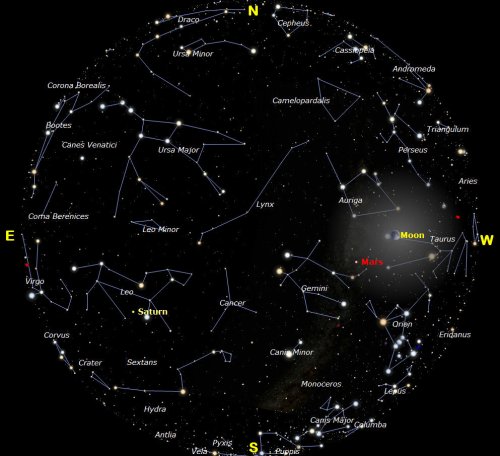
LAKE COUNTY – March is the month when the glorious stars of winter give way to the more sedate stars of spring.
On our star chart, you can see the constellation of Leo the Lion rising in the east. In Greek mythology, Leo was a huge beast that terrorized the Peloponnesian villages, devouring anyone he met. It took Hercules, the Greek strongman, to subdue Leo.
The brightest star in Leo is Regulus. It’s five times larger than our sun, and spins very fast – once every 15 hours. As a result, it looks like an egg!

Sharing the spotlight in the spring night skies is the planet Saturn, the Ring Master. Saturn is visible in Leo this year, and is about as bright as Regulus. Our star chart shows its location.

Saturn is the second-largest planet in our solar system. Unlike the earth, which is solid, Saturn is a big ball of gas.
Saturn has approximately 44 moons. The beautiful ring system was created when one of the moons drifted too close and broke up into thousands of chunks of rock in Saturn’s upper atmosphere. Even through a small telescope, Saturn is a magnificent object.
Looking toward the north, we see Ursa Major, the big bear overhead. Some of the stars in this constellation make up The Big Dipper. The two stars that make up the end of the cup of the dipper point to Polaris, the North Star.

For more information about astronomy and local astronomy-related events, visit the Taylor Observatory Web site at www.taylorobservatory.org. On March 8, starting at 8 p.m., the observatory will be open to the public. The topic for the evening is “Scopes for Folks,” a presentation about telescopes for the average person. You will also be able to view Saturn through the observatory’s telescopes.
John Zimmerman has been an amateur astronomer for 50 years. He is a member of the Taylor Observatory staff, where, among his many duties, he helps create planetarium shows.
{mos_sb_discuss:2}

CLEARLAKE – Habitat for Humanity will mark a special event next weekend, when it holds a double dedication for two homes it is about to complete.
The dedication takes place at noon Saturday, March 8, at 15798 and 15802 37th Ave. in Clearlake. The public is welcome to come join in the celebration.
Habitat for Humanity Executive Director Lisa Willardson reported that the event will celebrate the ninth and 10th homes Habitat has worked on locally.
She added that the community will have an opportunity to experience first-hand the results of almost a year of hard work by volunteers and homeowners.
Habitat for Humanity is a world wide, nonprofit, Christian-based group that works hard to make a difference in Lake County, one family at a time in eliminating poverty housing.
While giving the opportunity of homeownership to those that might not be able to purchase a home through conventional methods, Habitat for Humanity also offers homeowner workshops to help prepare the prospective homeowners for their home.
During the building process, homeowners must also help build their home and other Habitat homes under the direct supervision of a construction manager.
After completion, homeowners pay a zero-interest mortgage, taxes and insurance monthly. The mortgage fees are then used along with donations from the community to build more homes in Lake County.
Willardson reported that volunteers find that building or helping with the family selection process for Habitat for Humanity is very rewarding and a good way to give back to the community.
Habitat is also always looking for land to build on, as well as those wishing to volunteer in a variety of ways – from help with construction to office work.
For those who are looking to own their own home or for those that wish to volunteer, call Habitat for Humanity at 994-1100.
{mos_sb_discuss:2}
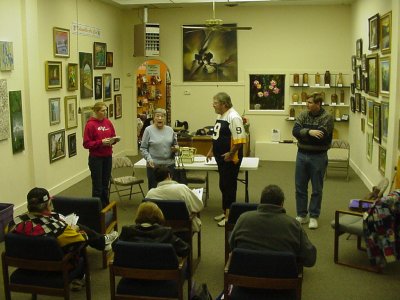
Faded At Four will play at 9 p.m. Saturday, March 1, at Carlo's and Vinny's, 370 S. Main St. The cost to attend is $10 per person. The event is limited to those 21 and older.
The superstars-in-waiting – Jon Foutch, Brian Kenner, Martin “Martan” Scheel and Chris “Pencil” Sanders – are competing in the Bodog Battle of the Bands.
They will travel to Los Angeles in the next week and a half for the competition's regional finals. The band will perform at The Avalon in Hollywood on March 12.
A total of 4,500 bands from across the U.S., Canada and Europe began the competition last summer.
The winner of that competition will take part in the reality-based TV show “Bodog Battle of the Bands,” in which eight bands will take part in touring and music-based contests in hopes of winning a $1 million recording contract from Bodog Music.
E-mail Elizabeth Larson at
{mos_sb_discuss:5}
The California Department of Food and Agriculture (CDFA) reported Friday that a single male light brown apple moth was found in a trap that was part of a 613-trap array deployed in the county as part of the state's detection program.
The tiny moth, native to Australia, has a mighty appetite, with hundreds of major crops – including winegrapes, pears and other North Coast commodities – among them.
The discovery trigged more trapping in the immediate area to determine if additional moths are present, CDFA reported. If they are, officials will carry out eradication efforts, and quarantines to limit movement of plants, produce and yard waste will be put in place.
That doesn't count the damage to interstate commerce, because many states have now issues restrictions on California produce because of the moth. Internationally, trade partners Mexico and Canada have imposed export regulations on California because of the moth infestation.
Those restrictions on trade with Mexico could have serious implications for local farmers if the moth were to be found here, because Mexico has banned pears that come from infested counties.
In an interview with Lake County News last May, Chuck Morse, the county's deputy agriculture commissioner, said a large quantify of local Bartlett pears are shipped to Mexican markets.
Currently, there are no detection traps in Lake County for the light brown apple moth, according to a CDFA report. In December, 126 had been reported in the county.
CDFA has categorized the moth as a “Class A” pest – it's most serious rating – because of the risks it poses to the state's multibillion-dollar agriculture industry.
Officials also warn the moth could damage the natural environment, causing damage to park lands and California's beloved redwoods, cypress and oak trees.
Since the discovery of a light brown apple moth was confirmed in the Bay Area in February 2007, more than 17,000 of the moths have been found in 14 counties.
Sonoma is the second of Northern California's major wine country counties to find the moth.
Last May, the moth was found in Napa County. Since then, a second moth has been found there, but CDFA said Friday that Napa's small, isolated infestation has been eradicated, thanks – in part – to a “twist tie” treatment that emits a pheromone to confuse the moth and prevent it from breeding. The twist ties also were used to rid Los Angeles of its own small infestation.
In response to the infestation, Sen. Patricia Wiggins (D-Santa Rosa) introduced the Light Brown Apple Moth Act of 2007, which established the Light Brown Apple Moth Program in the CDFA and created an account from which the department can allocate funds to local agencies for eradication activities.
Last September, Gov. Arnold Schwarzenegger signed into the bill into law.
CDFA and the US Department of Agriculture are working together to conduct the light brown apple moth eradication program.
As part of that program, they've implemented aerial spraying of moth pheromone over Central Coast communities. The spraying has resulted in public outcry and hundreds of health complaints which the agencies have maintained are not related to the pheromone.
Aerial spraying is supposed to take part over some Bay Area communities beginning this summer as part of this year's eradication program, which has resulted in resolutions against the spraying by the city councils of Albany and Berkeley. Additionally, Berkeley is threatening to sue the state.
Last week, several Bay Area legislators introduced a suite of bills that would, among other things, place controls on the state secretary of agriculture's power to direct an eradication effort and require more notifications and studies before spraying in urban areas.
Earlier this year, USDA dedicated nearly $74 million to the effort, which will include a nationwide survey to see if the moth has spread to other states besides California and Hawaii.
Officials said they plan to closely look at the nursery industry, as it's believed the moth – like so many invasive species – entered the United States in imported plant materials.
A USDA study estimates that if California becomes generally infested, the moth could cause as much as $640 million annually in crop damage.
E-mail Elizabeth Larson at
{mos_sb_discuss:2}
A Lakeport Disposal garbage truck driver called Lakeport Police Tuesday morning just after 7 a.m. to report that he had knocked over the lamp post, located at 199 N. Main St. in front of Transitions, reported Lt. Brad Rasmussen.
“The pole went down and actually caused some damage to the business,” said Rasmussen.
The collision, Rasmussen explained, broke the lamp post off at the base.
“Since it was knocked down by a vehicle the city will be seeking restitution,” he said.
The Lakeport Main Street Association worked to raise money for the lamp posts, which are now maintained by the city's Public Works Department, said Lakeport City Engineer Scott Harter.
Harter said the lamp posts cost between $4,000 and $5,000 each. He didn't have a timeframe for when the lamp post might be replaced.
Another 12 lamp posts along Third Street and at the City Hall parking lot are due to be installed in conjunction with the first phase of the downtown improvement plan, said Harter.
E-mail Elizabeth Larson at
{mos_sb_discuss:2}
Education
Health
Business
Obituaries
Veterans
Recreation
Religion
Arts & Life
Government & Politics