 How to resolve AdBlock issue?
News
The event will take place at 10 a.m. Wednesday, July 9. The courthouse is located at 255 N. Forbes St.
The following 18 individuals have been chosen to serve during the upcoming year.
Supervisorial District 1
Terry Bissonnette, Hidden Valley
Charles O’Neill-Jones, Lower Lake
Supervisorial District 2
Jesse O. Firestone Sr., Clearlake
Dave R. Johnson, Clearlake
Supervisorial District 3
Linda M. Alexander, Witter Springs (holdover from 2007-08 jury)
Joy K. Allred, Upper Lake
Richard P. Everts, Upper Lake (holdover from 2007-08 jury)
Loretta A. Krentz, Lucerne
Carolynn Manley, Lucerne
Supervisorial District 4
Virginia L. Cline, Lakeport (holdover from 2007-08 jury)
John G. Daniels, Lakeport
Kathleen H. Harrell, Lakeport (holdover from 2007-08 jury)
Phillip E. Myers, Lakeport
Lawrence Platz, Lakeport
Carol M. Vedder, Lakeport
Supervisorial District 5
Melissa Bentley, Cobb
Harold W. Dietrich, Loch Lomond
Steven Tellardin, Kelseyville
The 2007-08 Grand Jury's report is expected to be released later this month.
{mos_sb_discuss:2}
City Engineer Scott Harter reports that the project limits will be on Third Street, directly east of Main Street to the east side of Park Street, and the parking lot adjacent to City Hall.
FEDCO Construction began mobilizing and performing preparatory work last week, according to Harter.
Construction is expected to last 11 weeks, during which Third Street will remain open with the exception of 12 days for removal and repaving operations.
Harter said all affected businesses – The Ink Spot, On the Waterfront and Park Place restaurant – will remain open during construction. Alternative vehicle access for businesses on the north side of Third Street and the Third Street boat ramp is via Fourth Street and the waterfront parking lot.
Alternate vehicle access to The Ink Spot is via Second Street along the alleyway between Main and Park Streets, according to Harter.
Questions may be directed to Harter at 263-5614, extension 11.
{mos_sb_discuss:2}
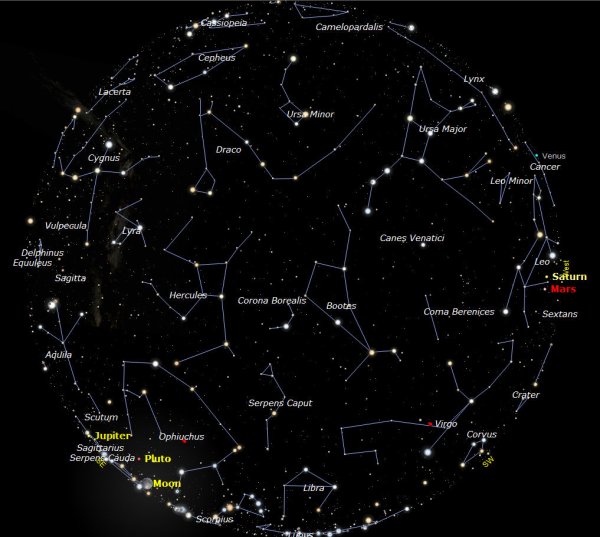
LAKE COUNTY – July’s heat brings out some nasty critters in the night sky – specifically, a dragon and a scorpion.
Let’s start with the dragon, who is named Draco. Our star chart shows Draco to be a faint constellation that wraps itself around the little dipper (Ursa Minor).
In Greek mythology, Draco was a hundred-headed beast who was charged with guarding some golden apples. The superhero Hercules came along, put Draco to sleep with music, and stole the apples. Perhaps that is the origin of the saying “music soothes the savage beast.”

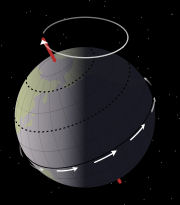
The brightest star in Draco is named Thuban. In 2500 BC, Thuban, not Polaris, was our north star. Why? Because the earth slowly wobbles as it turns – this wobble is called precession. Over time, this causes the position of celestial north to change. A diagram of how precession works is shown below.
From Draco in the north, we now turn to the south to view the glorious constellation, Scorpius the Scorpion.
You can barely see Scorpius on our star chart, but under Lake County skies, this constellation shines brilliantly in the south.
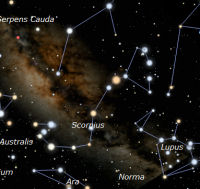
If you own a small telescope, there is a wealth of objects to be viewed in this constellation.
In Greek mythology, Scorpius was the creature that killed Orion, the mighty hunter. Orion rules the winter skies, while Scorpius lives in the summer skies so that the two are never together and so cannot fight one another.
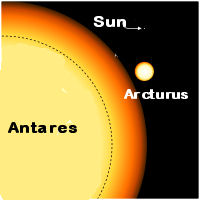
The brightest star in Scorpius is Antares, a huge red supergiant. In last month’s column we showed how small our Sun is compared to the star Arcturus. The following diagram shows how much larger Antares is than Arcturus.
Aside from the dragon and the scorpion, our star chart shows a number of planets inhabit July night skies. Setting in the west are Saturn and Mars. Rising in the east is the solar system’s biggest planet, Jupiter. Pluto is also in the night sky, but you need a very large telescope to see it.
For more information about astronomy and local astronomy-related events, visit the Taylor Observatory website at www.taylorobservatory.org.
On July 26, starting at 8 p.m., the observatory will be open to the public. The topic for the evening is “Gems of the Night,” a presentation about the beautiful objects visible only through a telescope. There will also be a planetarium show and telescope viewing.
John Zimmerman has been an amateur astronomer for 50 years. He is a member of the Taylor Observatory staff, where, among his many duties, he helps create planetarium shows.
{mos_sb_discuss:2}
In many cases, it doesn't lead to happy endings.
The Humane Society of the United States reports that kitten season is really three seasons at once, with cats giving birth to litters beginning in the spring, with the births peaking in late spring and early summer, and coming to an end in fall.
The warmer weather coincides with female cats' heat cycles, the group reports, and with unspayed and unneutered cats being in abundance all over the country – and also here in Lake County – forces coincide to cause a population explosion.
Despite the fact that the county and the cities of Clearlake and Lakeport all have adopted spay and neuter ordinances, there still are many unaltered animals in the county, according to Animal Care and Control officials.
Here in Lake County, Animal Care and Control reports that it's seeing a flood of cats and kittens making their way into the new shelter, located near the Lake County Jail.
“We're getting them in every day,” said Officer Eric Wood.
The shelter now has well over 60 kittens, Wood said. “We've already overloaded all of our rescue with them.”
That's just a drop in the bucket, according to Shelter Program Director Paula Werner. One week, the shelter saw 130 kittens come in.
She quotes statistics from the Humane Society of the United States that say an unaltered female cat and her unaltered offspring can produce 1.2 million cats in eight years. Werner said female cats can breed rapidly, able to go back into heat again immediately after pregnancy.
Despite the cute and cuddly factor, kittens present a lot of problems for shelters, especially in massive quantities.
Wood said kittens get sick very easily. “We don't have the means to medicate them all the time.”
That's why it's critical to get them into rescue care, which the shelter has been very successful in doing in recent years. Werner said in a previous interview that shelter staff have worked hard to form relationships with rescue groups, who have taken animals and helped reduce the county's euthanasia rates.
However, euthanasia is still highest in the county for cats, according to shelter statistics. In fiscal year 2006-07, 3,275 cats were impounded; of those, 2,648 were euthanized. Kitten season often only exacerbates the problem.
Many younger kittens, under 8 weeks old, have to be fed with a bottle, and if rescues don't take them they often are euthanized because the shelter doesn't have the staff to attend to them, said Wood.
The jump in population can often lead to cruelty, when people attempt to rid themselves of the animals by dumping them.
Just such a situation occurred one night last month.
On the evening of June 12, Wood got an after-hours call from the California Patrol reporting that some 30 animals – cats and kittens – had been dumped along Spruce Grove Road near Lower Lake, and that the animals were running down the side of the road.
When he got there around 10 p.m., Wood found some kind-hearted citizens trying to round up the kittens.
In all, they recovered 21 kittens – ranging in age from 6 to 10 weeks old – and two adult female cats, with some others escaping, said Wood. He estimated the kittens were from three separate litters.
“It was definitely a dump job,” said Wood.
He added, “I've never seen anyone dump that many cats at once.”
No one has yet reported seeing who dumped the animals, he said.
Most of the kittens had some upper respiratory infections but were otherwise OK, said Wood.
The animals weren't wild, he added, but had been socialized. “The 21 I brought in were friendly.”
Despite the overload on kittens, Wood said they were successful in getting them out of the shelter and into rescues. On June 13, one of the mothers and six kittens went to rescue, and more were on the way.
“They got real lucky,” he said.
Werner added that it's a felony offense, and the shelter is keenly interested in finding out who is responsible.
It's not the only recent dumping situation that's happened, said Wood. Public Works reported finding kittens dumped along Sulphur Bank Road in Clearlake Oaks not long ago.
Wood says he's sure it happens a lot more than they know about.
Anyone with information about dumping activities is asked to call Lake County Animal Care and Control, 263-0278.
E-mail Elizabeth Larson at
{mos_sb_discuss:2}
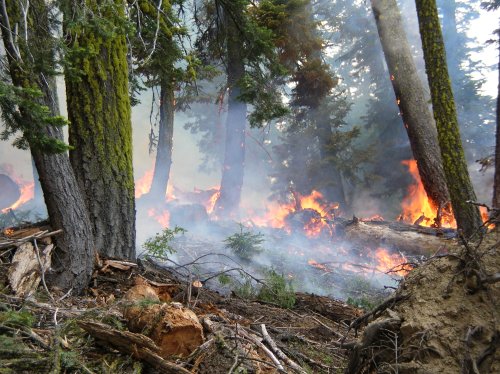
The Mendocino Lightning Complex has burned 41,200 acres, led to the death of a volunteer firefighter, destroyed two homes and injured 24, according to Cal Fire statistics.
After two weeks of firefighting the complex is 40-percent contained, and more personnel continue to arrive, Cal Fire reported. On Saturday a total of 1,749 firefighters were on scene.
Adding that complex to the Walker Fire, 55,700 acres have burned across Mendocino and Lake counties in recent weeks, which doesn't count more than 12,000 more that have burned on the Mendocino National Forest.
On the forest's Upper Lake Ranger District, three of the four fires in the Soda Complex remained active Saturday, with the 2,190-acre Big Fire close to containment, while the Mill and the Monkey Rock fires continue to steadily burn, forest officials reported.
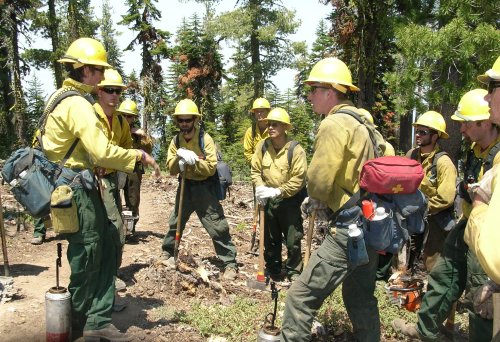
The Soda Complex is 73-percent contained, with 476 personnel assigned to it. Mop up and rehabilitation already is under way in some areas.
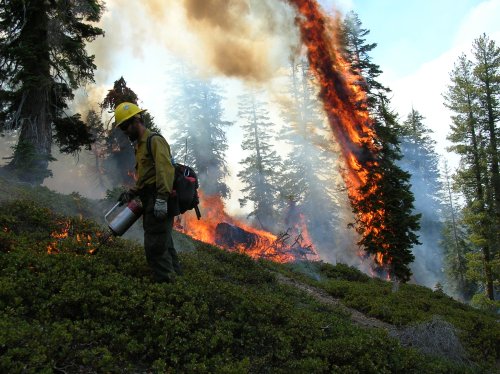
On the Yolla Bolly Complex – which is in the Yolla Bolly-Middle Eel Wilderness in Mendocino, Trinity and Tehama counties – backfires began Saturday to control that series of fires, which has blackened 7,122 acres and is 20-percent contained. Approximately 197 firefighter are assigned to that complex, which officials reported has cost more than $1 million to fight to date.
For more information visit the Forest Service Web site at www.fs.fed.us/r5/mendocino/currentconditions or Cal Fire at www.cdf.ca.gov.
E-mail Elizabeth Larson at
{mos_sb_discuss:2}
A couple of months ago I had them both sit down and talk it out. The compromise came to this: We switch from carnivore to herbivore every other day.
Unfortunately the two of them are like the yin and yang parts of a hetero symbol, always opposites and very little in common except that they are parts of a whole. So for my first vegetarian dish I announced that I would make eggplant lasagna ...
“Yea! I love eggplant!” from my daughter.
“I hate eggplant!” from my wife.
Oh, this new menu is going to be fun, I think to myself while I beat my head against the refrigerator. Luckily with my foundation in Japanese and Asian cuisine I have a bunch of Buddhist recipes to fall back on. “Tofu steak” has become a regular dinner at our place, with everyone in the house enjoying it as if the name alone pleases everyone: “Tofu” for the vegetarian, and “steak” for the meat eater.
I think the thing that confuses carnivores/omnivores about vegetarians is that vegetarians have dozens of “classes” or castes, so let’s go through and define some of them to avoid confusion.
Vegans eat nothing that has anything to do with animals. This not only includes meat of any animal or sea creature, but also eggs, milk and honey (honey, like milk is a product manufactured by animals). I personally could never even come close to being vegan; either God or Darwinism has chosen to make my anatomy with eyes on the front of my head like a predator and not on the sides of my head like a prey animal, and I can’t go against that evidence. Testosterone just fortified these feelings out of cold, hard steel ... that steel then formed into the shape of a knife that can be used to track down and kill weak autotroph-eating creatures so they can be roasted over a fire and ... Sorry, I don’t know what happened there.
Anyway, lacto-vegetarians don’t eat meat or anything that could have become meat like eggs, however milk and honey are fair game. Ovo-vegetarians don’t eat meat or milk but eggs and honey are permitted. Ovo-lacto-vegetarians don’t eat the flesh of animals but the products they produce like milk, eggs, and honey are edible.
Another vegetarian group called fruitarians eat only beans, seeds, rices, fallen fruit and grains since plants are living things and shouldn’t be killed for food.
This list can also include things like semi-vegetarians who eat seafood or poultry in limited amounts but no beef, or pollo-vegetarians who eat birds but not hoofed animals.
But at this point I’m sure that you get the idea. People limit their food categories in a hundred different ways based on their beliefs about the value of life on the food chain.
My daughter has chosen her own version of vegetarianism that could be called Petting Zoo Vegetarianism. If it’s cute and cuddly it can’t be eaten. Rabbits, lamb, quail, piglets, calves, deer, are all safe in this diet, but vultures and armadillos better run and hide.
I can’t fault any person’s diet since I too have my own eating quirks, and I completely support anyone’s choice to eat whatever they want. Over time, I’m sure that readers will pick up on my dietary oddities.
Vegetarian foods are dominant in many countries due to religious/moral, economic or population reasons. We here in the United States are uniquely spoiled in our view of food. Because of the abundance of land and wealth in our society we think that meat should cover the majority of our dinner plate, while the vegetables and carbs are more for garnish than anything else.
I’ll be the first carnivore to admit that this practice will not last for long. Mankind is going to have to rely on a more plant-based diet in the future to insure that the world can stay fed. Adopting my daughter’s petting zoo vegetarianism and my wife’s every-other-day vegetarian compromise is my contribution to easing the pressure on the planet.
One quick note about the following recipe: I mix wheat flour and rice flour for the coating in this recipe. Why not use one or the other? Wheat flour is good when browning food in oil, however it doesn’t get really crisp; rice flour gets crispy when fried in oil but doesn’t brown well. By combining the two you get the best of both worlds.
Tofu steaks
Ingredients:
One block of extra firm tofu
4 tablespoons flour (I prefer 2 tablespoons wheat flour and 2 tablespoons rice flour, mixed)
6 tablespoons soy sauce
3 tablespoons butter or your favorite oil to fry in.
Your favorite condiments or, for a more authentic Japanese feel, use chopped green onions or chives, finely grated fresh ginger and bonito flakes (if you are avoiding meat you should know that bonito flakes are dried shaved fish).
Set the tofu block on its end and cut downward through its width like you were cutting cards off of a deck, so you get three even steaks (just cutting in half leaves the steaks just a little too thick for my taste, so thirds works out best for me, but feel free to experiment).
Even with extra firm tofu, some of the moisture needs to be squeezed out or the steaks will fall apart during cooking. Lay out all three pieces separately on a kitchen towel or several sheets of paper towels and then lay another towel or several sheets of paper towels over them (about one cup of moisture is going to be squeezed out during this process so stack your paper towels accordingly).
Gently place your heaviest cutting board on top of the towel and weigh it down with some cans of soup or anything with a little weight to it, just not so much that you crush the tofu. Let this sit on your counter top for a minimum of an hour, then remove tofu and wipe up all of that liquid all over the counter top.
Gently spoon one tablespoon of soy sauce over each one of the tofu and let sit until it soaks in (a couple of minutes is all that’s needed), then flip the tofu steaks over and repeat.
Heat your butter or oil in a frying pan on medium high heat while you dredge the tofu steaks in the two-flour mixture. Gently shake off any excess flour and put tofu steaks in the heated pan. Fry until golden brown on both sides and drain momentarily on paper towels. Add condiments and serve.
You could substitute the soy sauce in this recipe for Italian salad dressing, which works quite well. If you’re OK with eating a little meat, you can marinade the steaks in strong chicken broth or even the liquid from a can of tuna for a heartier taste (call it fusion cuisine). Tofu is much like a blank canvas that you can experiment with a lot of different flavors, so have fun!
Ross A. Christensen is an award-winning gardener and gourmet cook. He is the author of "Sushi A to Z, The Ultimate Guide" and is currently working on a new book. He has been a public speaker for many years and enjoys being involved in the community.
{mos_sb_discuss:4}