 How to resolve AdBlock issue?
News

The envelope, please.
And the winner is Bernie Butcher of the Tallman Hotel/Blue Wing Saloon and Café.
With Butcher’s second annual Blue Wing Blues Festival, Big Blues have hit Upper Lake one more time. As the legendary star of Wednesday night’s opening show, Charlie Musselwhite, would say, “I ain’t lyin’.”
First things first. Even the opening act on Wednesday night are stars. The great Kathi McDonald with Rich Kirch and David Hayes sport resumes that boast tenure with some of the greatest names in music.
At the tender age of 19 McDonald became the first white woman to be an Ikette. In a post show interview McDonald spoke highly of both Ike and Tina Turner. She actually lived with the Turners and was a witness to the many talents of them both.
McDonald has also worked with Big Brother and The Holding Company, Joe Cocker, Leon Russell, The Rolling Stones and many others. She has appeared on more than 150 albums. Her own first solo project, “Insane Asylum,” is a collector’s item.

Guitar man Rich Kirch was born in Chicago and learned that style of blues first hand. He became a member of the Jimmy Dawkins Band which secured him a regular spot on the Chicago Blues scene. He has played in Musselwhite’s band and spent 13 years with John Lee Hooker. Visit Kirch at his Web site, www.richkirch.com. 'Nuff said..
David Hayes has played bass for Terry and The Pirates, Van Morrison, Southside Johnny and The Ashbury Jukes, Jesse Colin Young and many others. For more information on his music visit www.davidhayesmusic.com.
McDonald, Kirch and Hayes played a dynamic set of tunes to open the show, covering the likes of Sonny Boy Williamson, Peter Frampton, Muddy Waters, Freddie King and others. McDonald’s three-and-a-half-octave voice was in fine form and the band’s set was very explosive. They set the stage for local favorites Twice As Good.
Father and son team Rich and Paul Stewart notched up the energy immediately upon taking the stage. They opened their set with their theme song, “2XG,” and followed it with T-Bone Walker’s “T-Bone Shuffle.” Paul lost his porkpie hat while cavorting through the crowd but didn’t miss a lick. The band, featuring Bruce Hodge on drums and Chris Hoke on bass, burned through “Bad Case Of Love,” “Don’t Treat Me Right,” “Shake Your Money Maker,” “Going To Mississippi” and “Shame, Shame, Shame,” among others.
The legendary Charlie Musselwhite joined Twice As Good onstage for the last hour of their set.
Musselwhite, Mississippi born and blues bred, has recorded more than 25 albums and is an elder statesman of the genre. He introduced the crowd to a form of Brazilian blues that he learned on a recent trip there.
The stage marriage of Twice As Good and Musselwhite is seemingly one cast in Blues Heaven. The dance floor was frantic with Lake County dancers and one observer was heard to declare, “Hell, Musselwhite oughta just take Twice As Good on the road with him.”
Sounds like a plan to me.
T. Watts writes on arts and culture for Lake County News, and hosts his own music program on KPFZ 88.1 FM. He's covering the blues festival this week in Upper Lake.

{mos_sb_discuss:5}
At the end of the day Wednesday the US Geological Survey's gage height in feet placed Clear Lake's depth at 3.20 feet above Zero Rumsey, the lake's natural low water level, which is 1318.256 feet above mean sea level, according to the Lake County Department of Water Resources.
Wednesday's level for the 63-square-mile lake surpassed that of the same date last year, when it measured 2.78 feet above Rumsey. The 3.20 foot measurement Wednesday also is slightly above the lake's annual average height of about 3.00 feet above Rumsey, recorded between 1979 and 2006.
The Solano Decree, first handed down in 1978 and modified in 1995, determines how much water Yolo County Flood Control and Water Conservation District – which owns the water rights to Clear Lake – can take out of the lake based on water levels on May 1, Water Resources reported.
If the lake is full – or 7.56 feet Rumsey – on May 1 Yolo Flood can take its full allotment, according to Water Resources. If the lake is below 3.22 feet Rumsey, no water can be taken.
Water Resources reported that on May 1 the lake was at 6.67 feet Rumsey, following 8,352 acre feet of water being removed from the lake in April, which reduced the lake's level by 0.09 feet Rumsey.
The slightly better water levels this year meant that Yolo Flood was able to take 119,960 acre feet – 80 percent of their annual allocation – out of the lake for irrigation this year, Water Resources reported.
An acre foot of water is 326,000 gallons – the amount of water it takes to cover an acre of land with one foot of water, according to Water Resources.
That means that, this year, Yolo Flood took more than 39 billion gallons of water from Clear Lake. Had the lake been full, they could have taken an allocation of nearly 49 billion gallons.
In 2007, the May 1 measurement was 5.82 feet Rumsey, which meant Yolo Flood only received a 57-percent allocation, which was just over 85,000 acre feet – or nearly 28 billion gallons of water, as Lake County News has reported.
Due to surface evaporation, Clear Lake's levels can drop anywhere from 3 to 6.5 feet in a summer, according to Water Resources.
Lake levels had started off very strong earlier this year thanks to early season rains and runoff from snow in the mountains, with Clear Lake hitting its fullest point – 7.11 feet Rumsey – on March 21, as opposed to its highest level for 2007, 6.13 feet Rumsey.
The area's creeks are running at below average, according to the US Geological Survey. While Kelsey Creek and Cache Creek at Lower Lake show lower-than-normal gage heights and less water discharge, both Putah Creek near Guenoc and Cache Creek near Hough Springs recorded zero discharge.
Although the lake's depth isn't record-breaking, it's in a better position than some other lakes and reservoirs in Northern California.
Indian Valley Reservoir, also owned by Yolo Flood in Lake County, had 37,296 acre feet of storage on Wednesday, down more than 69,000 acre feet from this time last year, according to Yolo Flood measurements.
Late last month, the state Department of Water Resources reported that levels were dropping in Lake Oroville to the point where the agency was going to have to use extensions for the lake's boat launch ramps, which were on dry ground.
That lake is at 49 percent of average for this time of year and is only 62 feet above its historical low point, reached in September of 1977, the state Department of Water Resources reported.
E-mail Elizabeth Larson at
{mos_sb_discuss:2}
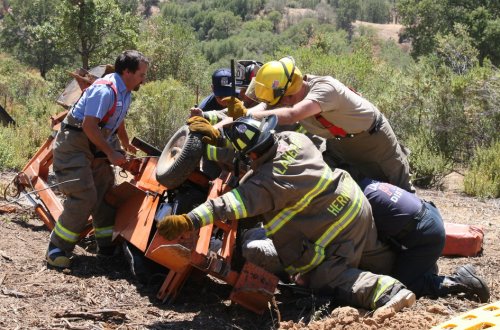
LAKEPORT – A Lakeport man on Tuesday found himself trapped under a tractor, but quick action by medics saved him from serious injury.
Willis Knight, 67, was operating a medium-sized gas-powered trenching tractor on his property on Hendricks shortly before noon Tuesday.
Knight was working on a slope when the tractor overturned and pinned him to the ground.
His wife, Barbara, called 911 and within five minutes medics arrived, including one engine and a medic unit from Lakeport Fire Protection District, along with several off-duty responders. A REACH helicopter arrived at about 12:14 p.m.
Rescuers uprighted the tractor and, instead of taking Knight by REACH, Lakeport Fire medics determined that Knight's injuries were not life-threatening and recommended he be transported to Sutter Lakeside Hospital.
Late Tuesday afternoon Lake County News spoke with Barbara Knight, who indicated that her husband had been treated at Sutter Lakeside Hospital and also had undergone an intensive MRI and external physical examinations.
The results showed no internal damages but did reveal moderate to severe bruising on several areas of his body as well as moderate cuts and scratches.
Knight was treated and released and was recovering in his home by 6 p.m., according to his wife.
She said her husband is “a very lucky man.”
E-mail Harold LaBonte at

{mos_sb_discuss:2}
LUCERNE – After gaining ground in recent months, the Lucerne Alpine Senior Center is once again facing a challenge following the state's seizure of thousands of dollars from the center's bank accounts because of past unpaid state taxes.
Center Executive Director Lee Tyree said the center's accounts were essentially drained last week by a levy from the State Franchise Tax Board's Industrial Health and Safety Collections department.
The State Franchise Tax Board has told the center it owes more than $10,000, said Tyree.
On July 31, without warning, the state took $7,000 out of the center's accounts, said Tyree.
“It wiped us out,” she said. “We couldn't even make payroll.”
A State Franchise Tax Board spokesman told Lake County News on Monday he was looking into the matter to see if the agency could offer a comment on the action this week.
The State Franchise Tax Board is responsible for California's two major tax programs – personal income tax and corporation tax, according to the agency's Web site. It's also responsible for collecting back wages for the state's labor board.
Last August, the center reached a tax settlement of just over $33,000 with the Internal Revenue Service for unpaid federal taxes, an amount the center was able to pay after selling its thrift shop building to the county for $150,000.
Center officials at the time said those taxes had not been paid by Rowland Mosser, 63, who served as the center's executive director from July 2002 to August 2005, as Lake County News has reported.
In April Mosser was arrested for felony embezzlement, grand theft by an employee, grand theft and keeping a false record of government funds in connection with funds that allegedly went missing from the center. Former center board president Jim Swatts said previously he believes as much as $200,000 was unaccounted for in the center's finances.
Mosser's wife, Jayne, 60, also was arrested in April on a felony grand theft charge.
A week before the state levy hit, Tyree said the IRS also levied the center's accounts for $1,800 and required the center show proof that it had paid income tax for 2004 before returning the funds.
Those were taxes that had been settled last year, said Tyree. “And we had to prove it to them again.”
In this latest issue there are labor board claims involved. Tyree said two past employees, hired by Mosser, reported to the board that they were owed for past wages.
Mosser, who has an upcoming court date in his embezzlement case, also has a claim against the center for $5,400 in vacation pay amassed between 2002 and 2005 for which he has claimed he has not been paid, according to Tyree.
“That hasn't gone through yet,” she said.
Brad Onorato, district representative for Congressman Mike Thompson, said Thompson's office and the office of state Assembly member Patty Berg are trying to work with the Franchise Tax Board to see if they can put a hold on the board's actions against the center.
“We're not quite certain if we're going to be successful,” said Onorato. “It's going to take a couple of days until we really know.”
District 3 Supervisor Denise Rushing said the county also is monitoring the situation.
Besides buying the thrift shop last year to help the center pay its bills, the county also has been trying to secure the building from further deterioration, said Rushing. That includes setting aside $30,000 earlier this year to help replace the building's leaking roof.
Rushing said the county will look at further action to help the center but needs to make sure it's on a “solid financial footing” before they do much more.
Struggling to keep the center going
Tyree said the state's levy drained all the center's money to support its Meals on Wheels program.
The center serves Meals on Wheels to seniors from Blue Lakes to Paradise Cove, and from Elk Mountain over toward the area of the Passion Play grounds off of Highway 29, Tyree said.
“We're back to square one again,” said Tyree, who called the situation “very, very sad.”
She said it costs at least $1,000 a week to cover expenses for Meals on Wheels and congregate meals served at the center during the week, she said.
Tyree said many people have stepped up to the plate, including volunteers and community members who are making donations out of their own pockets to keep the center going. The center was current on its bills for the levy took place, Tyree noted.
The center has received help on another front, said Tyree.
She said the building's cooling system had broken down and seniors weren't coming for meals because the building was too hot.
Former Supervisor Louise Talley called Piedmont Lumber and spoke to manager Ted Mandrones, who sent out a two-man crew within three hours to install a commercial-grade swamp cooler. Tyree said she was very grateful to the company for its help.
Tyree said the center is seeking contributions and more help in order to keep the doors open. “At the moment we need all the donations we can get,” she said.
For information on how to help call the Lucerne Alpine Senior Center at 274-8779.
E-mail Elizabeth Larson at
{mos_sb_discuss:2}

UPPER LAKE – An acclaimed muralist whose work can be seen in Upper Lake and in Lakeport has won a $1.1 million art desecration lawsuit for a downtown Los Angeles mural that was painted over.
Kent Twitchell, 65, is known locally for painting Upper Lake antique shop owner Tony Oliveira in western attire on the side of a building in Upper Lake, a town where Twitchell also lived for a time in recent years.
His work also is featured on the ceiling of the former Bank of Italy on Second and Main streets in downtown Lakeport, which now houses the antique shop Traditions.
But Twitchell also is a world-renowned muralist, whose best-known works are on display in Southern California.
One of those works was called the “Ed Ruscha Monument,” a 70-foot-high painting on the side of a building at 1031 S. Hill St. which Twitchell created between 1978 and 1987. The painting depicts an important Los-Angeles-based pop artist.
In 2006, the building – owned by the US Department of Labor and occupied by the Job Corps – underwent repair and the six-story-tall mural was intentionally painted over, according to Sheldon Mak Rose and Anderson PC, the Pasadena law firm that represented Twitchell.
Twitchell sued the US government and 12 other defendants for painting over the mural, citing the Federal Visual Artists Rights Act and California Art Preservation Act, the firm reported.
Under those laws, Twitchell was to have received prior notification of the government's wish to have the mural removed so he could make arrangements to preserve it. The law requires a 90-day notice, said William Brutocao, Twitchell's attorney.
The US Department of Labor did not respond to Lake County News' request for a comment on the case.
Twitchell originally asked for $5.5 million, said Brutocao. The negotiated final settlement reached late in April was for $1.1 million, believed to be the largest settlement ever reached under the Federal Visual Artists Rights and California Art Preservation Acts. The U.S. Government is contributing $250,000 to the settlement amount.
“This settlement sets an important precedent which will benefit other artists,” Twitchell said in a written statement. “This resolution makes it clear that when it comes to public art, you have to respect the artist’s rights, or incur significant liability.”
Brutocao said who is responsible for deciding to paint over the mural “remains kind of a mystery.” While the government owns the building, they have other people running it. He doesn't think there was a conscious decision to set out to destroy the mural, and attributes the painting over of the mural to a “bureaucratic snafu.”
If Twitchell had been given the notice, he would have removed the mural or negotiated to keep it in place, Brutocao said.
Art consultants have determined that it may still be possible to salvage the 11,000 square-foot mural, although it may be difficult and expensive. Brutocao said it will involve a complicated method using a small machine resembling a jack hammer to remove the outer layers of paint.
“It effectively sort of peels off like wallpaper,” he said.
From the time of the ruling going into effect in April, Twitchell – now living primarily in Southern California – has 14 months to remove the mural, Brutocao said.
Twitchell – who Brutocao called “a treasure” – is happy to have the lawsuit behind him. “This has been a distraction and a burden for him,” said Brutocao.
Defacement of Twitchell's art also has been a problem in Lake County. Several years ago Oliveira's portrait was the victim of graffiti. Following Twitchell's restoration of the work, it was covered by a door that protects the painting, which is displayed only at certain times.
The money wasn't what motivated Twitchell in the suit, said Brutocao. “That's not important to him. What's important to him is to create works of art.”
E-mail Elizabeth Larson at
{mos_sb_discuss:2}
Education
Health
Business
Obituaries
Veterans
Recreation
Religion
Arts & Life
Government & Politics