 How to resolve AdBlock issue?
News
Now, Laird is saying goodbye to his old job as he leaves to move closer to family on the Central Coast.
Laird originally joined the division in February of 2001 as an extra help advocate before being offered a permanent position a few months later as an elder abuse advocate. He came to the agency with no experience, but quickly picked up what he needed to know on the job.
Since that time, Laird has navigated the challenges of reduced funding and a growing caseload, and dedicated untold hours of his own time to representing victims and, most recently, to building a new interview center that is dedicated to abused children.
Now, Laird is moving on – he's accepted a job with Monterey County's Resource Management Agency, a vast organization that umbrellas several departments and also oversees the natural resources of Monterey Bay.
Laird, who was raised in Gilroy and Santa Cruz, has family in the area, and has been longing to take his young daughter and two dogs and return there for some time. “It was an offer I couldn't refuse.”
But, he adds, that doesn't mean leaving was easy. “There will never be another job like this, ever,” he said of leading Victim-Witness.
Laird said Lake County's Victim-Witness Division is considered one of the best in the state, thanks to the quality of its people. “Everybody here is dedicated and solid.”
The division has more advocates even than Sonoma County, and offers a wider range of services, including help with restraining orders and working closely with law enforcement on investigations, said Laird.
“We're awfully active for a little county,” he said.
Laird said he followed the example set for him by his predecessor, Mike Blakey, who he said had a maverick approach that emphasized getting things done on behalf of crime victims.
Blakey is credited with starting the division in 1984, and over his more than 20 years of service became a widely respected advocate for victims' rights.
Laird trained under Blakey and, he said, followed his playbook. “I just continued to do the same things he did,” said Laird.
Besides making smart choices, Laird also brought personal experience to his job. As a young man he was brutally attacked in Monterey, on the night before his brother's wedding.
He said a police officer dismissed the attack as a bar brawl with several sailors who were in town. Laird, however, said he didn't know the men and was on his way home when they jumped and beat him.
Based on that, he said he knew what it was like to be dismissed by an official who has made up their mind about a case before having all of the facts. He said he let that inform his approach to the victims he has worked with at the division.
District Attorney Jon Hopkins said Laird has had “a very large impact” on the county's victim services operation.
“Not the least of which is his work on the project which successfully built the Multi-Disciplinary Interview Center (MDIC) building for interviewing children at the Victim-Witness property,” said Hopkins. “This was accomplished almost exclusively by community contributions of labor, materials, ideas and support. Rob Brown and the Kelseyville Rotary were the main players in this effort, and Sam was a crucial liaison and driving force.”
The MDIC center is certainly one of Laird's most visible and moving contributions to the community. Last year the effort to build the center got under way, with Laird, Brown and a host of community volunteers spending their weekends at work on the building behind the main Victim-Witness center.
Today, the little building on N. Brush Street is complete. A June 30 dedication celebrated the building and all of the people who made it possible. (See New interview center puts focus on safety, security of child victims.) It offers a safe haven where investigators can interview victimized children in a secure and comfortable environment.
The biggest challenge of his old job, said Laird, was getting the necessary funding.
“Since the war the funding has been an issue, and it's not going to get any better,” he said.
He also worried that the government's recent bailout package might end up impacting services like those offered by the division. “That money's got to come from somewhere.”
Even on the state level, Gov. Arnold Schwarzenegger cut out funding for numerous domestic violence and victim funds, Laird pointed out.
While the funding is the most difficult, there are other day-to-day challenges, such as the human pathos of dealing with those who have been hurt either directly or indirectly by crime.
Laird said every day is different – advocates don't know if they'll be called to the hospital or to a murder scene.
Finding qualified people who can face those daunting circumstances, and be strong enough to keep their focus in the midst of human suffering, is another challenge, said Laird.
Somehow, he managed to do it. Laird said he tried to surround himself with the best people he could, who care and want to do the right thing in advocating for crime victims. Hopkins credited Laird with assembling an outstanding team of advocates.
Laird said he's seen an increase in the division's caseload. When he began in 2001, they were seeing between 900 and 1,000 new cases each year.
Last year, that number was up to 1,400, said Laird, with more cases of drunk driving, simple assaults and domestic violence being reported.
The factors behind that increase are many, Laird theorized – including a bad economy and social unrest.
However, just as critical a factor may be the division's outreach efforts, which are drawing attention to the services they have to offer. As a result, people are getting a lot better at reporting crimes, he added.
Hopkins said Laird has worked tirelessly to obtain and keep numerous grants that fund essential prosecutors, investigators and victim advocates so that the District Attorney's Office can meet the public safety needs of Lake County.
“Sam was an integral member of the team that built our Elder Abuse Unit, and I still get glowing reports about his dedication from victims and families he worked with in that unit,” said Hopkins.
Laird said he will be assisting Hopkins in Victim-Witness-related matters until they recruit his successor, which may take several months at least. Finding the right person for a job that deals with such sensitive issues can be a challenge.
“We will miss Sam and his commitment to victims, and his contributions to the office,” Hopkins added.
E-mail Elizabeth Larson at
{mos_sb_discuss:2}
LAKE COUNTY – With the cost of fuel for heating expected to rise this winter, many Americans may seek out alternative sources of fuel, and that could increase the incidence of home fires.
The American Red Cross and the National Fire Protection Association (NFPA) have released results of a September survey showing the majority (79 percent) of Americans are concerned about the rising cost of heating their homes, and many will use an alternative heating source to reduce their bills this winter.
The survey identified additional behaviors related to appliance maintenance and cooking that could also present home fire hazards this winter.
This follows an extremely long and dry fire season on the North Coast. In June and July, wildfires destroyed thousands of acres, and local Red Cross groups set up four shelters to help people who were forced to leave their homes.
Now, as evening temperatures drop, local residents may be thinking of using ways of heating their homes that turn out to be deadly.
With a costly heating season set to begin, the survey results provide a critical opportunity to remind people about the things they can do to prevent home fires and keep their families safe and warm this winter, said NFPA President James. M. Shannon.
“If people use alternative heat sources to reduce energy costs, it is critical they use devices that are new or in good working order, and they turn off units when they go to bed or leave the room,” Shannon said.
According to NFPA reports, cooking and heating are the leading causes of home fires.
The survey revealed the majority of Americans are concerned about the rising cost of heating their homes (79 percent), and that 48 percent of households will use an alternative heating source to reduce their bills this winter. Alternative heating sources include portable space heaters, stoves, ovens and fireplaces.
One third (3 percent) of people with fireplaces reported they never cleaned or inspected their chimneys. The survey also found 23 percent of respondents did not consider it essential to make sure someone is home when food is cooking on the stove.
Respondents also revealed another unsafe behavior, which is disabling (37 percent) smoke alarms when they go off in a non-testing situation. More than half (53 percent) of the households surveyed have not taken any of three common actions in most home fire escape plans, which includes discussing with family members how to get out of the home, deciding on an outdoor meeting place and practicing the plan.
NFPA and the American Red Cross offer these and other safety tips:
Stay in the kitchen when you are frying, grilling or broiling food. If you must leave, even for a short time, turn off the stove.
Give space heaters space by keeping them at least 3 feet from anything that can burn. Turn off heaters when you leave the room or go to sleep.
Install smoke alarms on every level of your home, inside bedrooms and outside sleeping areas.
For additional fire safety tips visit the American Red Cross at www.redcross.org/homefires or the National Fire Protection Association, www.firepreventionweek.org.
{mos_sb_discuss:2}
The purpose of these meetings is twofold: first, to educate residents regarding fire safety, defensible space, and the Community Wildfire Protection Plan; and second, to learn from community members about local wildfire risks and hazards, and their priorities for addressing these issues.
Residents will have the opportunity to provide input into how wildfire issues are addressed in Lake County. They will identify what projects they would like to see undertaken to reduce the hazards and risks of wildfire, such as fuel reduction, education, evacuation planning, or any number of other ideas.
"I encourage individuals to get involved in wildfire protection planning in their community,” said Denise Rushing, Lake County District 3 supervisor who is spearheading the efforts. “Our collective goal is to reduce the risk of wildfires and help prevent devastation and loss of life. We need a solid community-centered plan to accomplish this goal."
Jeff Tunnell, fire mitigation and education specialist for the Bureau of Land Management and a member of the Fire Safe Council, said, "Creating a fire-safe environment around your home, neighborhood, and community makes the firefighters’ efforts more effective and safe.”
Tunnell encourages all residents to attend a community meeting because everyone’s assistance and preparation is needed so local, state, and federal firefighters can best help in an emergency – to keep homes protected and to have everyone go home safely at the end of the day.
The Lake County Community Wildfire Protection Plan (CWPP, as it is in known in fire circles) will be introduced at these meetings.
The CWPP is being developed over the coming year to identify priorities to reduce wildfire hazards and risks; the plan is being written by Tracy Katelman of ForEverGreen Forestry (www.forevergreenforestry.com/fire.html). Katelman, a California Registered Professional Forester, also encourages residents to attend the meetings.
“We see this planning process as an opportunity to both educate Lake County residents about the many things they can do to prepare their homes and families for eventual wildfires, as well as to learn from them about those things that are important to protect from wildfire, and how we might go about doing that,” Katelman said. “There is a lot of local knowledge out there, and we’ll all benefit from learning what those who live in fire-prone areas know about where they live.”
She said the 10 meetings are being held in order to bring the fire plan to people where they live.
At the meetings, fire experts will provide residents with information about how to prepare their property for fire and what to do before, during, and after a wildfire. Attendees will be able to learn what to do and how to do it to improve their odds of surviving a wildfire.
The numerous large fires that occurred this summer serve as a reminder to residents of the need to prepare for wildfire to minimize its impact on individuals, families, and the community.
“With the fires we've seen in other areas of the state, I think people realize that complacency is not an option,” said Linda Juntunen, of the West Lake Resource Conservation District. “These meetings are a chance for residents to learn how to protect themselves and their homes, and to help our firefighters.”
All Lake County residents are strongly encouraged to attend the meeting closest to their home or property. Weekday meetings will be held from 6:30 p.m. to 9 p.m.; weekend meetings will be held from 2 p.m. to 5:30 p.m.
Doors open half an hour before meeting start times for informational displays and refreshments.
For more information about the meetings, including schedules, a sample agenda, and meeting posters, as well as fire safety information, please visit www.co.lake.ca.us/FireSafeCouncil.htm.
For general information about the meetings or the CWPP, contact Mireya Turner, Lake County Assistant Clerk of the Board, at 263-2368; or e-mail
The following is a list of community meetings.
Monday, Oct. 20, 6:30 p.m.; covering the Lake Pillsbury, Blue Lakes and Upper Lake communities; Odd Fellow’s Hall, 9480 Main St., Upper Lake.
Tuesday, Oct. 21, 6:30 p.m.; covering Hidden Valley and Middletown; Calpine Visitors Center, 15500 Central Park Road, Middletown.
Thursday, Oct. 23, 6:30 p.m.; covering Lakeport and Scotts Valley; Scotts Valley Women’s Clubhouse, 2298 Hendricks Road, Lakeport.
Friday, Oct. 24, 6:30 p.m.; covering Nice and Lucerne; Lucerne Alpine Senior Center, 10th and Country Club Dr., Lucerne.
Saturday, Oct. 25, 2 p.m.; covering Cobb Mountain; Cobb Mt. Lions Club Community Center, 15790 Bottle Rock Road, Cobb.
Sunday, Oct. 26, 2 p.m.; covering Spring Valley and the Double Eagle subdivision; Spring Valley Home Owners’ Association, 3000 Wolf Creek Road, Clearlake Oaks.
Monday, Oct. 27, 6:30 p.m.; covering Jago Bay, Lower Lake and Clearlake; Brick Hall, 16374 Main St., Lower Lake;
Tuesday, Oct. 28, 6:30 p.m.; covering Glenhaven, Clearlake Oaks, Paradise Valley and Kono Tayee; Live Oak Senior Center; 12502 Foothill Blvd., Clearlake Oaks.
Wednesday, Oct. 29, 6:30 p.m.; covering Soda Bay, Rivieras and Buckingham; Riviera Elementary School Cafeteria, 10505 Fairway Drive, Kelseyville;
Thursday, Oct. 30, 6:30 p.m.; covering Finley and Kelseyville; American Legion Hall, corner of Gaddy Lane and 2nd Street, Kelseyville.
{mos_sb_discuss:2}
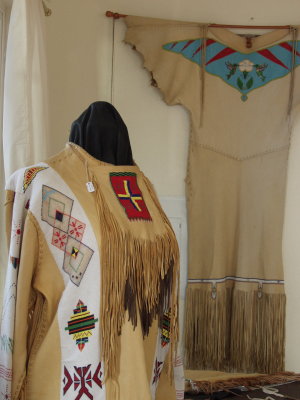
LUCERNE – A unique gathering of local artists now has a home on the lake in Lucerne, where it's hoped their presence will inspire and transform the community.
The Harbor Village Artists' colony is located on Highway 20 next door to Lucerne Harbor Park and overlooking Clear Lake.
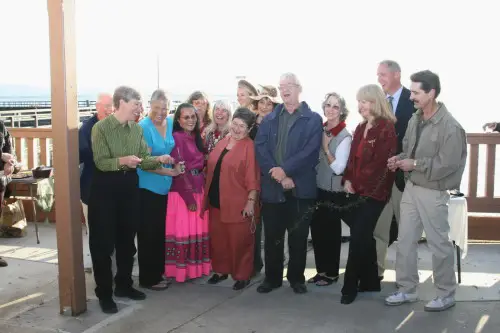
On Friday a ribbon cutting and grand opening celebration honored the new complex. The gathering featured the opportunity for dozens of visitors to browse through the shops, enjoy food and wine, and get to know the people behind the effort.
County Deputy Redevelopment Director Eric Seely told Lake County News that the Lake County Redevelopment Agency purchased the property in January of 2005 for $330,000.
The quarter-acre property has 80 feet of lake frontage. Seely said it originally had five cabins; one was removed and four were restored into artists' shops.
The result is that today Harbor Village Artists' four Alpine-style cottages are inhabited by The Gourd Gallery, Konocti Art Gallery/Studio, Lakeside Art and Pomo Fine Arts Gallery. All of the shops feature affordable and unique handmade items by local artisans and craftspeople.
Linda Kelly, her sister Sandie Coelho-Davis and their partner Marilyn Crayton are the proprietors of The Gourd Gallery, which opened July 2.
Since the shop's opening they've had about 400 visitors, said Kelly.
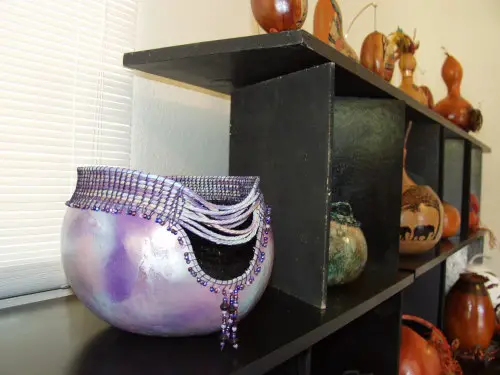
They're receiving positive reactions from people for their unique gourd art; they're also hearing from rom Lucerne residents who are encouraged at having that artists' shops located there.
“It's been very positive,” said Crayton. “We definitely have the support of the community.”
Pomo artist Luwana Quitiquit opened her Pomo Fine Arts Gallery in August. She said Harbor Village has given her the chance to have a gallery space for the first time; previously she has only taken her work to shows.
Quitiquit, who is joined at the studio by her son, two daughters and niece, said she is seeing a lot of interest in her native arts and crafts, which include beadwork, basketweaving, jewelry and other crafts.
She's well-known for her tribal dolls, which she has made for 20 years. Quitiquit makes dolls representing 35 US tribes; actor Kevin Costner even owns some of her dolls, she said.
Her studio includes examples of exquisite beadwork on buckskin shirts and dresses. A shirt takes about a year to complete by hand, she said.
Quitiquit plans to hold workshops on making traditional Pomo basketry. Outside of her show is a planter with a dogbane plant, which – when it matures – can be used to create string that is the basis of the baskets.
A change in vision, direction
The vision behind Harbor Village didn't originally include the arts, said Seely. “The initial concept was to renovate the buildings and operate it as a business incubator.”
He credited Supervisor Denise Rushing, who took office in January of 2007, with the suggestion to consider an artists' colony at the location.
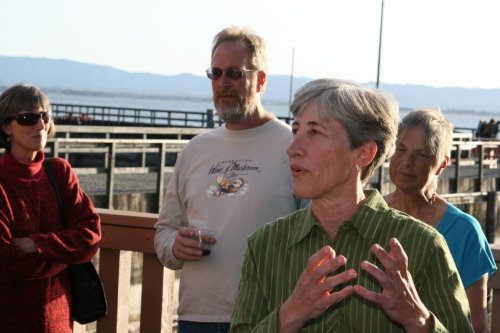
Rushing said at the gathering that the focus changed to an artists' colony after she and county Chief Administrative Officer Kelly Cox happened to attend a Sacramento workshop. There, they heard a talk given by social entrepreneur Bill Strickland, president and chief executive officer of the Manchester Bidwell Group.
Strickland recounted how, as a young man, he was preparing to drop out of school when one day he happened by a ceramics studio and saw an artist making pottery. He stopped and asked the artist, Frank Ross, if he could try it.
“And it transformed his life,” said Rushing.
The theory, she said, is that “art lifts the darkness,” and transforms not just people but communities.
Rushing said the county hopes that the artists' colony can help begin major transformations in Lucerne.
She credited the artists involved in the colony with courage for their willingness to move forward in tough economic times.
Seely said the redevelopment agency was very fortunate to be able to partner with the 20 artists working at the colony, who were giving soul to stone and mortar.
Kenny Parlet, representing both the Lakeport Regional Chamber of Commerce and the Northshore Business Association, credited county officials for their work to build the community and the economy through efforts like the artists' colony, and for using parks and open space to draw visitors.
There's also an effort under way to possibly hold an alpine festival in the town this spring, said Parlet.s
Harbor Village Artists is located at 6197 East Highway 20, adjacent to Lucerne Harbor Park, in Lucerne.
Store hours and contacts are as follows: The Gourd Gallery, 10 a.m. to 4 p.m., Wednesday through Sunday, telephone 274-2346; Konocti Art Gallery/Studio, 10 a.m. to 5 p.m. Wednesday through Sunday, telephone 278-0323; Lakeside Art, 11 a.m. to 4 p.m. Wednesday through Sunday, 274-1393; Pomo Fine Arts Gallery, 2 p.m. to 5 p.m. Wednesday through Friday, and 9 a.m. to 5 p.m. Saturday and Sunday, telephone 349-9588.
Elizabeth Larson at
{mos_sb_discuss:2}
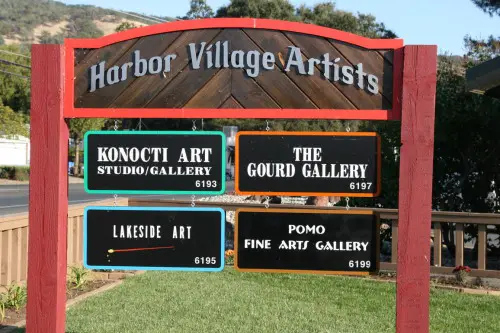
LUCERNE – The new Harbor Village Artists center is a cluster of four charming Alpine-style artist cottages tucked into a park-like setting in the town of Lucerne on the north shore of Clear Lake in Northern California. Each cottage houses a retail art gallery and working art studio featuring works for sale by local and regional artists.
Artist works for sale include original oil, acrylic, and watercolor paintings, Pomo baskets, sculpture, jewelry, original gourd art, gifts and hand-painted tiles.
Gallery shops include The Gourd Gallery, Konocti Art Gallery/Studio, Lakeside Art and Pomo Fine Arts Gallery.
Meet the artists:
Sandie Coelho-Davis
Sandie Coelho-Davis comes from a long line of Lake County pioneer families and, with her husband Jim, moved permanently back to her ancestral roots in 1989.
She was first introduced to gourds about 10 years ago and seriously got involved when a friend started the Bachelor Valley Gourd Club in June 2005. She enjoys the many friendships and creative gourd artists.
Coelho-Davis continues to learn new techniques and understands why the gourd has been in use for centuries. While she uses several gourd art techniques, woodburning has become a favorite.
In July of 2008, she and her gallery partners, Linda Kelly and Marilyn Crayton, opened The Gourd Gallery, the first gallery just for gourds in California. Coelho-Davis sells her work at the gallery and at craft fairs and gourd festivals.
Marilyn Crayton
Marilyn Crayton was born, raised, and employed in San Francisco before retiring to Lake County in 1998.
A guest speaker at a local garden club meeting first introduced her to gourds in 2000. Several years later, she began working with a few gourds that she had previously purchased. While she has never had any formal art classes, Crayton has taken a handful of one-day classes at gourd festivals, and in June 2005 she started a local gourd club that meets monthly.
Today, Crayton grows many of her own gourds on her ranch in Witter Springs. These gourds come in many shapes and sizes. At the end of the growing season, the gourds are picked and set out to dry slowly. When fully dry, the gourds are cleaned and decorated.
Virtually any technique that can be used on wood or leather can be applied to a gourd, including burning, dyeing, carving, staining, painting, sewing, etc. The choices seem to be limitless.
Crayton sells her gourds at local shops, The Gourd Gallery in Lucerne, and at several craft fairs.
Joan Facca
Joan Facca was born and raised in Redwood City and raised her family in Fremont. Facca spent many childhood summers at Clear Lake and moved to Lake County with her husband in 1985. Her love of art began at a very early age.
Mostly self-taught, Joan began painting with oils and moved to pastels, the medium she finds most rewarding. Her pastel landscapes reflect her love and respect for the natural world and the exceptional beauty of Clear Lake.
Ray Farrow
Ray Farrow was born in England and educated in England, Canada, and the United States. He developed his passion for painting after a successful career in the international resort industry.
Farrow is self-taught with the help of workshops, videos, books and through his association with other artists who, like himself, continue to hone their skills by painting daily.
He enjoys exhibiting his work where he learns from the comments and feedback of viewers and other artists. Farrow also is co-owner of Konocti Art Gallery/Studio in the artist colony Harbor Village Artists.
Meredith Gambrel
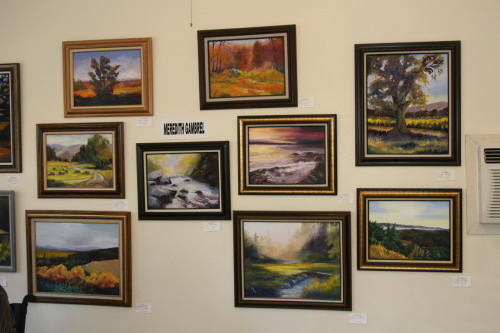
Meredith Gambrel considers her painting a hobby gone awry. She began painting and drawing at a very young age, studied at various art schools and colleges, and also studied under numerous well-known artists. Gambrel’s love of nature is the theme of most of her paintings.
While she has worked in most media, at the present time, her paintings are rendered in oil. Her love is to create beautiful paintings for all to enjoy.
Carolyn Hawley
Carolyn Hawley, former college music instructor and conductor of the Ukiah Symphony, is by profession a classical musician but has been painting since she moved to Mendocino and Lake counties in 1970. She is self-taught and has shown her work in numerous solo and group art shows,
locally and in the Bay Area.
Hawley has won many ribbons and prizes for her art, which critics have dubbed "magic realism." She paints landscapes, seascapes, skyscapes, people and animals and is inspired to capture the true "essence" of her subjects. She sells her paintings, prints, and gift cards in galleries and also by commission.
Lynn Hughes
Lynn Hughes is a Californian through and through. She was born and raised in San Francisco, and her great-grandparents were Lake County settlers.
Hughes was a stay-at-home mom with three children and returned to finish her college education at the age of 40. After working in San Francisco for 12 years, she retired in 1998 to a 16-acre horse ranch in
Bachelor Valley.
A combination of time and circumstance enabled Hughes to explore a new creative avenue, jewelry making, an adventure that has been filled with supportive friends, inspiring teachers, books and magazines, as well as joyful hours seeking just the right “ingredients” to make something beautiful.
This spring, Hughes was published in a national magazine with another piece of jewelry to be featured in Beadunique in spring 2009. She creates jewelry for pleasure.
While she finds it gratifying to receive compliments about her jewelry, she finds the biggest compliment in having a piece of her jewelry sell.
Linda Kelly
Linda Kelly had always wished to move to Lake County, and 10 years ago that wish came true when she moved from San Jose. She loves Lake County, its beauty and how friendly the people are. Her daughter and son, grandchildren, and even a great-grandchild live in San Jose.
Kelly has always enjoyed crafts and also enjoys gardening. Once, she was given a few gourd plants that she planted and watched as they grew to cover a 30-foot fence with a beautiful vine and about 26 huge gourds. At the time, she had no idea what to do with them, so she stored them in the garage.
Upon moving to Lake County, she met a group of gourd artists who happily took the gourds and created a form of art that, until then, Kelly had never seen.
Then three years ago, Kelly, along with her sister, Sandie Coelho-Davis, and fellow gourd artist Marilyn Crayton formed the Bachelor Valley Gourd Club, which now has grown to 22 members. Together, they recently opened The Gourd Gallery.
Kelly also shows beautiful, artistic gourds at craft fairs and gourd festivals and in local shops.
Barbara LeVasseur
Barbara LeVasseur has been self-employed for 27 years, painting on ceramic tiles with her own glazes for homes and businesses. She has produced custom tile gifts for Williams-Sonoma, Sur la Table and Gardener’s Eden catalogs, as well as custom corporate gift tiles for the Heinz Corp. for the last 11 years. She is the owner of Frozen in Fire Tile.
LeVasseur has studied privately with teachers for graphics, photography and painting over the years and has a fine arts degree from the Rochester Institute of Technology School of Art and Design. Her painting media are oil, gouache and ceramic glaze.
While serving on the Board of Directors of the Lake County Land Trust, LeVasseur began the Art and Nature Show at Rodman Preserve, an annual fundraiser and public outreach event that she has chaired for the last six years. She is a member of Lakeside Art, the Konocti Art Society and the Konocti Plein Air Painters.
Diana Liebe
Diana Liebe is a lifelong artist, winning her first competition at the age of 8. She holds a bachelor’s degree in fine art and education. Her experience in arts and crafts is varied, and she has been working in watercolors and hand-painted clothing for the past 10 years.
Liebe keeps involved with the Lake County communities through several art groups including the Lake County Arts Council, Main Street Gallery, the Konocti Arts Society and the Plein Air Painters. She enjoys meeting new friends and staying active in the community.
Carolyn Morris
Carolyn Morris is a 30-year resident of Lake County. She and her husband are longtime business owners of a local video store and currently live in Buckingham Estates, where she enjoys painting garden scenes. She has two grown children who reside in the Petaluma area.
Morris is a self-taught artist who has painted for many years on the side. Her favorite medium is that of oil painting and her goal is to spend more time painting and make a career out of what she loves. She enjoys painting local scenes and the vast opportunities that life in Lake County has offered for beautiful scenery and festive events to feature in her artwork.
Patricia Oates
Patricia Oates is a native of Marin County, and upon moving to Lake County 25 years ago, found a love of Mt. Konocti, much as she had loved Mt. Tamalpais in Marin.
When Oates started painting in earnest, she painted only Mt. Konocti for several years but has since painted other subjects. She is always trying new ideas, new techniques and new palettes. Her teachers have been Lorraine Brady Hull, Sandra Powell, Pat Hopper and Jack Balance, and she has attended workshops with Hope Stevenson, Armand Cabrera, and Adele Pruitt. Her main interest is, and
probably always will be, the landscape.
Oates and her husband Jarth owned and operated a local dry-cleaning business for 19 years and were active in the Lakeport Regional Chamber of Commerce; she also was on the board of the Lakeport Main Street Association. Since selling the cleaners two years ago, Oates has devoted much of her time to her artwork and art events in the county.
She belongs to the Konocti Plein Air Painters, the Konocti Art Society and the Lake County Arts Council. She is pleased to be a part of Lakeside Art and the Harbor Village Artists.
Richard Seisser
Richard Seisser finds real joy in painting with pastels, saying it has opened a window into another world, so vast, and more beautiful than any world he could imagine. He loves to paint the places he visits in nature with all its beauty and mystery and tries to visualize what is there and capture the unusual on paper.
After graduating from art school in 1955, Seisser spent his early years sketching, drawing with pen and ink, and painting with watercolors and acrylics. He recently began working with pastels and has discovered that his years of sketching and drawing gave him the advantage needed to discover the soft vagueness of pastels, the distinctive line of pastel pencil and the brilliant contrast of rich pastel colors.
Seisser became an avid reader and studied the works of master pastel artist Elizabeth Mowery. He credits patterning much of his style of pastel painting after her work.
He and his wife Mary married in 1961 and set about a life together to raise two daughters. After many years in industry, he retired and came to California determined to become an artist, a good artist. He
says he’s still working at it.
Jackie Smythe
Jackie Smythe has been painting for several years. She has taken classes at Mendocino College. Her art includes painting in oil and watercolor, and drawing in pencil, charcoal, and ink. She enjoys painting still life, peaceful landscapes, portraits and photography.
Ruth Wagner Morgan
Ruth Wagner Morgan was born in Detroit in 1950 and grew up in the suburbs. She studied painting and printmaking at Eastern Michigan University and graduated with a Bachelor of Fine Arts in 1972. She moved to California in 1975, where she worked as a draftsperson in engineering offices and painted whenever she could.
She met and married artist and tile contractor Jackson Morgan in 1988 and lives in Jerusalem Valley with her family and an assortment of tame and wild creatures. She has shown and sold paintings at the Jessel Miller Gallery in Napa for the past 20 years.
Luwana Quitiquit
Luwana Quitiquit has been weaving traditional Pomo baskets for more than 30 years. She became interested in basketweaving as a student at the University of California at Berkeley and traveled many miles to study with renowned Pomo basketweaver Mabel McKay. As a student who also was raising a family, it was difficult for her to find time for weaving, but she was determined to learn.
When Quitiquit retired and finished raising her family, she decided to dedicate her life to teaching basketry. She also has started a native nursery where she cultivates the plants needed for weaving because these materials have become scarce in the region. She also uses only indigenous materials, including handmade dogbane cordage and twine, in place of the usual commercial cotton cord or fish line.
One of Quitquit's goals is to train her students to be instructors so they can then carry on the basketweaving tradition. In fact,she has taught representatives from the seven Lake County Pomo tribes traditional basketweaving techniques. She also now operates a retail gallery studio, called the Pomo Fine Arts Gallery at the Harbor Village Artists center.
Harbor Village Artists is located at 6197 East Highway 20, adjacent to Lucerne Harbor Park, in Lucerne. For information about Harbor Village Artists, call 707-274-2346.
{mos_sb_discuss:2}
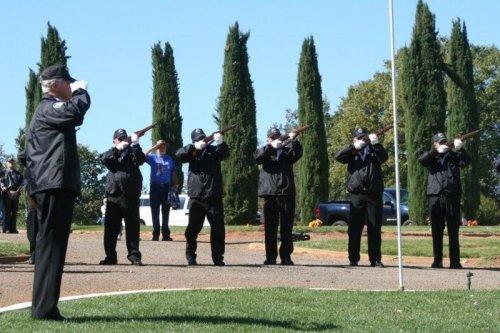
LAKEPORT – Two local veterans were honored in a special ceremony Saturday that drew dozens of people from throughout Northern California and the county.
Although the event may have appeared, at first glance, to simply be another veterans' funeral, it had a special significance, since both the men had no relatives and, in the case of one of them, his remains had gone unclaimed and unburied since his death five years ago.
Lawrence John Quinn died Sept. 11 at age 79; Robert Kincaid died on June 10, 2003, at age 76. Both men served in the Navy and died, for the most part, without family or friends to take care of them.
They received a military funeral on Saturday at Veterans Circle, located at Hartley Cemetery.
Approximately 55 motorcycles ridden by members of the Patriot Guard Riders escorted the cremains of the two men to the cemetery.
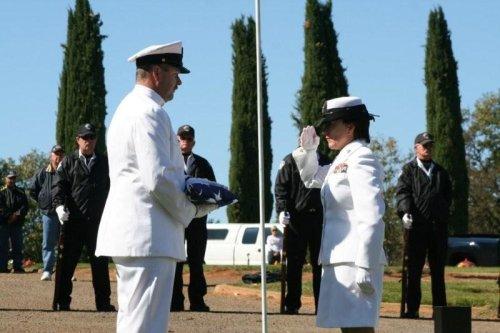
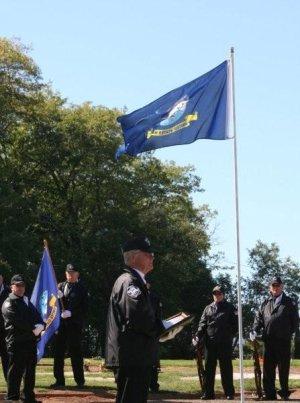
Two Naval officers, dressed in stark white uniforms, carried the small boxes of cremains to the center of Veterans Circle, setting them on two small benches next to U.S. flags folded into careful, star-studded blue triangles. A bagpiper and a bugler played the men to their rest, and the United Veterans Council Military Honors Team fired a salute.
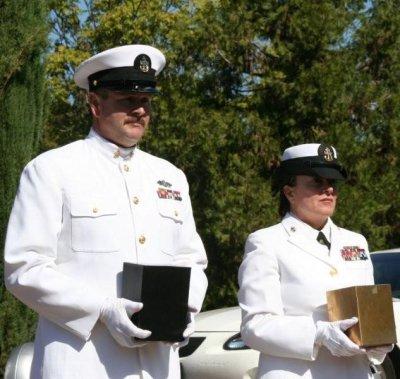
Capt. Herman “Woody” Hughes, a retired US Naval Reserve officer and chaplain for the United Veterans Council, said Quinn and Kincaid died alone and with few friends.
Hughes said it was important to remember them and their sacrifice, and quoted English poet John Dunne's words, “No man is an island, entire of itself, every man is a piece of the continent ... any man's death diminishes me, because I am involved in mankind ...”
As veterans, the two men were part of the World War II and Korean War conflicts, according to their records.
“There are no unimportant jobs in the armed forces,” said Hughes. “There are no unimportant people in the armed forces.”
Dean Gotham, president of the Vietnam Veterans of America Chapter 951, accepted Quinn's flag from the Navy representatives, while Slick Hultquist of Lakeport, a Patriot Guard Rider member who also is involved with the Missing in America Project, accepted Kincaid's flag.
Relatively little is known about Quinn and Kincaid. The United Veterans Council was able to acquire basic information on Kincaid, who was born July 23, 1927, and served as an apprentice seaman in the Navy from 1945 to 1946 during World War II.

Slightly more is known about Quinn, whose discharge records was obtained by the United Veterans Council. Quinn, who was originally from Syracuse, New York, was born Feb. 2, 1929 and died this past Sept. 11.
Record show Quinn served in the Navy from January of 1953 to January of 1956. For his service he earned a Korea Service Ribbon, United Nations Service Ribbon, Navy Occupation Service Medal with a European clasp, China Service Medal, National Defense Service Medal and an American Area Campaign Medal.
He also received a World War II Victory Medal, which was given to any member of the armed forces who was on active or reserve duty from Dec. 7, 1941 to Dec. 31, 1946. Local vets suggested he may have had previous service during World War II that didn't show on the last discharge records.
Both Kincaid and Quinn were discharged honorably, according to military records.
Missing in America Project works on behalf of forgotten veterans
Playing an important part in Saturday's burial was the Missing in America Project (MIAP), a group whose mission is to locate, identify and inter the unclaimed cremated remains of veterans. Lake County News profiled the group in a May 2007 article, Missing in America Project searches for forgotten veterans.
MIAP, which incorporated in February of 2007, has a massive task ahead of it, considering the untold thousands of veterans – some of them having served in wars across a timespan that stretches into the 19th century – believed to be unburied and sitting on storage shelves in mortuaries, hospitals and institutions around the nation.
In many cases, the veterans have no living family or friends, and so they're left in the care of funeral homes. After a waiting period, the funeral homes must then decide what to do with the remains.
Oregon resident Fred “Ducpho” Salanti, executive director of MIAP's veterans recovery program and a Vietnam veteran, attended Saturday's ceremony.
Since May of 2007, when Lake County News first reported the group's efforts, significant progress has been made, said Salanti.
So far, MIAP has succeeded in retrieving and interring the cremains of 346 veterans – including Kincaid – which had been in storage and unclaimed by next of kin, said Salanti.
They've located another 6,300 stored cremains, of which between 10 and 30 percent are expected to be veterans. Salanti said they've also visited 620 funeral homes to inquire about helping inter unclaimed cremains.
Congresswoman Carolyn B. Maloney (D-NY) is drafting a bill that Salanti expects to be introduced in the 111th Congress next year; he said the legislation will assist in setting time limits that cremains can be held before being interred.
“We finally have some national sponsorship,” said Salanti.
Seven states – not including California – are working to have those time limits reduced before turning over information either to the Department of Defense or the MIAP, which can then verify if an individual is a veteran. That will then allow open the way to arranging for interment.
Kincaid is the first Lake County veteran whose cremains were interred through the efforts of MIAP working with local funeral homes. Hultquist is working with mortuaries in Lake and Mendocino counties to continue the process of interring lost vets.
For more information about the MIAP's local or national effort, contact Hultquist at 263-8105, Salanti at
E-mail Elizabeth Larson at
{mos_sb_discuss:2}