 How to resolve AdBlock issue?
News
Boaz Joshua Pak, 20, and Simon Chulmin Son, 19, both of Hidden Valley Lake; Luke Kotaro Nishikawa, 22, of Honolulu, Hawaii; and Chong Whon Shin, 20, of Aloha, Ore., were killed in a crash that occurred on Deer Park Road east of the Silverado Trail in Napa County at about 11:45 p.m. Saturday, Nov. 15, according to the California Highway Patrol's Napa office.
"The PUC community mourns the loss of four wonderful young men who were already giving service back to the community," said College President Richard Osborn in a statement released Sunday. "Our entire campus is grieving along with their families. But as a faith-based college, we have hope that springs from our beliefs as we celebrate all these young men accomplished in their brief lives."
CHP Officer Jaret Paulson said that while it's early in the investigation, investigators believe speed was a factor.
The college reported Sunday that the students had just finished playing basketball at the college gym and were on their way to Safeway in St. Helena to get something to eat when the crash took place.
Pak was driving a 2003 Honda Civic westbound on Deer Park Road when the crash occurred on one of the last curves heading down toward Silverado Trail, according to Paulson.
“It appears the vehicle lost control and actually slid sideways into opposing traffic,” Paulson said.
Pak's Honda collided broadside in the eastbound lane with a 1993 Toyota pickup driven by 28-year-old Sandalio Martinez of Angwin.
Carlos Rio Ortiz, 20, also of Angwin, was traveling eastbound in a 1993 Honda Civic behind Martinez. Following the first collision, Ortiz hit the back of Martinez's pickup.
The four students were declared dead at the scene, according to the CHP.
Martinez sustained major injuries and was transported to Santa Rosa Memorial Hospital for treatment, the CHP reported.
Ortiz, who suffered minor injuries, was booked into the Napa County Jail on suspicion of driving under the influence, Paulson reported.
Paulson added that the CHP also is investigating the possibility that Martinez may have been driving under the influence.
The students, he added, did not appear to have been drinking.
Three of the men were wearing their seat belts, while Shin was not, according to the CHP.
Paulson said the CHP is not saying driving under the influence caused the crash, “but DUI was there.”
Pak's vehicle suffered “significant” damage, said Paulson. It took emergency personnel a few hours to remove the young mens' bodies from the vehicle.
The investigation, evidence collection and scene measurements and cleanup took a long time, said Paulson. “We were there a good nine hours.”
While CHP was processing the scene, Deer Park Road was closed and Sanitarium Road was used as a detour around the collision scene.
“It's a tragedy, it's a huge loss to our community,” said Paulson. “It's a great reminder to everyone to slow down and buckle up their seat belts.”
On Sunday, Pacific Union College – the Angwin-based liberal arts college of 1,400 students that is affiliated with the Seventh-day Adventist Church – held a prayer meeting in honor of the four young men, with counselors and pastors available to students afterward.
Pak, Son, Shin and Nishikawa “were well known and liked on campus,” the college reported.
The college said that Pak was a biology and pre-pharmacy major, while Nishikawa was studying American history. Shin was involved in youth ministry at the Rohnert Park Korean Seventh-day Adventist Church and studied business administration and pre-dentistry.
Son was involved in a campus outreach program called Homeless Ministries, according to the college statement. On Saturday morning, students said that Son had gone to the Bay Area with a group of students to feed the homeless. He was majoring in nursing.
The college reported that grief counselors, residence hall deans, and the campus chaplain began working with students during Saturday night as news of an accident involving fellow students spread around campus. On Sunday, the college offered support groups and one-on-one counseling for the campus community.
The college's Web site is offering a message board at www.puc.edu/news/memorial for students, friends and family to post their tributes to the students.
Messages have been coming in from around the country and around the world in memory of the young men, with one poster sending condolences from the United Kingdom.
On Thursday at 10 a.m., Pacific Union College will hold a memorial service for the young men during their weekly colloquy in the college church.
E-mail Elizabeth Larson at
{mos_sb_discuss:2}
Five engines – one each from Lake County Fire Protection, Kelseyville Fire, Northshore Fire, Anderson Valley and Hopland – left on Sunday, said Lake County Fire Protection Battalion Chief Willie Sapeta.
The group included three firefighters per engine, said Sapeta.
Chief Jim Robbins of Northshore Fire said his district sent two battalion chiefs, Jamie Crabtree and Pat Brown, to serve as strike team leaders.
Capt. Dave Bosserman of Kelseyville Fire said their three firefighters got the call to go at 3:30 a.m. Sunday. They took with them a type-three fire engine, which he described as a four-wheel-drive truck with a pump system on it, which is good for wildland firefighting.
Sapeta said his firefighters pulled out at 7:15 a.m. Sunday.
The firefighters got to their destination in Southern California last night at about 10 p.m., said Robbins.
Robbins said they were assigned to the nearly 29,000-acre Freeway Complex, which Cal Fire reports includes the Freeway and Landfill fires. Nearly 3,700 firefighters are currently assigned to that complex.
The fires started in Riverside County and are now burning through rugged terrain in Orange County. Cal Fire says the complex is 40-percent contained.
The local strike team was assigned to a 24-hour rotation to work the fires, said Robbins. Sapeta added that the firefighters were due to be on the fireline first thing Monday.
“They were going with five other strike teams to the head of the fire,” said Robbins. “They know the Lake County boys can put the fire out.”
He spoke with firefighters Monday morning after their briefing. Brown told him about the eerie experience of driving down Highway 71, the Chino Valley Freeway, and finding its eight lanes barricaded and empty of all but fire traffic.
Over the weekend Gov. Arnold Schwarzenegger proclaimed a state of emergency in Orange, Riverside and Los Angeles counties due to a devastating series of wildland fires that have hit the area beginning Nov. 14. Santa Ana winds have assisted in fueling and moving the fires, according to officials.
A day earlier, Santa Barbara County was hit with the Tea Fire, now at 95-percent containment, with an estimated 210 homes destroyed, Cal Fire reported.
Sapeta said they have no idea how long the local firefighters will be needed in Southern California, although they have a seven-day minimum and 14-day maximum commitment period, after which they'll be switched out if more help is needed.
Local firefighters have ventured out of the county to offer assistance on fires in other regions several times this year, said Sapeta.
In May, a strike team was sent to the Summit Fire burning in the Santa Cruz Mountains, then the Humboldt Fire in Butte County and the Mendocino Lightning Complex in June, and to Santa Clara County in July. Local fire districts sent nine ambulances to Colusa County in October when a bus crash occurred, killing several people.
Lake County has received its fair share of help this year. Cal Fire, the US Forest Services and fire agencies from around the state converged in Lake County in June to fight the 14,500 Walker Fire east of Clearlake Oaks and the 8,652-acre Soda Complex burned from June to July in the Mendocino National Forest.
While it was very busy in the beginning of the fire season, until recently it had quieted down, said Sapeta.
Sapeta said there have been some years where local strike teams have been called out during the winter months of January and February in response to Southern California wildfires fueled by those devastating Santa Ana winds, which can make a fire deadly at any time of year.
E-mail Elizabeth Larson at
{mos_sb_discuss:2}
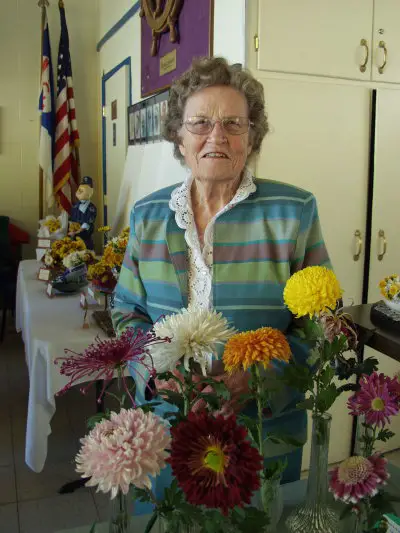
LAKEPORT, Calif. – The chrysanthemum – it's the flower of November, and is beloved in China and Japan. {sidebar id=105}
The beautiful fall flower with dozens of variations and colors was featured at a special show in Lakeport Friday afternoon.
The Dance of the Mums flower show, hosted by the Clear Lake Trowel and Trellis Club at the Lakeport Yacht Club, gave mum enthusiasts their first chance in several years to concentrate on the special flower, said club member Jo Jameson.
Another club member, June Beto, said the show – which also featured one of the biggest and tastiest selections of homemade goodies around – had many visitors, which may lead to future shows.
Lakeport resident and club Carol Kesey is considered by many to be the local expert on chrysanthemums.

Kesey, who will be 91 in December, started growing chrysanthemums in the 1950s, when she moved to her home on Ninth and High streets. She still lives there, with a yard that's a veritable flower showcase.
“I just love them all,” Kesey said of flowers.
Mums generally are in season September through November, said Kesey. That means the flowers arrive in time for the Lake County Fair, where Kesey has won many show ribbons. But she hasn't been of a mind to brave the late summer heat to show her flowers at the California State Fair in Sacramento.
Jameson said Kesey has encouraged other club members to enter their flowers in the fair. She added that Kesey also is incredibly generous, and shares her flower starts with anyone who drops by and asks for some.
Kesey, who comes from a family of people with “green thumbs and muddy hands,” said growing chrysanthemums is addictive. “You just can't stop.”
Mums also have taken over her yard, forcing her to grow vegetables in pots rather than the ground.
Getting the big, lush flowers requires a lot of work, including a process called “disbudding,” which Kesey said involves breaking the flowers down a few times.
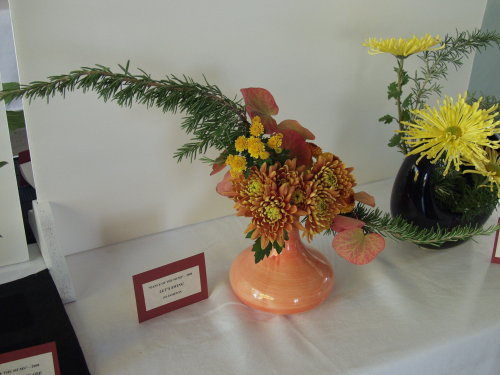
Many of the chrysanthemums at the show were grown by Kesey, with numerous arrangements crafted by her friend, Shirley Estrem. Not one to play favorites, Kesey said she couldn't pick any one in particular that she liked the best.
Each day Kesey spends three to four hours outside working in her garden. Kesey, who could easily pass for about 20 years younger than her 90 years, credits her garden and working in it for her youthful outlook and good health.
Growing mums, like life, take some time to get right, according to Kesey, who has a sparkling wit.
“In about 50 years you usually get it all figured out,” she said.
E-mail Elizabeth Larson at [email protected].




{mos_sb_discuss:2}
“We have to adapt the way we work and plan in order to manage the impacts and challenges that California and our entire planet face from climate change,” Governor Schwarzenegger said in a written statement. “Given the serious threat of sea level rise to California’s water supply, population and our economy, it’s critically important that we make sure the state is prepared when heavy rains cause flooding and the potential for sea level rise increases in future years.”
There are four key actions in the executive order including:
Initiate California’s first statewide climate change adaptation strategy that will assess the state’s expected climate change impacts, identify where California is most vulnerable and recommend climate adaptation policies by early 2009;
Request the National Academy of Science establish an expert panel to report on sea level rise impacts in California to inform state planning and development efforts;
Issue interim guidance to state agencies for how to plan for sea level rise in designated coastal and floodplain areas for new projects; and
Initiate a report on critical existing and planned infrastructure projects vulnerable to sea level rise.
One key benefit that the executive order will facilitate is California’s first comprehensive climate adaptation strategy. This effort will improve coordination within state government and adapt the way work so that better planning can more effectively address climate impacts to human health, the environment, the state’s water supply and the economy.
The order also provides consistency and clarity to state agencies on how to address sea level rise in current planning efforts, reducing time and resources unnecessarily spent on developing different policies using different scientific information.
The executive order and its actions carry on the governor’s environmental leadership by continuing to address climate change adaptation in coordination with our climate change mitigation policies as outlined in AB 32. The states of Washington and Oregon, as well as Canada and Mexico, along with several global institutions have expressed interest in coordinating our climate change adaptation policies as outlined in this order.
California’s Energy Commission, the California Ocean Protection Council and Caltrans are conducting numerous scientific studies on the impact of climate change, including new sea level rise impact projections that are being used to develop the state’s climate change adaptation strategy.
Full text of executive order:
EXECUTIVE ORDER S-13-08
by the Governor of the State of California
WHEREAS climate change in California during the next century is expected to shift precipitation patterns, accelerate sea level rise and increase temperatures, thereby posing a serious threat to California’s economy, to the health and welfare of its population and to its natural resources; and
WHEREAS California is a leader in mitigating and reducing its greenhouse gas emissions with the 2006 Global Warming Solutions Act (Assembly Bill 32), the Low Carbon Fuel Standard (Executive Order S-01-07), the 2008 Senate Bill 375 and the Renewable Portfolio Standard; and
WHEREAS these efforts, coupled with others around the world, will slow, but not stop all long-term climate impacts to California; and
WHEREAS California must begin now to adapt and build our resiliency to coming climate changes through a thoughtful and sensible approach with local, regional, state and federal government using the best available science; and
WHEREAS there is a need for statewide consistency in planning for sea level rise; and
WHEREAS California’s water supply and coastal resources, including valuable natural habitat areas, are particularly vulnerable to sea level rise over the next century and could suffer devastating consequences if adaptive measures are not taken; and
WHEREAS the country’s longest continuously operating gauge of sea level, at Fort Point in San Francisco Bay, recorded a seven-inch rise in sea level over the 20th century thereby demonstrating the vulnerability of infrastructure and resources within the Bay; and
WHEREAS global sea level rise for the next century is projected to rise faster than historical levels with the Intergovernmental Panel on Climate Change predicting that global sea levels will rise by between seven to 23 inches this century and some experts predicting even higher rises; and
WHEREAS while climate models predicting global sea level rise are generally understood and improving, less information is available for sea level rise projections specific to California that accounts for California’s topography, coastal erosion rates, varying land subsidence levels and tidal variations; and
WHEREAS billions of dollars in state funding for infrastructure and resource management projects are currently being encumbered in areas that are potentially vulnerable to future sea level rise; and
WHEREAS safety, maintenance and operational efforts on existing infrastructure projects are critical to public safety and the economy of the state; and
WHEREAS the longer that California delays planning and adapting to sea level rise the more expensive and difficult adaptation will be; and
WHEREAS the California Resources Agency is a member of the California Climate Action Team and is leading efforts to develop and implement policy solutions related to climate change adaptation regarding current and projected effects of climate change; and
WHEREAS the Department of Water Resources (DWR) is responsible for managing the state’s water resources to benefit the people of California, and to protect, restore and enhance the natural and human environments; and
WHEREAS California’s coastal management agencies such as the California Coastal Commission, the California Ocean Protection Council (OPC) and California State Parks are charged with managing and protecting the ocean and coastal resources of the state; and
WHEREAS the California Energy Commission’s (CEC) Public Interest Energy Research Program has funded research on climate change since 2001 including funding the development of preliminary sea level rise projections for the San Francisco Bay area by the Scripps Institution of Oceanography/University of California at San Diego.
NOW, THEREFORE, I, ARNOLD SCHWARZENEGGER, Governor of the State of California, by virtue of the power vested in me by the Constitution and statutes of the State of California, do hereby order effective immediately:
1. The California Resources Agency, in cooperation with DWR, CEC, California’s coastal management agencies, and the OPC, shall request that the National Academy of Sciences (NAS) convene an independent panel to complete the first California Sea Level Rise Assessment Report and initiate, within 60 days after the signing of this Order, an independent sea level rise science and policy committee made up of state, national and international experts.
2. By March 31, 2009, the OPC, DWR and the CEC, in coordination with other state agencies, shall hold a public workshop to gather policy-relevant information specific to California for use in preparing the Sea Level Rise Assessment Report and to raise state awareness of sea level rise impacts.
3. The California Resources Agency shall request that the final Sea Level Rise Assessment Report be completed as soon as possible but no later than December 1, 2010. The final Sea Level Rise Assessment Report will advise how California should plan for future sea level rise. The report should include: (1) relative sea level rise projections specific to California, taking into account issues such as coastal erosion rates, tidal impacts, El Niño and La Niña events, storm surge and land subsidence rates; (2) the range of uncertainty in selected sea level rise projections; (3) a synthesis of existing information on projected sea level rise impacts to state infrastructure (such as roads, public facilities and beaches), natural areas, and coastal and marine ecosystems; and (4) a discussion of future research needs regarding sea level rise for California.
4. The OPC shall work with DWR, the CEC, California’s coastal management agencies and the State Water Resources Control Board to conduct a review of the NAS assessment every two years or as necessary.
5. I direct that, prior to release of the final Sea Level Rise Assessment Report from the NAS, all state agencies within my administration that are planning construction projects in areas vulnerable to future sea level rise shall, for the purposes of planning, consider a range of sea level rise scenarios for the years 2050 and 2100 in order to assess project vulnerability and, to the extent feasible, reduce expected risks and increase resiliency to sea level rise. However, all projects that have filed a Notice of Preparation, and/or are programmed for construction funding the next five years, or are routine maintenance projects as of the date of this Order may, but are not required to, account for these planning guidelines. Sea level rise estimates should also be used in conjunction with appropriate local information regarding local uplift and subsidence, coastal erosion rates, predicted higher high water levels, storm surge and storm wave data.
6. The Business, Transportation, and Housing Agency shall work with the California Resources Agency and the Governor’s Office of Planning and Research (OPR) to prepare a report within 90 days of release of this Order to assess vulnerability of transportation systems to sea level rise that will include provisions for investment critical to safety, maintenance and operational improvements of the system and economy of the state.
7. By June 30, 2009, the California Resources Agency, through the Climate Action Team, shall coordinate with local, regional, state and federal public and private entities to develop a state Climate Adaptation Strategy. The strategy will summarize the best known science on climate change impacts to California (led by CEC’s PIER program), assess California’s vulnerability to the identified impacts and then outline solutions that can be implemented within and across state agencies to promote resiliency. A water adaptation strategy will be coordinated by DWR with input from the State Water Resources Control Board, an ocean and coastal resources adaptation strategy will be coordinated by the OPC, an infrastructure adaptation strategy will be coordinated by the California Department of Transportation, a biodiversity adaptation strategy will be jointly coordinated by the California Department of Fish and Game and California State Parks, a working landscapes adaptation strategy will be jointly coordinated by the California Department of Forestry and Fire Protection and the California Department of Food and Agriculture, and a public health adaptation strategy will be jointly coordinated by the California Department of Public Health and the California Air Resources Board, all as part of the larger strategy. This strategy will be facilitated through the Climate Action Team and will be coordinated with California's climate change mitigation efforts.
8. By May 30, 2009, OPR, in cooperation with the California Resources Agency, shall provide state land-use planning guidance related to sea level rise and other climate change impacts.
This Order is not intended to, and does not, create any rights or benefits, substantive or procedural, enforceable at law or in equity, against the State of California, its agencies, departments, entities, officers, employees, or any other person.
I FURTHER DIRECT that as soon as hereafter possible, this Order shall be filed with the Office of the Secretary of State and that widespread publicity and notice be given to this Order.
IN WITNESS WHEREOF I have hereunto set my hand and caused the Great Seal of the State of California to be affixed this 14th day of November 2008.
________________________________
Arnold Schwarzenegger
Governor of California
ATTEST:
________________________________
Debra Bowen
Secretary of State
{mos_sb_discuss:3}
The California Department of Transportation suggests drivers follow the following tips for driving in deer country.
Be particularly attentive between sunset and midnight, during the hours shortly before and after sunrise, and in foggy conditions. Most deer-vehicle collisions occur during those times.
Drive carefully in areas known to have high deer populations. Places where roads divide agricultural fields or streams from forestland are particularly dangerous.
If you see a deer, slow down. Others are probably nearby.
Use high-beam headlights when there is no oncoming traffic. The high beams can reflect off their eyes and warn you of their presence.
If a deer is in your lane, brake firmly but stay in the lane. The most serious crashes occur when drivers swerve.
Don't rely on deer whistles, deer fences, or reflectors to deter deer.
Wear seat belts.
If your car strikes a deer, don't touch the animal. If the deer is blocking the highway, call 911.
These tips are used with permission from the National Park Service.
{mos_sb_discuss:2}
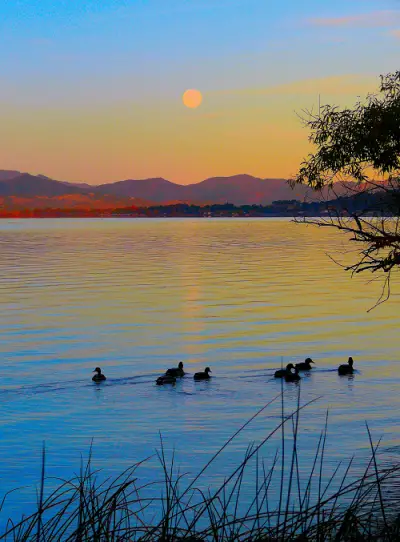
Photographer Ron Keas of Lucerne captured the full moon setting at 7 a.m. on Thursday. The shot was taken from Lucerne.