How to resolve AdBlock issue?
News
The association’s 2009 State of the Air report, released this week, gave Lake County an “A” rating.
The report ranked Lake County as having the lowest small-particulate concentrations in California and third-lowest airborne small-particulate concentrations in the entire United States. Nationally, Lake County was right behind Gallatin, Mont., and Laramie, Wyo., which tied for best air. Last year the county was ranked No. 9.
It’s the best ranking the county has received since the American Lung Association began doing the reports several years ago, according to , said county Air Pollution Control Officer Doug Gearhart.
Lake was the only California county to rank in the top 10 cleanest counties in the United States for particulate matter, and was one of only 12 counties that did not have any days of ozone air pollution levels in the unhealthful range, Gearhart said. Among the top 25, the only other California counties to be ranked were Mendocino, Inyo and Nevada.
The report looked at the years 2005, 2006 and 2007, said Gearhart. During those three years, zone and small particles in the air never exceeded allowable levels.
Information on 2008, which saw Lake County skies clouded by thick smoke from wildland fires, wasn’t included, he added.
“We’re in our 20th year of clean air attainment in Lake County,” said Gearhart.
He credited the program’s success to strong community support and cooperation of local agencies, the local fire protection districts, Cal Fire, the local agricultural community and industry.
That community support, Gearhart added, has enabled the county to comply in full with Federal Clean Air Standards and the more rigorous California standards for ozone and other air pollutants for the past 20 years.
The clean air rankings have become controversial in recent years, with some area residents saying that they don’t believe the county’s high air quality rankings are representative of the true state of the air.
Gearhart explained that the county has three separate particulate monitoring stations in the county – in Lakeport, the Glenbrook/Cobb area and Anderson Springs – but is only required to have one.
Over the years, the county has established a burn ban beginning on May 1 and running through the fall, which is credited as another way of keeping the local air clean.
Gearhart said illegal burning still happens, but it’s becoming less frequent, with only about 2 percent of the local population being found illegally burning. He said educating people about burning rules, and making sure they understanding that the rules are there to protect them and their neighbors, has helped reduce the activity.
“The biggest challenge that we typically have is keeping people educated,” said Gearhart. “A lot of people don’t remember what it took to get here.”
Lake’s air basin gets help from coastal breezes, which can push out smoke and other particulate, but Gearhart doesn’t think that factor is a major one in determining local air quality. He pointed to Mendocino and Sonoma counties, which are on the coast but whose air quality isn’t as good as Lake County’s.
The Lake County Air Quality Management District, which has four full-time staffers and several part-timers, monitors air quality year-round, said Gearhart.
The majority of the district’s funding coming from permits – especially industry such as geothermal and gas stations. Gearhart said the district also receives funding from the state to enforce state air toxic control measures with a small amount of funding from the Environmental Protection Agency for specific monitoring.
“Our resources are fine,” he said. “We’re not feeling the same pinch that most agencies are feeling. We’re just feeling delays when we deal with the state, but our funding sources are still there, are still present.”
E-mail Elizabeth Larson at
The CHP reported at least 10 collisions around the county on Friday, with no serious injuries reported.
One crash that occurred just after noon on Highland Springs Road at Rodello Lane involved a small Chevrolet pickup striking a power pole. The driver, who was alone in the vehicle, was said to have minor injuries.
Heavy rain was believed to be a factor in a single-car crash into an embankment on Highway 20 near Paradise Cove shortly after 4 p.m. No injuries were reported, according to the CHP.
Two vehicles were involved in a crash that occurred just after 4:30 p.m. on Highway 20 at mile marker 44, a stretch of highway about 15 miles east of Clearlake Oaks that has been an area of a number of crashes due to speed and wet conditions, as Lake County News has reported.
One of the vehicles rolled over and minor injuries were reported. The highway’s eastbound lane had to be shut down for a short time while debris from the crash was cleaned up.
Yet another noninjury collision on Highway 20 at mile marker 40 east of Clearlake Oaks, which occurred just after 7 p.m., nearly resulted in another collision because of a vehicle blocking the highway. There was oil and diesel in the road, according to the CHP, which required that Caltrans respond to put down sand.
The weather caused road hazards in other areas, including a downed line in Spring Valley, large rocks in the roadway on Highway 29 and an oak tree that fell across both lanes of Hendricks at Scotts Valley Road after 6:30 p.m., with the Lake County Road Department called to remove the tree.
E-mail Elizabeth Larson at

UPPER LAKE – On April 23 District 3 Supervisor Denise Rushing and County Public Works Director Brent Siemer hiked the levees along Middle Creek south of the Highway 20 Bridge at Upper Lake to evaluate the feasibility of a foot and bike trail along Middle Creek and into the Rodman Slough area. Both are eager to see this picturesque area with abundant wildlife opened to public access.
Assuming easements can be obtained from two landowners and the State Department of Water Resources, there is only one obstacle to making an off-road connection from Upper Lake along the old Bridge Arbor Road all the way to the Land Trust Visitors’ Center at the Nice-Lucerne Cutoff.
That one obstacle is a pedestrian and bike bridge over Scotts Creek near its confluence with Middle Creek. Heavy pilings remain from the now washed-out bridge that previously carried the main road between Lakeport and Upper Lake.
Siemer was enthusiastic about the possibility of making use of these pilings to construct a replacement bridge over the 175 foot span. He suggested a possible design competition to spur creativity or using a Bailey Bridge or other types of pre-fab construction.
The project may qualify for grant funding through state and federal transportation programs and is generating interest in local fundraising efforts.
Bridge Arbor trail is one option contemplated within the local Konocti Regional trails plan, with a focus on promoting the region and improving the local economy.
Funds for the bridge and trail enhancements may be available from county reserves for bike access expansion plus local community fund raising efforts.
Rushing commented that the modest expenditures associated with opening up the beautiful Rodman Slough area to foot and bike traffic should provide a tremendous return on investment for the community. It also would demonstrate how controlled public access over private land can be done in a responsible way without property-owner liability.
Also along on the hike were Tallman Hotel owner Bernie Butcher as well as Chuck Lamb and Holly Harris, who are spearheading the efforts for a broader Lake County Trails Network.
Harris said they’ve secured the services of a rural trail expert on a project basis and that individual will be available to help Denise and Brent move the Bridge Arbor project forward.
On Thursday, the Mendocino County Sheriff's Office received a message on the agency's Tip-Line in regards to an Internet scam. A sheriff's office detective contacted the person who left the message and learned the following about a scam targeting potential renters.
On April 26, the caller was checking the listings for rental properties in Mendocino County, via the Craigslist Web site. The rental listing was for a three bedroom, two and a half bath, 2,300-square-foot, single-family home on 43 acres. The listing directed people who were interested to email “
The caller began to communicate with the supposed owner, James, via email. In these email communications "James" stated he was in Africa working for a charitable organization called "Go West Africa". James sent the caller a questionnaire and asked the caller to complete it and then email it back to him. The caller completed this questionnaire, which included the caller's full name, current address, monthly income, spouse's full name, occupations and telephone numbers.
James replied to the questionnaire by informing the caller they could rent the house provided they send $1,700 by Western Union to Africa ($1,200 for rent and $500 as a security deposit). James advised the caller that the residence was located at 4700 Orr Springs Road and told the caller they could check out the exterior of the home and property if they desired. James said he would not provide the caller with a key in order to see the interior of the house until after he had received the $1,700 money wire.
The caller did not send the money and began to do some research on the property. The caller learned the home was currently listed for sale with a local real estate company and that "James" was not the first name of the property's owner. The caller stated they were provided with two telephone numbers by James (2348027403145 or 0112348027403145) in case they wanted to speak with him in person but the numbers were never called.
The Mendocino County Sheriff's Office is warning the public of this specific Internet scam and others of a similar nature. Any suspicious Internet postings of this nature should be thoroughly investigated and reported to local law enforcement prior to the wiring of any money under these circumstances.
NORTH COAST – With salmon populations still showing troubling declines, the federal government announced Thursday that it is extending fishing restrictions to protect the fish.
US Commerce Secretary Gary Locke said Thursday he was extending the 2008 West Coast salmon disaster declaration for California and Oregon in response to expected poor salmon returns to the Sacramento River, which have led to management reducing commercial salmon fishing off southern Oregon and California to near zero.
Locke also announced that he would release $53.1 million in disaster funds to aid fishing communities.
“Salmon returns are expected to be near record lows again this year. The extension of the disaster declaration will ensure that aid will be available to affected fisherman and their families to help offset the economic impact of the closure of the commercial fisheries,” said Secretary Locke. “These funds can also aid fishing-related businesses, such as ice and bait suppliers, who may struggle with the financial effects of the closure.”
Locke’s announcement followed the Pacific Fishery Management Council’s April 8 recommendation that California’s commercial salmon fisheries be closed for the 2009 season. Following its recommendations, California's Fish and Game Commission took action to close recreational ocean fishing.
The National Oceanic and Atmospheric Administration (NOAA) will formally adopt the Pacific Fishery Management Council’s full recommendations, made in April, halting virtually all commercial salmon harvests off the West Coast south of Cape Falcon, Ore. A recreational coho fishery and a limited commercial fishery will be allowed off Oregon. Salmon season formally begins May 1.
On April 21, Gov. Arnold Schwarzenegger and Oregon Governor Theodore Kulongoski sent a letter to Locke, requesting the disaster declaration extension of additional federal aid for those impacted by the closure. Schwarzenegger also declared a state of emergency in California in response to the salmon situation.
On Thursday, Schwarzenegger thanked Locke for taking the action. “California’s salmon are not only a vital part of our state’s overall economy, they directly affect the livelihoods of thousands of California fisherman and their families.”
NOAA’s National Marine Fisheries Service will work with the states and the Pacific States Marine Fisheries Commission to distribute the $53 million in remaining salmon aid from last year’s $170 million Congressional appropriation to help fishing communities affected by the poor returns.
Based on the economic impact, of the remaining $53 million, Locke has allocated approximately $46.4 million to California and $6.7 million to Oregon.
Sacramento River Fall-run Chinook are the foundation of the West Coast’s commercial salmon harvest and in typical years 400,000 to 600,000 of them return to spawn. Under current federally approved rules for managing the ocean salmon fishery, a minimum of 122,000 Sacramento River Fall Chinook must be predicted to return to the Sacramento-San Joaquin River system before any harvest can take place.
Last year, barely 66,000 Fall Chinook returned to their spawning grounds in the system. This year, a greater number of Chinook are expected, but only marginally more than the 122,000 needed to maintain the health of the fishery. Agency biologists said the 2008 collapse was triggered primarily by climatic conditions that produced little food in the ocean, compounded by too much reliance on fish produced in hatcheries instead of the wild.
“NOAA will continue to work with the states and our partners in the region on habitat and hatchery issues that may be contributing to the difficult fishery management problems that the Sacramento River system has been experiencing,” said Jane Lubchenco, Ph.D., Under Secretary of Commerce for Oceans and Atmosphere and NOAA Administrator.
Earlier this week, three bills by Sen. Patricia Wiggins (D-Santa Rosa) aimed at helping salmon and the industry based on them cleared a key legislative hurdle.
On Tuesday, the Senate Committee on Natural Resources & Water voted to approve Senate Bills 539, 670 and 778, which now move to the Senate Appropriations Committee.
Senate Bill 539, which the committee approved 7-4, directs the state Ocean Protection Council (OPC) to give the Legislature a report that ranks the solutions to reversing the alarming decline of salmon and steelhead populations and lists the costs to implement those actions. The OPC is the state arm that coordinates state agencies’ efforts to protect and conserve coastal and oceanic ecosystems.
In her testimony before the committee, Wiggins said that the OPC’s mission “is to ensure California maintains healthy, resilient, and productive ocean and coastal ecosystems for the benefit of current and future generations. SB 539 enlists the OPC in restoration efforts by authorizing it to engage in the full range of activities needed to bring back salmon and steelhead.”
Senate Bill 670, which the committee approved on a bipartisan vote of 8-3, prohibits the use of suction dredge mining equipment in rivers and streams that provide critical habitat to spawning salmon until the state Department of Fish and Game (DFG) completes its court-ordered overhaul of regulations governing the controversial recreational activity.
In presenting SB 670, Wiggins noted that “the salmon numbers are so low that the National Marine Fisheries Service has placed a ban on all salmon fishing along the coast of California and Oregon. This ban affects the livelihoods of thousands of commercial fishermen, fish processors, and charter boat operators. Yet while fishermen are being told to stop fishing, suction dredge mining is allowed to continue. SB 670 is about equity. We simply cannot ask an entire fishing industry to stop their work while a small group of hobbyists are allowed to continue.”
Senate Bill 778, which the committee approved on a bipartisan vote of 9-1, requires the state DFG to provide a thorough accounting of funds generated from commercial salmon fishing permits, known as “salmon stamps.” The self-taxation funds paid by fishermen are required to be spent on fisheries and habitat restoration.
There is growing concern in the fishing industry that the money is not getting to top priority projects. SB 778 would incorporate measures, based on an audit, to strengthen the program and, with agreement from fishermen, will increase the price of the “stamp” in order to ramp up protection efforts during the ongoing salmon crisis.
In her testimony, Wiggins said SB 778 “continues the tradition of commercial fishermen dedicating a portion of their permit fees to help restore the salmon fisheries that sustain their industry. The dedicated portion of the fee is managed by the DFG for salmon regeneration. Because of the salmon crisis, fishermen are volunteering to raise the cost of salmon permit to $350. The bill also seeks to require the DFG to provide a better accounting for the expenditures of this fund. This will ensure that the funding goes directly to priority projects, in a timely manner.”
Wiggins, who chairs the Joint Legislative Committee on Fisheries and Aquaculture, said that it’s imperative that the Legislature and the responsible state agencies do all that they can to protect the invaluable salmon populations.
“Salmon are not just trophy and sport fish. They form the backbone of California ecosystems, tribal cultures, local economies, a commercial fishing industry and a once-plentiful, wonderful food. We must work together to give these magnificent fish a chance to recover,” Wiggins said.
.
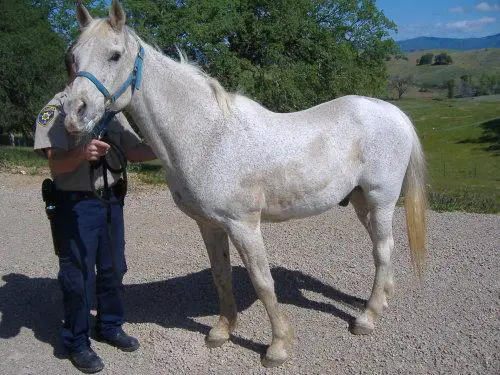
LAKEPORT – A horse who – when he was rescued earlier this year – was severely underweight and in bad condition has made a big recovery, and Lake County Animal Care and Control officials are hoping to find him a new home.
Animal Care and Control took the 25-year-old Arab gelding into custody due to neglect, according to Deputy Director Bill Davidson.
He said on Feb. 4 Officer Nehemiah White responded to a neglected horse call off of Highway 29 near Lower Lake.
Davidson said Animal Care and Control immediately called Dr. Jeff Smith of Middletown Vet Hospital, who estimated that the horse was approximately 150 pounds underweight, had parasites, long hooves and severe dental disease.
On Wednesday Davidson said that they've passed the two-month mark in the horse's recovery, and the veterinarian has given the all clear on the horse's condition.
The difference in the horse, said Davidson, is incredible.
When he was first brought in, the gelding's ribs and hip bones jutted out under his ragged, “flea-bitten” – denoting small flecks of color – gray hide.
Now, however, he's looking much healthier, with added weight and alert eyes.
“We did some dental work, parasite control, supplied the proper nutrition, and that's all it took,” said Davidson. “Following Dr. Smith's regimen of care we now have ourselves a healthy, energetic and potentially rideable horse.”
Davidson said Animal Care and Control will submit a case to the District Attorney's Office sometime next week, seeking animal cruelty charges against the horse's former owner.
They also have the happier work of looking for a loving, forever home for the gelding.
Davidson said they are accepting sealed bids from interested horse lovers through 5 p.m. May 18.
The minimum bid is $250, said Davidson. The highest bidder with an approved application will get to take home a new four-legged friend.
For more information, contact Lake County Animal Care and Control, 707-263-0278.
E-mail Elizabeth Larson at