 How to resolve AdBlock issue?
News
Students, parents, teachers and other Kelseyville Unified staff came to make a statement to the board – that they refuse to settle for anything less than excellence.
About 200 chairs were assembled to accommodate the crowd of concerned citizens expected at the meeting Tuesday evening, but the chairs were half-filled.
For the board and the community members who came to the meeting, the budget crisis was the main concern.
District officials had plenty of bad news to share – from potential job cuts to the fact that the district is now on a state monitoring list.
Board President Rick Winer said the board wasn't planning any action Tuesday.
After a brief introduction, Superintendent David McQueen took the floor and began a slide show presentation. The audience followed along with copies that were offered in the form of a thick packet.
The very first slide was a collage of news bits about various California schools districts’ woes. The slide noted that class prep was being cut at Ukiah Unified, where they are getting five furlough days and coaches stipends are being eliminated. In the Willits Unified School District, they're giving notice to more than 100 teachers, eliminating class size reduction as well as music and art. And the list went on.
“It is amazing – the amount of districts facing these issues,” said McQueen. “There have been a lot of school closures.”
Aside from the well-known elimination of programs, such as the cost of living fund, another factor contributing to the struggle the education system endures that was discussed was how people and businesses are leaving the state, straining California’s economy to the breaking point.
“The state has reduced instructional days and allowed schools to go back to a 175-day school year,” McQueen said.
“Since the recession began, school districts have been cut approximately $400 per student per year in revenue limit funding,” he said.
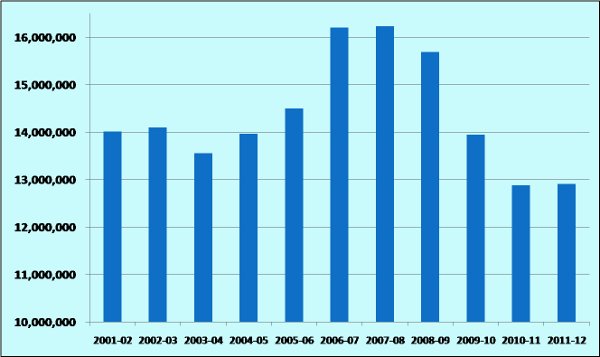
The presentation was filled with easy-to-read graphs to show the true impacts of the budget crisis and how Kelseyville Unified has come to its lowest point on its revenue scale.
McQueen then handed the microphone over to Tiffany Kemp, the district's chief financial officer, who reviewed revenue limit cuts and their effects on the district.
The first item she wanted to clarify was what “ADA” – “average daily attendance” – means.
“It’s actual days of butts in the seats,” said Kemp.
In 2003, 1,872 students were enrolled; now there’s only 1,739. Enrollment numbers are projected to continue to fall, Kemp said.
As a sample ratio, Kemp explained that if a student attends 175 days out of a 180-day school year, that generates 0.972 ADA.
As another example – not using actual figures – if the revenue limit for the school district was $6,000, the district would only get that number divided by the ADA percentage. So they would only qualify to get $5,832 – not what they needed to have to spend.
Kemp said that because the reduction in revenues from the state was simultaneous with the district’s ongoing spending, Kelseyville Unified is facing a $1.9 million ongoing deficit.
“This year and next year, we’re surviving off of one-time government funds and our reserves,” she said. “We can’t continue to function at that level.”
In fiscal year 2008-09, one-time monies reinvigorated the struggling school systems, but the American Recovery and Reinvestment Act funds are running out.
When McQueen spoke again, he discussed the district's future.
There are cash flow issues on top of less cash flowing, he said.
“In balancing the budget over the 2010-12 school years, we must realize that reductions need to be ongoing,” said McQueen. “The more we can reduce in ongoing expenses up front to attack the $1.9 million deficit in the next two years, the bigger impact we’ll see down the road. But, it is such a huge amount there is no way I see us tackling the whole $1.9 million.”
He further explained how Kelseyville Unified is now on a state monitoring list and may be at risk for negative certification. They may be assigned a fiscal advisor and even need county intervention if these trends do not improve.
McQueen also made it clear that Kelseyville Unified has nearly exhausted its reserve funds. One idea the district considered a total cut of transportation, but it was quickly dismissed since it would directly affect ADA.
Other methods of generating revenue are in the works. Fees will most likely be implemented for sports if sports programs are to continue. Transportation is another possible source of revenue using fees.
“The reality is, for 2010-11 we are looking at possibly laying off 11 to 13 certificated positions and 11 to 14 classified positions,” McQueen said.
Shortly after that note, the floor was opened up to the audience, who were invited to step up to the podium with a question or statement for the board.
Agents also arrested three other people who were sub-dealers or otherwise involved in the area's heroin trade.
All six suspects are Mexican nationals and have been placed on immigration hold.
"This is the largest heroin seizure ever made in this community," Attorney General Jerry Brown said.
He said the arrests “will significantly impact the availability of hard drugs in the Yuba-Sutter area."
Bureau of Narcotic Enforcement Task Force agents began the investigation in January and served three separate search warrants in Yuba City over a three-month period.
The investigation revealed that Juan Carlos Lopez, Joseph Valdez and Hugo Roberto Rios Martinez were "full time" heroin dealers.
Seven days a week from morning to night, the three traffickers sold the heroin, which was produced in either Mexico or South America and delivered to the area through Stockton.
From Lopez's residence, agents seized 6.64 grams of heroin, 1.5 grams of cocaine, adulterant, packaging material, scales, a .38-caliber handgun, a 12-gauge shotgun, a rifle, and $6,199.00 in drug proceeds.
From the Valdez residence, agents seized 34.27 grams of heroin, packaging material, 35 Hydrocodone pills, and $1,311.00 in drug proceeds.
From the Martinez residence, agents seized 1,554.55 grams of heroin, adulterant, packaging material, scales, 2 handguns, a rifle, and $24,377 in drug proceeds.
Valdez's 16-year-old daughter, who was at school during the service of the search warrant, was taken into protective custody by Sutter County Child Protective Services. A 10-year-old child was removed from the Martinez home and taken into protective custody.
The Bureau of Narcotic Enforcement Task Force determined the street value of the heroin to be $250,000.
All individuals were booked into the Sutter County Jail for possession for sale of heroin. Martinez and Valdez also were charged with child endangerment.
None of the six suspects have any known prior criminal record in California.
Located in the Attorney General's office, the Bureau of Narcotic Enforcement is the oldest narcotic enforcement bureau in the United States.
Follow Lake County News on Twitter at http://twitter.com/LakeCoNews and on Facebook at http://www.facebook.com/pages/Lake-County-News/143156775604?ref=mf .
Kirby's comments followed the unanimous decision by the Lakeport Unified School District Board of Trustees to eliminate nine positions as part of a list of programs and services to be cut for the 2010-11 school year.
Superintendent Erin Hagberg and other board members echoed Kirby's feelings.
“There is nothing on that list that I feel good about,” Hagberg said during the brief discussion before more than a half-million dollars in cuts was approved for next year.
The meeting, which was attended by fewer than 15 people – most of them administrators and employee representatives – lacked spirit.
“Where's the alarm?” asked Clear Lake High School Principal Steve Gentry, who presides over the district's large budget committee.
In this third consecutive year of major budget reductions, Gentry said he felt the budget committee process had run its course.
“We have very few new ideas at this point, quite frankly,” he said. “Many of the options have been used.”
After reviewing the current year budget and multi-year revenue projections, district business manager Linda Slockbower had little optimism, showing the state reducing the district's budget by $5.3 million in coming years.
Referring to per-student funding amounts, Slockbower explained, “It's like saying 'here's your paycheck but you can only have 81 percent of it.'”
Employee representatives had little to say.
Local Classified Employees' Association representative Doreen McGuire commented that past years' budget cuts have sparked local protests and demonstrations, which are being held in cities throughout California, but not here.
Instead, she blamed legislators. “These cuts do have to stop because the only way to invest in our future is to invest in our kids,” she said. “We need to get in touch with our lawmakers.”
In the absence of Lakeport Unified Teachers' Association representation, middle school teacher Rob Alves thanked the board for its consideration.
He referred to the practice by other districts of laying off many teachers only to hire them back in the fall.
“I appreciate the effort that goes into the decision-making,” he said, “so that it affects as few lives as possible.”
Director of maintenance and transportation Dave Norris also put blame squarely on the state for the elimination of a bus route, telling the board, “We should not feel guilty about this.”
He pointed out that although other states nationwide require busing, in California transportation is not mandated.
Norris stated in a prepared report that Lakeport's school district receives a disproportionately small amount of money per student for busing.
As an example, he showed that Konocti Unified School District receives $2.73 per student per day for transportation in contrast to Lakeport's $1.03.
He pointed out after the meeting that in addition to flaws in the funding formula at the state level, urban districts have the advantage of alternative public transportation systems unavailable in rural areas like Lake County.
To the board, he directed his focus on teaching parents and children how to be safe when walking to school.
“There are 19 registered sex offenders living within two miles of our school,” he said.
Norris said he has had parents calling expressing concern about bus stops being located near such residences. “Now they're walking to school,” he said.
But Norris did not dispute the decision, saying he felt it is better to keep the money in the classroom.
Instead he encouraged the board to explore working with the city of Lakeport to provide crosswalks on major roads, develop “walking buses” – or groups of students walking together – and publicize Web sites that provide information about safe routes to school.
E-mail Maile Field at
The six-woman, six-man jury must now decide justice for Shannon Lee Edmonds, 35, and Melvin Dale Norton, 38, two friends who are accused of killing 25-year-old Shelby Uehling.
The three men were involved in a confrontation along Old Highway 53 early on the morning of Sept. 22, 2009.
Norton and Edmonds testified to walking up to confront Uehling – parked in his car, the motor running and lights off at around 1 a.m. near Norton's trailer park – and tell him to leave Patricia Campbell alone.
Campbell is a longtime friend of Norton's and a woman who had been briefly involved with Uehling during a breakup from Edmonds, who she'd lived with on and off since last June. After abruptly breaking it off with Uehling, she returned to Edmonds. When Uehling tried to see her and call her, she told the men he was stalking her.
The early morning fight with Uehling began with a shoving match between him and Norton, during which Uehling reportedly reached into his waistband to pull out a weapon, according to testimony during the trial. At that point in the fight, Edmonds arrived at the scene and charged Uehling, both Edmonds and Norton testified.
Closing arguments in the case began Wednesday, running the length of the day and continuing Thursday.
Norton's attorney, Stephen Carter, finished his arguments Thursday morning.
Carter questioned the testimony of a witness who claimed that, despite the night's dark conditions, he could see two men leaning over a body on the ground.
Due to the lighting conditions, Carter suggested the testimony was embellished, and that the man by that point was aware of the case facts from media reports.
In order to conclude Norton and Edmonds are guilty of murder, Carter told the juror that they would need to break the allegations down and look at the elements of murder, which must all be met for a conviction.
While it's accepted in the case that Edmonds struck the fatal blows to Uehling, who died of a slit throat, Norton is charged with murder also under the theory that he aided and abetted the crime. Carter explained to the jury that theory by giving them an example of another crime, such as a sexual assault, where a person holds the victim down.
He maintained that there is no evidence showing Norton had any part in the confrontation once Edmonds arrived and began to brawl with Uehling.
Norton also faces an assault with a deadly weapon charge for allegedly swinging a golf club at Uehling as he sat in the front seat of his car. Carter said Norton swung the golf club at the car to distract Uehling, who Carter said was reaching down to the floor looking for a weapon. An examination of Uehling's body at the hospital found a small knife tucked in his shoe.
During opening arguments, prosecutor Art Grothe argued that the handle end of the golf club – which broke when it hit the car – was used to make a large puncture wound in one of Uehling's buttocks.
“That was a big argument for the prosecution,” he said.
However, Carter asked, “Has that been proven? No, in fact the exact contrary has been proven to you.”
Carter cited the trial testimony of forensic pathologist Dr. Thomas Gill, who performed Uehling's autopsy and noted the wound and the end of the broken golf club shaft were inconsistent.
In additional, state Department of Justice criminalists who tested the club found no biological evidence – blood or DNA – to show that it had wounded Uehling, Carter said.
Norton and Edmonds left the club behind at the scene and therefore it can't be argued that the club handle was washed to remove such evidence, he added.
Carter said that his client was being accused of involvement because he hadn't initially been forthright during interviews with police.
“It's not fair to accuse someone of something they didn't do,” he said, suggesting that should make the jurors wonder why Norton was charged.
Carter then read a portion of a transcript from a jail phone call between Edmonds and Norton's aunt Gigi.
Edmonds said of Norton, “It was self-defense for me and he was just like, he was there, he didn't do anything.” He added, “Melvin did nothing,”
Those statements, said Carter, “show Shannon in an unguarded moment, simply saying what the deal is, what the situation is in this case.”
Carter asked the jury not to convict Norton of something he didn't do. Norton didn't murder anyone and neither did he act as an accessory, since when they changed their clothes and cleaned Edmonds' knife at Norton's house a short time later, Carter argued the Norton didn't know Uehling was dead, and that as a convicted felon he was acting out of fear for himself.
“You have the power to do justice, and that's after all what we ask from a jury,” he said.
Carter said the scene where the fight occurred was left open and unguarded for hours afterward by police.
“It's not good police work, that's true,” he said. “In a scene like that mistakes are made, but what a heck of a mistake, to leave the scene unguarded for that long.”
There was a search of one field near the area, but that was it, said Carter.
He asked the jury to think about how Norton felt, riding his bicycle home early on Sept. 22, and seeing Uehling parked not far from his home.
Norton already was concerned about Campbell, who had claimed Uehling was stalking her. “You ever see somebody get played like that before?” Carter asked, noting that Norton had not reason not to believe Campbell.
“Now we've got a different mindset for Melvin, one of wanting to protect,” both himself and Campbell, Carter explained.
“I ask you to convict Melvin Norton of nothing,” Carter concluded.
In a rebuttal argument that took about 45 minutes, Grothe said the witness who claimed he saw Edmonds cut Uehling's throat had no reason to lie, but Grothe said Norton's first statements to police were filled with lies. A second police interview never hinted at self-defense, Grothe added.
Regarding Carter's statements about the quality of the police work, which Edmonds' attorney Doug Rhoades also had challenged on Wednesday, Grothe said Uehling's car has been locked up in an evidence holding facility since day one.
“If any one of these folks wanted something out of that car, it was there and available,” he said, adding that instead they want to take “cheap shots” at investigators.
Grothe also dismissed Rhoades' suggestion Wednesday that marks on Uehling's chest – which Grothe had argued during his initial closing arguments were caused by an extendable baton, or asp, that he alleges Edmonds wielded – were caused by nylon backboard straps used to transport Uehling to the hospital.
“They match up with nothing else in this case but an asp,” Grothe said.
He replayed brief portions of Norton's police interviews. During that interview, Norton mentioned Edmonds jumping into the fight after Norton and Uehling had been shoving each other.
Clearlake Police Det. Tom Clements asked Norton, “Why didn't you tell us that in the first place? I told you, you have to be completely honest with us.”
Although both Rhoades and Carter has questioned the investigators' thoroughness on scene – it was noted that a knife that Edmonds said Uehling used to stab him in the arm was never found – Grothe said investigators looked very closely at the scene. They accounted for everything from doughnuts scattered about the site to blood spatter that had been found about 8 feet up a nearby tree.
“If there had been some kind of knife out there they would have found it,” he said.
Grothe told the jury that a person who engages in mutual combat or first engages in force can only use self-defense as a legal defense if they try to stop the fight. He said Uehling tried backing out of the fight several times, but added, “Shannon Edmonds kept pressing that fight,” and he wanted “a piece of Shelby,” Grothe added.
The right to use self-defense exists as long as the danger exists, then it ends, Grothe maintained.
“At the end of this fight, Shelby's down on the ground and Shannon Edmonds is standing over him, Melvin's about 20 feet away, yells at Shannon to stop, 'Let's go.' Shannon is standing up at that point. Shelby is on the ground,” Grothe recounted.
Then, he alleged that Edmonds bent down and took one last punch, slitting Uehling's throat with the knife.
Norton, who first arrived on the scene, kept Uehling from leaving, got him out of his car, got between Uehling and the car so he couldn't get away, Grothe said.
“He kept him there until Shannon got there. And he kept him there so Shannon could take care of business.”
Uehling was beaten down to the point that “there was no danger of any kind of resistance,” Grothe said, and as Uehling lay there screaming as a neighbor had testified, Edmonds reached down and cut his throat.
“That is deliberate, premeditated murder,” Grothe concluded.
With about an hour left in the morning session, Judge Arthur Mann read through the jury instructions, which explained how to consider charges, what information jurors can and can't use in deliberations, how to weigh testimony, the differences between perpetrators and those accused of aiding and abetting, and the difference between homicide and manslaughter.
Words, he said, no matter how offensive, and nonthreatening actions don't justify assault.
Mann also cautioned jurors about stating their opinions too early in the deliberations process, which can interfere with working toward a solution.
The clerk of the court then swore in the bailiff, who took charge of the jury.
After breaking for lunch, the jury began deliberations at 1:30 p.m. and went beyond 4:30 p.m., according to Carter.
They'll be back to continue deliberations on Tuesday morning.
E-mail Elizabeth Larson at
Carron M. Boyd, 21, her 8-month-old daughter, Allesandrya Hinojosa, and the child's father, Randal C. Hinojosa, all of Clearlake Oaks, were injured in the three-car collision, which occurred Tuesday evening, according to Officer Jonathan Sloat of the Santa Rosa office of the California Highway Patrol.
Sloat said that at approximately 6:24 p.m. Tuesday Faustino Vega-Xicohtencatl, 24, of Santa Rosa, was driving his 2004 Ford F-150 pickup westbound on Mark West Springs Road approximately one-quarter mile west of Quietwater Road at an estimated speed of more than 45 miles per hour.
Boyd was driving a 2002 Mercury Mountaineer eastbound on Mark West Springs Road with Hinojosa and their young daughter, with 45 miles per hour their reported speed, according to Sloat.
Following behind Boyd was another Lake County resident, Marty Lee Nelson, 52, of Hidden Valley Lake, driving a 2007 Chevrolet Cobalt, Sloat said.
Vega-Xicohtencatl was seen by a witness attempting to pass slower-moving traffic across solid double-yellow lines and tailgating. After rounding a curve onto a short straightaway, Vega-Xicohtencatl crossed the double-yellow lines into the eastbound traffic lane directly in front of the Mercury Mountaineer, Sloat said.
Witnesses stated that the Ford F-150 and Mercury Mountaineer hit head-on instantly. Sloat said the Mercury then rotated in a counter-clockwise manner and the rear struck the adjacent hillside. The Ford rotated in a counter clockwise manner and came to rest across the eastbound traffic lane.
Nelson took evasive action by steering to the right and braking and struck miscellaneous debris in the roadway, according to Sloat.
Boyd suffered major head and body trauma and was taken to Santa Rosa Memorial, where spokesperson Katy Hillenmeyer said Thursday that Boyd remained in critical condition. Randal Hinojosa suffered minor injuries.
The infant was transported to Sutter Hospital, then transferred to Oakland Children’s Hospital by air with severe head injuries. Sloat said he thought the child was going to survive but had no specific update on her condition.
Nelson had no injuries, but Sloat said Vega-Xicohtencatl appeared extremely intoxicated and claimed that he had not been driving. He was transported to Santa Rosa Memorial for complaint of pain.
Through further investigation, Vega-Xicohtencatl was determined to be the driver. He was arrested and booked into the Sonoma County Jail on two charges of felony driving under the influence and driving unlicensed, Sloat said.
Follow Lake County News on Twitter at http://twitter.com/LakeCoNews and on Facebook at http://www.facebook.com/pages/Lake-County-News/143156775604?ref=mf .
Capt. Kurt Smallcomb reported that 47-year-old Gary O'Flanagan of Ukiah was arrested Tuesday after deputies were dispatched to the 3800 block of North State Street in Ukiah for a report of a male adult who had been stabbed in a domestic dispute.
Upon arrival, Smallcomb said deputies spoke to the victim who stated that she lived with and dated O'Flanagan.
That night they got into an argument because the victim wanted some money that O'Flanagan owed her. During the argument, O'Flanagan allegedly punched the victim in her chest, according to Smallcomb's report.
Smallcomb said the woman feared for her safety and grabbed a pair of scissors due to prior domestic issues. O'Flanagan allegedly came at her and attempted to take the scissors out of her hands but instead got cut on his hand when grabbing the scissors.
O'Flanagan was arrested for domestic violence and taken to county jail after he was medically cleared. Smallcomb said O'Flanagan's bail was set at $10,000.
Also on Tuesday, deputies arrested another Ukiah man, 28-year-old Victor Vargas, after a woman arrived at the Mendocino County Sheriff's Office to make a report of domestic violence, Smallcomb said.
The victim, Vargas' wife, told them that earlier in the day she was at her home Vargas returned. Smallcomb said she reported that they got into an argument during which Vargas allegedly slapped her in the face and arm causing injury to her arm. She went to the home of a friend who helped her get to the sheriff's office.
Deputies contacted Vargas, who Smallcomb said admitted to them having an argument, but denied assaulting his wife. Vargas was arrested for domestic violence and booked into the county jail. Vargas' bail was set at $25,000.
In the third case, at around 1 a.m. Wednesday, deputies were dispatched to the 300 block of Lake Mendocino Drive for a report of an assault with a deadly weapon, Smallcomb said.
Upon arrival, deputies spoke to the victim who stated that 19-year-old Grant Burnham of Ukiah was following his ex-girlfriend who was a passenger in a vehicle with several other people. Smallcomb said Burnham was distraught over the breakup and became enraged over her being in another vehicle with a male.
Burnham subsequently followed the vehicle several miles to a location on Lake Mendocino Drive where he rammed the vehicle and pushed it about 20 feet and then fled the area. Smallcomb said no one was injured during the incident but there was about $5,000 worth of damage to the victim's vehicle.
Burnham was arrested the following day for assault with a deadly weapon and vandalism of $400 or more and taken to county jail where his bail was set at $30,000, Smallcomb said.
Follow Lake County News on Twitter at http://twitter.com/LakeCoNews and on Facebook at http://www.facebook.com/pages/Lake-County-News/143156775604?ref=mf .
Education
Health
Business
Obituaries
Veterans
Recreation
Religion
Arts & Life
Government & Politics